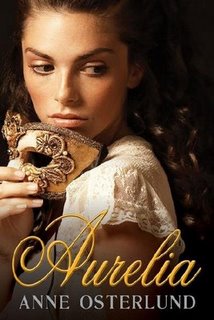
Aurelia

by Anne Osterland
ages: 13+
First sentence: “Death disturbed the night.”

There are several elements that make a good fantasy tale, at least for me. There must be:

A feisty hero or heroine — I do better with feisty heroines, but a good, swashbuckling hero is great, too.

Action — swordfighting, adventuring, chasing, etc.

Romance — must have romance. Always nice to have a to-die for with an awesome leading pair, but even if it’s just hinted at (or one of the parties is cluesless), that works for me, too. I do unrequited okay, but pining just turns me off.

Intrigue, suspense, mystery, and magic are all optional.

Most of all, it must be fun.

Aurelia fits the bill. Feisty heroine: check. Aurelia is a conflicted person, but in the end, finds herself and kicks some butt. Action: great swordfighting, awesome horse-racing, mostly well-written. Romance: *swoon*. Mystery and intrigue and suspense: check. I was biting my nails, intent on figuring out who was behind the plot to assassinate Aurelia (that’s basically the plot of the book), and kept pestering M with questions (she read it before I got to it) until I figured it out. Granted, I was nearly done with the book at the time.

And fun? Check. It definately was fun. Very, very fun.

Fire and Hemlock

by Diana Wynne Jones
ages: 12+
First sentence: “Polly sighed and laid her book face down on her bed.”

A while back, I asked for suggestions for fairy tale adaptations. Mostly because I wanted something new to read for the Once Upon a Time challenge, and (having read many of them), I was running out of ideas. I’d read most of the ones that were suggested, but Nymeth and Kailana both suggested this one. How could I refuse to read it?

Those two ladies do know what they’re talking about. It’s an amazing fairy tale retelling. It’s based on two British tales, Tam Lin (that’s actually Scottish) and Thomas the Rhymer, neither of which I’d heard of before (quick Googling got me up to speed, sort of…). But, I found that it didn’t matter that I didn’t know the source material. The novel took itself in interesting directions, not the least of which was the format (divided up into four movements, each with a music tempo assigned to it). I was hooked.

Polly, at age 19, is packing to go back to college when she stumbles across a book she’d never seen before. Except, upon reading it, she thinks she had. But, it was different before… and she can’t quite remember. Until, thinking back, she remembers a funeral she crashed at age 10, the place when she met Tom Lynn, a cellist. Tom and Polly took an immediate liking to one another, and they began to play a game of “pretend”, Tom was Tan Coul and Polly was Hero, and both were heroes-in-training. It all sounds innocent, except for Mr. Leroy and his son Seb who are constantly lurking about threatening Polly, warning her that any involvement with Tom will lead to disaster.

It’s a sweeping novel, not just in time — it covers, on and off, about nine years — but in scope. There’s intrigue, romance, life, danger, excitement, pain… you name it, it’s in there (except for, perhaps, the really really dark stuff…). I liked the use of magic in the book, too. It’s there, but it’s so understated, that it takes you quite a while to figure out what it is, and how it’s being used. I suppose, if I was being totally fair, that the dark figures didn’t do much besides lurk and smirk, and that the heroic figures were posturing more than doing, but I found I didn’t really mind. I liked Polly (especially the younger Polly) and her relationship with Tom; I’m not sure I totally bought that it evolved into romantic love, but I liked the way they played off each other.

Then there was the bookishness of it all. Tom took to sending Polly books for a good portion of the book, and, wonderfully, they are all real. So, at the end when Polly figures everything out, and she uses the Oxford Book of Ballads to help her, I found myself intrigued, and checked at the library. Sure enough: it’s a book, and I’m looking forward to reading both Tam Lin and Thomas the Rhymer, if only to say that I have.

The Order of the Odd-Fish

by James Kennedy
ages: 12+
First sentence: “The desert was empty, as though a great drain had sucked the world underground.”

The jacket flap of this delightfully surreal book claims it’s “equal parts Monty Python and Roald Dahl,” which, to my mind, is no laughing matter: that’s some serious humor and oddity that they’re evoking. How could one not approach this book with incredibly high expectations?

Thankfully, Kennedy does not disappoint.

Jo was left in the washing machine of washed-up actress Lily Larouche’s desert palace when she was a baby. Left with her was this note: “This is Jo. Please take care of her. But beware. This is a dangerous baby.” Thirteen years later, Jo has shown no signs of dangerousness; in fact, with Aunt Lily’s heath (and sanity) waning, Jo’s pretty much taken over running the household. Until one Christmas Eve, when things go, well, wacky, and get infinitly more complicated. Jo meets Colonel Anatoly Korsakov and his sidekick Sefino, who just happens to be a 3 1/2 foot all talking cockroach, a black box drops out of the sky, addressed to, and she meets her nemisises (of sorts), Ken Kaing and The Belgian Prankster. They all (somehow) manage to make their way to Eldritch City, where Jo discovers that Lily, Korsakov and Jo’s parents were all part of The Order of the Odd-Fish, and that (just perhaps) Jo really is as dangerous as the note implies.

Actually, while I was in the middle of all the zany action and weirdness that was this book, the thought that popped into my mind was that it’s not so much a Monty Python-Roald Dahl hybrid as it is a weird love child of Douglas Adams and J.K. Rowling. Jo is Arthur Dent/Harry, Lily is Ford Prefect/Hagrid, there a group of friends that Jo meets once she gets to the Odd-Fish that could fill the roles of Ron and Hermione (as well as Ford andTrillian). There’s a couple of delightfully grumpy people who are dead on Marvins… you get the picture. Once I figured that out, though, it the book that much more enjoyable. (For me, once I’ve “pegged” the humor, I can sit back and let it roll over me… I’m weird that way, I guess.)

Laini Taylor, in her review, mentioned that this is the sort of thing that should be shared with someone, to elbow them at the right moments, or read a passage aloud to savor them. And I have to toally and completely agree. Thankfully, M had read this one first, and so I was able to do some of that. But, it’s also much like The Hitchhiker’s Guide in that it’s almost a lot more fun to talk about this book than it is to read it. (Additionally, hearing this book read aloud might be more condusive to the humor in it…) So, in the interest of sharing the laughs, I’ll leave you three of the passages where I actually laughed — hooted, snorted, guffawed — out loud:

Ken Kiang laughed diabolically! Then he stopped, disappointed: no, his laugh wasn’t quite diabolical. He made a mental note to practice his diabolical laughter for fifteen minutes a day. The devil, he knew, was in the details.

Jo threw up her hands. “This is ridiculous! You’re not even trying to be right?” At this rebuke Sir Oort halted, grew grave, and drew himself up; for a moment, he radiated a kind of majesty; then he spoke, in tones both severe and inspiring, and his awkward voice rang out like a bell. “As an Odd-Fish, it is not my job to be right,” said Sir Oort. “It is my job to be wrong in new and exciting ways.”

For the next one, you need the description of the character first: “Oona Looch was a mannish, square-jawed woman, about sixty years old, mammoth but not fat, a stout giant of muscle and bone. Her bald skull was gouged with scars, her nose and ears seemed nailed on, and her smile revealed she had no teeth at all.”

Okay. Now then:

“You disgust me, Fipnit!” shouted Oona Looch. “You don’t do anything for me as a woman. You don’t know how to treat a lady! One of these days, Fipnit, I’m gonnna sit on you! And then I’ll forget about you… Maybe a few weeks later I’ll pick you out of my behind and say, ‘Well! There’s Fipnit! So that’s where he went!’ Then I’ll throw you away. What a tragic end to a beautiful romance!”

“Meep,” said Fipnit.

Wacky, weird, zany, unusual, off-kilter, and, yes, odd. You shouldn’t miss it.

Flygirl

by Sherri L. Smith
ages: 12+
First sentence: “It’s a Sunday afternoon, and the phonograph player is jumping like a clown in a parade the way Jolene and I are dancing.”

Ida Mae Jones has always wanted to fly. Ever since she was put behind the wheel (is it a wheel?) of her daddy’s Jenny and taught how, she knew that this was what she was born to do. Except, she’s an African American (yes, I am being politically correct here), and lives in the outskirts of New Orleans. Not only can she not get a pilot’s license because she’s a woman; she can’t get one because she’s the wrong color.

It’s only when her younger brother spies and article about the Army’s WASP program (that’s Women’s Airforce Service Pilots), and that there was a Chinese-American woman in it, that Ida gets an inkling of an idea. She forges her daddy’s pilot’s license, and since she’s light enough skinned to pass for white, she applies. And gets in.

The part in the program is what interested me the most about Smith’s book. I thought that while the conflict between black and white, and Ida’s internal conflict about lying about who she really is, was interesting (and probably worth some thought), I really liked Ida learning how to fly military planes. I liked the challenges posed by the program, the obstacles she had to surmount in order to succeed in a man’s world. It was not only historically interesting, but had a universal appeal: what woman hasn’t faced the “you can’t do it because you’re a girl” and fought her way to success in whatever that is?

It’s books like these that make one grateful for the pioneers, the women who were courageous enough to break the race, sex, or whatever barrier, and achieve their dreams. And it’s good to have a book like this to remind us of it. As well as being a cracking good story.

Evernight

by Claudia Gray
ages: 13+
First sentence: “The burning arrow thudded into the wall.”

The basic story: Bianca is a new student at Evernight Academy, which is not something she’s terribly excited about. But then she meets Lucas (cue dreamy music) and all of a sudden it’s not such a terrible place. Except terrible things seem to happen. And it turns out that although Lucas and Bianca looove each other, they are probably the least compatible people on the face of the earth, for reasons which will eventually all be revealed.

Things I liked about the novel:

  • I found it was far more engaging than I will admit in public. (Except I just did, didn’t I?)
  • I liked how Gray played with the vampire lore. It was a bit Twilight-y (especially the beginning; if you miss it, you’re clueless, or haven’t read Twilight yet), but for the most part it worked.
  • I liked Balthazar. He was cool.
  • The action was pretty good.
  • The Romeo and Juliet aspect of the story; I don’t do starcrossed lovers, but this was a very well done extreme case of two people who really shouldn’t fall in love.
  • The second plot twist. It didn’t catch me off guard, but I thought it worked well, and made the ending that more dramatic.

Things I didn’t like:

  • The first plot twist. It really, really, really, really bothered me, primarily because I thought it nullified the first third of the book. I was really annoyed at the author, and I almost gave the book up at that point.
  • Bianca was whiny and annoying (like Bella), though she redeems herself in the end.
  • The first plot twist. Really. She completely had me misdirected, and I hate misdirection.
  • The snotty rich kids. So stereotypical. So done.
  • The first plot twist. I mean withholding information is okay, but in the first third Bianca’s afraid, running scared, worried she won’t fit in… and it’s all for naught.
  • All the lying and betraying and trying to figure out who is what and why. It got old.
  • Have I mentioned the first plot twist?

In the end, the book was just okay. Which isn’t a bad way to spend a day. Especially one where you’ve had little sleep and you don’t feel like doing a whole heck of a lot. But if you don’t have one of those (or you’re not a die-hard Twilight fan, who needs something else to read, but can’t stand to branch out of the vampire-romance genre), then you might want to find something else to read.

Speak

by Laurie Halse Anderson
ages: mature 12+
First sentence: “It is my first morning of high school.”

I was wandering through the bookstore a couple months back, and I chanced upon a display with the 10th anniversary edition of this book. Some part of my brain recognized it (aside from “Hey, that’s the woman who wrote Chains!”) as an important/noteworthy book, and willed me to stop. I picked it up, read the back and the first section, and was hooked. I didn’t walk away with it that night (ah, self control!), but went home and put it on hold at the library. (I think I may have to go buy it now, though.)

Melinda is beginning her freshman year as a complete and total outcast because she called the cops on a party a few weeks prior to the beginning of school. And the year goes downhill from there. Melinda spends the year trying to survive (and not always making it), while her grades fall and she spends more and more time locked inside her head. As it turns out, calling the cops wasn’t so much a tattling thing (as one might initially suspect) but a real cry for help from Melinda, who was raped at the party. As the year progresses, Melinda comes to terms with what happened to her that night, as well as the person who did it to her.

Jen Robinson pointed out two things in her review that I thought were worth mentioning. One, that it’s a scarily accurate portrayal of someone who is monumentally depressed. Melinda is hopeless, and while she spends much of the book living in her head, and trying to escape her world, it’s not a hopeless book. She’s funny on occasion, and her powers of observation are keen, especially about the stupidity of the high school world. Secondly, Jen mentioned that Anderson hopes that teenage boys will read this book, if only to get a sense about what a young woman who has been raped would possibly go through. One of the things I liked most about the book was realizing that while Melinda was suffering in silence, she wasn’t necessarily the only one suffering; her actions caused her parents, teachers, and, yes, even old friends (at least the ones who noticed) worry, and while that worry was often misdirected and misapplied, they were affected by her.

But the thing that got me most was that Anderson was able to take something as harsh as rape and put a human face on it, and make you feel something (depression, anger, triumph) for Melinda. That’s a mark of a good writer. And a good book.

Just One Wish

by Janette Rallison
ages: 12+
First sentence: “I would have expected to see this sort of line if, say, Elvis had returned from the dead to give a concert.”
Review copy received from the publisher.

Annika Truman is not used to losing and, generally, will stop at nothing to get what she wants. Her little brother, Jeremy has been diagnosed with cancer and is going to undergo surgery in a week. She wants — desperately — for him to come through okay, so she invents a “genie” that will grant three wishes. She expects him to ask for an action figure from his favorite TV show, Teen Robin Hood (that’s what the line was for in the opening sentences), but (surprise!) he wishes for Robin Hood to come and spend a day teaching him archery.

Well, Annika decides that Jeremy must have his wish. So, off she goes to Burbank (and living in Henderson, Nevada, makes it a convenient four hours away) to find the actor, the uber-dreamy Steve Raleigh, and convince him to come spend time with her little brother before he goes into surgery. She has two days. Impossible? Of course not.

Actually, the whole book is impossible. Implausible. Unrealistic. Not-happing-in-anyone’s-lifetime. Real people don’t just drive to California, cleverly weasel their way into basketball stadiums and TV sound lots, happen to run into TV stars (who are all generally nice people… man, I need a sarcasm font), and have everything work out in a nice little package tied up with a green and red plaid bow.

That’s not to say I didn’t love the book. I did. A lot. An absurdly enormous amount, in fact. (Especially absurd considering my age, and the fact that I’m married and have four girls and shouldn’t be fantasizing about running off to California to chase actors. Okay. That was probably more than you needed to know…)

No, I didn’t buy into the fantasy — I knew it was totally unreal — but I bought into the book. There’s enough depth there — Annika’s love for and devotion to her little brother, as well as her struggles with mortality and infinity, for example — to make it less fluffy than it could have been. And it’s quite funny (the part where Annika and Steve were jumping from trailer roof to trailer roof? Hilarious.) And the romance is, well, dreamy. What teenage girl doesn’t dream about being swept off their feet by a movie (okay, TV, star)? Um… I’m sure they’re out there, but I wasn’t one of them. Granted, it all doesn’t wrap up quite so neatly, something which I really appreciated.

And even though it’s a fantasy (realistic fantasy though; there’s no fairy godmothers here), reality did kick in, in the end, just to make sure Annika — and the reader — is still grounded. There’s no happily-ever-afters, no riding off into the sunsets, no perfect sweep us off our feet moments.

Even with all that — the implausibility, the over-the-topness of it all — it was totally and completely worth reading.

Graceling

by Kristin Cashore
ages: 13+
First sentence: “In these dungeons the darkness was complete, but Katsa had a map in her mind.”

When Abby commented on the Library Loot post that she loved Graceling, I knew it was good. It was a Cybil’s fantasy finalist, and practically everyone who has gotten their hands on it loved it. The question was (after I pried it out of M’s hands… she kept picking it up every time I put it down, and she’s already read it twice!): does it live up to the hype.

Well. Yes. It does.

First, let me say that reading this book was a test of my self control. I started it Saturday night after I got the kids in bed, and I stayed up until after midnight reading. I was only halfway done. Sunday is normally crazy for me, and I didn’t get a chance to get back to it until evening. I can’t tell you how torturous this was. All I wanted to do was play hookey, shut myself in my room and finish the dang book. And then, today… it was calling… it was pleading… and so I finally caved, put on a movie, and read it to it’s very satisfying conclusion.

Oh, do you want to know the story?

I’ll give you the basics (trust me: the less you know, the better the book). Kasta is our heroine, and she is Graced — a magical ability that sets her apart from other people; Gracelings are recognized for their different color eyes — with the ability to kill. She’s her uncle, King Randa’s, strong-arm, performing executions, beatings, whatever he needs. On the side, she’s part of a Council, a secret movement to help citizens in the seven kingdoms. She rescues the Liendan king’s father from the dungeons of another king, which sets off a chain of events that will not only change her life, but change the fate of several kingdoms.

I loved the action — M asked me what my favorite part was, and I had to admit that I loved the fighting scenes. Cashore has a way with words that vividly portrays action, and I was on the edge of my seat most of the time. Which brings me to point number two: I loved the tension, the twists and turns. The “bad guy” is truly horrible, evil, and malicious, and even though he only shows up a couple of times, both times I was biting my nails with the tension of it all. And I loved the romance. Not since Crown Duel have I read a fantasy romance that was as intriguing and satisfying as this one is.

All of this is a very rounabout way of saying what M announced the first time she finished the book: it’s awesome and we have to own it.

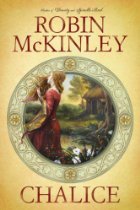
Chalice

by Robin McKinley
ages: 12+
First sentence: “Because she was Chalice she stood at the front door with the Grand Seneschal, the Overlord’s agent and the Prelate, all of whom were carefully ignoring her.”

I’ve tried to type a summary of the book, but I’m not getting very far. Part of that is because it’s a Robin McKinley book; none of which are really easy to describe. She doesn’t write in a way that’s easy to sum up, or even to describe: lyrical, circular, dense, narration-heavy, internal… yet totally captivating.

I liked this one less than I thought I would. Perhaps it was because I wanted something lighter, something with more romance, something that would take less brain energy. But, that said, I liked it a lot. I especially liked the world that McKinley created: the heirarchy of magic from the (power-hungry) Overlord to the Master and the Circle. I liked how the magic was heavily entertwined with nature, how the whole purpose of the magic was to hold nature together; without it, or without it being used responsibly, the natural world would rend and fall apart. I liked the use of honey and bees; I’m not an insect person, but I liked the way McKinley gave the bees a personality in this book. I did like Marisol, the main character, the Chalice of the title (and the first sentence). I liked how she struggled, but was willing to make a go of it, to find her own way, not willing to be cowed into following tradition. And I liked the Master — the younger brother of the Master that caused havoc and disharmony and perished with the Chalice in a horrific fire — and how he, too, had to make a go of it, coming back from seven years training to become a priest of Fire. I admired their partnership, their trust, and while the romance was kind of ho-hum, it fit.

What I’d really like, though, is to spend more time in this world that McKinley created. So, I can only hope (and hope it is, since she rarely does this) that she is willing to revisit this world another time or two. And maybe I will find myself enjoying the stories even more.

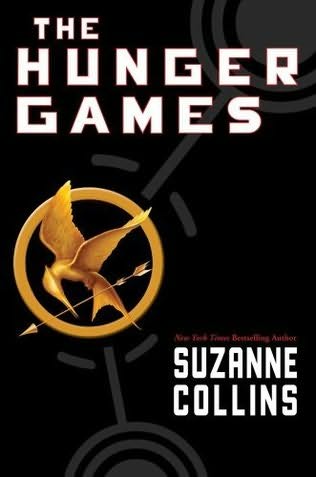
Hunger Games

by Suzanne Collins
ages: 12+
First sentence: “When I woke up, the other side of the bed was cold.”

If you’ve been living in a cave (or at least not hanging out on the book blogs), then you haven’t heard the buzz about this one. The buzz that’s been growing — steadily — over the past six or so months. It started out as a trickle; one person here, another there… but by now it’s a flood. This is only a sampling of the reviews I’ve read of the book:

Cybils Science Fiction/Fantasy shortlist
Abby (the) Librarian
Fuse #8
The Reading Zone
Becky’s Book Reviews
Sarah Miller
Library Queue
My Thoughts Exactly
Shelf Elf
It’s All About Books
Squeetus

And it’s unanimous: this is an awesome book. (Of course I agree. I couldn’t put it down. In fact, I had to read it fast, because M was dying to snatch it away, especially after she learned that Collins wrote the Underland Chronicles, which is one of M’s favorites.) Click through if you want plot summaries or details.

Three things you need to know about this book.
1) You will not be able to put it down. If you do, in the event that you’re a nail-biting type of person, you will not be able to stop thinking about the main characters, or the events of the games, or whether or not they will make it out alive. And sooner rather than later, you will find yourself picking the book up again.

2) It’s graphic, but not gruesome. Collins is masterful at balancing brutality and humanity, and making us care for characters in the face of awful situations. It’s a dystopian novel after all, a cross between Scott Westerfield’s Uglies and Survivor gone horribly wrong.

3) You will finish it wanting more… and yet be completely satisfied with the current story. I was totally captivated with the plot, completely buying the ending, and then it ended. AH! Not since a Percy Jackson or Harry Potter book have I finished it and then immediately thought, “How long until I can read the next one?”

So go get it already and see for yourself what the fuss is about!