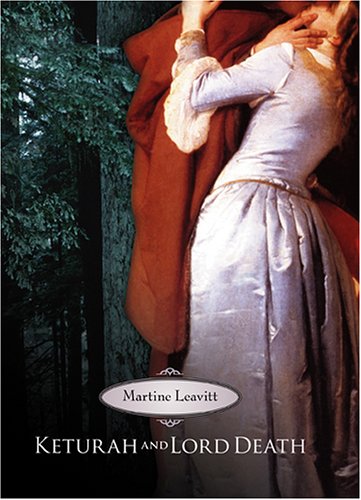
Keturah and Lord Death

by Martine Leavitt
ages: 12+
First sentence: “I was sixteen years old the day I was lost in the forest, sixteen the day I met my death.”

I’m trying to get a handle on this book. I really liked it, don’t get me wrong, but it’s one of those books that’s really hard to sum up. Keturah gets lost in the woods for three days, and is visited by Death — in the form of a man. She pleads, cajoles for her life, and it doesn’t work. Then, Scheherazade-like, she tells Death a story, withholding the end until the next day. She heads back to her village, suddenly aware of how blessed she is for just being alive. As the story progresses, her stories and bargains with Death become increasingly more varied — she bargains for lives of those in her village, mostly because she cannot bear to see them die. As an addendum for all this, she has to find her one True Love, for only if she finds him and marries him will Death truly set her free. Full of earthy magic — it strongly reminded me of A Curse Dark as Gold — high romance, mystery and Life Lessons, it truly is one of those tales that could be called timeless.

Buy it at: Amazon, Powell’s, or your local independent bookstore.

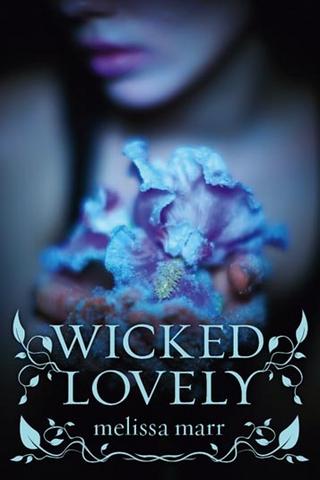
Wicked Lovely

by Melissa Marr
ages: 14+
First sentence: “The Summer King knelt before her.”

Aislinn can see faeries.

Granted, that’s not always a good thing. She’s not supposed to let on that she can see them, especially since they tend to get vindictive when they find out. So, for her whole life, she’s been going around pretending that what she can see doesn’t exist.

It works out fine, until one — Keenan, the Summer King — starts paying attention to her. See, he’s been bound by Beria, the Winter Queen, and he will not have his full power until he chooses one to be his queen. She has to willing give herself to him, and if she isn’t the One, she will carry the curse of the Winter Queen. Not an easy fate, and something that not many girls will choose. And it seems that for Keenan, Aislinn is The One. Except. She’s in love with Seth, an ordinary mortal, which makes things slightly more complicated.

You have everything in here: urban fairies, kicking heroine, love triangle (of sorts), faerie mythology, good overcoming evil… there’s nothing to not love. Except, while it was good and gripping and intriguing, I felt disconnected from it all. The was something missing, that I couldn’t quite put my finger on. Or maybe it was just disconcerting to read a dark faery tale, one where everything was harsh and edgy. However, it wasn’t enough to keep me from being curious as to what happens in the next book. I guess that’s a good thing.

Buy it from: Amazon, Powell’s or your local independent bookstore.

Wintersmith

by Terry Pratchett
ages: 12+
First sentence (not including the Nac Mac Feegle glossary): “When the storm came, it hit the hills like a hammer.”

I got this email from Laura from Life after Jane yesterday that I haven’t been able to stop thinking about. She says,

You never get just a story with Pratchett. You get life lessons and a unique way of looking at things. I’ve heard him called the Douglas Adams of fantasy fiction but I have to disagree. If you ever read any of the Hitchhiker’s Guide series you’ll notice that fabulous and witty as it is, Adams clearly didn’t like people. With Pratchett I’m always amazed how he can poke fun at the silly, pettiness of people while at the same time expressing a very real and warm love of them. I always finish his books feeling that he has a very profound point and that he really just adores everything and everyone.

I haven’t been able to stop thinking about it because she’s absolutely right. It’s the reason why his books are so delightful — even if they’re not quite as soaring as the other books in the series — why you find yourself laughing out loud or nodding in agreement: because Pratchett cares, and it comes across in the writing.

Like the other two books in the Tiffany Aching adventures, the plot really isn’t what matters. It’s the characters — in this one we have the Wintersmith and Roland, who are both infatuated with Tiffany, even if she’s not really that interested, and Nanny Ogg whom you just want to hug, as well as ones from the other books — and the little nuggets of wisdom or humor that are littered throughout. My mom said that she thought these were good “girl” books, but I’ll take it a step further: these are just good books.

And Pratchett is definitely a good writer.

Buy it at: Amazon, Powell’s or your local independent bookstore.

A Hat Full of Sky

by Terry Pratchett
ages: 12+
First sentence: “The Nac Mac Feegle are the most dangerous of the fairy races, particularly when drunk.”
Book 5 for the 48 HRC

There are different sorts of books that make you happy. The swooning book, the hilarious weird book, the slapstick snort-out-loud book. And then there are the ones that have a bit of elements of all of those, and get under your skin to make you unquestionably, utterly happy.

This was one of those books.

The plot is really immaterial: Tiffany (from The Wee Free Men, which is also delightful, but in a different way) is off to learn how to be a witch, except it’s nothing like she thought it would be. That, and she’s hunted by a… thing… that lives off of ambition. Unfortunately, because it can’t be killed, it’s really up to her to learn how to defeat it. In her own special Tiffany way. With the help of the Nac Mac Feegle, of course.

There’s so much to love about this book: Tiffany’s strong will and the hilarious Nac Mac Feegle, of course, but there’s also Miss Level, and Jeannie the new kelda, and Miss Weatherwax, and Petulia… and…

I could go on. But it’d be simpler if you just read the book.

I almost forgot one of my favorite quotes from the book, because I totally and completely empathize:

It turned out that when Miss Level had asked Tiffany if she was scared of heights, it had been the wrong question. Tiffany was not afraid of heights at all. She could walk past tall trees without batting an eyelid. Looking up at huge towering mountains didn’t bother her a bit. What she was afraid of, although she hadn’t realized it until this point, was depths. She was afraid of dropping such a long way out of the sky that she’d have time to run out of breath screaming before hitting the rocks so hard that she’d turn to a sort of jelly and all her bones would break into dust. She was, in fact, afraid of the ground. Miss Level should have thought before asking the question.

There. Now go read the book.

Buy it at: Amazon, Powell’s, or your local independent bookstore.

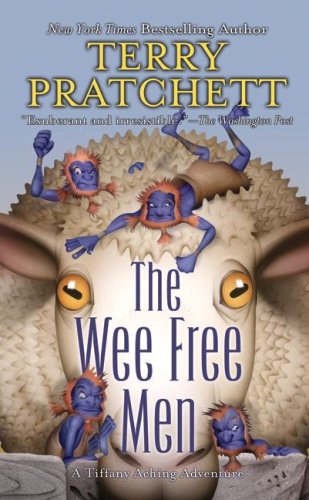
The Wee Free Men

by Terry Pratchett
ages: 12+
First sentence: “Some things start before other things.”

 Yes, I’m here in Cincinnati, enjoying the lull in the reunion (there’s an awesome uncle who make a great playmate, and the rest of us thoroughly enjoy the downtime… though they do come away really wound up)… it’s been fun being with family.
And I managed to get a bit of reading done in the cracks. In fact, it was kind of hard to get it read because I’d leave it lying around, and I’d come back and find it had been snatched up by one family member or another. Which is a testament to how fun this little novel is.
Tiffany is a nine year old girl, the daughter of sheepherder, who isn’t really noticed by much of anything, especially now that Granny Aching has died. That is, until the day when she saw a monster come out of the river. She hit the monster with a frying pan, and the path of her life was changed: she was a witch. That, and her younger brother was stolen by the Queen of Faeries. Tiffany, being the sort of girl she is, decides not to wait for help, and tackles the problem head-on… with the help of the Nac Mac Feegle, the Wee Free men.
But this book isn’t about plot, really. It’s a wonderful example of character- and world-building. The characters — from Tiffany down to the Nac Mac Feegle — are fully drawn and exciting and interesting and engaging. Which makes the book thoroughly entertaining.
I’m going to have to leave it at that… this has taken me a lot longer than I thought it would, mostly because conversation around me is more interesting than the review I’m writing. Needless to say, I’m going to read the next two in the Tiffany Aching series. Terry Pratchett is definately an author — and Discworld a world — worth checking out.

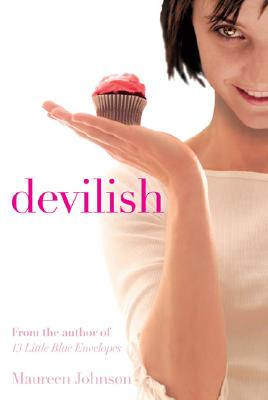
Devilish

by Maureen Johnson
ages: 13+
First sentence: “So this was how it ended.”

Ingredients for a fun YA romance:
1 kick-butt heroine (this one’s named Joan)
1 best friend in trouble (Allison)

Add
1 not-so-hot ex-boyfriend
1 interesting new friend who may be trouble
1 new guy who may or may not be a love interest

Mix in some adventure, interesting family members, a curious conflict, and some swoon-worthy romance.

Have Maureen Johnson stir it up, and bake and enjoy for an afternoon or so.

Absolutely delicious.

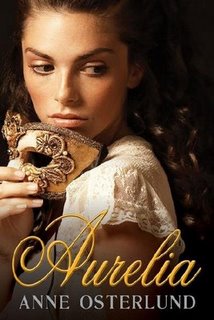
Aurelia

by Anne Osterland
ages: 13+
First sentence: “Death disturbed the night.”

There are several elements that make a good fantasy tale, at least for me. There must be:

A feisty hero or heroine — I do better with feisty heroines, but a good, swashbuckling hero is great, too.

Action — swordfighting, adventuring, chasing, etc.

Romance — must have romance. Always nice to have a to-die for with an awesome leading pair, but even if it’s just hinted at (or one of the parties is cluesless), that works for me, too. I do unrequited okay, but pining just turns me off.

Intrigue, suspense, mystery, and magic are all optional.

Most of all, it must be fun.

Aurelia fits the bill. Feisty heroine: check. Aurelia is a conflicted person, but in the end, finds herself and kicks some butt. Action: great swordfighting, awesome horse-racing, mostly well-written. Romance: *swoon*. Mystery and intrigue and suspense: check. I was biting my nails, intent on figuring out who was behind the plot to assassinate Aurelia (that’s basically the plot of the book), and kept pestering M with questions (she read it before I got to it) until I figured it out. Granted, I was nearly done with the book at the time.

And fun? Check. It definately was fun. Very, very fun.

Fire and Hemlock

by Diana Wynne Jones
ages: 12+
First sentence: “Polly sighed and laid her book face down on her bed.”

A while back, I asked for suggestions for fairy tale adaptations. Mostly because I wanted something new to read for the Once Upon a Time challenge, and (having read many of them), I was running out of ideas. I’d read most of the ones that were suggested, but Nymeth and Kailana both suggested this one. How could I refuse to read it?

Those two ladies do know what they’re talking about. It’s an amazing fairy tale retelling. It’s based on two British tales, Tam Lin (that’s actually Scottish) and Thomas the Rhymer, neither of which I’d heard of before (quick Googling got me up to speed, sort of…). But, I found that it didn’t matter that I didn’t know the source material. The novel took itself in interesting directions, not the least of which was the format (divided up into four movements, each with a music tempo assigned to it). I was hooked.

Polly, at age 19, is packing to go back to college when she stumbles across a book she’d never seen before. Except, upon reading it, she thinks she had. But, it was different before… and she can’t quite remember. Until, thinking back, she remembers a funeral she crashed at age 10, the place when she met Tom Lynn, a cellist. Tom and Polly took an immediate liking to one another, and they began to play a game of “pretend”, Tom was Tan Coul and Polly was Hero, and both were heroes-in-training. It all sounds innocent, except for Mr. Leroy and his son Seb who are constantly lurking about threatening Polly, warning her that any involvement with Tom will lead to disaster.

It’s a sweeping novel, not just in time — it covers, on and off, about nine years — but in scope. There’s intrigue, romance, life, danger, excitement, pain… you name it, it’s in there (except for, perhaps, the really really dark stuff…). I liked the use of magic in the book, too. It’s there, but it’s so understated, that it takes you quite a while to figure out what it is, and how it’s being used. I suppose, if I was being totally fair, that the dark figures didn’t do much besides lurk and smirk, and that the heroic figures were posturing more than doing, but I found I didn’t really mind. I liked Polly (especially the younger Polly) and her relationship with Tom; I’m not sure I totally bought that it evolved into romantic love, but I liked the way they played off each other.

Then there was the bookishness of it all. Tom took to sending Polly books for a good portion of the book, and, wonderfully, they are all real. So, at the end when Polly figures everything out, and she uses the Oxford Book of Ballads to help her, I found myself intrigued, and checked at the library. Sure enough: it’s a book, and I’m looking forward to reading both Tam Lin and Thomas the Rhymer, if only to say that I have.

The Order of the Odd-Fish

by James Kennedy
ages: 12+
First sentence: “The desert was empty, as though a great drain had sucked the world underground.”

The jacket flap of this delightfully surreal book claims it’s “equal parts Monty Python and Roald Dahl,” which, to my mind, is no laughing matter: that’s some serious humor and oddity that they’re evoking. How could one not approach this book with incredibly high expectations?

Thankfully, Kennedy does not disappoint.

Jo was left in the washing machine of washed-up actress Lily Larouche’s desert palace when she was a baby. Left with her was this note: “This is Jo. Please take care of her. But beware. This is a dangerous baby.” Thirteen years later, Jo has shown no signs of dangerousness; in fact, with Aunt Lily’s heath (and sanity) waning, Jo’s pretty much taken over running the household. Until one Christmas Eve, when things go, well, wacky, and get infinitly more complicated. Jo meets Colonel Anatoly Korsakov and his sidekick Sefino, who just happens to be a 3 1/2 foot all talking cockroach, a black box drops out of the sky, addressed to, and she meets her nemisises (of sorts), Ken Kaing and The Belgian Prankster. They all (somehow) manage to make their way to Eldritch City, where Jo discovers that Lily, Korsakov and Jo’s parents were all part of The Order of the Odd-Fish, and that (just perhaps) Jo really is as dangerous as the note implies.

Actually, while I was in the middle of all the zany action and weirdness that was this book, the thought that popped into my mind was that it’s not so much a Monty Python-Roald Dahl hybrid as it is a weird love child of Douglas Adams and J.K. Rowling. Jo is Arthur Dent/Harry, Lily is Ford Prefect/Hagrid, there a group of friends that Jo meets once she gets to the Odd-Fish that could fill the roles of Ron and Hermione (as well as Ford andTrillian). There’s a couple of delightfully grumpy people who are dead on Marvins… you get the picture. Once I figured that out, though, it the book that much more enjoyable. (For me, once I’ve “pegged” the humor, I can sit back and let it roll over me… I’m weird that way, I guess.)

Laini Taylor, in her review, mentioned that this is the sort of thing that should be shared with someone, to elbow them at the right moments, or read a passage aloud to savor them. And I have to toally and completely agree. Thankfully, M had read this one first, and so I was able to do some of that. But, it’s also much like The Hitchhiker’s Guide in that it’s almost a lot more fun to talk about this book than it is to read it. (Additionally, hearing this book read aloud might be more condusive to the humor in it…) So, in the interest of sharing the laughs, I’ll leave you three of the passages where I actually laughed — hooted, snorted, guffawed — out loud:

Ken Kiang laughed diabolically! Then he stopped, disappointed: no, his laugh wasn’t quite diabolical. He made a mental note to practice his diabolical laughter for fifteen minutes a day. The devil, he knew, was in the details.

Jo threw up her hands. “This is ridiculous! You’re not even trying to be right?” At this rebuke Sir Oort halted, grew grave, and drew himself up; for a moment, he radiated a kind of majesty; then he spoke, in tones both severe and inspiring, and his awkward voice rang out like a bell. “As an Odd-Fish, it is not my job to be right,” said Sir Oort. “It is my job to be wrong in new and exciting ways.”

For the next one, you need the description of the character first: “Oona Looch was a mannish, square-jawed woman, about sixty years old, mammoth but not fat, a stout giant of muscle and bone. Her bald skull was gouged with scars, her nose and ears seemed nailed on, and her smile revealed she had no teeth at all.”

Okay. Now then:

“You disgust me, Fipnit!” shouted Oona Looch. “You don’t do anything for me as a woman. You don’t know how to treat a lady! One of these days, Fipnit, I’m gonnna sit on you! And then I’ll forget about you… Maybe a few weeks later I’ll pick you out of my behind and say, ‘Well! There’s Fipnit! So that’s where he went!’ Then I’ll throw you away. What a tragic end to a beautiful romance!”

“Meep,” said Fipnit.

Wacky, weird, zany, unusual, off-kilter, and, yes, odd. You shouldn’t miss it.

Flygirl

by Sherri L. Smith
ages: 12+
First sentence: “It’s a Sunday afternoon, and the phonograph player is jumping like a clown in a parade the way Jolene and I are dancing.”

Ida Mae Jones has always wanted to fly. Ever since she was put behind the wheel (is it a wheel?) of her daddy’s Jenny and taught how, she knew that this was what she was born to do. Except, she’s an African American (yes, I am being politically correct here), and lives in the outskirts of New Orleans. Not only can she not get a pilot’s license because she’s a woman; she can’t get one because she’s the wrong color.

It’s only when her younger brother spies and article about the Army’s WASP program (that’s Women’s Airforce Service Pilots), and that there was a Chinese-American woman in it, that Ida gets an inkling of an idea. She forges her daddy’s pilot’s license, and since she’s light enough skinned to pass for white, she applies. And gets in.

The part in the program is what interested me the most about Smith’s book. I thought that while the conflict between black and white, and Ida’s internal conflict about lying about who she really is, was interesting (and probably worth some thought), I really liked Ida learning how to fly military planes. I liked the challenges posed by the program, the obstacles she had to surmount in order to succeed in a man’s world. It was not only historically interesting, but had a universal appeal: what woman hasn’t faced the “you can’t do it because you’re a girl” and fought her way to success in whatever that is?

It’s books like these that make one grateful for the pioneers, the women who were courageous enough to break the race, sex, or whatever barrier, and achieve their dreams. And it’s good to have a book like this to remind us of it. As well as being a cracking good story.