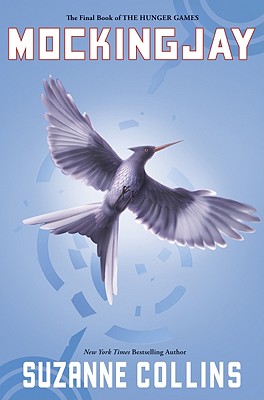
Mockingjay

by Suzanne Collins
ages: 14+
First sentence: “I stare down at my shoes, watching as a fine layer of ash settles on the worn leather.”
Support your local independent bookstore: buy it there! (Though you probably already have.)

NO SPOILERS. Promise.

Like Hunger Games and Catching Fire, this book is very unputdownable. Thankfully, I set aside the day to sit and read, otherwise I’d have been biting my nails and obsessing over the book. Better to get it all over with in one sitting.

And, for the most part, I really really liked the book. I liked what Collins did with Katniss, and the rebellion, and Gale, and especially Peeta. I liked the direction Collins was taking the books, the whole Katniss-as-Mockingjay thing. There were touching moments, some kick-butt moments, she kept me guessing as to where the plot was going, and she generally laid foundation work for something absolutely incredible to happen. There’s a lot of good anti-war stuff in there, how rebellions don’t always work right, how killing ourselves isn’t always the answer.

There are some things I wished she would have done: I missed Cinna, I wished Haymitch had more to do, I wished she had done something more with the District 13 government. Those were minor quibbles, though.

Because, the book fell apart for me. Completely and totally by the last 45 pages. There’s a moment near the end — and if you’ve read the book, you know where it is — where I was on the edge of my seat, disbelieving. However, in the pages that followed, Collins made choices — with characters, with the plot, with narrative — that completely derailed the rest of the book. It would have been so much better if… but it wasn’t. The whole ending was anticlimactic, and took the book in a direction that felt forced. I ended up feeling dissatisfied with the whole book, in the end. I’m not sure what I wanted, really, but it wasn’t the ending that Collins gave me.

Which, unfortunately, left me with a less-than-stellar reaction to the book overall. (And am I the only one?) And that’s too bad. Because it’s a great series: thought provoking and intense. I just wanted something better to end with.
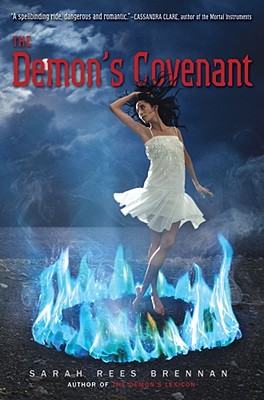
The Demon’s Covenant

by Sarah Rees Brennan
ages: 14+
First sentence: “”Any minute now,’ Rache said, ‘something terrible is going to happen to us.'”
Support your local independent bookstore: buy it there!

First step: read The Demon’s Lexicon. Second step: come back and read this. Because there isn’t any way I can write this part without spoiling the first book.

Picking up a month where we left off… Alan and Nick are back in Mae and Jamie’s life, primarily because Gerald — new leader of the magician’s Obsidian Circle — is trying to recruit Jamie to be part of the circle. This, for many reasons, completely freaks Mae out, and so she calls the Ryves brothers back to help keep Jamie safe. Except, Nick isn’t exactly the safest person in the world, being a freed demon. That creates its own problems: Alan is making bargains with magicians and demons, Mae is finding she’s falling in love with both the brothers, Jamie is actually becoming friends with Nick. And there’s a whole lot else going on that’s completely impossible to sum up.

It’s slow getting started, but picks up about a third of the way into it. At one point I was flabbergasted, wondering where on earth Brennan was going with the storyline, how it all would work out. It’s one of those instances where the right narrator makes the book; it’s from Mae’s point of view this time, and that makes all the difference. Especially when the book all comes together in the end.

Also, as Charlotte pointed out, Brennan does write some very swoon-inducing prose. Very much so. Very, very much so. But she’s not just skilled in writing swoon; the book is SO much better than that. There’s angst and surliness, yes; but, there’s also mystery, and adventure, and magic, and surprise zombies (it’s not a party until someone brings the surprise zombies), and an ending that will — I promise — leave you begging for the next installment.

Which begs the question: how long do we have to wait, and what can we do to make Sarah Rees Brennan write faster?

Incarceron

by Catherine Fisher
ages: 12+
First sentence: “Finn had been flung on his face and chained to the stone slabs of the transitway.”
Support your local independent bookstore: buy it there!

For some books, the plot summary comes easy. But as I was reading this book this past weekend, when people asked me what it was about, I was really at a loss. Mostly, I just said, “It’s complicated.”

It’s one part dystopian novel: Incarceron is a prison that the “Outside” designed for the refuse of society as an experiment. They meant it to be a Paradise, but over the years, it has degenerated into the worst of Hells. Finn has recently appeared; he was “cell born” — he has no memory of a childhood: he just appeared in Incarceron’s cells one day. He struggled to survive, and joined a group of thieves, becoming oathbrothers with a man named Keiro. Circumstances happen to push Finn, Keiro and a couple of others to attempt to escape, and the book is mostly their attempt to get out of Incarceron.

But, it’s also one part political intrigue: Claudia is on the Outside, the daughter of the Warden of Incarceron. She’s been playing her father’s game of power her whole life, matching him move for move in his quest to make her Queen. She’s not exactly happy about this; the current Queen is ruthless, and her son is a complete idiot; Claudia would have rather married the original heir, who died in an accident. The only person she can truly trust is her mentor and tutor, Jared. In her end of the game, she desires to know what her father actually does, and in the process finds a crystal Key and ends up communicating with Finn in Incarceron.

Complicated.

And yet, Fisher pulls it off beautifully. It’s difficult to explain, but while reading it, the plot makes complete sense. It’s a page-turner of a book; you have to see what happens next. The characters range from the sympathetic to the mistrustful, and yet you find yourself interested in their fates, invested in the outcome. Fisher has a talent for writing action; from the opening scene in the book, she has you completely invested in the book. In addition, the world she’s created is a fascinating one, something that is the product of a very creative imagination. And yet, there’s a balance between the world and the rest, so that neither dominates the book.

And all this means the only thing wrong with the book is that it’s the first in a series, and we have to wait for the rest.

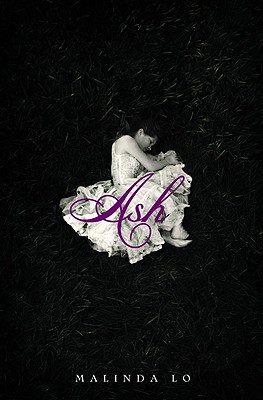
Ash

by Malinda Lo
ages: 13+
First sentence: “Aisling’s mother died at midsummer.”
Support your local independent bookstore: buy it there!
Review copy picked up at KidlitCon 09

Aisling lives in a world where there are fairies, but the belief in them — that they are dangerous, that they even exist — is waning. There’s still tales, healing women called greenwitches, and people who generally believe in both. But, the belief is fading.

Aisling also has lost both her parents, and, because of her father’s death, is forced to be a servant in her step-mother’s home. (Yes, this should sound familiar.) She has been moved away from her own home, to the south of the country, near the king’s City. Whenever she can — which isn’t often — she sneaks away to walk in the woods. Which is where she meets the fairy Sidhean, developing an interesting, if somewhat uncomfortable — she mostly just wants him to take her away from her miserable life, but he says it’s not time — friendship with him.

Then she meets Kaisa, the King’s Huntress. It takes time, it creeps upon Ash slowly, but she eventually finds a reason to live. And a will to love. Except that, to get there, she indentures herself to Sidhean (he plays the role of fairy godmother). And the trick is, figuring out what she really wants.

There is much good going on in this retelling of Cinderella. It’s similar enough to the fairy tale that you can recognize it for what it is. But Lo has created a world that is unique on it’s own, from the weaving in of original fairy tales and folk wisdom, to the twists on the love story. In a sense, it does try to do too much: is it a story about the repercussions getting involved with the fairy, or is it a story about a girl realizing that she can, and does, love another woman? It’s really both, and while it worked for me last night, it does seem to undermine each of the story lines. The ending in particular, while it was satisfying and the “right” ending, the getting there seemed a bit rushed.

It is a good book, well-written and well-paced: a excellent first novel, even with the drawbacks.

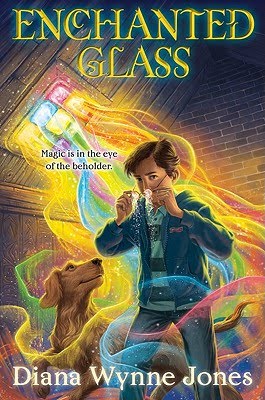
Enchanted Glass

by Diana Wynne Jones
ages: 12+
First sentence: “When Jocelyn Brandon died — at a great old age, as magicians tend to do — he left his house and field-of-care to his grandson, Andrew Brandon Hope.”
Support your local independent bookstore: buy it there!

I’m having one of those smack myself moments: why, oh WHY, have I not read Diana Wynne Jones before? I’ve looked at her books, but never really felt called to pick one up. I don’t even know why this one ended up on my stacks, but it did, and even though the UK cover is much nicer than this one, I felt compelled to read it.

And, I’m SO glad I did.

It’s high fantasy, teeming with magic and fairies and all sorts of otherworldly creatures. A magician — Andrew — who doesn’t quite remember what he’s supposed to do. A lovely little romance. A boy, Aiden, at the center of it all drawing power to himself — sort of, anyway — and trying to find a place where he belongs. There’s crotchety, yet lovable, characters — Mr. Stock the gardener and Mrs. Stock the housekeeper (no relation; don’t even suggest it) and their various punishments and intimidations foremost among them. There’s adventure and mystery: who is Aiden, what is his purpose and who, exactly, is the reclusive Mr. Brown in the Manor next door. And of course, the mounting tension as Andrew and Aiden try to figure out what is going on in the village around the house. But, most of all, is Jones’s thoroughly wonderful writing. It’s not poetical like other writers, but there is a sparseness about it that makes you realize there is nothing wasted between the covers.

A quick passage, from the beginning, to give you a feel:

One way or another, it was nearly a year before Andrew could move into Melstone House.

Then he had to make sure that the various small legacies in his grandfather’s Will were paid, and he did that too; but he was vaguely puzzled that this Will, when he saw it, was quite a different size and shape from the paper his grandfather’s ghost tried to give him. He shrugged and gave Mrs. Stock her five hundred pounds.

“And I do hope you’ll continue to work for me just as you did for my grandfather,” he said.

To which she retorted, “I don’t know what you’d do if I didn’t. You live in a world of your own, being a professor.”

Andrew took this to mean yes. “I’m not a professor,” he pointed out mildly. “Just a mere academic.”

An interesting side note: I’m not quite sure why this is in the YA section of my library. It feels more teen than adult, but our two characters are 30 (Andrew) and 13 (Aiden). I think this is the first time I’ve come across a YA book that has an adult as a main character. It just struck me as odd.

But who cares, really? It’s a rollicking good time of a book, and that’s all that matters.

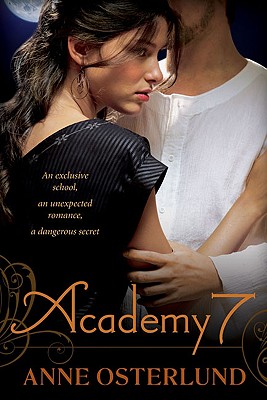
Academy 7

by Anne Osterlund
ages: 13+
First sentence: “Aerin tried to ignore the bloodstain on the control panel of the Fugitive.”
Support your local independent bookstore: buy it there!

Perhaps it was because Hubby and I just discovered Firefly (yeah, yeah, I know: we’re behind the times), but this book really hit the spot this past week. The quick description: it’s a space drama with a bit of mystery and a dash of romance. I could easily see how this would transfer, quite well actually, to the screen: while its pacing is slightly off (too much too fast at the end, with a whole chunk of time just skipped over), it’s a thoroughly enjoyable jaunt into a fascinating universe of Osterlund’s imagining.

Aerin’s on the run — escaped from the slave planet where she’d been living for the past six years since her father’s death — when she’s intercepted/rescued by a trade ship. The captain ran some tests, and it turns out that Aerin’s smart enough to be accepted into the Alliance (the central governing body of the group of planets) top school, Academy 7. There, she finds her top competition is Dane Madousin: son of the top general in the Alliance’s military, he’s never really been challenged in much of anything before. They both rise to the competition, and building upon a tentative friendship, slowly discover much about their parents’ pasts, which, invariably, effects their shared future.

Much of the mystery is related to the pasts of Dane’s and Aerin’s parents; unasked questions gone unanswered for most of their individual lives. And yet, those unasked questions shaped their views of the present. And all this is sounding much hokier than it comes off in the book. We’re privy to both Aerin’s and Dane’s thoughts and their individual insecurities and determination help make the book quite compelling. However, in retrospect, much of the book isn’t really about Dane and Aerin; it’s about the consequences of their parents actions. Which makes me hope for a sequel: I want to know more about Dane and Aerin, and how they choose to move forward after the revelations at the end of this book. It also helps that the universe is really quite cool.

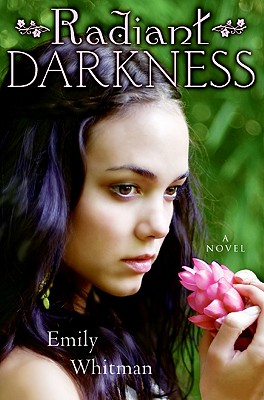
Radiant Darkness

by Emily Whitman
ages: 12+
First sentence: “Persophne. Daughter of Demeter, the harvest goddess.”
Support your local independent bookstore: buy it there!

You know the story: Persephone, the daughter of the goddess Demeter, is walking through the fields of her mother’s realm, when Hades, god of the Underworld, opens a chasm in the ground and snatches Persephone away. Demeter is so distraught that she ceases to help mortals until their suffering is so bad that Zeus interferes, demanding Persephone’s return. Except, she’s eaten some pomegranate seeds, which binds her to the Underworld. The compromise is that she spends some time up on Earth with her mother, and the rest in the Underworld with Hades.

Except, as Whitman’s imagined it, that isn’t the story at all. Or, more specifically: not all of it. Whitman takes the basic myth and expands it, changing the motivations. Persephone — thank heavens — is no longer a passive character, totally at the whims of more powerful gods, but a acting, thinking, feeling person. She dislikes her mother, from whom she can’t seem to get much approval and who doesn’t accept that Persephone is growing up. She falls in love with Hades; though they sneak around behind Demeter’s back, he doesn’t kidnap her. And most of all, this Persephone makes choices.

Unfortunately, many of those choices were based on faulty information: both Hades and Demeter chose to refrain from telling Persephone information that would have helped her make better choices, or helped her be more at ease with the choices she did make. And this grated; both Hades and Demeter filled parental roles: they knew better than Persephone, and therefore limited her. Hades, especially, grated: he was trying to fill both the role of lover and parent, which kind of made him seem Edward-creepy. Most of the time, I wanted to smack him. And while we’re told that Demeter’s actions were motivated by love, we never really saw it. (Either that, or it’s some funny kind of love…)

All of that added up to making the book kind of… flat. I really wanted to like the book. I did like Persephone, as a character. And Whitman’s vision of the Underworld was interesting; it became not just a place for the shades to reside, but an actual kingdom, something that Persephone could work with and improve. (Though, as M pointed out, my perceptions of Greek mythology may be forever warped because of Percy Jackson.) But the gods-being-gods aspect of it kept me, at least. from really enjoying the story.

A Conspiracy of Kings

by Megan Whalen Turner
ages: 12+
First sentence: “The king of Attolia was passing through his city, on his way to the port to greet ambassadors newly arrived from distant parts of the world.”
Support your local independent bookstore: buy it there!

First off, if you haven’t read the other three books in the series (The Thief, The Queen of Attolia, and The King of Attolia) go do that first. Secondly, when I discovered that Melissa at One Librarian’s Book Reviews was also reading this, I knew we had to do a buddy read. Thankfully, she agreed. Here are my answers to her questions; you can pop over to her blog to read her answers to mine.

This book follows the story of Sophos, one of the characters from The Thief, and what happened to him after he and Gen parted ways in Eddis. There’s a lot of action, a lot of political intrigue, and a very nice twist at the end. It’s amazing to watch the growth of Sophos as a character; you know from the beginning that he has been made king of Sounis, but his journey to that point and afterward is fascinating. It’s a complex, involved story, one that works the backstory in brilliantly without compromising the current story being told. It’s suspenseful, and is resolved in ways that you won’t expect. A worthy addition to a great series.

How does this book rank for you as compared to the other three in the series?
I’m not sure I can really answer that question; it’s been nearly two years since I read the other three. (I meant to do a reread, but never really got around to it.) However, when I finished this, the one book I wanted to go back and reread was The Thief. I’m not sure Conspiracy was as good as that one, but I think I liked it better than the other two Attolia books, even if Gen wasn’t in this one very much.

Did you remember characters and events from the previous books well, or did you have to go back and refresh your memory on some?
I had to go back, dig up The Thief, and remind myself who the heck Sophos was. I had no clue. And then I had to find a plot summary of that book to remind me of the relationship between Gen and Sophos and the mage. I really should have been patient and reread the others first!!

Having read her other books, were you watching for the twists and surprises? Did this help you to see any of them coming?
I wasn’t really watching for twists and turns, but because I’d read her other books, by the time I got to the final section, I had this feeling that something was missing, that something was going to happen. I had no idea what, but I got to a point where I couldn’t put it down because I had to know how it was all going to end. Which it did most satisfyingly (and spectacularly).

Why do you think Turner used the different narrative styles in this book (the 1st, 3rd, 1st structure)?
I think to give us a sense of immediacy when there’s action, and to make the boring political part go more smoothly? I think if it had all been in first person, the middle section would have really dragged. As it was, while we were still tied to Sophos’s perspective, we got more of a feel of the other characters than we would have had we stayed in Sophos’s head. Or I may just be blathering here.

Who’s your favorite character from the book or the series?
I still love Gen, even though he was hardly in this book. When he was, though, he stole the show. I also found myself intrigued by the Queen of Eddis.

Where do you think Turner will go with the next book (if there is one) or what would you like her to write about?
I’d like to know Eddis’s story. How she became queen, some of the decisions she had to make, and what’s going to happen with her and Sophos. I think it’s about time we had another book about one of the female characters, anyway.

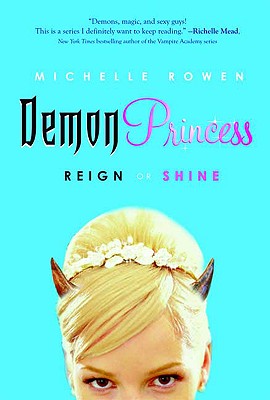
Demon Princess: Reign or Shine

by Michelle Rowen
ages: 12+
First sentence: “‘That guy is staring at you.'”
Support your local independent bookstore: buy it there!
Review copy sent to me by the publisher.

To tell the truth, I was hoping this book would be really bad. It would be so easy to make fun of: Nikki just turned 16, and has discovered that her father — who left her mother soon after Nikki was born — is the demon king of the Shadowlands, the border lands between the human world and the Underworld. There’s a budding forbidden romance with one of the Shadow people as well. It’s the kind of hip, supernatural stuff that’s all the rage right now, no thanks to Stephenie Meyer, and I was primed to mock it.

Yet, it didn’t suck.

Sure, that’s not the same as saying it was really good, but still. The whole thing kept me entertained while I was on the elliptical for several days running. Granted, once I was done, I didn’t really think about it until I got back on again. But it did make the workouts fly by.

I think much of my problem with it — if you can call it a problem — was that it took itself too seriously. I think I would have liked it better if there more tongue-in-cheek humor, something to say that this is fun, this is not to be taken seriously. Which is kind of what the cover suggests. Except there’s issues, problems — like domestic abuse and almost date rape — as well as political overtones, and evil family members. I wanted it to be a romp, a laugh, and while it was entertaining, it wasn’t that.

Sigh.

At least it didn’t end in a cliffhanger.

Candor

by Pam Bachorz
ages: 14+
First sentence: “Ca-chunk, ca-chunk, ca-chunk.”
Support your local independent bookstore: buy it there!
Review copy given to me by the author.

There’s perfect, and then there’s Candor.

Perfect houses on perfectly manicured lawns, full of perfect parents and perfect children all doing perfectly respectable things. And it’s desired: the waiting list to get into the community is over a year long, because once you move into Candor, you don’t move out. It’s not just that you don’t want to, it’s that you can’t. No, there’s no fences; there’s something more sinister holding you there: subliminal Messages piped into all the music that’s constantly running throughout the town, all day, all night. Messages training you to do perfect things, say perfect things, be perfect people.

Except for Oscar Banks, son of the town’s founder.

He’s figured out a way to get past his father’s Messages, and knows how to create his own. He uses this knowledge to help smuggle teens — ones old enough to survive on their own — out of Candor. Not out of the goodness of his heart; no, he’s making a bundle on this, all squirreled away in a nice offshore account. He’s the perfect kid by day, rebel — complete with a shed full of magazines, candy and liquor — by night.

And then Nia moves in. Oscar is immediately attracted to her: she’s everything that Candor is not. Free, artistic, fun, slightly dangerous. He wants to help her, and yet can’t bring himself to tell her everything. It’s a long, slippery slope, one that, ultimately, Oscar finds he can’t control.

It’s an intense book, one that looks at the danger of conformity as well as the meaning of freedom. There’s not a wasted word or scene; everything builds upon everything else leading toward the inevitable conclusion, the one which you hope won’t come, and yet expect all at the same time. The tension between being human and being perfect was palpable throughout the book, which just added to the intensity.

It’s also got one of the best bad guys to hate: Oscar’s father is quietly evil, doing what he deems to be “right”, and yet you just want to yell at (or possibly) kill the guy. I don’t think I’ve had this strong of a reaction to a character in a very long time. Oscar’s father. is. evil. As for the rest of the characters, they range from the pathetic — Sherman — to the creepy — Mandi. The only one I felt was truly “real” was Nia. Perhaps, though, that’s the way we’re supposed to feel about them.

At any rate: an excellent story.