Candor

by Pam Bachorz
ages: 14+
First sentence: “Ca-chunk, ca-chunk, ca-chunk.”
Support your local independent bookstore: buy it there!
Review copy given to me by the author.

There’s perfect, and then there’s Candor.

Perfect houses on perfectly manicured lawns, full of perfect parents and perfect children all doing perfectly respectable things. And it’s desired: the waiting list to get into the community is over a year long, because once you move into Candor, you don’t move out. It’s not just that you don’t want to, it’s that you can’t. No, there’s no fences; there’s something more sinister holding you there: subliminal Messages piped into all the music that’s constantly running throughout the town, all day, all night. Messages training you to do perfect things, say perfect things, be perfect people.

Except for Oscar Banks, son of the town’s founder.

He’s figured out a way to get past his father’s Messages, and knows how to create his own. He uses this knowledge to help smuggle teens — ones old enough to survive on their own — out of Candor. Not out of the goodness of his heart; no, he’s making a bundle on this, all squirreled away in a nice offshore account. He’s the perfect kid by day, rebel — complete with a shed full of magazines, candy and liquor — by night.

And then Nia moves in. Oscar is immediately attracted to her: she’s everything that Candor is not. Free, artistic, fun, slightly dangerous. He wants to help her, and yet can’t bring himself to tell her everything. It’s a long, slippery slope, one that, ultimately, Oscar finds he can’t control.

It’s an intense book, one that looks at the danger of conformity as well as the meaning of freedom. There’s not a wasted word or scene; everything builds upon everything else leading toward the inevitable conclusion, the one which you hope won’t come, and yet expect all at the same time. The tension between being human and being perfect was palpable throughout the book, which just added to the intensity.

It’s also got one of the best bad guys to hate: Oscar’s father is quietly evil, doing what he deems to be “right”, and yet you just want to yell at (or possibly) kill the guy. I don’t think I’ve had this strong of a reaction to a character in a very long time. Oscar’s father. is. evil. As for the rest of the characters, they range from the pathetic — Sherman — to the creepy — Mandi. The only one I felt was truly “real” was Nia. Perhaps, though, that’s the way we’re supposed to feel about them.

At any rate: an excellent story.

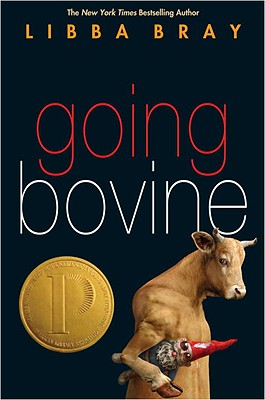
Going Bovine

by Libba Bray
ages: 15+
First sentence: “The best day of my life happened when I was five and almost died at Disney World.”
Support your local independent bookstore: buy it there!

I think this is one of those books that if you don’t read it at exactly the right time — whenever that is for you — it will mostly likely fall flat. But, if you catch it right, like I did this week, then it will soar. Touching at spots, wild, weird, and very hilarious, it will make you want to shout from the rooftops that this is the best. book. ever.

For those of you that don’t know, the plot is simply this: our hero, Cameron, is a loser and a stoner and basically aimlessly trying not to connect with any other human being. His parents are disconnected, his twin sister hates him. He goes along like this until suddenly — though it takes him a while to realize it — he gets Creutzfeldt-Jakob variant BSE, or in other words: mad cow disease. That’s when the weird stuff begins to happen. Angels, fire demons, the Wizard of Reckoning: throughout the rest of the book, Bray throws all sorts of wild, weird and wonderful things at us, asking us to question what is real.

Cameron is sent on a quest — and I admit that if I hadn’t had seen The Lightning Thief recently, I might have missed this — one that is both epic and legendary. It’s playing right into the whole Greek mythos: young man sent on a quest for x (in this case, to save the world and heal himself), and on those adventures, he is tried, tested and eventually found worthy. I like to think Bray knew this going in — though I think she was aiming more for Norse mythology than Greek; by the way, Balder, the kick-butt yard gnome was, hands down, my favorite character — and used it to her advantage. It sounds like a silly plot, but Bray’s writing — foul though it is — keeps you turning pages. What’s going to happen next? It’s so over the top, so off the wall, it makes you want to know: what’s the next thing Bray’s going to throw at Cameron?

And she keeps you guessing, wondering, all the way up through the very end: was it real? Did it happen? What the heck was that?

Wild.

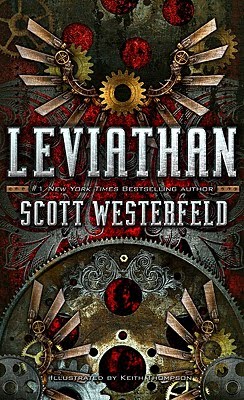
Leviathan

by Scott Westerfield
ages: 12+
First sentence: “The Austrian horses glinted in the moonlight, their riders standing tall in the saddle, swords raised.”
Support your local independent bookstore, buy it there!

First, a disclaimer: I have never, ever heard of steam punk before this book, let alone read it. I had no idea what it entails, what makes a good steam punk book, or what even to expect.

But if this is even remotely typical of the genre, I’m hooked. It was an awesome, wild and weird ride, a fabulous adventure — no one writes nail-biting action like Westerfield — and a grand beginning to a story that has the potential to be absolutely amazing.

It’s 1914, on the eve of the Great War. Alek is a prince of the Austro-Hungarian empire and it’s the murder of his parents that sets off the war, as well as sends Alek on the run for his life. All he has with him is a few loyal men, and a Stormwalker in order to fend off the Germans. Deryn is a commoner, a girl, who desperately wants to fly in the British Air Service. Mind you, they’re not flying planes, but rather Darwinist living creatures — huge ecosystems of creatures that work together to get off the ground. Deryn disguises herself as a boy, and by a fluke or two of nature (ha!), ends up as part of the crew of Britain’s newest airship, the Leviathan.

Told in alternating chapters, the book details not Alek’s escape from his palace and Deryn’s entry into the air service, but their eventual meeting and the results of that meeting. As I mentioned before, there’s tons of nail-biting action from Alek’s initial escape to a couple of attacks by the Germans. But what I found most fascinating (and wild and weird) was the combination of historical fiction and futuristic elements, as well as a re-imagining of science. I loved the Clankers versus Darwinist feud, as well as each individual science. The clanker machines were awesome, powerful, and captivating to read about. But the Darwinist inventions — the wild cross-breeds, the machinations to keep them up in the air, the things (like flechette bats, for instance) that Westerfield created — were the things that kept me turning pages and shaking my head in amazement. What kind of imagination dreams this stuff up? (Well, Westerfield’s, of course.)

The book ends somewhat abruptly, but I’m totally sold: I want to know what happens next. I want to know what adventure Deryn and Alek are going to go on, and I want to know about the small mystery that’s part of the larger story.

The problem — like all books with sequels — is being patient until the next one comes out.

Ninth Grade Slays

The Chronicles of Vladimir Tod, #2
by Heather Brewer
ages: 10-13
First sentence: “Jasik gripped the photograph in his hand and scanned the face of the boy.”
Support your local independent bookstore: buy it there!

We pick up again with Vlad at the beginning of his freshman year. His one goal over the summer was to call Meredith (the love of his life), but… he chickened out. So, where does that leave our teenage vampire? Depressed. Bummed out.

Must be high school.

Vlad has new challenges this year: there’s the leftover problem the vampire community has with his existence. There’s a vampire slayer kicking around Bathory. There’s the training his uncle wants him to get with a uber-vampire in Russia. There’s the teen angst of not knowing whether or not Meredith likes him.

There’s the problem that the book (still) has too much set up and not enough pay off. That Vlad is annoying, the dialogue stilted and the action uninteresting. Which means, even though I read every single page, there wasn’t much there for me to truly like.

Sigh. That’s what really slays, y’know.

Lips Touch Three Times

by Laini Taylor/Illus. by Jim Di Bartolo
ages: 12+
First sentence: “There is a certain kind of girl the goblins crave.”
Review copy picked up from the ARC exchange table at KidlitCon 09.
Support your local independent bookstore: buy it there!

Wow.

Oh, I knew Laini Taylor had a fabulous imagination, having adored both Blackbringer and Silksinger, but, really: wow.

This one is three short stories in which the only connection is the act of kissing. Taylor explores what that “means”, but because it’s Laini Taylor, the exploration is not what you’d expect. Or maybe you would, if you’d read her other stuff. In short, it’s weird, wild, entrancing and just plain fabulous. Without giving too much away…

The first story, “Goblin Fruit”, takes something that every girl wants — to be noticed by the popular, cute boy — and turns it ever-so-slightly sinister. Kizzy has a weird immigrant family, one that she’s embarrassed about. It’s all she can do to avoid their practices, beliefs, superstitions, especially those of her (now-dead) grandmother, who believed quite strongly that there are goblins out there waiting to capture your soul. Kizzy tries to live a normal life, even from the sidelines of her high school, but she wants. Wants — to be popular, to be in the arms of the cute boy — so badly it’s palpable. So, when Jack Husk — beautiful, amazing, wonderful Jack Husk — shows up and pays attention to her, she goes with it. It’s got a bit of an open ending: what really does happen to Kizzy, but it doesn’t really matter. In this story, it’s the getting there that counts.

The second story, “Spicy Little Curses”, was my favorite. Taylor played off of Hindu religion and myth on this one, not only setting the story in Imperialist India, but giving us a devil in Hell who thrives off of making life (and death) miserable for humans. There’s a human liaison to Hell who tries to temper what this devil does, but one day — in exchange for twenty two souls — she allows the devil to curse the daughter of the Political Agent. The curse: if she ever speaks, she’ll kill everyone in the sound of her voice. She manages never to speak, but of course, she grows up into a lovely young woman and a soldier falls in love with her. There is not a happy outcome (again, of course), but the twists and turns and the language (oh, the language!) make it simply a joy to read.

And, finally, “Hatchling”. It’s the longest of the three stories, the most developed, the most interesting world-building that I’ve read in a while. Taylor takes were-lore and vampire-lore and develops it in a new and fascinating way in giving us the Druj. Not quite werewolves (and yet they shape shift), not quite vampires (and yet they use and abuse humans for their own pleasure), they terrorize and terrify humans. Mab was one of those, and for some reason, she managed to escape from the Queen. She was pregnant at the time and with her daughter, Esme, she has been in hiding ever since. Fourteen years later, Esme wakes up one morning with one blue eye and one brown eye. This not only terrifies Mab, but leads Emse to the destiny that she never knew she had, changing the way the Druj interact with each other and the world in the process.

I know I didn’t quite capture the wonderfulness that is this book. But it truly is amazing.

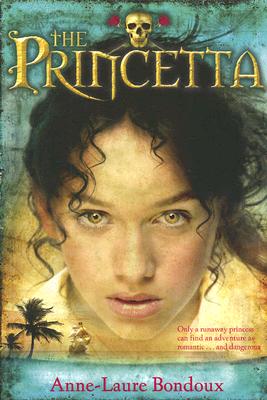
The Princetta

by Anne-Laure Bondoux
ages: 12+
First sentence: “A few months ago you summoned me to the Council Chamber.”
Support your local independent bookstore: buy it there!

Malva dreams of adventure. She’s the crown princess of Galnicia, and she loathes being a puppet in her parent’s grand plans. She hates sitting, looking perfect and pretty and dreams of escape. So, on the night before her engagement party (to some stuffy old prince), she and her maid escape from the castle.

Thus begins The Princetta, a book in the tradition of Grand Fantasy: high adventure, romance, princesses, noble sailors, evil revenge-seeking counts, giants, sirens, mystical lands, battles, storms… in fact, it reminded me a lot of The Princess Bride. Except, it didn’t quite work.

I don’t know if it was the translation — it was originally written in French — or the story. But, honestly, about halfway through the book I started skimming because it was boring. There was a lot of telling, rather than showing, and Malva — for all her feisty ideals — wasn’t terribly interesting. For all the characters to juggle, it was managing okay, until they got to the mystical Archipelago, where they were to get Tested and Tried. The book was only half done, and I had no idea how it was going to manage for the rest of the (overlong) 430 pages. I skimmed enough to get the gist of it, read the ending (which wasn’t predictable at all, which surprised me) and called it quits.

I do wish it had been better, though.

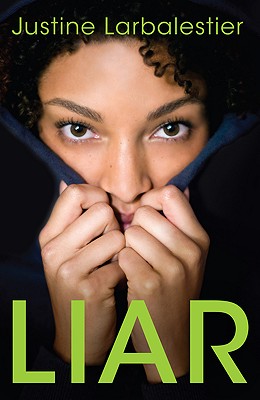
Liar

by Justine Larbalestier
ages: 13+
First sentence: “I was born with a light covering of fur.”
Review copy sent to me by the folks at Bloomsbury.

The hardest part about reviewing a book like this is not giving anything away. The hardest part about reading a book like this is knowing what to believe.

There are unreliable narrators — characters who don’t understand what’s going on around them, who whether willfully or unknowingly misinterpret the information around them, while the reader fully understands what’s going on. Then, there’s Micah. Micah is a liar, something for which she’s very up front about.

However, that means everything in the book is suspect. Everything.

I think the basic plot — that Micah’s “after hours” boyfriend, Zach was brutally killed — is pretty much sound. But everything else, from the opening sentence to the final paragraph, is suspect. How much is truth? Micah tells you that she’s telling the truth, but as the book unravels, there are lies. So you wonder: is she lying about lying? You can’t trust her as a narrator, and yet you have no information other than what she gives you. Everything in the book is on shaky ground, and you’re left at the end wondering what really happened.

It’s a compelling look at… what? Lying and truth-telling, yes. But other things as well. But you could also go meta here: it’s exploring the role of a narrator in a book, the role of a reader and the agreements the reader makes with the narrator/author when opening up the book. It’s an exploration of a girl trying to fit in, but… how?

I’d go on, but really, as Justine Larbalestier says, it’s better left spoiler free. Once you’ve read the book, head over to the spoiler thread and leave your two cents on what it all means.

I’m still reeling from it all. Fascinating.

Ice

by Sarah Beth Durst
ages: 12+
First sentence: “Once upon a time, the North Wind said to the Polar Bear King, ‘Steal me a daughter, and when she grows, she will be your bride.'”
Review copy sent to me by the publisher at the author’s request.

Cassie has spent her life knowing two things: polar bears and ice. It’s because she grew up with her father at a remote research station in northern Alaska. There was one other thing she was told: her mother was the daughter of the North Wind, and she was currently residing in the troll castle in exchange for defying the North Wind and having a daughter (who she promised would marry the Polar Bear King). Cassie figured it was just a fancy way for her dad and grandmother to tell her that her mother had died.

Until, on her 18th birthday, she discovers that the story was really true: she encounters Bear, who comes to take her to his castle and marry her.

Thus begins Sarah Beth Durst’s latest book, a modern adaptation of the fairy tale East of the Sun, West of the Moon. There have been other adaptations of this tale, but Durst takes it in a couple of new and intriguing directions. First, by setting it in modern day, it makes the fairy tale end of it seem more surreal. There aren’t supposed to be talking bears or magic in our modern, scientific world. Durst makes this work by introducing a vaguely religious aspect to the book: Bear and his kind are munasqri: beings who have powers in order to capture souls of the dying and deliver souls to the born of the creatures they oversee. It’s an intriguing concept: one that allows for magic without making things overly fairytale-ish.

The other thing I found interesting was that the marriage between the main character and the bear took place near the beginning of the book, rather than being the reward for finding the bear. The basic elements of the tale were there, except that Cassie is married — and pregnant — for most of the book. It added something more to the book; it’s almost more believable that Cassie would go to the ends of the earth and beyond for her husband rather than someone she just discovered she loved (though there’s some of that, too), especially because she’s carrying their baby. As a mother and a wife that particularly touched me. I’m not sure how much teens would find it interesting — M really enjoyed reading the book, though — but I did appreciate it for the picture of a loving, healthy relationship.

Durst opts for a more quiet tone than in her previous two books. There is no supreme adventure, a race against evil — though interestingly enough, evil takes a similar form in this one as it did in both of her other books. No, it’s a quest, a journey in the traditional sense: Cassie is searching for her husband, questing to prove to herself that the impossible can be done, learning that she not only can do what she thought she could — both physically and emotionally — and overcoming all in the end.

An excellent addition to this fairy tale’s adaptations.

The Princess and the Bear

by Mette Ivie Harrison
ages: 12+
First sentence: “Long ago, there lived a wild cat that was the sleekest, fastest, and bravest of its kind.”

One of the things I like best about sequels and series, especially in fantasy books, is getting to visit the world the author imagined again. Especially when the world is as fascinating as the one that Mette Ivie Harrison has imagined.

The Princess and the Bear follows the story of the Hound and the Bear from the end of The Princess and the Hound. Told through alternating chapter narratives, the book tells the story of the two unlikely companions who find solace in their togetherness, until the spread of unmagic threatens to destroy their comfortable — if lonely — life. They journey to the wild man, the one person who can aid them in righting this horrible wrong. The wild man sends the Hound and the Bear back to a point in time when the magic is overly volatile, to deal with and stop the source of the unmagic. It also happens that this point in time is when the Bear was a human: King Richon, a spoiled brat of a king who was used and taken advantage of by his evil advisers. It’s up to him, with the aid of the Hound — now a human, Chala — to find the source of evil, right the wrongs that Richon did before spending 200 years as a human, in order to fix the future.

The best part of this novel, much like the first one, was the words. Harrison paints a gorgeous picture of the world she’s imagined. It’s also a thoughtful book, one in which the reader does not plow through, but instead lingers over the pages soaking in the atmosphere. Yet, for all its flowingness and thoughtfulness, Harrison is a writer for a particular sort of person, someone who is willing to take a slower, quieter pace and enjoy the words instead of the characterization and plot. There’s very little action, there’s very little romance (like the first book, it grows slowly, so much so that you almost miss it). There is a definite character arc, but, again, its something that will sneak up on you, almost without you knowing. It’s not exactly something that will keep you on the edge of your seat. The evil guys aren’t that scary, the action isn’t that captivating, the romance isn’t that swooning.

Yet, there is something magical in Harrison’s writing. And that’s just enough to draw the reader in and be completely captivating.

Dreaming Anastasia

by Joy Preble
ages: 12+
First sentence: “I didn’t always dream about my family.”
Review copy sent to me by the publisher.

Dreams are funny things.

They’re often just manifestations of stress or hopes or fears. But, what if they were real? What if what you dreamed really happened… or was about to happen? And what if you dreamed about someone other than yourself?

Anne has dreams like that: she dreams she’s Anastasia Romanov, grand duchess of Russia, supposedly dead as part of the communist revolution in 1918. Except, as Anne slowly finds out, things aren’t always as they seem. Her life was ordinary — except that her brother recently died of cancer — until Ethan showed up… and then ordinary became extraordinary (and not just because he was wicked hot), as both Anne and Ethan work to put right the wrong that was done to Anastasia nearly 100 years before.

Part historical novel, part fantasy, part romance: this book has a little bit for everyone. The best bits were the ones with Anne and Ethan — told in alternating chapters — as they tried to figure out how to unravel the magic that was done 100 years before. It was intense in the action, the magic wasn’t overpowering or awkward, and while the romance was very, very subtle, there was still enough of it to satisfy. I enjoyed Anne as a character as well, as she struggled to grow into herself and come to terms not only with her dreams, but with her own history as well.

In fact, the only real complaint I have is the font for the Anastasia letters — it’s so incredibly difficult to decipher (and I thought my handwriting was bad!) that I was pretty sure I was missing plot points. Other than that, it was an entertaining read.

Check out the rest of the tour:
Hope is the Word (9/20)
Zoe’s Book Reviews (9/21)
Homespun Light (9/21)
Teen Scene magazine (9/21)
Galleysmith (9/22)
Once Upon a Bookshelf (9/22)
Café of Dreams (9/23)
My Friend Amy (9/23; 9pm EST author chat)
The Brain Lair (9/24)
Ms. Bookish (9/24)
Lori Calabrese Writes (9/25)
Mrs. Magoo Reads (9/25)
Ramblings of a Teenage Bookworm (9/26)
Fantasy Book Critic (9/26)
Into the Wardrobe (9/27)
In the Pages (9/27)
Beth Fish Reads (9/28)
Reverie Book Reviews (9/28)
BookLoons.com (9/28)