Froi of the Exiles

by Melina Marchetta
ages: 15+
First sentence: “They call her Quintana the curse maker.”
Support your local independent bookstore: buy it there!
Others in the series: Finnikin of the Rock

For the past three years, Froi has made his home in Lumatere, as part of the Queen’s Guard. He lives with a family in the Flatlands, working the fields. He trains and has a bond with the captains of the guard. He struggles with his past — as a slave boy and thief — but for the most part he’s happy.

Then, a Charynite makes his way across the Lumatere border (you have to understand that the Charynites invaded Lumatere and that prompted the events of Finnikin — so, yes, you kind of need that one first — and to say that they don’t like each other is an understatement.) and offers a chance for the Lumaterians — specifically Froi — to assassinate the king.

See, over there in Charyn, things aren’t all rosy. Eighteen years ago, someone assassinated their top religious leader, the oracle, and razed a province to the ground. Since then, the Charynites haven’t been able to have babies. The only salvation is in the princess Quintana, who has been prophesied to bear the first child. Because of this, she is kept prisoner in the castle, and is half-insane.

Froi heads to the castle, with the intentions of killing the king, but discovers that his role in Charyn, and his life, is so much greater than he thought it would be.

That summary doesn’t do this enormous, involved, intricate, intense book justice. Let’s just say that my offhand comment in my Finnikin review –“Sure there are some missteps: I wasn’t quite sure what Marchetta meant to do with the slave boy, Froi; he just seemed to lurk around in the background, never fully part of the story.” — is brought to fruition. Froi is the star of this show. Even though Finnikin and Isaboe play roles (and are quite delightful), as do a myriad of other minor characters, the real story here is Froi’s. And he’s quite a character to get to know: tortured, conflicted, with definite anger management problems, full of longing and desire but without the emotional resources to handle it.

It makes for a different kind of read than Finnikin: it’s still dark (there’s rampant rape, and lots of corruption), but there is a hope in this one that I don’t quite remember from Finnikin. That somehow, maybe Froi will figure things out, and that Charyn, contemptible though it is, maybe is worth saving.

And now, to wait for the ending. I’m sure it will be just as excellent as the other two. 
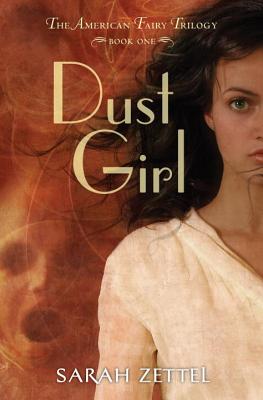
Dust Girl

by Sarah Zettel
ages: 12+
First sentence: “Once upon a time, I was a girl called Callie.”
Support your local independent bookstore: buy it there!
Review copy provided by my place of employment.

It’s the heart of the Great Depression, and in Slow Run, Kansas, Callie LeRoux and her mother are struggling to survive. She’s the daughter of a single mom, living in a run-down hotel, and to make things worse (considering the time period), she’s half African-American. Then, one day (Sunday, April 14, 1935, to be exact), she learns — quite by accident — that she’s not exactly who she thought she was.

She is the daughter of a human mother, yes. But her father is a faerie prince.

This knowledge doesn’t come all at once, and Callie doesn’t readily believe it. The things she does know is that the Seelie have taken her mother, and Callie wants — no, needs — to get her back. She sets off on an adventure with a hobo named Jack, determined to get her mother back.

I’ll say this up front: it’s the first in a series, and it reads like a first in a series. There’s a lot of exposition and getting things going, and the actual plot doesn’t really begin until the book is nearly done. That said, the whole world that Zettel built is excellent. It’s a unique choice to involve race in the whole faerie world: the Unseelie are black; the Seelie… well, not so much. Not only are there human vs. faerie elements, but race also comes into play. And this makes it unusual for a fantasy novel.

Callie and Jack are also, for the most part, interesting characters. I think Callie becomes more interesting as the book progresses, especially when she finally faces her father’s family. Which makes me intrigued with this story, and curious to know where Zettel plans for it to go.

It’s not brilliant, but it’s solid, and it’s definitely worth the time.

The Cry of the Icemark

by Stuart Hill
ages: 13+
First sentence: “Thirrin Freer Strong-in-the-Arm Lindenshield carried her names with ease.”

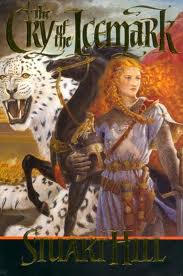
Aside from the horrid cover, I really wanted to like this one. I thought it would be like Tamora Pierce’s Lionsong novels: a strong girl, a warrior girl, leading her people in a fight against Incredible Odds.

And maybe it is.

However, I couldn’t read it. I gave it 50 pages to grab me (maybe I should have held in there longer?), but it didn’t. Part of it was that Thirrin was supposed to be 13, and yet she was acting like an 18-year-old. (Which isn’t new; I mean, how often in fantasy novels do 13-year-olds actually act like a 13 year old does?) Part of it was the ridiculous names (Primplepuss????). Part of it was that Thirrin’s father, the king, never spoke, but shouted, guffawed, hollered, and bellowed.

But, mostly, it was because I am tired of authors telling me what is going on. Thirrin thought this. Thirrin did that. Thirrin wants this. Thirrin thinks that.

*sigh*

I just want to read a story where I can interact with the characters, enjoy the plot, and be SHOWN what is going on.

And that is really why I bailed on this one.

Code Name Verity

by Elizabeth Wein
ages: 14+
First sentence: “I am a coward.”
Support your local independent bookstore: buy it there!

Things this book is:
A World War II book.
A book about friendship, between two young women, specficially.  Funny.
A book about torture.
A book about the Resistance.
A book about women pilots.
A book about things a person will do to save their skin.
An amazing example of voice. Seriously, the characters leap off the page.
Unputdownable. (Yeah, I know. Still, it fits.)
Freaking awesome.

Things this book is not:
Trite.
Another Holocaust book.
Boring.

In other words: if you haven’t yet read this story about Maddie and Verity, and been captivated by their story, you are missing out.

And yes, it really is just as good as “they” all say.

Throne of Glass

by Sarah J. Maas
ages: 14+
First sentence: “After a year of slavery in the Salt Mines of Endovier, Celaena Sardothien was accustomed to being escorted everywhere in shackles and at sword-point.”
Review copy provided by my place of employment
Release date: August 7, 2012

At first glance, this should be a great fantasy novel. A strong, but not exactly noble, heroine (is there an assassin theme this year?) is put up against twenty three other people (Hunger Games!) in competition for the spot to be the king’s Champion (i.e., heavy) and win her freedom.

Of course she’s Beautiful, Desirable, Awesome, Cool, Flawed, Intelligent, Perfect, and both the prince and the Captain of the Guard is in love with her. (Or so I assume; I never actually got to that point.)

It has Everything a Woman Fanasty Reader wants, right?

Well, there is one problem: the writing is crap.

Sorry. I suppose I should beat around the bush, and I do have to admit that it may be me, not the book, but honestly I had no patience for this (all from the ARC, so maybe the editing will get it together in the next month…):

“She curtsied, looking up at him beneath lowered lashes.” (*eye roll* I understand she’s playing a part, here, but this is just lame.)

“She actually did trip on her dress, and her shoes cut into her heels quite terribly, but he would hear none of her objections as he dragged her into the hall.” (Blah blah blah. There were a lot of instances like this, where I just wanted to say: Really, we don’t need to know how many buttons are on her dress, or whether or not her heels hurt terribly. Get. On. With. It.)

“‘Save it for the competition,’ he said softly, but not weakly.” (SERIOUSLY??? Why does “softly” imply “weakly”? Why do I care?)

“Ahead, Cain turned a corner, heading north — back toward the castle. [repetitive] Like a flock of birds, they followed him. [What have they been doing up to this point?] One step after another, never slowing down. [I didn’t think, giving the previous two sentences, that they had been slowing down.] Let them all watch Cain, let them plot against him. [Okay then: she switched Point of View here, didn’t she?] She didn’t need to win the race to prove she was better — she was better without any kind of validation that the king could give her! [You keep telling yourself that, dearie.] She missed a breath, and her knees wobbled, but she kept upright. The run would be over. Soon. [Not soon enough.]”

There were more, but that pretty much gives you an overview of my irritation. I know that by reading so many middle grade and young adult fiction books, my patience with plotting and wordiness has become limited. But, this was egregious even for a crossover novel (was it supposed to be teen? Adult? I never did figure that out).

So, I bailed. The romance(s) were moving too slowly for me (too much simpering, not enough smouldering), the author kept telling me rather than showing me stuff, and the whole plot was taking way. too. long.

One other note: this author has a huge fan base [don’t shoot me!], and has written several on-line prequels leading up to this novel. I don’t think reading on-line fiction should be a prerequisite to enjoying a novel, and yet I felt that I was missing something when reading this one. Yet another reason I bailed.

But I’m sure some people will luuuuuvvvv it.  Just not me.

Seraphina

by Rachel Hartman
ages: 13+
First sentence: “I remember being born.”
Support your local independent bookstore: buy it there!
Release date: July 10, 2012
Review copy provided by my place of employment.

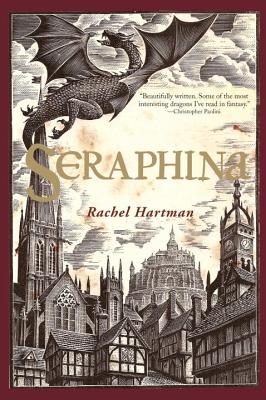
I should get the gushing out of the way first: I have read books about dragons, some of which were really clever, but I have never seen dragons like this.

And that blew. me. away.

I have struggled with how to sum this novel up, but am completely at a loss. There is so much going on, much of which is best left to be discovered as you go, that a summary is almost impossible. This is what I can tell you: the main character is Seraphina, a sixteen-year-old assistant chief musician in the castle. Except she has a secret, one that will cost her her life if revealed. The country is Goredd, which has been at peace with the dragons for forty years. It’s a tentative peace, one which is hanging by the slimmest of threads. There is prejudice against the dragons rampant in the populace of Goredd, a fire that is barely constrained. And so when Prince Rufus is found beheaded, it’s everyone’s — from the military down to the common people — assumption that the dragons did it, and there are people calling for blood.

And then there are the dragons. They walk among the humans, as humans: learning, teaching, advising, observing. Granted, they stand out to the humans; dragons are more rational, less emotional, mathematically minded, and not at all spontaneous. But, even though they are differences, it’s their ability to mimic humans that is the root of all the prejudice and terror in Goredd.

Really, that’s all you need to know to start. Know this as well: this is an excellent first novel. It’s a rich, rich world that Hartman has created, full of religion, politics, romance, music, and action. And while it works as the start of a trilogy, it also stands on it’s own, bringing the story arc to a satisfying conclusion, while leaving threads open to pursue in later books.

But really, read this one for the dragons. You’ll never see them like this again.

Crossed

by Ally Condie
ages: 12+
First sentence: “I’m standing in a river.” 
Support your local independent bookstore: buy it there!
Others in the series: Matched

I’m not quite sure how to do this without giving too much of Matched away, so if you’re one of the people in the world who haven’t read it, you might want to skip this.

Cassia and her True Love, Ky, have been separated, but Cassia’s not going to let that stop her. She gets herself reassigned to the Outer Provinces, in hopes of tracking him down; he was sent there as a result of a sort she had done earlier. In the meantime, Ky is doing his best to survive, and when he finally lands in the village he was from, he sees his chance, and with a couple others, takes it.

Eventually, Cassia and Ky meet up (was there any question that they would, really?), and find their way — with their hangers on — through the caverns of the Carving to something resembling safety: the Rising, or rebellion.

In some ways, this was less pedantic than Matched: instead of treading the same old dystopian line, Condie is expanding her world, showing bits and scraps of the Society, its founding and what it’s capable of. It’s also interesting to get things from Ky’s perspective; in many, many ways he’s a more interesting and complex character than Cassia is. I appreciated knowing his history and motivations, things we weren’t given in Matched.

But there’s still so many unanswered questions, so many loose threads at the end of the book. It makes you curious, but at the same time impatient for answers. And even with all the loose ends, this one is less gripping than Matched.  Too many moments of Ky and Cassie either pining for one another, or staring into each others’ eyes once they do meet back up. Gag. There has to be more to a plot than Romance, right?

So. I don’t know if I’ll scramble for the next one, waiting for it to come out with baited breath. But it wasn’t a complete waste of my time. 

Matched

by Ally Condie
ages: 12+
First sentence: “Now that I’ve found the way to fly, which direction should I go into the night?”
Support your local independent bookstore: buy it there!

I’m probably the last person on earth to read this, which is part of the reason why I’ve avoided it for so long. (You know me and my hesitance to read popular books…) I figure something that popular couldn’t be that good. Right?

Well, in some ways yes: perhaps it’s because I’m immensely tired of dystopian books, but it seems as if this one doesn’t really cover anything new. A perfect society, headed by a controlling government? Check. A person who, after years, realizes that the society and perfection isn’t all it’s cracked up to be? Check. A love triangle? Check. Lots and lots of set-up for the next in the series (because none of these can be stand alones)?  Check. It was all very run-of-the mill.

And yet, I enjoyed the world that Condie had built: while she never explained the demise of the society, she did manage to convey the loss of history, of tradition that is so important in a diverse culture. I liked Cassia and Ky and even Xander as characters, and liked that Condie didn’t make anyone out to be truly malicious. In a sense, everyone in the book was just a cog in the system, which in itself is unique.

It’s enough to make me curious about the second book, and I’ve got it sitting in my pile for the weekend. That said, I don’t think it’s the best, or even most original, dystopian tale out there.

The Lost Code

by Kevin Emerson
ages: 12+
First sentence: “The morning after I arrived at Camp Eden, I drowned for the first time.”
Support your local independent bookstore: buy it there!
Review copy provided by the author, whom I met at KidLitCon 2011

Owen is not what you’d call the outdoorsy type. Growing up in the Hub — the caves where people live in the outer reaches of the society — he never really had a chance to go outside, to get much exercise, to enjoy nature. Sure, much of this has to do with the radiation levels from the depleted ozone. But, it’s also because that’s not exactly the person Owen is. So, when he gets a chance to go to Camp Eden — a nature preserve inside a dome that protects the world from the radiation — he takes it. Even if it seems like something he wouldn’t do.

Once there, weird things start happening: he drowns, but doesn’t die. He grows gils, he discovers a secret society. And the people who are supposed to be protecting him and the other campers turn out to be something more… sinister.

The thing that this book really has going for it is that it’s a unique combination of dystopian and fantasy: the world that Emerson builds is clearly dystopian: there’s talk of radiation leaks, and technology that has enabled people to be frozen and reawakened later. But, it’s also fantasy: the evolution of gils, and the set-up of a quest that involves Owen and some friends he makes at camp are clearly not in the realm of the possible. In addition, it’s got that summer-camp feel to it: there are typical power dynamics and interactions (including a romance) that could fit in any YA novel. It truly is a unique hybrid of styles.

Unfortunately, though, it’s all set-up, and it does take a long time to get to where the action really begins. There are a lot of questions, and while many of them are answered by the end, it almost takes too long to get there.

Still, it’s an intriguing enough beginning to make me curious as to where the series will go.

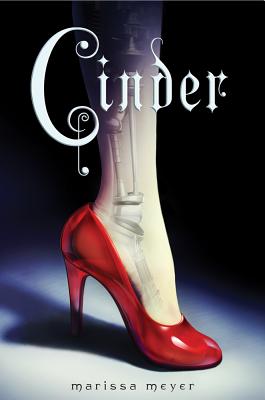
Audiobook: Cinder

by Marissa Meyer
Read by: Rebecca Soler
ages: 12+
Support your local independent bookstore: buy it there!

Cinder is a cyborg — part human, part machine — which puts her at the fringe of the New Beijing society. She’s just a mechanic, even if she is a good one, and just barely tolerated by her stepmother and stepsisters. (Well, one of her stepsisters, Peony, is her friend. The other, not so much.)

Then, once day the crown prince Kaito shows up at her booth, dragging an android that needs to be fixed. And Cinder’s world — for better and for worse — is changed forever.

I should get this out of the way for all of you who haven’t read it: yes, this is a first in the series. I somehow missed this fact, and so by the end of the book, when it was clear that it wasn’t going to be wrapped up in one story, I was pretty frustrated. I think, if I had known this would go on longer, I would have been less impatient with the story.

Because, really: it took too long to tell. I know it didn’t help that I figured out the twist a little ways into Book 2, but really: this story could have been told sufficiently in one book; making it a series just felt forced to me.

That said, there were elements I did like: I liked Cinder’s android friend, Iko, and Cinder’s relationship with her. I liked Cinder, and the way her cyborg elements helped, enhancing her as a character. I liked the doctor (I don’t remember his name; since I listened to it.), and his role in the story. I liked the world that Meyer built: part dystopian, part fairy tale. I did like the way she was morphing the Cinderella story into something else: the basic elements were still there, but melded quite well with the world that Meyer created. I loved the reader: she was brilliant, and her reading made the story pop.

I guess, in the end, the positives of the book outweigh my frustration at the story taking too long to tell.