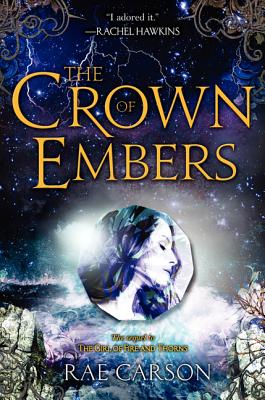
The Crown of Embers

by Rae Carson
ages: 13+
First sentence: “My entourage of guards struggles to keep pace as I fly down the coridors of my palace.”
Support your local independent bookstore: buy it there!
Others in the series: The Girl of Fire and Thorns

(Obviously, slight spoilers for the first one. You really should read that first.)

On the heels of the war with the Inviernos and the death of her husband, the king, seventeen-year-old Elisa has taken over ruling the country of Joya d’Arena. This is no easy task: attempts on her life are made, members of her Quorum (the ruling council) are plotting her overthrow behind her back, and the only person she can truly trust is Lord Hector, the commander of the Royal Guard.

Most of this book is taken up with Elisa trying to figure out how to be a ruler. She was never really given instruction on court politics, and she makes some (dangerous) missteps along the way. Even so, Carson manages to keep the action going (it helps that she comes up with an assassination attempt every 50 pages or so), and the court politics interesting. Also: for the detractors for the first book, there is a lovely, lovely romance in this one. *swoon*

It turns out that Elisa has more to do than just figure out how to rule a country on her own: being the bearer of the Godstone, she needs to figure out how to harness its power, and that involves a trip to the southern islands, to find the zafira: the source of all power.

Much like the first book, the thing I liked best was that Elisa was a strong character, and yet she’s incredibly vulnerable. She is human — she has weaknesses and makes bad decisions — and yet she is admirable: constantly finding depths in herself that she didn’t know existed, finding ways to handle situations she didn’t think she could. I loved the way Carson wove religion through the book, without making it seem hokey or preachy.

And, because it ends at a point where I was sitting on the edge of my seat, I can’t wait to read the final book in the trilogy.

Railsea

by China Miéville
ages: 13+
First sentence: “This is the story of a bloodstained boy.”
Support your local independent bookstore: buy it there!

I first saw Railsea when it came into the store sometime in late April, early May. I checked our distributor to see where I should shelve it, and they said it was middle grade, ages 9-11. So, I stuck it there, and didn’t really think of it again. Then Cybils time came around, and it got nominated in the YA category. I thought that was a bit odd, so I figured I needed to read it. I put it on hold at the library, and when I got it, I noticed something weird: it was labeled as Adult sci-fi.

All of this is a roundabout way of me saying that I mostly picked up this one because I was fundamentally curious as to the target age group: where does it belong?

And after reading it, my answer would have to be… Yes. All of the above.

It is, briefly, a post-apocolyptic/dystopian retelling of Moby Dick with trains and mutant rodents instead of boats and whales. Our main character is a boy of indeterminate age, Sham Yes ap Soorap, who signs on to the moletrain — kind of like a whaling boat: it’s a train that rides the complex “sea” of rails, hunting the mutant moles for meat and skin to sell — as a doctor’s assistant. Their captain, Captain Naphi, has a “philosophy”: she lost an arm to a huge white mole rat, Mocker-Jack, and is determined to hunt it down. But, that’s not all: they find a wreck of a train, with an unusual picture on a digital camera: of a single rail line headed into the horizon. Sham heads on his own personal mission (or “philosophy”) to hunt down the owner of the camera, which turns out belongs to the children of a couple of adventurers. It turns out that the government, loosely speaking, is after these children because their parents discovered something they shouldn’t have: the path to Heaven.

Yes, this is all really convoluted. It’s not just you.

There is nothing in this book that a 9-year-old couldn’t read. I’m not sure they’d “get” it though. It’s very stylized (Miéville loves to use ampersands, even when they start sentences. & that’s very distracting.), and I came to realize through the course of the book that the more you know Moby Dick, the better this one is. It’s quite the faithful retelling, I think. (I’ve never read it, though I know enough about it to get the gist of what Miéville was trying to do). So, I’d give it to a teen or adult whose interested in dystopian who has also read Moby Dick. They’ll be better equipped to understand Railsea.

Was it good? I’m not sure. I was impressed with the feat Miéville was undertaking more than  I enjoyed the story. I respected this one, but I don’t think I liked it very much. So, take that for what it’s worth.

At any rate, I’ve read it now, so I can begin to figure out where it belongs.

Steampunk!

An Anthology of Fantastically Rich and Strange Stories
edited by Kelly Link and Gavin Grant
ages: 13+
First sentence: “Orphans use the puppet of a dead man to take control of their lives.”
Support your local independent bookstore: buy it there!

I went into this knowing about this much about Steampunk: it’s a meld between the past and the future, giving new technologies to a time period that didn’t have them. The only steampunk I’ve read before this was Scott Westerfeld’s Leviathan series. And, even though M really really wants a steampunk costume, I really don’t have much invested in thknois fantasy sub-genre.

So I didn’t really know what to expect from this collection of short stories. However, while I enjoyed many of them, I kept wondering: what is steampunk, really? Because these stories were all over the map. Some, like Kelly Link’s “Summer People”, were just straight fantasy. Others, like Ysabeau S. Wilce’s “Hand in Glove” (a mystery) or “Steam Girl,” by Dylan Horrocks or “Seven Days Beset by Demons,” by Shawn Cheng, felt more straight fiction than fantasy/steampunk at all. Does the throwing in of some mechanical somehow make a story steampunk? Even when the mechanical element doesn’t play a role in the larger story?

Others, like Libba Bray’s “The Last Ride of the Glory Girls” and Cory Doctorow’s “Clockwork Fagin” and M. T. Anderson’s “The Oracle Engine,” felt more “authentically” steampunk to me, and as a result, those were my favorite stories. It could also be that I know Bray’s and Anderson’s writing (not so much with Doctorow, though I’ve met the man)  and love the way that they tell stories. But, I felt that they did what I expect steampunk to do: marry technology with a pre-tech state, and give me a good story where the technology is important to the outcome.

Perhaps the whole idea of this anthology was to stretch the definition of steampunk, and allow for it to encompass more genres. But I’m not sure that worked for me. Steampunk really is at its best when it limits itself to its stated definition. And when you find an author that can do that, it’s fascinating to see the outcome.

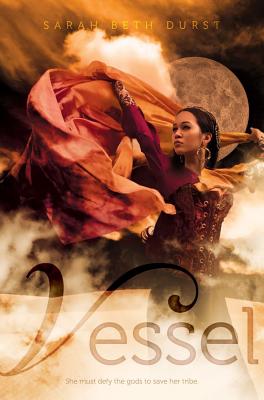
Vessel

by Sarah Beth Durst
ages: 14+
First sentence: “On the day she was to die, Liyana walked out of her family’s tent to see the dawn.”
Support your local independent bookstore: buy it there!

Liyana is one of the Turtle People, the people of the desert. Every hundred years, the gods and goddesses they worship come back from the  Dreaming, entering a Vessel that has been prepared in order to walk among their people, helping them with magic live for another hundred years in the desert.

Liyana is the vessel for the goddess Bayla, and even though she doesn’t want to die, she does want to do her duty. But then, something goes wrong: Bayla doesn’t come. Liyana’s clan leaves her to die, but shortly there after the trickster go Korbyn shows up with some bad news: someone has trapped the gods and goddesses and if they don’t save them, then the entire Turtle People will die. (The stakes are even higher than Korbyn realizes: the emperor of the Crescent Empire is planning to invade in search of a lake, in order to ease the Great Drought that has affected his people.) His plan: find the vessels for the rest of the gods/goddesses captured and then find the gods/goddesses and rescue them.

So far, so good: Durst makes interesting use of the idea of freedom, worship and sacrifice for the greater good. Liyana is a strong, likeable girl, someone who was willing to make the sacrifice of her life to help her clan, but in the face of another decision and path, would willingly look at the other options. (There was another vessel who wasn’t as open to other ideas, and she irritated me to no end.) And an extra bonus to her for writing a great fantasy character of color.

The place where it broke down for me — though not enough to give up on the book — was when the group finally confronted the emperor and found the gods. I wasn’t able to suspend my disbelief: for even though Liyana was capable and strong, I’m not sure she’d have made such a connection with an emperor (yes, he was young and handsome), so quickly. Her relationship with Korbyn, forbidden though it was, was a whole lot more believable. Maybe it’s just because I’m down on instalove.

But, the end? That I believed and enjoyed. And I love that Durst can write a compelling fantasy story in. one. book. and doesn’t need a whole trilogy to work out her storyline. For that alone (though the story really is compelling and intriguing, even if it is a bit slow in parts), this one is worth reading.

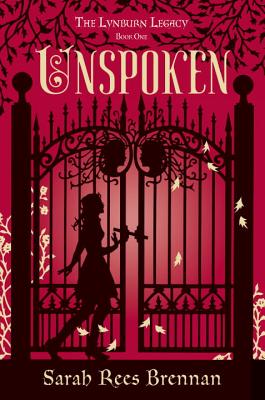
Unspoken

by Sarah Rees Brennan
ages: 12+
First sentence: “Every town in England has a story.”
Support your local independent bookstore: buy it there!

Kami has an imaginary friend.  She has had him in her head, talking to her, keeping her company for as long as she can remember. She’s learned not to talk about him, because people in her small English Village, Sorry-in-the-Vale, tend to think she’s a bit crazy, but he’s there and she’s learned to live with it.

Not for one moment did she ever think that 1) he was really real and 2) he’d show up in her village.

Kami is also an aspiring investigative reporter, something which won me over immediately. I loved her spunk and her gumption, and her Nancy Drew/Veronica Mars/His Girl Friday determination to get to the bottom of the story. Because in Sorry-in-the-Vale there are a LOT of secrets that no one is willing to tell.

To be honest, that kind of bugged me for a lot of the book: the fact that Brennan hinted at secrets, and hinted at secrets, and hinted at secrets, but the reader was as CLUELESS to understanding them as Kami was. I wanted more information, but it wasn’t enough of an annoyance to make me throw the book across the room. No, what kept me reading was the witty writing — the balance between humor, romance, and suspense — and the characters. I adored the girls: Kami, of course, but also her friends Holly and Angela. And the guys weren’t that bad either.

And when the secrets were finally revealed, I understood why Brennan approached it the way she did. She has a way of keeping me engaged, turning pages, until her satisfying-yet-frustratingly-open conclusion.

I can’t wait for the next one!

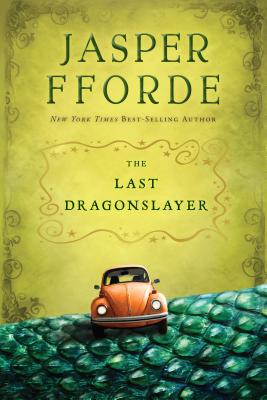
The Last Dragonslayer

by Jasper Fforde
ages: 12+
First sentence: “It looked set to become even hotter by the afternoon, just when the job was becoming more fiddly and needed extra concentration.”
Support your local independent bookstore: buy it there!
Review copy provided by my place of employment.

Jennifer Strange, 15, is just an indentured servant running the Kazam Mystical Arts Management in the wake of owner Mr. Zambini’s disappearance. No, it’s not easy managing a group of magicians whose magic is slowly fading, but she’s managing.

Then one of her magicians has a vision: Maltcassion, the last dragon, is going to be killed at noon on Sunday. By the last dragonslayer. Which happens to be Jennifer.

On the one hand, this little book is classic Fforde (granted, I’ve only read one other of his books): witty, slightly odd, with a tendency for clever names. The story is… intriguing… and interesting alternative history (The Ununited Kingdoms, for example, where Jennifer lives in the Kingdom of Hereford, under King Snood). But, while it’s whimsical, it’s also… odd. I’m not sure quite why I feel that way, just that while I thought the oddness worked in The Eyre Affair, I don’t think kids will get the oddness. Now, to be fair, I may be underestimating the 12-year-old British magic fans out there, but it just felt like a grown-up novel slightly whitewashed in order to make it suitable for kids books.

And while the story is passable and somewhat entertaining, I’m not sure that’s enough to offset the oddness of the book.

Froi of the Exiles

by Melina Marchetta
ages: 15+
First sentence: “They call her Quintana the curse maker.”
Support your local independent bookstore: buy it there!
Others in the series: Finnikin of the Rock

For the past three years, Froi has made his home in Lumatere, as part of the Queen’s Guard. He lives with a family in the Flatlands, working the fields. He trains and has a bond with the captains of the guard. He struggles with his past — as a slave boy and thief — but for the most part he’s happy.

Then, a Charynite makes his way across the Lumatere border (you have to understand that the Charynites invaded Lumatere and that prompted the events of Finnikin — so, yes, you kind of need that one first — and to say that they don’t like each other is an understatement.) and offers a chance for the Lumaterians — specifically Froi — to assassinate the king.

See, over there in Charyn, things aren’t all rosy. Eighteen years ago, someone assassinated their top religious leader, the oracle, and razed a province to the ground. Since then, the Charynites haven’t been able to have babies. The only salvation is in the princess Quintana, who has been prophesied to bear the first child. Because of this, she is kept prisoner in the castle, and is half-insane.

Froi heads to the castle, with the intentions of killing the king, but discovers that his role in Charyn, and his life, is so much greater than he thought it would be.

That summary doesn’t do this enormous, involved, intricate, intense book justice. Let’s just say that my offhand comment in my Finnikin review –“Sure there are some missteps: I wasn’t quite sure what Marchetta meant to do with the slave boy, Froi; he just seemed to lurk around in the background, never fully part of the story.” — is brought to fruition. Froi is the star of this show. Even though Finnikin and Isaboe play roles (and are quite delightful), as do a myriad of other minor characters, the real story here is Froi’s. And he’s quite a character to get to know: tortured, conflicted, with definite anger management problems, full of longing and desire but without the emotional resources to handle it.

It makes for a different kind of read than Finnikin: it’s still dark (there’s rampant rape, and lots of corruption), but there is a hope in this one that I don’t quite remember from Finnikin. That somehow, maybe Froi will figure things out, and that Charyn, contemptible though it is, maybe is worth saving.

And now, to wait for the ending. I’m sure it will be just as excellent as the other two. 

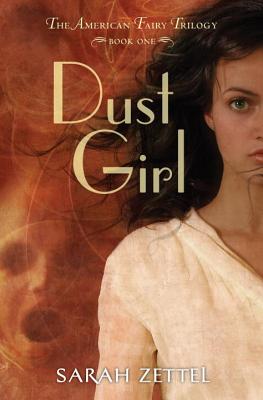
Dust Girl

by Sarah Zettel
ages: 12+
First sentence: “Once upon a time, I was a girl called Callie.”
Support your local independent bookstore: buy it there!
Review copy provided by my place of employment.

It’s the heart of the Great Depression, and in Slow Run, Kansas, Callie LeRoux and her mother are struggling to survive. She’s the daughter of a single mom, living in a run-down hotel, and to make things worse (considering the time period), she’s half African-American. Then, one day (Sunday, April 14, 1935, to be exact), she learns — quite by accident — that she’s not exactly who she thought she was.

She is the daughter of a human mother, yes. But her father is a faerie prince.

This knowledge doesn’t come all at once, and Callie doesn’t readily believe it. The things she does know is that the Seelie have taken her mother, and Callie wants — no, needs — to get her back. She sets off on an adventure with a hobo named Jack, determined to get her mother back.

I’ll say this up front: it’s the first in a series, and it reads like a first in a series. There’s a lot of exposition and getting things going, and the actual plot doesn’t really begin until the book is nearly done. That said, the whole world that Zettel built is excellent. It’s a unique choice to involve race in the whole faerie world: the Unseelie are black; the Seelie… well, not so much. Not only are there human vs. faerie elements, but race also comes into play. And this makes it unusual for a fantasy novel.

Callie and Jack are also, for the most part, interesting characters. I think Callie becomes more interesting as the book progresses, especially when she finally faces her father’s family. Which makes me intrigued with this story, and curious to know where Zettel plans for it to go.

It’s not brilliant, but it’s solid, and it’s definitely worth the time.

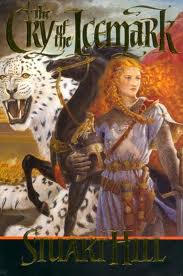
The Cry of the Icemark

by Stuart Hill
ages: 13+
First sentence: “Thirrin Freer Strong-in-the-Arm Lindenshield carried her names with ease.”

Aside from the horrid cover, I really wanted to like this one. I thought it would be like Tamora Pierce’s Lionsong novels: a strong girl, a warrior girl, leading her people in a fight against Incredible Odds.

And maybe it is.

However, I couldn’t read it. I gave it 50 pages to grab me (maybe I should have held in there longer?), but it didn’t. Part of it was that Thirrin was supposed to be 13, and yet she was acting like an 18-year-old. (Which isn’t new; I mean, how often in fantasy novels do 13-year-olds actually act like a 13 year old does?) Part of it was the ridiculous names (Primplepuss????). Part of it was that Thirrin’s father, the king, never spoke, but shouted, guffawed, hollered, and bellowed.

But, mostly, it was because I am tired of authors telling me what is going on. Thirrin thought this. Thirrin did that. Thirrin wants this. Thirrin thinks that.

*sigh*

I just want to read a story where I can interact with the characters, enjoy the plot, and be SHOWN what is going on.

And that is really why I bailed on this one.

Code Name Verity

by Elizabeth Wein
ages: 14+
First sentence: “I am a coward.”
Support your local independent bookstore: buy it there!

Things this book is:
A World War II book.
A book about friendship, between two young women, specficially.  Funny.
A book about torture.
A book about the Resistance.
A book about women pilots.
A book about things a person will do to save their skin.
An amazing example of voice. Seriously, the characters leap off the page.
Unputdownable. (Yeah, I know. Still, it fits.)
Freaking awesome.

Things this book is not:
Trite.
Another Holocaust book.
Boring.

In other words: if you haven’t yet read this story about Maddie and Verity, and been captivated by their story, you are missing out.

And yes, it really is just as good as “they” all say.