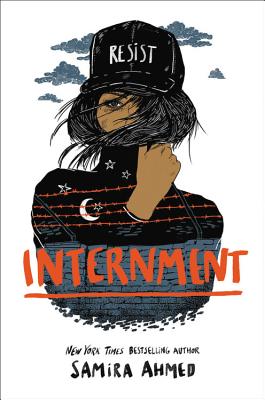
Internment

by Samira Ahmed
First sentence: “I strain to listen for boots on the pavement.”
Support your local independent bookstore: buy it there!
Review copy provided by the publisher.
Content: There are instances of mild swearing, plus a handful of f-bombs. It’s in the Teen section (grades 9+) of the bookstore, but just because of language. The themes are good for anyone, really.

It’s in the near future, and the U. S. government has decided that Muslims are a threat to the country. It started with a registry, with everyone declaring their religion. And then Muslims began to be discriminated against (well, they probably were already), and now they’re being rounded up and taken to internment camps. To keep the rest of America safe from them.

Layla and her parents are among those rounded up and sent to camp Mobius in the California desert. It’s a harrowing experience: being arrested at home and then shipped on a train to an isolated “camp” (read: prison; there aren’t cells, but they’re kept in with an electric fence) where they were expected to comply to rules and are constantly watched over by drones and guards.

Layla, however, is not okay with all this. (Fair.) In spite of her parents’ pleas to just get along, Layla decides that she needs to Do Something. So, she smuggles out articles she’s written about conditions in the camp — the Director using intimidation and force and the disappearances of other internees — to be put on blogs. She organizes protests. She makes friends with sympathetic guards on the inside who help her along with her boyfriend on the outside. They stand up for what they believe in, and resist.

I think that was the thing that was most striking to me: that resistance to authority comes from the teenagers. It probably always has. Adults get complacent, and are conditioned to not make waves. But teenagers? They’re often idealistic and want a better world. And have the courage to make it happen. And Ahmed captured that perfectly.

Yes, this book is heavy-handed: Ahmed hammers the idea that This. Is. Wrong. home in so many ways, but I think this book is meant for White People. Seriously. I am sure that so many of the themes of racism and exclusion and mistrust of the Other are already known to Muslim (and Black and Asian and Native) people. The people who need to see this are White. And probably middle class. And comfortable in their lives. (Like me.) We need to remember that inaction is the same as action. And that just because we don’t see or experience the problems doesn’t mean they’re not there.

In the end, the question I thought this book was asking was: What kind of White Person will you be? (Granted, I’m coming at it with this perspective. I’m sure others will get something different out of it.) And that’s a good question to be asking right now.

Love, Hate, & Other Filters

by Samira Ahmed
First sentence: “Destiny sucks.”
Support your local independent bookstore: buy it there!
Content: There’s some talk of sex, but none actual. There is also swearing, including some f-bombs. It’s in the Teen section (grades 9+) of the bookstore.

Senior Maya Aziz has one goal in life: to go to NYU (she’s been accepted!) and get a degree in filmmaking. However, her parents — even though they’re on the liberal end of the Indian Muslim scale — would rather she go close to home — University of Chicago or Northwestern — and get a degree in something practical. It also doesn’t help that they’re trying to set her up with a nice Indian Muslim boy… even if they don’t want her to get married just yet.

Maya just wants to live her life the way she wants to, and she was starting to make headway (even with the super popular white football player who’s interested in her!) when there’s a hate crime in a nearby city, and suddenly her small town isn’t safe — for her — anymore. And things just escalate when her parents’ dental practice building is vandalized Now her parents are refusing to let her go anywhere, let alone to New York to go to school.

Oh this was SUCH a good debut! Ahmed tackles conflict in a religious family, not with just culture but with belief, and she tackles the differences between parents and children — Maya’s parents aren’t bad or controlling; they just feel they know what’s best — and tackles the differences between immigrants and their first-generation American children. But she also addresses racism and prejudice all while wrapped up in a very sweet love story.

She’s definitely a writer to watch.

The Last Voyage of Poe Blythe

by Ally Condie
First sentence: “Call tells me he sees a star and that makes me laugh.”
Support your local independent bookstore: buy it there!
Release date: March 26, 2019
Review copy provided by the publisher.
Content: There is some violence. It’s in the YA section (grades 6-8) of the bookstore.

In this near-future, dystopian world, Poe is a member of the Outpost, a group of people who mine the river for gold and basically try to survive. (From what, we don’t know). They are up against the raiders, every time they take to the rivers, and when Poe is on her first voyage, the raiders kill her love, Call. So, she vows revenge. She creates an impenetrable armor for the ships as they dredge the rivers, collecting gold. And now, it’s her last voyage, the one on the biggest river, the one where she’s captain. The one where she will get revenge for Call’s death.

And then everything goes. wrong.

I wanted to love this one. I wanted it to be fierce girls taking on the patriarchy, overturning everything, breaking free from the bondage of male rule. But, what I got was one girl, grieving for a lost love, building a weapon out of revenge, and her personal journey to enlightenment. Not that it was a bad journey: I liked Poe, and I thought that (for the most part) her journey from one side of the conflict to the other was believable. Maybe a bit rushed, but understandable. Mostly I felt this book was an exploration of the anger stage of grief, and how a person gets through to acceptance and moving on. Which is fine and all, but not what I wanted out of the story. (For a much better girls taking on the patriarchy book, check out Anne Ursu’s The Lost Girl)

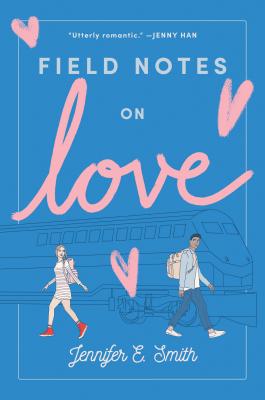
Field Notes on Love

by Jennifer E. Smith
First sentence: “Mae wakes, as she does each morning, to the sound of a train.”
Support your local independent bookstore: buy it there!
Content: It’s a romance, but there’s really nothing objectionable. Some mild swearing and a lot of kissing. It’s in the YA section (grades 6-8) of the bookstore.

Hugo is one of a sextuplet, and so he’e never really been alone. He’s never done anything extraordinary (unless you count being born) and he’s never really had an adventure. So, when his girlfriend Margaret breaks up with him, and begs off of their planned American cross-country train trip, Hugo is left aimless. That is, until he hatches a plan: find another Margaret Campbell and still make the trip.

Mae (aka Margaret Campbell) has applied to the USC film school, but when they reject her, she’s left aimless. That is, until she sees Hugo’s advertisement for someone named Margaret Campbell to go on this train trip with him. She jumps at the chance: why not go on a bit of an adventure before school starts? Maybe, then, she can find her direction again.

Since this is a romance, of course Hugo and Mae fall in love. Of course there is a falling out moment. Of course they (kind of) (mostly) end up together in the end. Of course it’s sweet and wonderful and all that.

Smith is excellent at writing charming, sweet, lovely romances, though. And this hit all the notes. Hugo and Mae were endearing and sweet, and I loved the cross-country train trip, which was something a little different. It’s completely unobtrusive and utterly delightful.

Words on Bathroom Walls

by Julia Walton
First sentence: “My first doctor said it was unusual for the symptoms to manifest in someone so young.”
Support your local independent bookstore: buy it there!
Content: There’s swearing, including multiple f-bombs, and some tasteful on-screen sex. It’s in the Teen section (grades 9+) of the bookstore.

Adam is a regular teen. Mostly. He has regular teen boy desires, interests… the only difference is that he’s been diagnosed with paranoid schizophrenia. The kind that make you see things — in Adam’s case, he sees people and hears voices. He’s on a new trial drug, though, and as part of it, he’s required to go to therapy. He doesn’t want to, and he doesn’t want to talk to the therapist, so the book is a series of diary entries where Adam describes what’s going on in his life, how he’s reacting to the drug, and answering the therapist’s questions, such as they are.

I found the format of the book to be super fascinating: it got us in Adam’s head, while not being mundane or super weird; the entries were made weekly, so Adam was able to reflect on the week. So, while he may have had episodes, the book never took the reader through the middle of them, since the entries were always written afterward. I thoroughly enjoyed being in Adam’s head; he had a super strong voice that came through, and I enjoyed his sense of humor around his mental health. It was also a case in which the parents (hooray!) were absolutely fantastic. They fought for Adam and his rights and wanted nothing but the best for him. The conflict was partially internal — Adam against his mental health — and from his peers, who just don’t understand what’s going on.

It’s a really excellent book; definitely a good look at a mental health issue that not many people know much about.

The Poet X

by Elizabeth Acevedo
First sentence: “The summer is made for stoop-sitting and since it’s the last week before school starts, Harlem is opening its eyes to September.”
Support your local independent bookstore: buy it there!
Content: There’s some mild swearing, a tasteful almost-sex scene, and some talk of smoking weed. It’s in the Teen section (grades 9+) of the bookstore.

Xiomara is many things: a daughter, a poet, a twin. But she feels like she doesn’t quite fit. It doesn’t help that her parents — both from the Dominican Republic — don’t really get along, or that her mother is super religious. Or that her twin, Xavier, is super smart, and goes to a magnet school, while Xiomara is stuck going to the not-really-great neighborhood one. And on top of everything, as she starts her sophomore year, her mother is insisting that she go to classes so that she can be confirmed (I think that’s how it is in Catholic churches?). But Xiomara has questions about God, and religion, and the way her parents treat her.

On the one hand, I can see where Xiomara’s mother is coming from. She wants her daughter to have all the things she didn’t have. She wants her daughter to follow in her footsteps, and to have the faith she did. What she doesn’t take into consideration — and this is the conflict at the heart of this elegant novel in verse — is that Xiomara’s feelings and desires might be different than her own. It’s often the conflict at the heart of young adult books: parents who believe they know better and don’t stop to listen to the desires of their kids. I loved getting to know Xiomara through her poetry, to understand her feelings and the tensions she perceived in her family. And I’m glad that, in the end, there was a resolution that didn’t involve someone dying. That Xiomara realized her parents loved her, even if they didn’t always show it in a way she could understand it.

Acevedo’s writing is gorgeous and her storytelling exquisite. This is definitely worth the hype.

Courting Darkness

by Robin LaFevers
First sentence: “I was born in the upstairs room of an ancient roadside tavern, a group of common whores acting as midwives.”
Support your local independent bookstore: buy it there!
Review copy provided by the publisher.
Others in the series: Grave Mercy, Dark Triumph, Mortal Heart
Content: There is violence (of course) and frank talk about sex, and some tasteful on-screen sex. It’s in the Teen Section (grades 9+) of the bookstore.

  1. My kick-ass nuns of death are back! Can I tell you how happy this makes me?
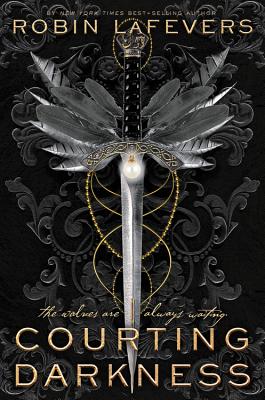
  2. Don’t you LOVE the cover re-do? SO much better than the original ones (check them out for the original trilogy, too.)
  3. You don’t have to read the original trilogy (or at least that’s what LaFevers said in some material that came with the ARC), but I think it would have been helpful if I had gone back and refreshed my memory about, at the very least, Sybella and her story (that’s Dark Triumph). I missed a bit because of it.
  4. This one is mostly Sybella’s story, as she follows Britanny’s duchess to France as she marries the king. But it’s also Genevieve’s story, a girl who was sent to the convent of Saint Mortain as a child, and then sent to France to be an undercover spy. She was forgotten, however, and sent to an outlying area by the French regent. (Who is, by all accounts, an awful, manipulative person.)
  5. It took me a while to get into this one (it would have been better had I refreshed my memory by reading the others first), but once I did, I fell into the court intrigue, the sheer awesomeness of the women in the convent, and just the way LaFevers tells a story.

And now, to wait for the second in this duology.

Audiobook: Finding Yvonne

by Brandy Colbert
Read by Maya Barton
Support your local independent bookstore: buy it there!
Listen at Libro.fm
Content: There is swearing, including multiple f-bombs, pot smoking by an adult, some teenage drinking and off-screen sex. It’s in the Teen section (grades 9+) of the bookstore.

Yvonne is a senior at an LA prep school, and has been putting her heart and soul into her violin playing ever since her mother left when Yvonne was seven. Now, though, she’s at loose ends: her violin teacher dropped her because she wasn’t “good” enough, and she feels like she has lost her passion for playing. But, without playing, who is she?

On top of that, Yvonne hardly sees her father, a successful chef. And she’s wanting to take the next step with Warren, who’s hesitant because of their age difference and because he works for her father. And so, when Yvonne meets a street musician, she explores a relationship there, mostly to see if it can help her figure things out.

I liked this one, but mostly because I think the narrator was really good. She kept me engaged in the story, and helped propel the narrative — which is super complicated, but then again, so are many senior kids’ lives — forward. I liked that Yvonne was a musician and a cook, and that she was looking for connection anywhere. It’s not the best book I’ve read, but it wasn’t terrible either.

The Lady’s Guide to Petticoats and Piracy

by Mackenzi Lee
First sentence: “I have just taken an overly large bite of iced bun when Callum slices his finger off.”
Support your local independent bookstore: buy it there!
Others in the series: The Gentleman’s Guide to Vice and Virtue
Content: There was some mild swearing and some frank depictions of 18th century medicine. It’s in the Teen section (grades 9+) of the bookstore, because that’s where Gentleman’s Guide is.

First off: you don’t have to read Gentleman’s Guide before reading this one, though it will probably help with some small references, and with knowing who the characters are.

It’s been a while since Felicity has come back from her “tour” with her brother and his now-boyfriend, Percy. She decided that instead of going back to her parents, she would rather try her hand at getting into a medical school in Edinburgh. However, that didn’t go well. At all. For all the reasons you can guess: she’s a woman, women are inferior, why don’t you go play with the midwives, honey? So when this man she has befriended, the Callum of the opening sentence, proposes, Felicity panics and heads back to London. Where, through a series of chance encounters (and some standing up for herself), she ends up on a trip to Stuttgart in the company of a less-than-trustworthy woman, to attend the wedding of her former best friend.

Of course, adventures ensue. Felicity and the other women — Sim, who turns out to be a pirate princess, and Johanna, the daughter of a naturalist — have to fight (both literally and figuratively) for their right to be heard, to be understood, to be listened to. And, along they way they learn a bit about themselves.

I adored this one (as much as Gentleman’s Guide, which means it wasn’t all the narrator with that one). I loved that Lee got in many different kinds of women, and several different feminist points (you can, in fact, loves clothes AND science!). I loved that Felicity was asexual, and was okay with that. She thought maybe she worked differently from other people, but that was okay with her. I loved that the girls all ended up as friends (even though Sim has a bit of a crush on Felicity), and that there wasn’t a romance in the plot. I loved that Lee gave us some feisty and fierce historical girls, who were willing to blaze paths and be unapologetic about making the world a better place.

A very excellent read.

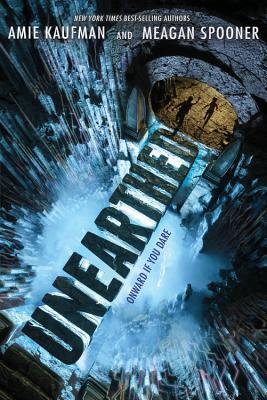
Unearthed

by Amie Kaufman and Megan Spooner
First sentence: “This is really, really not going the way I’d planned.”
Support your local independent bookstore: buy it there!
Review copy provided by the publisher for the Cybils.
Content: There’s some intense action, and some mild swearing. It’s in the YA section (grades 6-8) of the bookstore, but I’d give it to either older or younger readers depending on interest.

My 30-second handsell: It’s Indiana Jones in Space! I mean, kind of. It’s set in the future, after Earth — especially America — has ignored climate change and basically driven itself into ruin. Then, we get a message from aliens — the Undying — that went extinct 50,000 years ago, welcoming us to their planet, if we “dare”, It’s got a pair of teenagers working together — a girl who’s a scavanger (read: thief) and a boy who’s an archeologist who has spent his entire life studying the Undying. Put the two of them on this planet, and they have to figure out how to make it through a temple and read messages to figure out what the Undying was trying to say. Oh, and the government is trying to stop them.

Full of action, suspense, death-defying stunts, and just a whole lot of fun.

Okay, maybe that was longer than 30 seconds. But seriously: this was a ton of fun. I liked Kaufman and Spooner’s vision of the future; it was bleak but not overly so, and the idea of mixing post-apocalyptic with aliens is an interesting one. I liked that they kept the action moving, and that it was (mostly) plausible. It really did feel like a fun action movie; nothing deep (there’s a wee bit of romance, which I suppose was to be expected), but it did keep me turning pages.

And yes, I am going to read the sequel.