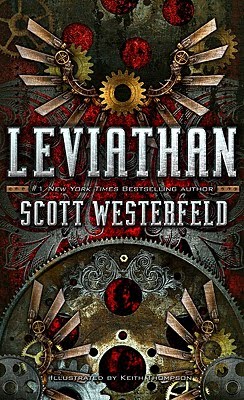
Leviathan

by Scott Westerfield
ages: 12+
First sentence: “The Austrian horses glinted in the moonlight, their riders standing tall in the saddle, swords raised.”
Support your local independent bookstore, buy it there!

First, a disclaimer: I have never, ever heard of steam punk before this book, let alone read it. I had no idea what it entails, what makes a good steam punk book, or what even to expect.

But if this is even remotely typical of the genre, I’m hooked. It was an awesome, wild and weird ride, a fabulous adventure — no one writes nail-biting action like Westerfield — and a grand beginning to a story that has the potential to be absolutely amazing.

It’s 1914, on the eve of the Great War. Alek is a prince of the Austro-Hungarian empire and it’s the murder of his parents that sets off the war, as well as sends Alek on the run for his life. All he has with him is a few loyal men, and a Stormwalker in order to fend off the Germans. Deryn is a commoner, a girl, who desperately wants to fly in the British Air Service. Mind you, they’re not flying planes, but rather Darwinist living creatures — huge ecosystems of creatures that work together to get off the ground. Deryn disguises herself as a boy, and by a fluke or two of nature (ha!), ends up as part of the crew of Britain’s newest airship, the Leviathan.

Told in alternating chapters, the book details not Alek’s escape from his palace and Deryn’s entry into the air service, but their eventual meeting and the results of that meeting. As I mentioned before, there’s tons of nail-biting action from Alek’s initial escape to a couple of attacks by the Germans. But what I found most fascinating (and wild and weird) was the combination of historical fiction and futuristic elements, as well as a re-imagining of science. I loved the Clankers versus Darwinist feud, as well as each individual science. The clanker machines were awesome, powerful, and captivating to read about. But the Darwinist inventions — the wild cross-breeds, the machinations to keep them up in the air, the things (like flechette bats, for instance) that Westerfield created — were the things that kept me turning pages and shaking my head in amazement. What kind of imagination dreams this stuff up? (Well, Westerfield’s, of course.)

The book ends somewhat abruptly, but I’m totally sold: I want to know what happens next. I want to know what adventure Deryn and Alek are going to go on, and I want to know about the small mystery that’s part of the larger story.

The problem — like all books with sequels — is being patient until the next one comes out.

Wintersmith

by Terry Pratchett
ages: 12+
First sentence (not including the Nac Mac Feegle glossary): “When the storm came, it hit the hills like a hammer.”

I got this email from Laura from Life after Jane yesterday that I haven’t been able to stop thinking about. She says,

You never get just a story with Pratchett. You get life lessons and a unique way of looking at things. I’ve heard him called the Douglas Adams of fantasy fiction but I have to disagree. If you ever read any of the Hitchhiker’s Guide series you’ll notice that fabulous and witty as it is, Adams clearly didn’t like people. With Pratchett I’m always amazed how he can poke fun at the silly, pettiness of people while at the same time expressing a very real and warm love of them. I always finish his books feeling that he has a very profound point and that he really just adores everything and everyone.

I haven’t been able to stop thinking about it because she’s absolutely right. It’s the reason why his books are so delightful — even if they’re not quite as soaring as the other books in the series — why you find yourself laughing out loud or nodding in agreement: because Pratchett cares, and it comes across in the writing.

Like the other two books in the Tiffany Aching adventures, the plot really isn’t what matters. It’s the characters — in this one we have the Wintersmith and Roland, who are both infatuated with Tiffany, even if she’s not really that interested, and Nanny Ogg whom you just want to hug, as well as ones from the other books — and the little nuggets of wisdom or humor that are littered throughout. My mom said that she thought these were good “girl” books, but I’ll take it a step further: these are just good books.

And Pratchett is definitely a good writer.

Buy it at: Amazon, Powell’s or your local independent bookstore.

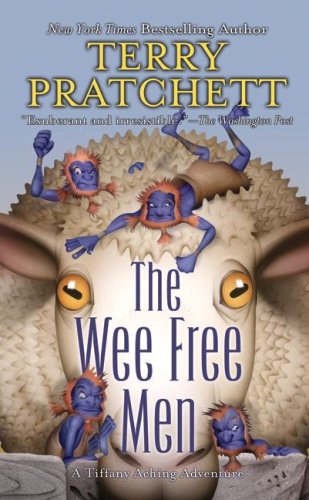
The Wee Free Men

by Terry Pratchett
ages: 12+
First sentence: “Some things start before other things.”

 Yes, I’m here in Cincinnati, enjoying the lull in the reunion (there’s an awesome uncle who make a great playmate, and the rest of us thoroughly enjoy the downtime… though they do come away really wound up)… it’s been fun being with family.
And I managed to get a bit of reading done in the cracks. In fact, it was kind of hard to get it read because I’d leave it lying around, and I’d come back and find it had been snatched up by one family member or another. Which is a testament to how fun this little novel is.
Tiffany is a nine year old girl, the daughter of sheepherder, who isn’t really noticed by much of anything, especially now that Granny Aching has died. That is, until the day when she saw a monster come out of the river. She hit the monster with a frying pan, and the path of her life was changed: she was a witch. That, and her younger brother was stolen by the Queen of Faeries. Tiffany, being the sort of girl she is, decides not to wait for help, and tackles the problem head-on… with the help of the Nac Mac Feegle, the Wee Free men.
But this book isn’t about plot, really. It’s a wonderful example of character- and world-building. The characters — from Tiffany down to the Nac Mac Feegle — are fully drawn and exciting and interesting and engaging. Which makes the book thoroughly entertaining.
I’m going to have to leave it at that… this has taken me a lot longer than I thought it would, mostly because conversation around me is more interesting than the review I’m writing. Needless to say, I’m going to read the next two in the Tiffany Aching series. Terry Pratchett is definately an author — and Discworld a world — worth checking out.

The Declaration

I found the premise of this book, by Gemma Malley, fascinating. It’s the not-too-distant future, 2140, and a drug — Longevity — has been developed that will extend life forever. It started out innocently enough; curing cancer, AIDS, other diseases… but eventually, someone discovered that cells could be regenerated, sickness cured, and no one would ever die.

The implications of that discovery, though, were profound. If no one ever died, and yet people kept having children, then… well, the Earth’s resources would be overwhelmed. Hence the Declaration. By taking Longevity, you forfeit the opportunity to have kids. Period. No discussions. Yet, some people still end up having kids, for one reason or another, and those children are called Surpluses. They’re illegal, they’re a burden on society. So, when they’re caught, they are stashed away in Surplus Halls, where they’re taught to become “Valuable Assets” to the rest of the Legal society.

That brings us to our main character, Anna. She’s a Surplus, living in Grange Hall since she was 3. She “enjoys” it; as much as she can “enjoy” anything. She’s a Prefect, in charge of a group of other Surpluses, she’s nearly 16, and working toward being a Valuable Asset. She’s determined to pay for her parents’ Sin of having her. That is, until Peter comes into her life.

Peter isn’t like the other Surpluses; for one, he’s lived on the Outside for 15 years, having only recently been caught. He doesn’t fit in. He doesn’t want to. He really only has one purpose: to rescue Anna from a life of being a Surplus.

Initially, I liked the set up — Surpluses as slaves, brainwashed into believing the things that the Head Mistress beats into them. The book is full of the ethical questions and the interesting implications of the choice for Humanity to live forever.

She remembered a time, when she was young, when energy was still plentiful and people thought that recycling was enough. Before islands started to be submerged by the sea, before the Gulf Stream changed Europe into the cold, grey place it was now, with short summers and long, freezing winters. Before politicians were driven to action because infinite life meant that they, not some future generation, would suffer if the world’s climate wasn’t protected.

Peter’s efforts to convince Anna to escape were interesting, too. How do you convince someone who had been so indoctrinated in something that the thing was wrong? How do you get someone like that to risk everything to escape into the Unknown? For three-fourths of the book, I enjoyed it, relished the ride. It was haunting, so close to what could be in real life. The Head Mistress, Mrs. Pincent, was brilliantly and chillingly cruel, at the beginning:

“Hit her,” ordered Mrs. Pincent, who was now walking towards her. “Make her know her Sins. Help her to learn from her mistakes and to understand what being a Surplus means. Make her see that she is unwanted, a burden; that every step she takes along these corridors are steps that she has stolen. Make her see that she is worthless, that if she dies no one will care, that in fact the world will be better off with her not trespassing on it. Make her understand all that, Anna.”

But on page 274, the book made, for me, a serious mistake: Mrs. Pincent got a backstory. One that was possibly supposed to make me feel for her, make me understand the gravitas of the decisions that needed to be made. Unfortunately, it just made me annoyed. It was so predictable. I thought the book saved itself a couple of pages later, but by the end, I was rolling my eyes. All the tension, all the chilliness, all the ethical implications were gone. Kaput. In short: the ending just didn’t live up to my expectations. It could have been so much better.

Which is too bad, since the rest of the book was quite good.

Specials

I finally got around to reading the third in the Uglies Trilogy by Scott Westerfield. And, like Pretties, I didn’t enjoy it nearly as much as I did Uglies, though I thought Westerfield did a good job tying up all loose ends and giving the story a decent punch at the end. (At least there’s no cliffhanger at the end of this one.) I’m not even going to try and review this book without spoilers. So if you are even remotely interested in reading this one, and you have a problem with spoilers… stop now.

I really disliked Tally for a great deal of the book. Like at the beginning of Pretties, she was completely controlled by what she had become, in this case, one of the Special Circumstances. At one point, though, I realized that I was supposed to dislike Tally. Or rather, I was supposed to dislike what Tally had become, what Dr. Cable had made her in to. Once I made this realization, I could deal with Tally: her snobbery, her insecurity, her need to be “icy”. (Though she did get better as the book went on.) But, I also disliked Shay. Was it just me, or did anyone else see parallels to drug use in this book? Shay was addicted (like a drug user) to cutting herself and very controlling of the people and situations around her. (She’d get really mean if things didn’t go her way.) Her friendship with Tally was superficial and controlling as well. The problem was that I disliked her so much that I wasn’t entirely convinced by her change and remorse in the end. Why would Tally even consider giving Shay yet another chance? How do we know that Shay’s change is real, complete? We don’t; and because of that, I distrusted it.

Speaking of change and remorse, Dr. Cable completely threw me for a loop. I’d been expecting some of it; she’s been the “bad guy” all along — controlling the town to extreme ends. I didn’t expect her to attack another city, though I suppose it wasn’t completely far-fetched. (I did like the line which went something like — I couldn’t find it to get it exactly — “All cities had given up war; it’s just that some cities had given it up more than others). But, I found it really hard to hate her because she had been lurking in the background for most of the books. As a result, the final confrontation between Tally and Dr. Cable at the end just completely fell flat. And after that… well, I understand it, but just because I understand it doesn’t mean I thought it made sense.

Which brings me to the ending. It was… okay. I guess I couldn’t have expected much better; how do you fully resolve a story like the one Westerfield created here? But, it kind of fell flat. After all the struggling Tally did in all three books — against the way she was brought up and against the subsequent operations — what more did I want from her? I don’t know. So, to quietly slink off into the wild with her first love is probably the best ending anyway. I just wasn’t fully satisfied by it.

All that said, though, Westerfield has created a very interesting and very compelling world. Uglies is a brilliant book, and the other two are still good, if flawed, reads. And since I did enjoy myself with these three, I’ll be picking up Extras as soon as the library gets a copy.

Uglies

Typically, I shy away from books with pictures of girls on the front that have tag lines, especially if those tag lines read: “In a world of extreme beauty, anyone normal is ugly.” I’d seen this book around, but every time, I looked at it and thought “Ugh. Chick book. Not my thing.” And walked on.

And then Inkling read the trilogy and was fascinated by it. And usually, when Inkling takes something seriously, it has to be good. (Since, as I’ve discovered over the years, she and I have similar tastes in books.) Still, it took me a while to get around to it, because every time I looked at it, I couldn’t get past the cover and the tag line.

Well, I’m glad it did, finally. Scott Westerfeld has written not only a good sci-fi/dystopian story, but a smart and thought-provoking one as well. The basic plot (the back cover blurb makes it sound like some dumb chick book): in the future, there are three types of people: littlies (those under 12), uglies (12-16), and pretties. When a person turns 16, it’s assumed that you’ll leave Uglyville (both literally and figuratively), and get the surgery that will turn you into a fun-loving, free-wheeling, extremely beautiful Pretty. Tally, with all her heart, want that. Until she meets Shay. Who doesn’t want to be pretty. She knows of a place — the Smoke — where you don’t have to become pretty, where you can stay ugly. Tally doesn’t understand this: who doesn’t want to be pretty?! But, Shay runs away, and then Tally is forced to make decisions that will change her life.

Really, it sounds silly, typed out like that, but if you knew the whole plot, it would ruin the point of the book.

Still, in addition to romance and adventure and typical end-of-the-world stuff (I loved all the descriptions of the Rusties), Westerfeld has some interesting observations about beauty and society. In fact, the whole book plays with our notions of what is and is not beautiful.

There was a certain kind of beauty, a prettiness that everyone could see. Big eyes and full lips like a kid’s; smooth, clear skin; symmetrical features; and a thousand other little clues. Somewhere in the backs of their minds, people were always looking for these markers. No one could help seeing them, no matter how they were brought up. A million years of evolution had made it part of the human brain.

Or this:

Back in the days before the operation, Tally remembered, a lot of people, especially young girls, became so ashamed at being fat that they stopped eating. They’d lose weight too quickly, adn some would get stuck and would keep losing weight… Some even died, they said at school. That was one of the reasons they’d come up with the operation. No one got the disease anymore, since everyone knew at sixteen they’d turn beautiful. In fact, most people pigged out just before they turned, knowing it would all be sucked away.

Fascinating stuff.

Still, it’s probably a bit predictable, and maybe even a bit done-before (when I was telling Hubby about it, he said it reminded him of Lois Lowry’s Gathering Blue). But for all that, it really was an excellent book.

Now I’m off to read Harry Potter. One week left…

Wildwood Dancing

I was supposed to get this one done before June 21st, for the Once Upon a Time challenge, but I didn’t, thanks to the library. But, better late than never, right?

This book, by Juliet Marillier, has gotten mixed reviews across the blogosphere. Some people love it. Some people not so much. I think I fall in the not-so-much category.

It’s not that the book was bad. In fact, it was a quick read. (For plot summaries, you can check out Becky’s and/or Erin’s reviews.) But, for me, it just didn’t sit well. For one, it just seemed too long. Even though it went quickly, I kept checking to see how much more left to go. Usually not a good sign. For two, I have little patience for “true love”. Especially when characters waste away because of it. I’m not terribly romantic (as my hubby often remarks), and I don’t have much tolerance for the heartbreak and heartsickness of true love. So when Tati, the oldest sister, lay dying because she couldn’t see her true love — an almost-Night Person (I totally missed that there were vampires in this book. Vampires are the in thing, aren’t they?) — I just gritted my teeth and plowed through. Please. Girls wasting away because they can’t be with someone they love? Not my idea of a good time. (Maybe having four girls has warped my sense of romance. I wouldn’t want them to think this was an acceptable way of handling disappointment or longing. Eating cake, however….)

And, I have to admit, I didn’t really care for the main character, Jena. I liked her a bit — she was feisty and quite capable, but she was just so practical. So sensible. The opposite of Tati. Which isn’t bad. (Ah! I’ve hit upon it here: Tati and Jena were opposites, both with their loves but not knowing how best to obtain that.) But she had to have EVERYTHING spelled out to her before she was able to act. It seemed for someone as capable as Jena, she ought to be able to do something without waffling about everything. Especially the important things.

The only thing I really enjoyed was loathing Cezar. He was a good villain — one of those that just give you the creeps. Not evil because he’s a monster, but because he’s a man who went wrong. (He didn’t get a good end, though; he just kind of petered out.)

The one redeeming factor is the absolutely beautiful cover. But then, we’re not supposed to judge a book by it’s cover, are we?

Sunshine

Ah, Robin McKinley. I love her writing. And I was reminded during my Twilight/New Moon phase that she had written a vampire novel. So, during the first lull I had (between challenges and Estella books), I popped over to the library and picked it up.

It’s an interesting story, set in an interesting world. Sunshine — Rae — is a baker in a coffee house, specifically the Cinnamon Roll Queen. She has a nice little life, a boyfriend, a time-consuming job, friends, but one night she feels restless. She drives out to the lake, to her father’s cabin (divorced parents, father’s whereabouts is unknown), and proceeds to get kidnapped by vampires. She is taken to be a sacrifice for Constantine, whom a master vampire (Bo), has captured and is keeping prisoner. But, Sunshine manages to escape (by changing a pocket knife into a key; she’s got magic powers, but hasn’t used them) and takes Constantine with her. And their lives will never be the same (ominous music here).

I liked the ethical dilemmas posed by this: if a human is supposed to, by default, have an animosity with vampires then how does one deal with the fact that you let one live? For Sunshine could have just let Constantine die in the beginning and never thought about it again. It was something the character struggled with throughout the book, and one I thought McKinley manages better than Stephenie Meyer does in Twilight (since that same ethical dilemma is present there, too, on some level). There’s a lot of musing and soul-searching in Sunshine, though, and while a lot of it works, sometimes it gets heavy-handed. And it definitely asks more questions than it answers.

I enjoyed the book, though the ending leaves things hanging. And, on one level, it’s okay. Sunshine comes to accept and deal with who she is (and it’s not just the Cinnamon Roll Queen). The big bad guy gets his comeuppance. She has a relationship with Constantine, but it isn’t as unhealthy and obsessive as Bella and Edward’s is. You can’t call it a romance, though it’s something more than a casual alliance or even friendship. It all ends happily, for what it’s worth.

But I really wanted to know what happens next. There were too many questions left unanswered, too many ends left loose. And sometimes that’s just unsatisfying.

Riddle-Master

Wow. I don’t know where to start with this trilogy — The Riddle-Master of Hed, Heir of Sea and Fire, and Harpist in the Wind — by Patricia McKillip. I’m at a loss for words.

It’s a huge, dense book, a homage to Lord of the Rings. And as a homage, it’s brilliant. Instead of copying the world, or the ideas from Tolkien, she used the themes — of redemption, of the passing of an age, of harnessing and the temptation of power — to craft a masterful work. I was caught up in the story, in the world, wanting to know the answers.

But… it was almost too dense. I would read passages and think “What the heck just happened?”, and re-read them. And they wouldn’t be any clearer. I’d go on with the hope that everything would make itself known in the end. I suppose if you read a book entitled Riddle-Master things are probably going to be confusing for a while. But, when the end finally came, and the resolution, I was oddly disappointed. Perhaps it was that I saw it coming pages before, but just didn’t quite figure it out. Or perhaps it was too pat and I wanted more. But I don’t know what that would entail.

I really enjoyed the first and second books. The first is Morgan (the Riddler of the title, the Prince of Hed, the Star-Bearer) figuring out his destiny, and traveling the realm looking for the High One (think High King) to get some answers. It ends with a spectacular cliff-hanger, which isn’t fully resolved until the end of the third book. The second is all about Raederle, who is Morgan’s love, companion, friend. Morgan disappeared for over a year after the end of the first book. She got worried. And, despite the objections of her father and all the other land-rulers (think oh, the lesser kings in LOTR), she and Morgan’s sister Tristan, and Lyra (a kick-butt guard; think Eowyn) they go looking for him. Raederle figures things out about herself, for herself, and becomes, gradually, Morgan’s equal (or at least comes close) in power. It’s quite the book.

The third, however, doesn’t work as well. It builds up, and builds up, but is way too dense to have made much sense to me. I tried to get it, but it all came crashing down in the end, a huge battle, thousands of lives lost, power thrown and hurled everywhere, and I couldn’t visualize it. I didn’t get it. I don’t get it. Someone will have to explain it all to me.

Still. I’m not sorry I read it. Thanks again, Corrine, for sending the book. I’ll get it back to you soon.

East

I had a hard time finishing this book by Edith Pattou. Not because of the book, though. Because my life wouldn’t let me sit down and just savor this book like a wanted to. I finally did, about 3/4 of the way through, because it was just too compelling. So, I let the home and Christmas stuff wait for a night. 🙂

The story is a retelling of the old fairy tale East of the Sun and West of the Moon. When I first read about this book in Chinaberry, I had no idea about the fairy tale, so we checked it out from the libarary as well. It’s a simple Norweigan fairy tale, one I think I’ve heard before. A white bear takes a girl from a poor family in exchange for wealth. He then takes her to live with him in his enchanted castle. It’s a fairly uneventful time, except that every night, someone comes to sleep with her in the bed. After a while, she aches to go home, and the white bear relents, with one condition: she must not be alone with her mother. She breaks this condition, tells her mother about the stranger in the bed, and her mother gives her a candle. Back at the castle she lights the candle and sees that it’s a man in the bed with her. Unfortunatly, though, with this act, she seals his fate: he’s taken away to marry the troll queen in the castle east of the sun and west of the moon. The girl then sets out to search for the man (whom she realized, too late, was the white bear). She walks for ages, picks up a golden spinning wheel, loom and harp, until the north wind takes her to the castle. There she trades the wheel, loom and harp for visits to the prince, finally succeeding in waking him up and breaking the troll queen’s curse.

East follows the basic fairy tale fairly well, but since I wasn’t attached to the original tale, I had no problems with Pattou’s changes to the story. She fleshes out the family, giving them reasons and motivations behind the departure of the girl (Rose, in the book). The relationship between Rose and the white bear is fleshed out. And the whole journey to find the bear is completely different. Rather than relying on magic, Rose relys on friends, common sense, and plain old inginuity. And, yes, she finally succeeds in the end, and it’s a completely satsifying success. Even the little (mostly unecessary) epilogue in the end doesn’t detract from the great ending to the story.

It was a wonderful book. Perhaps it was good that it took me so long to read. Maybe I enjoyed it more that way.