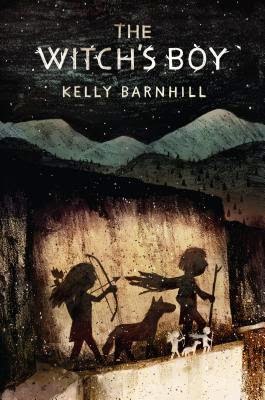
The Witch’s Boy

by Kelly Barnhill
First sentence: “Once upon a time there were two brothers, as alike to one another as you are to your own reflection.”
Support your local independent bookstore: buy it there!
Review copy snagged from the ARC shelves at my place of employment.
Content: There really isn’t anything objectionable. The pacing is slow, however, which is something that might turn more reluctant readers off. It’s in the middle grade (grades 3-5) section of the bookstore.

Ned has been “the wrong boy” since the fateful day when he and his twin brother, Tam, tried to sail to the sea and ended up drowning in the river. Or nearly drowning, in Ned’s case. See: his mother is the witch of the village, and she has been the keeper of the magic — dangerous, unruly magic which Ned is never to touch — for most of Ned’s life. And although she couldn’t save Tam, she saved Ned… by sewing Tam’s soul inside of Ned.

Fast forward a few years — ones in which Ned doesn’t have much strength, where he has a stutter, and where he can’t read — to when the Bandit King comes into their lives with the intention to steal the magic for his own. This is where Ned does something remarkable: he takes the magic into himself, and sets off on an adventure. One in which he’ll meet a friend — his first since his brother died — and change the course of the world.

It’s a slow, quiet book; one that reminded me strongly of Anne Ursu’s books. That’s a good thing, except it’s not one for people who are expecting Grand Action and Adventure. Much of the book is spent inside Ned’s head (mostly because he can’t talk, though I did like Barnhill’s methods for portraying Ned’s stutter), which doesn’t lend itself to fast reading. That said, given time, this book is really a fantastic read. I loved how Barnhill portrayed the magic; it had its own personality, one that can be controlled by it’s “owner”, provided the person is strong enough. And I really enjoyed seeing Ned come into his own. Yes, he was pushed around by (some of) the adults in his life (I loved his mother; she’s fantastic), but it’s a true middle grade novel in that Ned (and his new friend, Áine) face the conflict on their own, without adult help.

Speaking of Áine: she’s a remarkable character, too. Self-sufficient, yes, and strong, but she also finds it in her heart to be a friend and a true companion.

I think this is one that will stay with me for a while.

The Whispering Skull

by Jonathan Stroud
First sentence: “‘Don’t look now,’ Lockwood said.”
Support your local independent bookstore: buy it there!
Release date: September 16, 2014
Review copy snagged out of the box sent by our Hachette rep.
Others in the series: The Screaming Staircase
Content: There’s lots of ghosts, obviously, and some scary situations. Also a couple of deaths and a couple of instances of mild swearing. It’s in the middle grade (grades 3-5) section of the bookstore, but I’d be wary about giving it to an overly sensitive child.

It’s not very often, I think, that the second book in a series is as good (if not better) than the first one. This is one of those rare instances.

First off, it was wonderful to be back with Lockwood, George, and Lucy. Lockwood was as reckless and charming as ever; Lucy was still the glue that held the company together. But George was really the focus of this story. He got his moment in the spotlight, and was something more than the bookish, slightly overweight Other Guy.

The mystery this time is centered around a body Lockwood, Lucy, and George are hired to help secure.  A couple of grave excavators have found a grave site that wasn’t supposed to be there, the body of one Edmund Bickerstaff, who was a leading paranormal and psychic experimenter in Victorian times. It turns out that he was experimenting with things he shouldn’t have been, creating a Bone Glass which was supposed to give you a view into the afterlife, but instead kills anyone who looks at it.

Soon after the excavation, however, the Bone Glass is stolen, and Lockwood & Co are in a fierce competition with their rivals at Fittes to solve the mystery.

Oh, and yes, the whispering skull of the title (and the cover; love it!) does play a fairly major role.

There are so many brilliant things about this book. From the pacing (I couldn’t put it down!) to the hilarious asides, to the action-adventure feel.  It’s wonderful that you don’t really have to read The Screaming Staircase to enjoy this one. There are a few references to the previous book, but nothing happened in it that you Have to know before picking this one up. Additionally, even though there are teasers for the next book (which can’t come out soon enough) the story in this one wraps completely up. I love it when series books are like this.

I can’t wait for the next one.

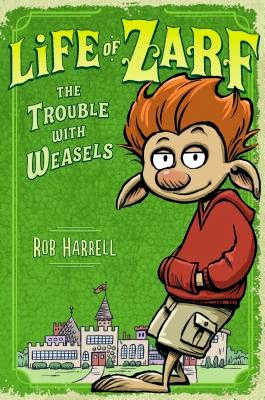
Life of Zarf: The Trouble with Weasels

by Rob Harrell
First sentence: “Zarf.”
Support your local independent bookstore: buy it there!
Review copy downloaded from Edelweiss.
Release date: September 2, 2014
Content: It’s pretty basic, and there are a lot of pictures. I’ll probably shelve it in the Middle Grade (grades 3-5) section of the bookstore, though it’d work for an advanced 1st or second grader. There’s nothing objectionable.

Zarf is a troll. That means, at this middle school of his, that he is the bottom of the bottom on the social ladder. Even his friends Kevin (of Littlepig fame) and Chester (the Jester) are higher up the social ladder than he is. But then, what do you expect when your the kid and grandkid of the trolls who bugged the billy goats?

Zarf’s pretty okay with his social nothingness. That is, until King Cheznott goes missing, presumably dead, killed (or kidnapped) by huge Snuffweasels. And his bully son (at least bully to Zarf), Roquefort, takes over. And throws Zarf  in the dungeon. Where he (somewhat inadvertently) finds himself on a rescue mission. And, of course, hilarity ensues.

Actually the plot is really secondary in this book. It’s mostly just about silliness. Serious silliness. Like:

“How can I explain that voice? It was so deep, it sounded like a cross between Darth Vader’s voice and someone farting through a tuba.”

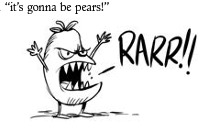
or odd creatures, like attack pears!

Or Chester’s really jokes (“How many wobble gnomes does it take to massage a swampfrog?” We never do find out the punchline to that one.)

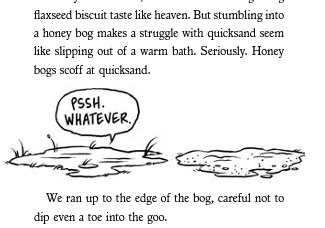
Or the clever asides:

As you can tell, this slim book is liberally scattered with pictures. Making it perfect for the reluctant reader. And it’s hilarious, which makes the appeal that much greater. At any rate, I laughed quite a bit and read it all in one sitting. Perfect, silly, stupid fun.

Ruin and Rising

by Leigh Bardugo
First sentence: “The monster’s name was Izmrud, the great worm, and there were those who claimed had had made the tunnels that ran beneath Ravka.”
Support your local independent bookstore: buy it there!
Others in the series: Shadow and Bone, Siege and Storm
Content: There’s some violence and lots of kissing and some off-screen sex (implied). It’s in the YA (grades 6-8) section off the bookstore.

Alina is in a bit of a predicament. She has two of the amplifiers and that enabled her to temporarily set back the Darkling. However, it cost her most of her power, turned her hair white, and has forced her underground and into the protection of the Apparate, whom she despises.

Her goal: fend of the zealots who consider her a saint, get out of the White Cathedral, hope that Nikolai is still alive (and in some sort of condition to be king), find the firebird and the third amplifier, and defeat the Darkling, once and for all.

And manage to come out of all of it alive.

My only complaint is that I didn’t reread the other two books beforehand; I really do think that this series is best read one right after another. Even so, it didn’t take me long to remind myself of the big, broad points. There’s a lot of action, and Alina is a major player in all of the decisions, including the final, heart-rendering one. There were a lot of small moments I loved, but I adored the big ones: the battles with the Darkling, the confrontation with the former king. Nikolai was fantastic, and even Mal (and the True Love between Mal and Alina) grew on me over the pages.

A fantastic way to end a series.

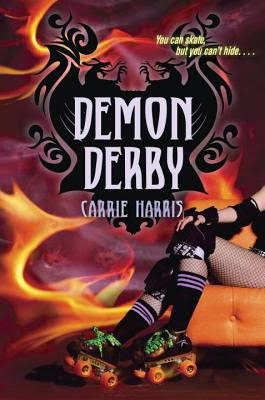
Demon Derby

by Carrie Harris
First sentence: “Once upon a time, whenever I saw a tall building, I wanted to jump off it.”
Support your local independent bookstore: buy it there!
Review copy snagged off the ARC shelves at my place of employment.
Content: There’s some violence — demon attacks and all — and the content is a little mature for younger readers (well, A tried reading it and lost interest). It’s in the YA section (grades 6-8) of the bookstore.

Casey Kent has cancer. It’s in remission right now, but it’s forced her to re-think her extreme lifestyle. No more free jumping. No more trick boarding. In fact, everyone — from her parents, to her older sister, to her best friend, Kyle — is pretty much making sure Casey stays in a safe bubble.

And it’s driving her insane.

So, she decides to try out for one of the junior roller derby teams in town. Where she discovers that the coach (hot as he is) isn’t human. He’s a Sentinel, here to train people to fight demons. And it turns out that Casey, having been on the brink of death with her cancer, is the perfect hunter.

I was thinking this was Supernatural meets the roller derby and in many ways it is. There’s creepy demons trying to kill people, and this book will definitely make you rethink ever buying a bobble-headed doll again. But, it lacked (for me) a certain… oomph. The hot guy wasn’t terribly interesting, the danger not terribly exciting. It was all kind of … meh.

What I DID like, however (and what kept me reading) was that this wasn’t your ordinary cancer book. Sure, Casey battled cancer and it’s in remission. But she was made strong because of it, not in spite of it. It was because of the cancer that she became an awesome Hunter and was able to defeat demons. And I liked that perspective. I also like that the person you thought would be the Traitor didn’t actually turn out to be one. It was a nice touch.

I wanted to like it more than I did, but reading about Casey — who was strong and feisty and awesome — made it worth wading through the meh elements.

The Fourteenth Goldfish

by Jennifer L. Holm
First sentence: “When I was in preschool, I had a teacher named Starlily.”
Support your local independent bookstore: buy it there!
Review copy snagged from the ARC shelves at my place of employment
Release date: August 26, 2014
Content: I think it’s geared towards younger readers: larger font, lots of white space, and everything is pretty much spelled out. It’ll go in the middle grade (grades 3-5) section of the bookstore, but could go for strong younger readers.

Eleven-year-old Ellie has a pretty normal life. Her parents — both Theater People — are divorced, but get along. She is dreading middle school, especially since she and her best friend since Kindergarten seem to be drifting apart. But, mostly, it’s just your normal, every-day life. That is, until her mom gets call to go pick up “Melvin”. Who happens to be her father, Ellie’s grandpa. Except now he’s 13. Turns out, he discovered a new species of jellyfish, one when ingested, gives you back your youth.

But things aren’t all roses and unicorns for Melvin: being 13 is not the same as being in your 70s. There are some upsides: a good digestive system, and the lack of a need to pee in the middle of the night. But the downside is that Melvin has lost access to his lab, which means if he can’t get the jellyfish, he can’t prove his theory, and he won’t win the Nobel Prize.

While Ellie is our narrator, it’s Melvin who drives the action. He’s the one who introduces Ellie to Science; gets Ellie to talk to her new friend, Raj; the one who needs to break into the building. One of my problems with this (aside from being Too Old; I do think younger readers will love it) is that Ellie is not proactive, but rather reactive in her own life. She’s a sweet girl, and a nice person to read about. But the book just wasn’t exciting.

It was, however, charming and informative. Holm managed to put a ton of science in her science fiction book: everyone from Galileo and Newton to Oppenheimer and Einstein make an appearance. And she explains some basic scientific concepts in pretty general — and clever — ways. So, while it wasn’t exciting, it was interesting. It did take me a while to figure out the title, why it was called the 14th goldfish (since goldfish didn’t play much of a role), but I thought the ending was sweet and Holm did explain it.

Not my cup of tea, but I’m glad I read it.

The Bitter Kingdom

by Rae Carson
First sentence: “We run.”
Support your local independent bookstore: buy it there!
Others in the series: The Girl of Fire and Thorns, The Crown of Embers
Content: It’s a pretty complex book, full of politics and machinations. But, even with all the fighting and killing and wars (and some brief sexytimes), it’s not a graphic book. It’s in the teen section (grades 9+) of the bookstore, but I think a strong younger reader would enjoy it as well.

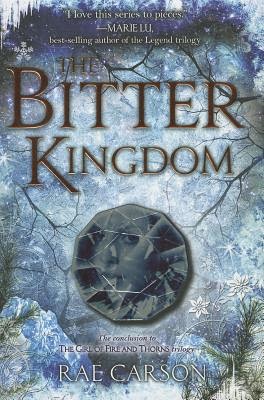
Queen Elisa is in a terrible predicament. Her country has been taken over by an ursuper, Conde Eduardo. The man she loves and the commander of her Royal Guard has been kidnapped by traitors. And she only has a few friends she can count on. The problem is that she needs to head into Invierne and convince them to stop invading her country. And figure out how to deal with her newfound power from her Godstone.

That doesn’t even begin to touch this complex and fascinating ending to a complex and fascinating trilogy. I’ve always loved the religious element to this story, how God plays a role in Elisa’s life. I really enjoyed the way Carson pitted the Joyans and the Inverinos against each other; both think they are right, and both think the other is wrong. It’s really a book about compromise and understanding, and I loved that.

Elisa has become, for me, one of my favorite heroines. She’s not kick-butt fighter, but rather a savvy, clever, and fascinating character; someone who uses her brain rather than her fighting skills. Carson also gave us Hector’s point of view a few times in this book, something which I appreciated. While I’ve loved seeing Hector from Elisa’s point of view, it was interesting to be inside his head and to know a little more how he works.

I do think that the only thing I would have done differently with this series is wait until they were all out so I could read them one after another. I think the experience of this story would be that much better if I had read it all in one gulp.

The Summer Prince

by Alaya Dawn Johnson
First sentence: “When I was eight, my papai took me to the park to watch a king die.”
Support your local independent bookstore: buy it there!
Content: I was initially thinking that this would be good for those who like Uglies; there’s about the same amount of swearing. But the reason it’s in the Teen section (grades 9+) is because there’s a lot of allusions to sex, including a couple (tasteful) sex scenes.

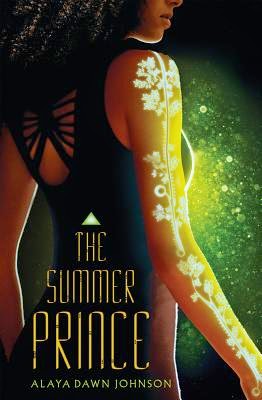
June Costa is the best artist in Palmeres Três. Or so she thinks; she just hasn’t had a chance to prove it yet. And in this, a moon year in which her futuristic, matriarchal society chooses a one-year Summer King to “rule”, she will have that chance. It starts innocently: her best friend, Gil, falls in love with the summer king, Enki. And she does, too, though she tells herself that it’s mostly about the art. And what art June and Enki create. Ever more elaborate, they end up sparking a revolution of sorts between the technophiles and the isolationists; the government, made up of women they call “Aunties”, has placed strict regulations on what kind of tech can be in the city.

It was this tech element that reminded me so much of Uglies. But, I think Johnson was pointing out the value of art and the power of love, even in a futuristic (and while not dystopian, certainly not perfect) society. It’s a very thought-provoking novel, one that winds and unfurls instead of proceeding in a linear fashion. And it was this winding that kept me most interested. Johnson chose to build her futuristic Brazilian society in bits and chunks throughout the entire book, dropping hints and clues about what happened to get the world to this point along the way. And the society she built was equally as fascinating, with all its machinations and political scheming.

But, ultimately, it was June and Enki and Gil (and June’s competition/friend, Bebel) that kept me reading in the end. I cared about what happened to them, how this year played out for the summer king and his newfound friends. I found myself moved by the ending, and thinking about the book long after I turned the last page.

Conversion

by Katherine Howe
First sentence: “How long must I wait?”
Support your local independent bookstore: buy it there!
Review copy downloaded from Edelweiss
Content: There is some mild swearing, and talk of sex, but nothing actual. It’d be happy in the YA section (grades 6-8) of the bookstore, but I might put it in Teen (grades 9+) so I can get the adult crossover.

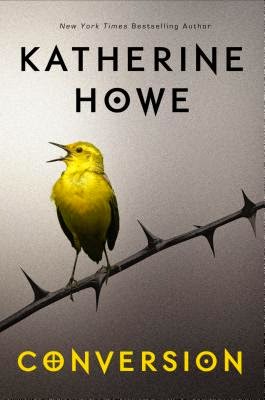
Colleen Rowley is a senior at St. Joan’s Academy, a high-profile, all-girls school in Danvers, Massachusetts. Everything is going great… mostly. Colleen is a tenth out of valedictorian position, something which stresses her out because her college acceptance to Harvard (only one of many Ivy League schools that have wait-listed her) is hinging on her senior year academic performance. She’s not the only one under pressure; all of her friends and many of her classmates are as well.

And then something strange happens: Colleen’s classmates, one by one, succumb to a mysterious illness that pulls them out of school. Some develop Turette’s Sydrome-like tics, others loose the use of their legs; still others’ hair is falling out. It’s an epidemic. Except Colleen, spurred on by some anonymous texts, is suspicious. And when she starts looking into the real events behind The Crucible, which they’re studying, especially Ann Putnam’s story, she finds that there is possibly a connection to what’s happening in Danvers now, and what happened in Salem back then.

Told in alternating storylines, Howe gives us both the story of the girls of St. Joan’s and Ann Putnam’s confession about the incident that began what came to be called the Salem Witch trials. She doesn’t spell things out for the reader; instead, she trusts our intelligence and in our ability to draw parallels between the two stories. And although the characters — especially Colleen and her friends — are quite sympathetic, it’s finding the parallels and solving the mystery that fascinated me most about this book.

Unfortunately, the ending didn’t hold up to the rest of the book. Howe kind of goes off into muddle-land, and doesn’t hold up to the suspense that the book built. Even so, it wasn’t enough to completely kill the book for me (it was more of a “HUH?” moment). And it’s made me curious about Howe’s adult books, which is a good thing.

The Hero’s Guide to Being an Outlaw

by Christopher Healy
First sentence: “Outlaws have too many feathers in their hats.”
Support your local independent bookstore: buy it there!
Others in the series: The Hero’s Guide to Saving Your KingdomThe Hero’s Guide to Storming the Castle
Content: There’s some kissing, a bit of violence (and almost violence), and it’s long for a middle-grade novel. It’d be in the middle grade section (grades 3-5) of the bookstore; don’t let the length fool you; it goes fast.

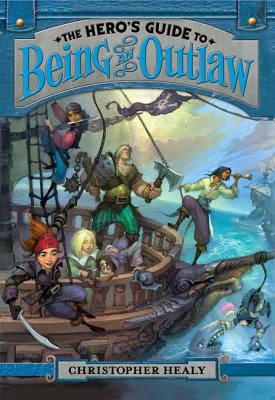
I don’t even remember what our Fair Heroes were doing at the end of the second book. But, honestly: it doesn’t matter. I fell right back into the silly stupidity (and I say that with all loving kindness in my heart) of this book, snorting and giggling as The League of Princes (and the Ferocious Female Freedom Fighters — or FFFF) try to save the Thirteen Kingdoms from Lord Rauber’s (who they thought they killed in the last book) evil plan to take over the world.

The point to the book, I think, is not the plot. Sure, there is a plot: The whole gang is branded as outlaws because they were supposed to have murdered Briar Rose (sure, she’s annoying, but they wouldn’t literally kill her. Only figuratively) so everyone’s on the run and trying to prove their innocence. But the point is for the guys to be dorky (ah, Duncan), the girls to be awesome (bonus: pirate captain Jerica! Double bonus: Gustav trying to flirt), and for super-silly jokes and asides (like the prisoner Val Jeanval. Get it??). Yes, it was stupid. But, I love it.

Full of action (and stupid jokes), and perfect for just about anyone who doesn’t mind a bit of fairy tale adventure.