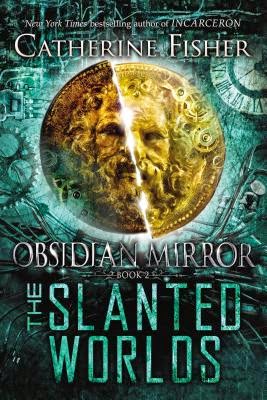
The Slanted Worlds

by Catherine Fisher
First sentence: “The Bomb fell in a split second of silence.”
Support your local independent bookstore: buy it there!
Others in the series: Obsidian Mirror
Content: There’s some violence and (much like the first one) this takes some effort to follow. Not for the reluctant of readers. It’s in the YA (Grades 6-8) section of the bookstore.

A few spoilers for the first one, obviously. You’ve been warned.

Both Jake and Venn have become increasingly desperate to use the mirror, to make it work right. Jake, in order to find his father. Venn, because he wants to turn back the clock to get his wife back. Neither of them know of the outside forces controlling the mirror — that’s a knowledge known intimately to Maskelyne, an old, old time traveler, who may have been the one who invented the mirror — but both are willing to do whatever it takes to keep the mirror safe, and bring back the ones they love. Including involving Summer, the leader of the Shee, the fae-like creatures.

I have realized while typing the above that I could recount the plot of the entire book and it probably wouldn’t make any sense to those who haven’t read it.

There are other factors, as well: Sarah’s still around, trying to destroy the mirror and rid the world of Janus, and she’s willing to involve the Shee as well.  In fact, the Shee is the wild card here: Summer is the chaotic evil here, working toward her own end, but we have no idea what that end it.

There’s a lot of wibbly wobbly timey wimey stuff in this book, time looping in and back and forward on itself in incredibly fascinating ways. Jake is the real focus of the book; its his quest to find his father that we follow most closely. It was a good thing to focus on one arm of the conflict, though I did miss having Sarah around.

But at the end, I was left wondering: how is this all going to come together in the next book? How are we going to resolve the tension between needing to rescue those trapped in time and the need to destroy the mirror to save the world?

I suppose I’m just going to have to read the third one and find out.

The Forgotten Sisters

by Shannon Hale
First sentence: “Miri woke to the rustle of a feather-stuffed quilt.”
Support your local independent bookstore: buy it there!
Others in the series: Princess Academy, Palace of Stone
Release Date: February 24, 2015
Review copy snagged from the ARC shelves of my place of employment.
Content: There’s some violence, but nothing graphic. And some kissing, which may be ew-inducing in the younger set. Still, I think it belongs in the middle grade (grades 3-5) section of the bookstore, though it might do better with the 5-7th graders.

Miri finished her year at the Palace and was looking forward to going back home to Mount Eskel, seeing her family, enjoying getting back to the life she once had before the Princess Academy changed her path. But, her winding road isn’t finished yet: the neighboring country, Stora, is threatening invasion, and in order to pacify them King Bjorn has offered up some distant cousins as a bride to the aging Storan king. And Miri is sent, unwilling and unprepared, to the swamp of Lesser Alvan to find these cousins and whip them into shape for a royal wedding.

What Miri finds when she gets to the swamp are three motherless girls — Astrid, Felissa, and Sus — who have been resourceful enough to find a way to survive without the help of the castle. They were supposed to be getting an allowance, which has been stolen by the local village overlord. They were supposed to have servants and a family, and they’ve been robbed of that, too. However, they made to, and once Miri figured out how to connect with them, things went well.

In fact, Astrid and Sus were my favorite characters. Felissa was nice enough — her main characteristic, as Hale often reminded us, was smiling — but Astrid was tough, no-nonsense, responsible, and just plain amazing. Sus soaked up the knowledge, and there’s a scene at the end (I won’t spoil it) where she talks coolly and rationally and logically and in the end makes everyone listen to her. Miri,too, was a bastion of resourcefulness: she adapted to the swamp life and fought back against the bandits and robber barons. She fought for justice and did so in a way that wasn’t violent.

The thing that kept running through my mind while reading this was that it was a girl power book, but not in the way we usually think of it. Usually, we want our girls to be like guys: kicking butt, fighting. But, Hale has given us girls and women who Do Things and stand up to people without violence, without force. In fact, you can look at this book as the myriad of ways women survive what men in power do to them. From making decisions to making war to actual physical violence, men can be (are often?) cruel and unthinking. But, women can survive and flourish.

It never got didactic or heavy-handed, though I did think some of the twists and turns of plot were a bit much. It came together in the end, though, in a very satisfying way. Because above all, Hale is a consummate storyteller. And this is definitely a good story.

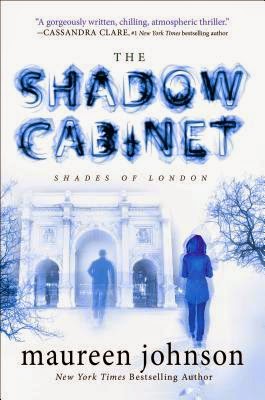
The Shadow Cabinet

by Maureen Johnson
First sentence: “The curtains at 16 Hyssop Close hadn’t been opened all day.”
Support your local independent bookstore: buy it there!
Review copy snagged from the box from the publisher rep.
Others in the series: The Name of the Star, The Madness Underneath
Release date: February 10, 2015
Content: There’s a lot of murder in this one, some of it gory, but never graphic. Other than that, it’s just intense. The series is in the Teen section (grades 9+) of the bookstore, but I wouldn’t oppose giving it to a younger kid who was interested in ghost stories.

First off: spoilers for the other two books, obviously. You’ve been warned. (And if you haven’t read them, you really should. They’re excellent.)

Two years is a long time to wait for a book. And in the process, I’ve forgotten all the anxiousness I experienced when I finished the last one. So I do have to admit, that this one took a little bit of time to get back into the swing of things.

It begins forty years ago, with the grisly murder of 10 teenagers by a pair of odd, unusual twins named Sid and Sadie (though in my mind, Sadie was always the Thrilling Adventure Hour Sadie…). It’s a violent way to begin a book (then again, they are murder mysteries) and it’s important, though it doesn’t come to fruition until the end. The main story is the two prongs leftover from Madness: trying to figure out what happened to Stephen when he died and trying to figure out where crazy Jane took Charlotte. Both of those lead Rory and the rest of the ghost team: Thorpe, Boo, and Callum down increasingly crazy paths.

Things I really liked: I loved the addition of Freddie, a new ghost hunter. She was spunky and funny and a breath of fresh air in the midst of Rory’s loss. And I loved that MJ brought back Jerome from book one. Even though he’s mostly kept in the dark, he plays an important role in all of the crazy that follows.

It’s as good as Name of the Star, I think. And it sets up an epic conclusion (I hope). Now, it’s just waiting until that conclusion comes.

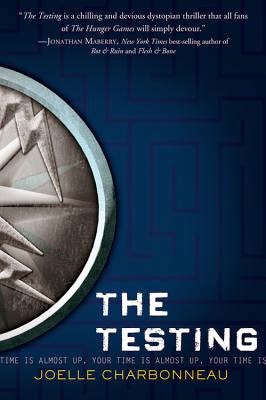
The Testing

by Joelle Charbonneau
First sentence: “Graduation Day.”
Support your local independent bookstore: buy it there!
Content: It’s violent, but not graphically so. And there’s kissing, but no sex. Which means it’s in the YA section (grades 6-8) of the bookstore. However, much like Hunger Games, I’d be wary of more sensitive readers liking it.

This book has been out for two years now, and I’ve been putting it off for just as long. Mostly because the whole post-apocalyptic/dystopian genre has been SO overdone, that I really didn’t want to read yet another one.

Then we scheduled Charbonneau to come to the store — they’ve been working on it since the first one came out and the rep mentioned it was set in a futuristic Wichita — and I was tasked with reading and reviewing the book before she gets here. And so I did, smacking myself when I finished for waiting too long to get around to this one.

Sixteen-year-old Cia Vale has just graduated from her colony’s small school near the top of her class. She’s excited: in this post-Seven Stages War America, now called the United Commonwealth, that means she’s likely to be chosen to attend The Testing in the capitol, Tosu City (aka Wichita, though it took me nearly the whole book to figure that out). Except her father — a former Testing candidate and University graduate himself — doesn’t want her to go. However, once Cia’s been chosen, she can’t say no; refusing the Testing is an act of treason, punishable by death.

So, Cia travels to Tosu City with her father’s warning — TRUST NO ONE — echoing in her ears, and discovers what he meant. The Testing is not just high-pressure and high-competition for the twenty university slots. It’s deadly.

While the plotting and writing isn’t as tight as Suzanne Collins’s, it’s still a quick, engaging read. Charbonneau sets the stakes high right away, with Cia’s roommate committing suicide, and doesn’t let up until the final pages of the book. There are twists and turns — some of which I saw, some of which I didn’t — and Cia is a good, strong narrator to carry this story on her shoulders. It’s definitely post-apocalyptic; Charbonneau cleverly gave us a brief history of how this country came to be in a series of short written test questions early on. The dystopian part is harder to see — Cia comes to hate the Testing officials, and the government as an extension, but I’m not sure I ever felt the way she did about the officials. Unlike, say, President Snow in The Hunger Games. (Yes, comparisons are inevitable.) I do think, on the other hand, that it’s a tighter, more interesting story than Divergent (yes, there’s a love interest, which I think was mostly unnecessary).

But the best thing about waiting to read this one is that the whole series is out already. And I don’t have to wait to read the second one. And I’m invested enough in Cia’s story that I’m quite curious to find out what happens next.

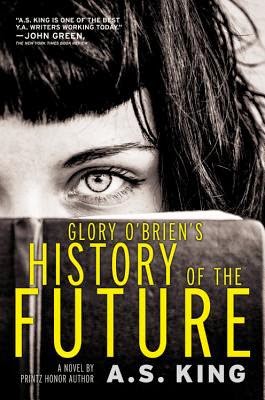
Glory O’Brien’s History of the Future

by A. S. King
First sentence: “So we drank it – the two of us.”
Support your local independent bookstore: buy it there!
Content: There’s some swearing — including multiple f-bombs — plus some frank talk about sex. It’s definitely a more mature book, and is in the teen section (grades 9+) of the bookstore.

Eighteen-year-old Glory O’Brien has had her mother’s suicide hanging over her for practically her whole life. It’s kept her father from doing his art; he stays home, eating, and working as an on-line tech consultant. It’s kept Glory from doing much of anything, really, frozen with the expectation that she, too, will commit suicide eventually.

And it doesn’t help that no one ever talks about It. Or her mom.

Then she and her best friend (by default, since they live across the street from each other), find a dead, mummified bat in the barn. It gets turned to dust, and they mix it with beer and drink it up. And then they start seeing visions.

Glory’s visions are of a horrific patriarchal future, where women’s rights are completely taken away, and the country ends up in another Civil War. This fascinates and terrifies Glory — what’s her role in this future? How does it come to be like this? Will it? — and the act of having these visions pushes her into action.

Trippy doesn’t even begin to cover this book. It’s wild, weird, trippy, odd… King has bitten off a huge piece of cake here, and I’m not sure how well it worked for me. On the one hand, I was thinking it was a Handmaid’s Tale-esque feminist warning about what will happen if we give up the fight and stop questioning the status quo. But the longer the book went, the more I wondered if there was a point to all this, aside from spurring Glory and her dad to action. Maybe there wasn’t. And while I am glad that Glory actually made decisions and started living her life, I kind of wish there were a less trippy way of doing it.

So, in the end, even though I liked the individual elements of the book, I was unsatisfied with it as a whole.

The Map to Everywhere

by Carrie Ryan and John Parke Davis
First sentence: “Fin crouched behind a rack of bootleg flavors, trying hard to ignore the taste of rat fur and broccoli juice seeping from the grungy bottles.”
Support your local independent bookstore: buy it there!
Content: It’s kind of long, there’s some difficult made-up words, and it does take a bit of time to get into, so not really for a reluctant reader. Then again, there’s some great illustrations… Either way, it’s i the middle grade section (grades 3-5) of the bookstore.

Marrill has lived a life of adventure, following her parents around the world. Now, what was supposed to be a temporary stop in Arizona has become (mostly) permanent: her mother has cancer, and they need to stay close to doctors. But the prospect of school and a stable home doesn’t make Marrill happy.

Across the universe, Fin is the opposite: stuck in the Khaznot Quay, where he was dropped off as a baby by his mother (who then disappeared), Fin has become a master thief, mostly because he’s the guy who can’t be remembered. Literally: people look at him and as soon as they look away, they don’t remember him anymore. It’s very convenient when you tend to steal things.

But when Marrill’s and Fin’s paths cross — it has something to do with the Pirate Stream (a magical time/space continuum thing; you can sail a ship almost anywhere in the universe on it) — they end up teaming up to stop a rogue wizard from destroying the stream, and therefore the universe.

This is a perfectly fine fantasy adventure, once it got started. The main problem for me was that it took too long to get started. I almost put it down several times as I was waiting for the adventure to start, wading through the new world, and how everything connected. However, once the people and things were in place, I really did enjoy Marrill and Fin’s adventures.

I’m not sure if I’m invested in the series, but I think the kids will like it.

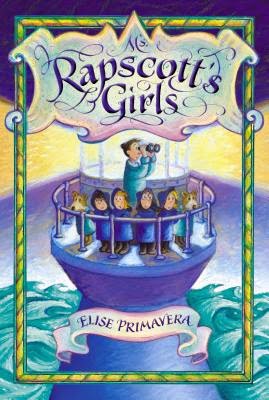
Ms. Rapscott’s Girls

by Elise Primavera
First sentence: “Attention, Busy Parents!”
Support your local independent bookstore: buy it there!
Release date: March 10, 2015
Review copy handed to me by the publisher rep.
Content: It’s a good mix of illustrations and print; while it’s out of the beginning chapter book phase, it’s a good one for reluctant readers. It will be in the middle grade (grades 3-5) section of the bookstore.

Ms. Rapscott likes things rough. An orphan at an early age, she figured out how to make her Way in Life. And this is a skill she wants to give to young girls. Especially young, neglected girls of Extremely Busy parents. At the start of this summer school term (though you wouldn’t know it by the weather at the lighthouse that serves as the school; it’s always storming), five girls are on their way — arriving by pre-paid post (yes, in boxes) — for Ms. Rapscott to mold. There’s angry Beatrice, lazy Mildred, timid Fay, and competent Annabelle as well. And, of course, Dalhlia, who was so tiny (and her parents so absent-minded) that she fell out of the box and went missing.

At first glance, it’s easy to call this one a modern-day Mary Poppins. Ms. Rapscott serves as a kind, but firm nanny (or boarding school mistress) who gives the girls cake and ice cream for dinner and pie for breakfast, and yet demands tidiness and hard work. There’s a slight magical element — flying boxes, for one, but also her assistants, two dogs who handle the day-to day operations. It definitely feels like one of those books. (I felt chastised, reading it as a busy parent, for not being more attentive to my kids. And I’m pretty attentive. Maybe I was just having a down day when I read this.)

But it’s more than that: Ms. Rapscott doesn’t just straighten up these unruly daughters of busy parents; she helps them learn to be parents. I’m not quite sure what kids will think of this — I need to get K to read it — but as a parent, I saw that Primavera was advocating for the need for variety in a kid’s life: too much pie is bad, but some pie is good. Too much TV and staying in PJs all day is bad, but sometimes, it’s what is needed. Adventure, exploring is good, and can be Learned From. But, mostly, being helpful, cheerful, and optimistic is the best. And, perhaps, that’s something we all need to be reminded of.

It’s a delightful little read.

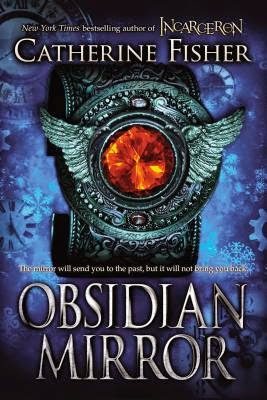
Obsidian Mirror

by Catherine Fisher
First sentence: “The boy put on the mask outside the door.”
Support your local independent bookstore: buy it there!
Content: Nothing objectionable, but it’s slow to start and is a  bit confusing. Not for the reader who gives up easily. It’s in the YA (grades 6-8) section of the bookstore.

This has been on my shelves for a long time. Seriously. I had the ARC, but gave that up, and finally, again, decided that I really needed to read this one. And I was in the mood this past weekend to indulge myself.

I shouldn’t have put it off. (Or maybe I should have: I’ve got the second one waiting to be picked up at the library. Shhhh. I know I said I wasn’t going to. But it’s CATHERINE FISHER.)

There’s three parts to this story. One is Oberon Venn, a very wealthy explorer who has spent the last two years in a depression because he was he cause of the accident that killed his wife, Leah. He will do anything to get her back. Including time travel. He and his trusty slave — there’s more to that than meets the eye — Piers are hidden out at Venn’s estate, trying to do just that: travel through time through the Obsidian Mirror.

The second player in this drama is Jacob, the son of Venn’s best fried. Who is missing and presumed dead. Or at least that’s what Jake thinks. So he’s headed, along with his unsuspecting teacher, Wharton,  to Wintercombe Abbey to force answers from Venn. Little does he know the web he will be tangled in.

The final player is the most complicated one: Sarah is possibly an escapee from an insane asylum. Or perhaps she’s a traveler from the future, a future where the mirror has destroyed the world, in order to destroy the mirror and prevent Venn from bringing his wife back.

There’s so much going on in this one, it’s hard to know where to begin. Yes, it’s slow and incredibly confusing to start with. I kept thinking “HUH?” But, I know Fisher’s work, so I stuck it out, and was richly rewarded. It’s time travel mashed with a mystery mashed with faery stories (yes, the Fey show up, and play a role), and if you give it time, it will begin to play out — it’s the first of a trilogy — in some incredible ways.

I can’t wait to read the next one.

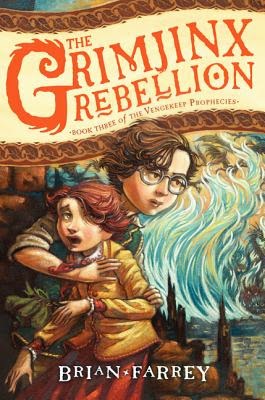
The Grimjinx Rebellion

by Brian Farrey
First sentence: “Of all the wisdom passed down through the generations of the Grimjinx clan, the bit I think about most came from Jerrina Grimjinx, wife of Corenus, our clan father.”
Support your local independent bookstore: buy it there!
Others in the series: The Vengekeep Prophecies, The Shadowhand Covenant
Content: There’s some action, and a few intense moments. The length will probably deter less confident readers, but (aside from the made up words) it’s really a page-turner. It’s in the middle grade (grades 3-5) section of the bookstore.

Jaxter thought, after he defeated the Shadowhand, that his troubles would be over. But, the High Laird has been raising taxes, and the population of the Five Provinces are getting restless. None of this bothers Jaxter very much, until the mages kidnap his sister. Who happens to be a powerful seer.

Jaxter, of course, can’t let this happen. So he, his parents, and some of his friends, head off to rescue Aubrin from the power-hungry mages and discover that they’re plotting to overthrow the High Laird and take over the provinces. Once again, Jaxter (and the whole Grimjinx clan) is in over their heads. But, true to form, they rally and figure out a way to Save the Day.

This is such a solid series: a great overarching story (elements of the first book came back again in this one), that involves themes of freedom and who has the right to rule. But it’s also grounded in family: I love the whole Grimjinx clan (even the wayward uncle) and how they pull for each other. They can do things individually, true, but as a family unit, they’re unstoppable. And I love how Jaxter’s friends got adopted into the family: they’re as important to him as his actual family. I especially like his relationship with Callie: you can tell he’s concerned about her, but there’s no romance. They’re just friends, and that’s great.

I also loved how this wrapped up, but didn’t tie everything up in a nice, neat bow. Farrey chose to leave things hanging; and I appreciated the ambiguity. Anything could happen, and that’s just great.

It’s a fantastic end to a fantastic series.

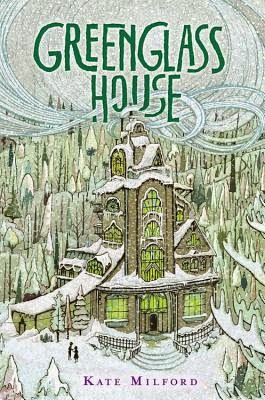
Greenglass House

by Kate Milford
First sentence: “There is a right way to do things and a wrong way if you’re going to run a hotel in a smuggler’s town.”
Support your local independent bookstore: buy it there!
Content: There’s nothing in the usual objectionable categories. However, it’s a slow book, especially at the start, and there’s some confusion sometimes when the characters switch names. That said, a good reader who loves mysteries would really like this one. It would be in the Middle Grade (grades 3-5) section of the bookstore, but I wouldn’t be adverse to putting it in the YA (grades 6-8) section either.

Milo and his parents run an inn at the top of a hill overlooking a river just outside of the fictional town of Nagspeake. The thing that makes their inn special is that it’s a safe having for smugglers. Milo and Mr. and Mrs. Pine know how to keep secrets.

However, it’s winter break, and Milo is looking forward to spending time alone with his parents. Without guests. So, he’s predictably disappointed when four guests, one right after another, show up for the winter.

Soon, they are in full swing, and have to bring up their usual cook, with her daughter, who just happens to be Milo’s age. Soon he and Meddy find themselves embroiled in an adventure and a mystery: figuring out why each of the four guests are there, their connection with the old house that Milo’s parents inherited, and who keeps stealing stuff.

The comparisons to Westing Game that I’ve read are valid. There is a mystery to solve, and it’s a quietly clever one, with a twist that I should have seen coming, but didn’t. (As we all know, I’m not the most careful of readers.) But it’s more than a mystery: it’s a lovely book, full of stories and quiet adventures (Meddy and Milo play a Dungeons & Dragons-like game for most of the book). I’m impressed that Milford wrote such a compelling book on such a small scale; because of the weather, Milo and Meddy hardly ever leave the house. It’s a very bleak landscape (Think The Dark is Rising bleak), but Milford infuses it with both warmth and mystery.

One more thing: Milo is adopted. He’s of Chinese nationality with white parents, and he feels that difference keenly at this point in his life. So, it’s not only a book with a mystery, it’s a book about belonging and family.

I loved it.