Upside Down Magic

upsidedownby Sarah Mynowski, Lauren Myracle, and Emily Jenkins
First sentence: “Nory Horace was trying to turn herself into a kitten.”
Support your local independent bookstore: buy it there!
Review copy pilfered off the ARC shelves at my place of employment.
Content: It’s simple enough for the younger set; probably good for advanced 2nd graders and up. It’s in the middle grade (grades 3-5) section of the bookstore.

Nory has a problem. She’s a witch, and she wants to get into the prestigious magic school that her super stuffy, absent father is head of. All she needs to do is turn into a kitten and hold that form for a few minutes. The problem is that she can’t do it. Well, she can turn into a kitten, but it never is just a kitten: it’s a beaver-kitten, or a dragon-kitten, or some other awful, terrible combination.

sOf course she doesn’t get into the school, and ends up going to a public magic school (the horror) and put in a class for those with “wonky” magic. There’s a kid who floats but can’t come down, another kid who turns into a rock, one who makes it rain inside and another one who is terrifying to animals. They are working to not only accept their magic as valid (in this society, those with wonky magic are Outcasts) and work together to make their magic do something incredible.

I think there’s a certain sort of kid who would love this kind of book. The kind of kid who likes magic stories, who likes an underdog story, and who doesn’t want to smack the adults in the book. I, unfortunately, am not that kid. I was annoyed at the predictable storyline and wanted to smack both the dad (the aunt who Nory ends up with is okay) and the mean girl at the new school. I understand I’m not the intended audience, so even though I didn’t care for it much, I realize that there are kids out there who will. And so I’m glad I read it for that reason.

(Just for the record: because this is a Cybils nominee, I’ve been asked to make sure y’all know this is my opinion only, and not that of the panel.)
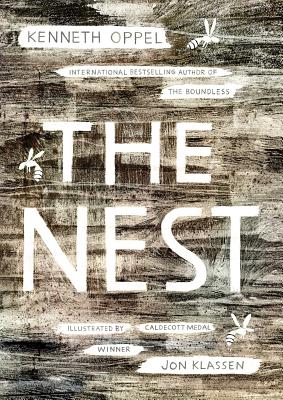
The Nest

by Kenneth Oppel
First sentence: “The first time I saw them, I thought they were angels.”
Support your local independent bookstore: buy it there!
Content: It’s sad and a bit odd, but there’s nothing, content-wise or language-level, that would kick it out of the middle grade (grades 3-5) section of the bookstore.

Steven’s baby brother has been in the hospital ever since he was born. The family and the doctor’s aren’t quite sure what’s going on, and how to fix it. So, when Steven starts having dreams about angels who have come to fix the baby, he figures that he’s either incredibly stressed about it all (which is what his therapist says) or that he’s going crazy (which is what he secretly thinks).

 Then those angels turn out to be a strange new breed of wasp that’s taken up residence in Steven’s house and suddenly what sounded like a good idea — fixing the baby — turns out to be a Horribly Bad One. Especially since Steven is fatally allergic to wasp stings.
This, I think, has to be (hands down) the weirdest book I’ve read. It’s a unique blend of things: mature and yet geared toward younger people; an allegory and a horror tale; both impossibly sad and incredibly strange. I’m not sure it always works as a story. But on the other hand, I kept coming back to it. I wanted to know how it ended, I wanted to know the choices that Steven made and how it all played out. And while I was never truly Terrified (which is why I’m hesitant to call this horror), I was really weirded out. It’s strange, it’s gripping, it’s odd, it’s engrossing.
In the end, I thought it was pretty good. I just have no idea who to sell it to.
(Just for the record: because this is a Cybils nominee, I’ve been asked to make sure y’all know this is my opinion only, and not that of the panel.)

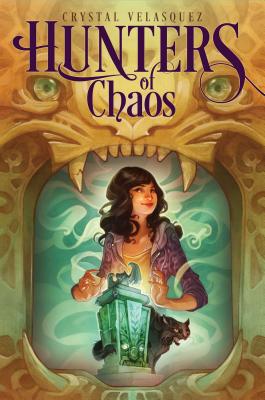
Hunters of Chaos

huntersofchaosby Crystal Velasquez
First sentence: “My muscles burn as the thick green jungle vines speed by in a blur.”
Support your local independent bookstore: buy it there!
Content: The characters are in high school and there’s some bullying and a little bit of romance (he like likes me!) but otherwise, it’s appropriate for the middle grade (grades 3-5) section of the bookstore.

Ana is an orphan (oh no!) living with her aunt and uncle, who happen to be enthusiastic scholars and collectors of Mayan artifacts. It’s their heritage, as well as Ana’s, and they’re incredibly proud of it. Even though Ana misses her parents, she’s incredibly happy. Then, the summer before high school, Ana gets a letter admitting her to to her parents’ alma matter, Temple Academy. Her aunt and uncle are a bit wary, but they send her off anyway.

At first, Ana tries to fit in with the super rich, super popular girls, which includes her roommate, Nicole. But, she soon finds out that fitting in costs way too much (both financially and morally). She ends up being friends with Doli, who’s Navajo, and Shani, who’s Egyptian. It turns out that the three of them — four with Lin, who’s Chinese, and a bit of a bully at first — are part of something bigger, something more ancient than any of them had ever expected.

It’s so hard for me not to spoil this book because it really was awesome. Not only are four of the main characters people of color (and descended from ancient civilizations which the author respects, I think) but they do some awesome things. There’s a whole scene near the end of the book that just had me cheering. There was a bit of a bullying dynamic and the love triangle-y stuff was a bit much (More adventure! More magic! Less love!), but it wasn’t enough to get me to dislike this. There’s just so much to love.

Give it to all those kids who are reading the Warrior books. They’d love it.

(Just for the record: because this is a Cybils nominee, I’ve been asked to make sure y’all know this is my opinion only, and not that of the panel.)

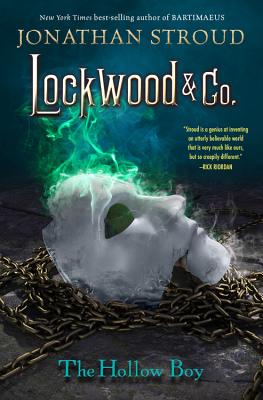
The Hollow Boy

by Jonathan Stroud
First sentence: “I think it was only at the very end of the Lavender Lodge job, when we were fighting for our lives in that unholy guesthouse, that I glimpsed Lockwood & Co. working together perfectly for the first time.”
Support your local independent bookstore: buy it there!
Others in the series: The Screaming Staircase, The Whispering Skull
Content: It’s scary, and a bit more angsty than I like my middle grade fiction to be. It, much like the others in the series, are best for the 5th grade crowd, but I’d give it to a precocious 3rd or 4th grader. It’s in the middle grade (grades 3-5) section of the bookstore.

I really don’t know if there’s much more I can say about this series except this: why aren’t more people reading it? Seriously. It’s funny, it’s scary, it’s got some great storytelling.

The next step for Lockwood & Co is to grow. It’s inevitable really. They’ve gotten a bit more notoriety and the cases are coming in. No longer are they utilizing their talents as a team, they’re spreading out. And their house/office is a complete pig sty. So, Lockwood and George decide that what they really need is an assistant: Someone to take calls, organize their lives, and clean up after them. So, they hire Holly. Which ticks Lucy — our main character — off to no end. And this is where the book gets angsty. Granted, Stroud never goes into full-out love triangle angst mode (yes, there is such a thing) and he lets the talking skull that Lucy carries around in her backpack do most of the snarking on Lucy’s mood but there’s no getting around it: she like-likes Lockwood, and she resents the intrusion of another girl.

There’s more to the plot than that: There’s an outbreak of supernatural activity in Chelsea and lots of agents lives are being put on the line. Lockwood wants in on the action, but he’s not considered skilled enough. So the course of the book is spent getting into the action in Chelsea. Additionally, Lucy wants more free reign to use her talent of communicating directly with the spirits, something which has dire consequences.

It kept me on the edge of my seat, turning pages until the very last cliffhanger (sort-of). And yes, I am sad that I have to wait another year to read the next one, but I don’t think I would put this series off. It’s just that good.

(Just for the record: because this is a Cybils nominee, I’ve been asked to make sure y’all know this is my opinion only, and not that of the panel.)

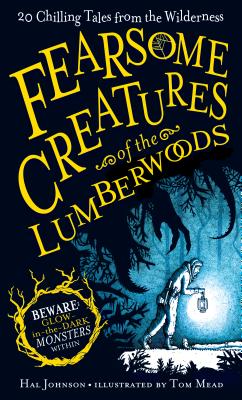
Fearsome Creatures of the Lumberwoods

fearsomecreaturesby Hal Johnson, illustrated by Tom Mead
First sentence: “While he lived, Paul Bunyan served as the master of the Michigan lumberwoods; since his death, its only master has been the hodag.”
Support your local independent bookstore: buy it there!
Content: It’s purportedly scary, but it’s really not. Some of the illustrations might be disturbing for younger readers, however. It’s in the middle grade (grades 3-5) section of the bookstore.

There’s not really a plot to summarize in this one; it’s a collection of tall tales about mythical/made-up beasts designed to scare you. It’s not really that scary, at least for an adult. The tales are simple and sometimes spooky (I could see reading these aloud, after dark, by firelight). But what I really loved was the presentation of the book. It’s gorgeously illustrated with black-and-white line drawings of the creatures, with some bonus glow-in-the-dark pages. I spent a good while just looking at the illustrations.  Additionally, the some parts of the text were set apart in a different font, just adding to the overall look.

It is an impressive package, even if the stories didn’t affect me the way they were supposed to.

(Just for the record: because this is a Cybils nominee, I’ve been asked to make sure y’all know this is my opinion only, and not that of the panel.)

The Scorpion Rules

 scorpionrulesby Erin Bow
First sentence: “Once Upon a Time, at the End of the World.”
Support your local independent bookstore: buy it there!
Content: There are exactly two f-bombs, some mild swearing, and one illusion to sex. It’s in the Teen (grades 9+) section of the bookstore, but I’d give it to a 7th grader, if they had no objections to the content.

At this point in my life, I’m very much been-there, done-that when it comes to dystopian/post-apocalyptic books. I feel like I’ve read/seen them all, and there’s really nothing new to explore there.  So, my first thought was that this was just going to be more of the same-old, same-old, and I passed on the ARC. Then it came in, and on the back were quotes from authors I respect, so I thought (somewhat begrudgingly), that I would give this one a try.

(I know, I know: I’m not “supposed” to start these with “I’m not a fan of x”. But bear with me.)

It didn’t take me too long to realize that I was utterly wrong. First of all, the premise is something I haven’t encountered in a long while: humans have destroyed the world through climate change and war, and somewhere along the way, invented artificial intelligence. One of the AIs decided that enough was enough, and took over — by blowing up a number of huge cities — ruling the world. And the way Talis, the AI, decided to keep the peace? By keeping the children of the world’s rulers hostage. If they enter into war, their children would be killed.

Brilliant, no?

Greta is the Crown Princess of the PanPolar Confederacy, a major North American power formed out of what we know as Canada. She’s also a hostage of Talis, living in the prairies of Saskatchewan at the Precepture with her compatriots, fellow hostages. Then one day, war breaks out, one of her friends dies, and a new boy, Elian, shows up. He’s the grandson of the leader of a new alliance, and he’s not at all willing to take his role as a Dutiful and Humble hostage. He fights every step of the way. And somehow, this awakens Greta (and the rest, including her best friend La Da-Xia) to the horrible reality that is her life.

There is so much more to it than that, but I don’t want to give it all away. I adored the combination of high-tech (there are flying battleships and smart pads and cameras and, of course, the AI) and low-tech (the children at the Precepture are basically farmers, thinking about raising goats and bees and harvesting vegetables. There’s a monastery-like feel, as well: they call the AI in charge “Father”. But I also loved the diversity: Bow rightly depicted people from all over the world — African, Asian, Native American, Hispanic — but it felt natural and organic rather than some sort of forced diversity.

But what I really loved was the fluidity of the romance. There’s a love triangle of sorts, but not your typical one; Greta is bisexual and there’s no angst or heartache about this. She’s in love with both a male and a female, and it’s just the way she is. And even Talis, when he shows up, was more gender fluid in his depiction (as benefiting and AI, no?). It was all very different, and very, very refreshing.

It’s the start of a series, and I’ll definitely be picking up the next one to see where Bow takes Greta’s story.

Milo Speck, Accidental Agent

by Linda Urban
First sentence: “Milo had read about magic before.”
Support your local independent bookstore: buy it there!
Review copy pilfered off the ARC shelves at my place of employment.
Content: There’s nothing objectionable, and the writing level is good for grades 3 and up. It’s in the middle grade section (grades 3-5) of the bookstore.

Milo’s mom disappeared years ago, and his father works really hard for the Tuckerman Agency. Which means that Milo is left mostly alone with “Grandmother” (a live-in provided by the agency). Milo’s lonely, but he does his best to fly under the radar. That is, until the day that he ends up sucked in to Ogregon through his dryer.

(Yes, you did read that right.)

Once there, Milo is unprepared for the adventures: being captured by ogres, the Evil Plots by the Evil Overlord, rescue attempts, and just general mayhem.  Plus trying to figure out where his father is. It’s a lot for a kid to handle.

It was a fun little book. Nothing too great, nothing too horrible. I did have a problem with Tuck; she was pretty annoying and she never really got better throughout the book. And it was all a bit silly, but I’m not the target audience. Perhaps this is one of those that kids will like — especially those who like monsters and adventure — but for me it was just meh.

Which is too bad. I had high hopes for this one.

(Just for the record: because this is a Cybils nominee, I’ve been asked to make sure y’all know this is my opinion only, and not that of the panel.)

Jinx’s Fire

by Sage Blackwood
First sentence: “Sticking to the path won’t always take you where you need to go.”
Support your local independent bookstore: buy it there!
Others in the series: Jinx, Jinx’s Magic
Review copy pilfered off the ARC shelves at my place of employment.
Content: There are some scary moments, but mostly it’s good for the fourth-grade and up crowd. It’s in the middle grade section (grades 3-5) of the bookstore.

Things aren’t looking good for Jinx and his friends. The Urwald is surrounded by warring armies — one of which is headed up by Jinx’s former friend, Reven. The Bonemaster is up to something, but Jinx doesn’t know what. And Simon is still trapped in goo, and it’s not looking good. The question is: how will Jinx solve everything and keep the Urwald (and the trees) safe, especially when he’s not very good at diplomacy?

Sometimes, an ending comes along that is just. so. perfect. that you have to love it. While it took me a bit to get into this one (being quite a long time since I’d read the other two), once I did, I fell again into loving the world that Blackwood created. I love Jinx and his grumpy demeanor. I love his friends, especially Elfwyn. I love the adventures that Jinx went on and the way Blackwood had him solve the problems he created. I adore the magic and the way Blackwood used it.

But, mostly I loved how Blackwood wrapped everything up, satisfyingly but not so neatly that it was implausible.

This series is definitely worth reading.


The Martian

by Andy Weir
First sentence: “I’m pretty much f***ed.”
Support your local independent bookstore: buy it there!
Content: As you can tell from the first sentence, the big content issue with this book is LANGUAGE. If you have problems with that, then this book isn’t for you. It’s in the science fiction section of the bookstore.

Mark Watney was one of six astronauts sent to Mars as part of an exploratory and scientific mission. He’s a botanist and was trained to be the fix-it guy, and he was expecting to spend 31 days on the planet with his crewmates and then head home. Then, six days in, a storm kicked up, and an accident happened and he was considered dead. So, the captain made the decision to leave him. Turns out, though, that he wasn’t dead.

Thus starts 368 pages of the best problem solving novel I’ve ever read. Seriously. Weir throws all sorts of things — most of them being normal, every day sorts of things; there’s not many super extreme situations here — at Watney and has him figure out how to survive. You wouldn’t think it would make for a fascinating, gripping novel but it does. Part of this is because Watney is a hilarious (if foul) narrator. He’s SO snarky, and laugh-out-loud hilarious, which helps diffuse the tension in the novel. It also makes it a very practical book, which makes me wonder how much of it is actually accurate science. (I gather, from the author notes at the end, quite a lot.) I kept turning the pages (and staying up late) wondering just what the heck was going to happen next.

I don’t usually go in for books that have a lot of hype or even a movie coming out, but this one is definitely worth all the buzz surrounding it.

Zeroes

by Scott Westerfeld, Margo Lanagan, Deborah Biancotti
First sentence: “More coffee?”
Support your local independent bookstore: buy it there!
Review copy pilfered from the ARC piles at my place of employment.
Content: There’s some talk of drug use (none of it by teens), a smattering of mild swearing, and one (unnecessary, misplaced, and kind of glaring) f-bomb.

Who are the Zeroes?

They are six teenagers, all born in the year 2000, who have discovered, over the years that they have extra-ordinary powers. Bellwether can charm a crowd of people into believing whatever he wants them to. Crash is bothered by electronics, and she can make entire systems, well, crash. Flicker is blind, and yet she can see through every one else’s eyes. Anon isn’t invisible, but he is easily forgettable; his parents once forgot that he was deathly ill and left him (to die) in the hospital. Scam has this voice inside him that can talk anyone into anything he wants, which is what gets all the Zeroes into trouble.

With Mob, who can control a crowd’s mood, and her father, who is in deep with the Russian mob.

The question is: will the Zeroes be able to help them? Or are they just going to make things… worse?

It’s kind of hard to juggle multiple points of view in a book, and in this one they tackle six of them. Some of them — Anon, Flicker, Scam, and Mob come out with the best story arcs in the book — are really well developed. Others — Bellwether and Crash — aren’t so much. But, for the most part, the flipping between people helped push the story forward, and I found that I didn’t mind seeing the action from different perspectives.

And the story was pretty seamless, considering there were three authors writing. I was worried that it would be choppy, but whatever they did — editing, lots and lots of rewriting — worked.

It’s definitely a ton of fun.