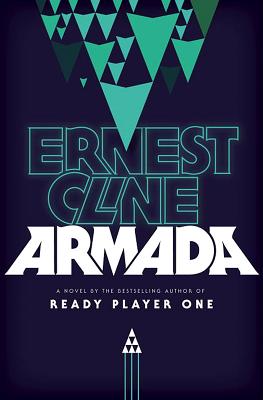
Armada

by Ernest Cline
First sentence: “I was staring out the classroom window and daydreaming of adventure when I spotted the flying saucer.”
Support your local independent bookstore: buy it there!
Release date: July 14, 2015
Review copy pilfered off the ARC shelves at my place of employment.
Content: There’s a lot of swearing, of all sorts. If you have a problem with that, then you probably shouldn’t be reading this. It’ll be in the Science Fiction/Fantasy section of the bookstore.

When I was a kid, one of my favorite movies to quote was The Last Starfighter. (I know: there’s no accounting for taste.) I swear my brothers and I watched it over and over again the summer of 1985 or 1986) and there were lines that incorporated themselves into our everyday lingo (“I’ve always wanted to fight a desperate battle against incredible odds.”). But, when I tried to show it to my kids, I cringed: it’s a pretty bad movie.

So, when I started Armada by Ernest Cline, I cringed: he’s pretty much riffing off the idea behind Last Starfighter (and Ender’s Game): video games, believe it or not, have been training for the impending alien invasion, and since the mid-1970s (it’s set in 2017, as far as I could figure), the top players of the game Armada have been recruited to serve as the Earth’s Defense.

Zack Lightman is one of those players. He’s been obsessed with games, and specifically Armada, since was was old enough to realize that his father — who died when Zack was barely one — was a gamer and Zack wanted to emulate him. Zack’s crawled up the ranks in Armada, until he’s the 6th highest ranked player in the world. And then: he sees a spaceship, one straight from Armada. That’s when his life gets really weird.

Like Ready Player One, this one has a litmus test. If you like/get the following passage, this book is probably for you:

In that moment, I felt like Luke Skywalker surveying a hanger full of A-, Y-, and X-Wing Fighters just before the Battle of Yavin. Or Captain Apollo, climbing into the cockpit of his Viper on the Galactica‘s flight deck. Ender Wigging arriving at Battle School. Or Alex Rogan, clutching his Star League uniform, staring wide-eyed at a hanger full of Gunstars.

I won’t give away too much more of the plot except to say this:  it took a while to get into it, but I was glad I kept with it. I liked the direction that Cline took it in the end.  A good read.
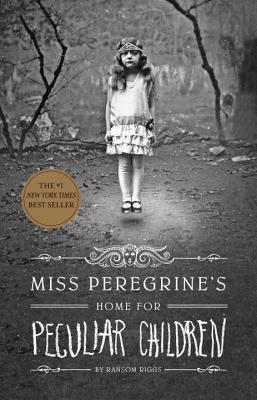
Miss Peregrine’s Home for Peculiar Children

by Ransom Riggs
First sentence: “I had just come to accept that my life would be ordinary when extraordinary things began to happen.”
Support your local independent bookstore: buy it there!
Content: There’s a few swear words and general creepiness. It’s in the Teen section (grades 9+) because that’s where adults want to find it, but I wouldn’t be adverse to giving it to a 7th or 8th grader.

I read this one by request of one of my fellow booksellers; she’d picked it for her summer teen book group and couldn’t make a session. So, I’m filling in.

I know the rest of the world has read this already, so I’ll spare much of the plot. I’ll just say that Jacob has grown up on his grandfather’s stories of the boarding school he stayed at in England during World War II. They weren’t normal stories, and the other children weren’t normal children. But Jacob thought that’s all they were: stories. That is, until his grandfather ends up dead in his garden, Jacob feels like he’s slowly going insane. So, he heads off to this island off the coast of Wales (or some place sufficiently secluded and broody and English-y) to find out the truth for himself.

Yes, the format was clever. Riggs intersperses (real) creepy, weird, old photographs and it’s quite unique how he incorporates the pictures. But, that’s all it was: clever. I never got past the whole “I’m supposed to be loving this?” feeling. Maybe it’s too much hype. Or maybe it was his writing. Or maybe it was just the mood I’ve been in, but this one fell flat.

On the other hand, that might make for more interesting discussion at the book group….

The Wrath and the Dawn

by Renee Ahdieh
First sentence: “It would not be a welcome dawn.”
Support your local independent bookstore: buy it there!
Review copy supplied by the publisher rep.
Content: There is some (implied) sex and there’s some violence, but it’s mostly appropriate for those who love grand, sweeping romances. I’d give it to an 8th grader and up, even though it’s in the Teen (grades 9+) section of the bookstore.

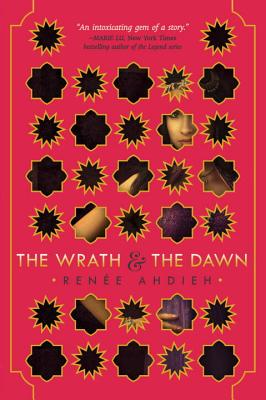
In this land, the king — 18-year-old Khalid — marries a new bride (chosen at random) every night, just to have her murdered the next dawn. It’s horrible for the people of the country who have come to look at him as a monster. But for Shahrzad, it’s personal: the most recent young woman sent to her death was Shazi’s best friend, Shiva. So (of course) Shahrzad volunteers for the job of bride.

And what follows is her attempt to stay alive.

If you know, even vaguely, the story of Arabian Nights, you pretty much know what’s going to happen. But, Ahdieh takes the story a step further: it’s not just the tales Shahrzad tells to keep alive. She gives motivation to Khalid (though in many ways it came too late for me to care very much) and she gives drive to Shahrzad. She’s there to exact revenge for her best friend, but discovers that there’s more to Khalid than murder.

Yeah, yeah, yeah.

I know people are loving this book. Seriously loving it. But, I just didn’t. I wanted to; I wanted to enjoy the sweeping Persian-inspired grandeur of the story, the fiestiness of Shahrzad, the illusions to the old tale. But, mostly what I wanted to do was smack Khalid and wonder why Shahrzad fell in love with him. (Too much telling, not enough showing?) It’s not that it didn’t make sense; it’s more that I just felt it was Decreed that they Fall in Love and So Mote It Be. I didn’t feel their love story. Then again, I didn’t feel Shahrzad’s rage. Or her first love’s betrayal. It was all Grand and Distant and I really didn’t care.

But since it’s getting pretty much universal raves from everyone else, it’s probably just me.

Spelled

by Betsy Schow
First sentence: “
Support your local independent bookstore: buy it there!
Review copy picked up at CI3 and signed by the author, who was a delightful person to talk to.
Content: Language-wise, it’s probably more advanced than the younger middle grade set can handle (unless they’re precocious), but content-wise there’s nothing. It’s in the YA section (grades 6-8), but it’d be good for a 4th or 5th grader as well.

You know, living in Kansas there’s one thing we get a lot around here: Oz stories. Seriously. It has its own section in the bookstore. And every time a spinoff comes (or a new reissue of the classic story, or a book about the film), we all kind of roll our eyes, knowing that we’ll have customers who just eat this stuff up.

This book is no exception.

It’s basically a twist on the Oz tale: Dorothy (Dorothea in this version) is a princess in the Emerald tower, and she’s kept captive because of a curse that was placed on her when she was born. As she’s gotten older, she’s grown to hate the restrictions on her life, and so she breaks the protection spell…. and all havoc breaks loose. Magic is turned upside down, the wicked witches are let loose, and suddenly Dorothea, her maid Riz, and her fiance (it happened very suddenly) are on an adventure to set things right.

If you know the plot of the book (or the movie for that matter). you’ll recognize the arc of Dorothea’s quest. And that’s okay. Schow was riffing on the well-known story, adding her own elements (having Ozma be the Hydra and turn into Baba Yaga was a nice tough). But, it was really just okay. The humor was okay. The romance was okay. The twist at the end was… okay. It never really became more than just “this is a decent book.” Which isn’t bad. And I’m sure fans of Oz will really like this one.

I suppose I was just hoping for more than okay.

Magonia

by Maria Dahvana Headley
First sentence: “I breathe in.”
Support your local independent bookstore: buy it there!
Review copy provided by the publisher.
Content: There’s a bunch of swearing, including several f-bombs. It’s in the Teen section (grades 9+) but I wouldn’t be adverse to giving it to an 8th grader as long as they knew about the language going in.

Aza Ray has spent the nearly sixteen years of her life struggling to breathe. It’s a miracle she’s even lived this long, since she’s got a weird disease (named after her, unfortunately) that basically renders her allergic to air. She’s managed okay, with the help of her family, and her BFF, Jason. But, now, on the eve of her 16th birthday, things are getting weird. Jason maybe wants to be more than BFFs. It’s getting harder and harder to breathe. And weirdest of all? She’s seeing ships in the sky.

There are spoilers ahead. You’ve been warned. Because, for better or for worse, this is about to get REALLY trippy.

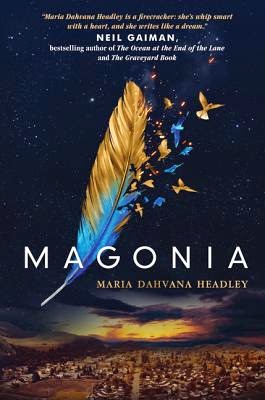
See: Aza Ray is seeing ships in the sky because there’s a country of bird people up there, called Magonia. And Aza is one of them. (Which is, duh, why she’s having trouble breathing regular earth air.) She was kidnapped as a baby and placed in a human home; whether it’s to punish her mother (according to her mother) or to save her (according to the bird-person who kidnapped her) remains to be seen. It’s really because Aza has this super-singing power that will either save Magonia or destroy the world. Or both. The problem is that she just can’t give up her human life (even though she DIED), and she just can’t quite kill off the humans.

I didn’t really know what to expect going into this, except that there’s a bit quote from Neil Gaiman on the cover and that everyone (at least on Edelweiss) is loving it. I completely — pun intended — missed the boat on this one. Seriously. I thought the premise was at best a drug-induced fantasy and at worst stupid. I thought the conversation was trying to hard to be John Green-esque and it sounded forced. I thought the plot was lame, even though it wrapped up nicely, and that the romance between Jason and Aza was forced. And even though I love fantasy, this just was NOT my thing.

But, as I said: it’s getting tons of love, so that may just be me not getting it.

Bone Gap

by Laura Ruby
First sentence: “The people of Bone Gap called Finn a lot of things, but none of them was his name.”
Support your local independent bookstore: buy it there!
Content: There’s some intense situations, some creepiness, and some on-screen, tasteful sex. It’s also pretty mature in its themes. For those reasons, it’s in the Teen (grades 9+) section of the bookstore.

Bone Gap is one of those places that everyone knows everyone else’s business and opinions once formed aren’t so easily changed. So, everyone knows that the Rudes are hopeless and mean. That Charlie Valentine is just plain weird. And that Priscilaa — who insists upon being called Petey — is homely. And that Sam and Finn are okay without their mom, who ran off, but they could be better. And that the strange newcomer, Roza, is the most beautiful girl ever.

They also know that Finn’s not the most reliable person; he’s kind of spacey, like his mom, and so when he says some guy in a black SUV took Roza, no one believes him. They chalk it up to “women are always leaving those boys”. They assume that Roza wants to go. But Finn? Finn knows different. So, he sets about trying to find Roza, not because he loves her but because his brother does and his brother can’t quite bring himself to find her. Little does Finn know that looking for Roza will change everything.

I have been sitting here, staring at the screen, trying to figure out what to say about this book. It’s not that I didn’t like it; I did. But I didn’t love it like I felt I should.

My favorite part?  The women. I loved them. I loved Roza and her desire to be Seen for herself and not for her beauty. I loved Petey and her fierceness. I wished there were more women to love, because Ruby knows how to write them whole and complex, people rather than stereotypes.  I liked that they saved themselves, even though the men weren’t worthless louts or even helpless. It was something that was just Done, that they rose up and just did that. They were my kind of women. I also loved the idea that what we assume about other isn’t always the Truth. That there’s more to people than what we see.

But aside from that, I didn’t really love it. Maybe it was the whole magical realism thing; that genre and I have never really quite gotten along. I think I prefer my magic overt: if there’s going to be something strange going on, then give me magic with Rules. I didn’t understand what was going on until the book was nearly done, and that left me feeling, well, stupid.

So, I didn’t enjoy it as much as others on the interwebs, but I still think it’s a novel worth reading.

Unusual Chickens for the Exceptional Poultry Farmer

by Kelly Johnson
illustrated by Katie Kath
First sentence: “My great-uncle Jim had your flyer in his barn.”
Support your local independent bookstore: buy it there!
Review copy swiped off the ARC shelves at my place of employment.
Content: There’s some tricky words, and I’m not sure whether or not the epistolary format will turn off reluctant readers or encourage them. There’s a lot of fun illustrations and some good chicken facts, though. It’s in the middle grade (grades 3-5) section of the bookstore, but I’d probably give it to a confident 2nd grade reader.

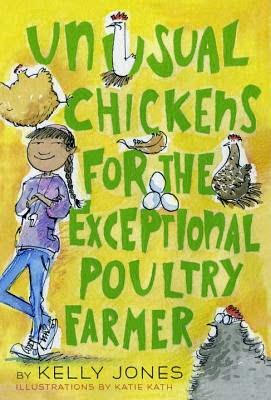
Sophie Brown and her parents have just moved from the bustling city of Los Angeles to a farm in the middle of nowhere California. It was a move partially because of necessity — her dad lost his job and hasn’t been able to find a new one — and partially out of happenstance — Sophie’s dad’s uncle died and left him the farm. So, they’re trying to figure this whole thing out. And it’s not going terribly well. That is, until Sophie discovers a catalog for “exceptional” chickens. Turns out, that Uncle Jim was not only a farmer (he had a vegetable garden and some grape vines) but he raised, well, unusual chickens.

The chickens are not quite magical, and they’re based on real chickens, but they’re not quite normal either. (One lays glass eggs, for example.) Sophie is given instructions by the person who runs the catalog on how to catch and care for the chickens, but someone is trying to steal Sophie’s chickens. The question is: will she figure out how to keep the chickens (without divulging their magical properties)? And can she stop the thief from stealing her chickens?

The cleverest thing about this book is the format: Sophie’s story spills slowly over the course of the book through letters she writes to her dead abuela, dead great-uncle Jim, and the chicken place. (It’s kind of unusual her writing to dead people, but it works. She doesn’t really expect an answer back.) It’s a very one-sided story, and we only get snippets of things other than chickens: her mother’s free-lance writing, or her father’s failing search for a job. But, the tone is light, and there is a mystery to be solved with the chicken thief. But what really comes through is Sophie’s voice. She’s a determined child, someone who is willing to figure things out and solve problems. She’s spunky. And she’s half Latina. All of which makes for a charming book, a fun read, and a book worth checking out.

Uprooted

by Naomi Novik
First sentence: “Our Dragon doesn’t eat the girls he takes, no matter what stories they tell outside our valley.”
Support your local independent bookstore: buy it there!
Review copy given to me by the publisher rep.
Content: There’s one graphic, but not explicit, sex scene. It’ll be in the science-fiction/fantasy section of the bookstore.

I picked this one up because our Random House rep said it was based on Beauty and the Beast, and we all know how much I love a fairy tale retelling. But, I didn’t count on how engrossing this book would be.

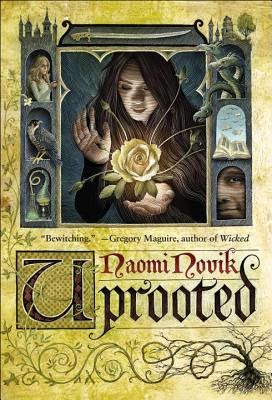
The rep was right: it is loosely based on Beauty and the Beast, but it’s so much more than that. In this valley in Polyna, their resident wizard, who goes by the Dragon, takes one girl every ten years to his tower. When he’s done with them, they don’t come back to the villages, so everyone (of course) assumes the worst. This year, a picking year, everyone guesses that he will take Kasia, our narrator’s, Neishka, best friend. But the Dragon comes, and he picks Neishka instead.

At first, this is terrifying: Neishka isn’t refined, she isn’t skilled for much of anything (except getting dirty), and she doesn’t want to be in the castle with this scary magician. But, as the book goes on, she discovers hidden talents inside herself: she’s a witch, one that is just as powerful as the Dragon, albeit wielding a different sort of magic from him. And its the combination of their magic that is able to confront the real evil in their country: the Wood.

I don’t want to give away much more than that, because this one is best discovered page by page. Novik has a way of pulling one into the story; this started out as a treadmill book (read twice a week for a half hour), but soon became the one I was spending all my time with. I wanted to experience Neishka’s story as it unfolded, with all the twists and turns and slow reveals and intricate pay offs.

M texted, recently, looking for a “Laini Taylor-esque” book, and honestly, this is what I thought of when she asked for that. Novik’s world-building is solid and always in the service of the story, rather than something separate. And, while her words aren’t gorgeous or lyrical, they’re more than pedestrian. They serve the characters and the plot, and make the whole work together just marvelously.

Just about perfect.

Circus Mirandus

by Cassie Beasley
First sentence: “Four small words.”
Support your local independent bookstore: buy it there!
Review copy provided by the publisher. (Plus: popcorn!)
Release date: June 2, 2014
Content: It’s kind of slow, and definitely heavy on the exposition, which may make more reluctant readers, well, reluctant to give it a try. But I’m assuming there will be gorgeous art throughout (I haven’t seen it yet), and so there’s that to give it a boost with those who like pictures with their books. It’ll be in the middle grade (grades 3-5) section of the bookstore.

Micah has been raised by his grandfather since his parents died when he was young. He’s had a good life; his grandfather is one of those Good people who know how to be happy. He was also a storyteller, raising Micah on stories of the grand Circus Mirandus and the Lightbender, who promised Micah’s grandfather a miracle.  Now, when grandfather’s health is failing, he calls in the Lightbender’s miracle. But getting that isn’t as easy as all that. And it’s up to Micah (and his friend Jenny Mendoza) to help grandfather get the miracle he deserves.

I am not a critical reader. I fall head first into stories, and they either work for me or they don’t. I don’t stop to think much about a deeper meaning, or issues, or (sadly) stereotypes and cliches. I like characters (or not), I like the plot (or not), I like the writing (or not). And so, I find myself loving books and not having a real “reason” for it.

This is one of those books. I loved it. Wholly and unabashedly. I fell into the magic and the suspension of disbelief. I understood the magic and the story that Beasley was trying to tell. I cried at the end. I am not sure I’ve felt this in love with a book since I read the first Penderwicks. This book? This book is my people.

I loved it. I loved the Big Fish-esque feel of the story. I loved Micah and his grandpa’s relationship. I loved the flashbacks to grandpa’s time with the circus. Yeah, so some of the characters — Aunt Gertrudis, especially — were pretty much caricatures, but so is Trunchbull in Matilda, and no one complains about that. I loved that Jenny was smart, and that they were just friends and that she wasn’t a romantic interest. I loved her skepticism, and her belief in her friend (if not in the magic). I loved the whimsy of the book. But most of all, I loved the heart of it. It has such a big heart.

I’m sure there are drawbacks, and people who this book won’t speak to. But, for me, this was a little slice of perfection.

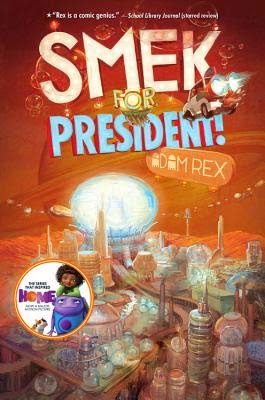
Audiobook: Smek for President

by Adam Rex
Read by Bahni Turpin
Support your local independent bookstore: buy it there!
Content: Nothing. Nada. Some fake swearing (“pardon my language”). The audio version is probably good for kids who have an attention span longer than 20 seconds; the book is in the middle grade (grades 3-5) section of the bookstore.

I loved the audiobook of The True Meaning of Smekday, so when I heard that Bahni Turpin was doing the sequel, I KNEW that was how I needed to experience this book. And I was right. Turpin is perfect for this. Seriously.

The story picks up a year and a half after Gratuity “Tip” Tucci and J. Lo save the world. The Boov have moved to New Boovworld, on one of Saturn’s moons. J. Lo and Tip are hanging on Earth, trying to get used to having Tip’s mom around. And, for J. Lo, trying to to fit in. They need a break, and so J. Lo soups up their car, Slushious, and they head off-world to check out the new Boov homeland. Since they saved the world, they’ll be welcomed as heroes, right?

Well, no.

Things don’t go quite like they planned. J. Lo is named Public Enemy Number One, and thrown into jail. Tip repeatedly avoids being captured, but only just barely. Which sends her on an adventure through New Boovworld. She meets and befriends a delightful flying billboard, whom she names Bill (of course), as well as several other Boov (and one human; Dan Landry’s son), in her attempts to free J. Lo and set everything right. There’s a lot of action, tons of humor, and a bit of time travel in the mix.

But what really made the book was Turpin. I adore her reading style, and it’s perfect for Adam Rex’s humor. I was chortling, guffawing on occasion, and I was thoroughly charmed by all the Boov voices (with their distinctive quirks). I was pleased to see that the Chief was back (if only in Tip’s imagination), as well as other favorite characters from the first book. I loved how Rex imagined New Boovworld. And it was satisfying (as a parent) to see that there were real consequences for Tip’s actions.

In short: I adored it.