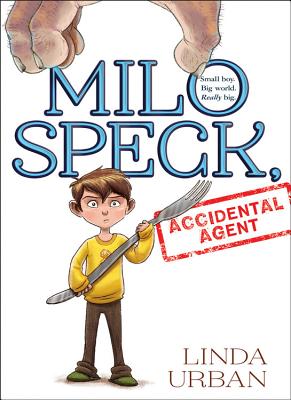
Milo Speck, Accidental Agent

by Linda Urban
First sentence: “Milo had read about magic before.”
Support your local independent bookstore: buy it there!
Review copy pilfered off the ARC shelves at my place of employment.
Content: There’s nothing objectionable, and the writing level is good for grades 3 and up. It’s in the middle grade section (grades 3-5) of the bookstore.

Milo’s mom disappeared years ago, and his father works really hard for the Tuckerman Agency. Which means that Milo is left mostly alone with “Grandmother” (a live-in provided by the agency). Milo’s lonely, but he does his best to fly under the radar. That is, until the day that he ends up sucked in to Ogregon through his dryer.

(Yes, you did read that right.)

Once there, Milo is unprepared for the adventures: being captured by ogres, the Evil Plots by the Evil Overlord, rescue attempts, and just general mayhem.  Plus trying to figure out where his father is. It’s a lot for a kid to handle.

It was a fun little book. Nothing too great, nothing too horrible. I did have a problem with Tuck; she was pretty annoying and she never really got better throughout the book. And it was all a bit silly, but I’m not the target audience. Perhaps this is one of those that kids will like — especially those who like monsters and adventure — but for me it was just meh.

Which is too bad. I had high hopes for this one.

(Just for the record: because this is a Cybils nominee, I’ve been asked to make sure y’all know this is my opinion only, and not that of the panel.)

Jinx’s Fire

by Sage Blackwood
First sentence: “Sticking to the path won’t always take you where you need to go.”
Support your local independent bookstore: buy it there!
Others in the series: Jinx, Jinx’s Magic
Review copy pilfered off the ARC shelves at my place of employment.
Content: There are some scary moments, but mostly it’s good for the fourth-grade and up crowd. It’s in the middle grade section (grades 3-5) of the bookstore.

Things aren’t looking good for Jinx and his friends. The Urwald is surrounded by warring armies — one of which is headed up by Jinx’s former friend, Reven. The Bonemaster is up to something, but Jinx doesn’t know what. And Simon is still trapped in goo, and it’s not looking good. The question is: how will Jinx solve everything and keep the Urwald (and the trees) safe, especially when he’s not very good at diplomacy?

Sometimes, an ending comes along that is just. so. perfect. that you have to love it. While it took me a bit to get into this one (being quite a long time since I’d read the other two), once I did, I fell again into loving the world that Blackwood created. I love Jinx and his grumpy demeanor. I love his friends, especially Elfwyn. I love the adventures that Jinx went on and the way Blackwood had him solve the problems he created. I adore the magic and the way Blackwood used it.

But, mostly I loved how Blackwood wrapped everything up, satisfyingly but not so neatly that it was implausible.

This series is definitely worth reading.


The Martian

by Andy Weir
First sentence: “I’m pretty much f***ed.”
Support your local independent bookstore: buy it there!
Content: As you can tell from the first sentence, the big content issue with this book is LANGUAGE. If you have problems with that, then this book isn’t for you. It’s in the science fiction section of the bookstore.

Mark Watney was one of six astronauts sent to Mars as part of an exploratory and scientific mission. He’s a botanist and was trained to be the fix-it guy, and he was expecting to spend 31 days on the planet with his crewmates and then head home. Then, six days in, a storm kicked up, and an accident happened and he was considered dead. So, the captain made the decision to leave him. Turns out, though, that he wasn’t dead.

Thus starts 368 pages of the best problem solving novel I’ve ever read. Seriously. Weir throws all sorts of things — most of them being normal, every day sorts of things; there’s not many super extreme situations here — at Watney and has him figure out how to survive. You wouldn’t think it would make for a fascinating, gripping novel but it does. Part of this is because Watney is a hilarious (if foul) narrator. He’s SO snarky, and laugh-out-loud hilarious, which helps diffuse the tension in the novel. It also makes it a very practical book, which makes me wonder how much of it is actually accurate science. (I gather, from the author notes at the end, quite a lot.) I kept turning the pages (and staying up late) wondering just what the heck was going to happen next.

I don’t usually go in for books that have a lot of hype or even a movie coming out, but this one is definitely worth all the buzz surrounding it.

Zeroes

by Scott Westerfeld, Margo Lanagan, Deborah Biancotti
First sentence: “More coffee?”
Support your local independent bookstore: buy it there!
Review copy pilfered from the ARC piles at my place of employment.
Content: There’s some talk of drug use (none of it by teens), a smattering of mild swearing, and one (unnecessary, misplaced, and kind of glaring) f-bomb.

Who are the Zeroes?

They are six teenagers, all born in the year 2000, who have discovered, over the years that they have extra-ordinary powers. Bellwether can charm a crowd of people into believing whatever he wants them to. Crash is bothered by electronics, and she can make entire systems, well, crash. Flicker is blind, and yet she can see through every one else’s eyes. Anon isn’t invisible, but he is easily forgettable; his parents once forgot that he was deathly ill and left him (to die) in the hospital. Scam has this voice inside him that can talk anyone into anything he wants, which is what gets all the Zeroes into trouble.

With Mob, who can control a crowd’s mood, and her father, who is in deep with the Russian mob.

The question is: will the Zeroes be able to help them? Or are they just going to make things… worse?

It’s kind of hard to juggle multiple points of view in a book, and in this one they tackle six of them. Some of them — Anon, Flicker, Scam, and Mob come out with the best story arcs in the book — are really well developed. Others — Bellwether and Crash — aren’t so much. But, for the most part, the flipping between people helped push the story forward, and I found that I didn’t mind seeing the action from different perspectives.

And the story was pretty seamless, considering there were three authors writing. I was worried that it would be choppy, but whatever they did — editing, lots and lots of rewriting — worked.

It’s definitely a ton of fun.

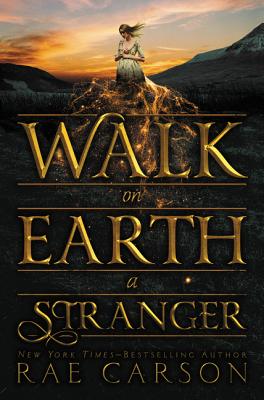
Walk on Earth a Stranger

by Rae Carson
First sentence: “I hear the deer before I see him, though he makes less noise than a squirrel — the gentle crunch of snow, a snapping twig, the soft whuff as he roots around for dead grass.”
Support your local independent bookstore: buy it there!
Review copy picked up at Children’s Institute and signed by the author (who I fangirled over).
Content: There’s some violence, including a few deaths, and some talk about sex (but none actual). It’s in the YA section (grades 6-8) of the bookstore.

Leah Westfall has a talent for finding gold. Well, maybe more than a talent: she can magically sense gold out in the wilderness. But, in northern Georgia in 1849, gold is getting pretty scarce. Even so, she and her parents get by. She’s fairly content. Then, her parents are brutally murdered by a man wants to control her “talent”, so she disguises herself as a man, runs away and head for the place where gold is most plentiful: California.

That’s basically the premise, as this book is primarily concerned with Leah’s — Lee’s — journey getting to California. It’s full of action and suspense, but it’s ordinary action and suspense. Robbers, rough rivers, threats from the known and unknown. It doesn’t seem like much, but it kept me turning pages.

This book deviates from Carson’s other works in that it’s more of a historical fiction piece and less of a magical one. Sure, Lee has magical abilities. But (so far), that’s the only magic. The rest of it, from the inherent sexism and racism to the trials they face while crossing the plains is historical. Even though I like Carson’s magic, I think I enjoyed this one more because the magic was so understated. It did help Lee out, on occasion. But for the most part, she was making her own way on her own terms. Which was awesome.

The other thing is that this is the first of a projected trilogy, but I have no idea where Carson is heading. Sure, the Big Bad isn’t taken care of, but he wasn’t a real threat in this novel either. I was actually content with the way this one ended: Lee survived the journey, she got to California, she can live happily ever after. However, I will follow Carson down whatever road she wants to take, and I wouldn’t mind reading more of Lee’s story at all.

Crenshaw

by Karherine Applegate
First sentence: “I noticed several weird things about the surfboarding cat.”
Support your local independent bookstore: buy it there!
Review copy snagged off the ARC shelves at my place of employment.
Content: There’s some difficult things for the younger set to handle, but Applegate handles them at an age-appropriate level. There’s larger print, a lot of white space, and illustrations as well. It’s in the Middle Grade (grades 3-5) section of the bookstore.

Jackson has had a bumpy life. His parents are musicians, which isn’t the most stable job, and his dad has MS. They’ve managed okay, mostly; though there was the one time when they were living in their van for a few months. It was during this time that Jackson’s imaginary friend, a huge cat named Crenshaw, showed up.

For the past few years, though, they’ve been pretty stable. Except things are going downhill again. How does Jackson know? Crenshaw has showed up again.

The question is: what can Jackson do about the piling bills, and the growing sense of helplessness that he feels. The answer may lie with Crenshaw.

I wanted to love this one. I really did. I adored The One and Only Ivan, loved Applegate’s simplicity in relating a story. But this one kind of fell flat. It wasn’t Jackson’s story: I feel that his story, the one of good people who just can’t make ends meet, is one that needs to be told. But I never could quite figure out what Crenshaw was doing there. Or why he was necessary. To add a bit of levity? To help Jackson? It never quite felt right, felt seamless to me.

That said, Applegate does know how to tell a story; it wasn’t so bad that I didn’t finish it. It just felt a little… off.. to me. Which, in the end, was disappointing.

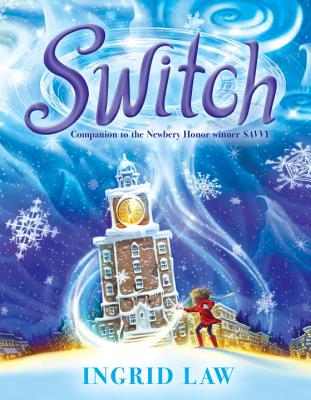
Switch

by Ingrid Law
First sentence: “Please, Mrs. Foster– I’ve seen your future, and you really don’t want to buy this soap.”
Support your local independent bookstore: buy it there!
Review copy provided by the publisher rep.
Others in the series: Savvy, Scumble
Content: It’s pretty basic for younger kids (though I think it might be a handful for some 3rd graders), and though there’s some kissing and a little bullying and some scary driving in the snow, it’s mostly harmless. It’s in the Middle Grade (grades 3-5) section of the bookstore.

One of the things I like best about Law’s books is that even though they’re a trilogy, they’re also three stand-alones. Sure, it helps if you know what a savvy is and what scumbling means, but other than that, the whole story is basically self-contained. And that’s wonderful.

This one is Gypsy’s story (who was a wee babe in the first book). It’s a couple months after Gypsy gets her savvy, which is seeing a person’s future (or past) when she looks at them. It’s a tough one to scumble, but she’s trying. Then comes the news that her Grandma Pat (her dad’s mom, one without a savvy and who doesn’t really like the Beaumont kids) is deteriorating and needs to come live with them. This is not something that Gypsy is happy about; she and her grandma don’t really get along. But, she doesn’t have much say in the matter, so she’s dragged along to Colorado when her mom takes her and her brothers Samson and Tucker off to Colorado to fetch Grandma Pat.

And that’s when things get interesting: somehow their savvys are switched. Mom is no longer perfect, Samson went from being invisible to being the Lord of the Fire, and Tucker, who is only eight, got his savvy five years early. And Gypsy discovers she can stop time. Then Grandma escapes the house (she has Alzheimer’s and is determined to go to a school dance) in the middle of a blizzard and it’s up to Gypsy, Samson, Tucker, and their new friend Nola to bring her back.

It had very much the same feel as Law’s other books: sweet, family-centric, with a bit of unbelievableness thrown in. I had a hard time suspending my disbelief: why on EARTH were they wandering around in Denver during a BLIZZARD? But, aside from that I loved Gypsy and Samson (and Tucker was adorable, though acted a bit young for an eight-year-old; he felt more like five). I liked the story, I liked that most of the book was over one night, and I liked that Gypsy learned to understand and accept her grandmother for who she was, not who Gypsy wanted her to be.

I’m not sure it’s my favorite of the series, but it’s a solid addition.

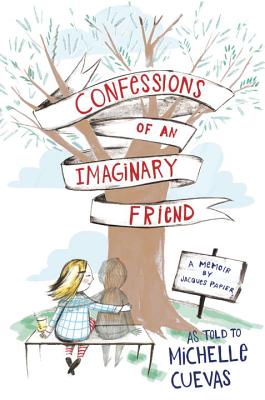
Confessions of an Imaginary Friend

A Memoir by Jaques Papier
by Michelle Cuevas
First sentence: “Yes, world, I am writing my memoir, and I have titled the first chapter simply this: EVERYONE HATES JACQUES PAPIER.”
Support your local independent bookstore: buy it there!
Release date: September 4, 2015
Review copy provided by the publisher rep.
Content: Aside from a few big words, this one is written at an 8-year-old’s level. I’d give it to 3rd-graders and up. It’ll be in the Middle Grade (grades 3-5) section of the bookstore.

For all eight years of his life, Jacques Papier has been happy. He has a wonderful twin sister, Fleur, and even though is parents seem to ignore him and the weiner dog, Francois, hates him, he’s pretty happy. Then one day, in second grade, his is forced to face this realization: he’s imaginary. This sets off both an existential crisis and an adventure as Jacques figures out what to do now that he’s no longer “real”.

It’s a pretty simple premise, but Cuevas executes it brilliantly. It’s framed as a memoir, and her voice for Jacques is spot-on. I love the other imaginary beings he comes across in his travels, and the way he becomes the imaginary friend of several other children. It’s scattered through with drawings (I think done by the author), which just adds to the whimsy of this one. And the ending is incredibly sweet without being too saccharine.

I adored it.

The Wand & the Sea

by Claire Caterer
First sentence: “Holly Shepard was unlike most twelve-year-olds in that she didn’t at all mid sharing a cramped cottage bedroom with her pudgy, snoring, laptop-loving younger brother.”
Support your local independent bookstore: buy it there!
Others in the series: The Key & the Flame
Review copy provided by the author’s publicist.
Content: It’s kind of slow to start, and the fantasy is more Narnia-esque than Harry Potter or Percy Jackson. Even so, there’s nothing content-wise, and if there’s a 9- or 10-year-old who likes Narnia, they’ll probably love this. It’s in the middle grade (grades 3-5) section of the bookstore.

It’s been a year since siblings Holly and Ben and their British friend Everett have been to the magical land of Anglielle, where Holly can do magic, and where they’re caught up in a good versus evil battle. They’re determined to get back, but this time, the portal they used before won’t work. This time, it’s the water element that’s highlighted. This time, they need to rescue their friends, who have been imprisoned by the king, and try and find the other adepts, who have been exiled from Anglielle.

Of course, it’s not a simple thing: Everett is still playing the role of the sulky somewhat traitor (think Edmund), the prince Avery’s loyalties are still in question. They do meet a group of pirates, on the ship the Sea Witch, that are quite fascinating. And when Holly finally confronts the Big Bad Guy, it’s pretty intense.

I went back and re-read my review/reaction to the first book in the series, and it seems I liked it. I had a less positive experience this time around; the first book didn’t stay with me as much, and it’s been a couple of years, and it took me longer to get into this story. Still, it’s channeling Narnia quite well, and in the end, the adventure was satisfying, while leaving room for another sequel. (I’m starting to suspect there will be four in all; one for each element.)

Not bad, overall.

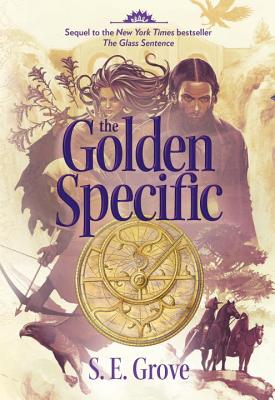
The Golden Specific

by S. E. Grove
First sentence: “Dear Shadrack, You ask me for news of the Eerie, and I can tell you that there is no recent news of them in the Indian Territories.”
Support your local independent bookstore: buy it there!
Others in the series: The Glass Sentence
Review copy provided by the publisher rep.
Content: It’s a long book, and it’s one of those that take some investment. Probably not for the younger end of the middle grade spectrum, even if it’s in the Middle Grade section (grades 3-5) of the bookstore. I’m actually wondering if these might do better in the YA (grades 6-8) section, with the Philip Pullman books…

I’ll be honest: I don’t really remember what happened in the first book. The good thing? You don’t really need to. There’s no real sum-up at the beginning (thank heavens!) but you get the sense, fairly quickly, about what’s going on. And Grove is nice enough to let us know what we need to know as the book progresses.

Which helps, because there are three story lines going here. One is Sophia’s continuing quest to figure out what happened to her parents 10 years ago. This involves going to restricted libraries and ending up across the Atlantic (accidentally by herself) in the Papal States, looking for the lost land of Ausentintia. (I read that Austen-tia every. single. time.) Her adventures there are weird and wild, and the way Grove messes with time, religion, and fantasy are quite mesmerizing. She makes new friends, particularly Errol and Goldenrod, who are fascinating additions to the world Grove has built.

The second story line is related: it’s the diaries that Sophia goes looking  for, the writing of her mother that Sophia was looking for. (This is a second in a trilogy, so there’s a lot of loose ends.) This was the least interesting part to me; yeah, I was curious about Sophia’s parents, but not especially invested in their journey, so to have the story I was interested in interrupted with this one was a bit annoying.

The third — and my favorite this time around — story line was that of Theo, who stays behind in Boston, and attempts to prove that Sophia’s uncle Shadrack didn’t, in fact, kill the prime minister. It’s a fascinating plot line, full of deceptions and intrigue. Additionally, it has the most intriguing characters; Theo’s new friend, Nettie, is the daughter of the police inspector, and absolutely delightful.

I don’t know if it’s as strong as The Glass Sentence was, but I do think that this will be a compelling series once it’s completed.