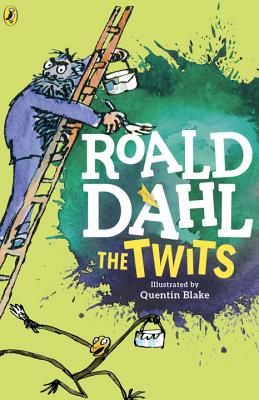
The Twits

thetwitsby Roald Dahl
First sentence: “What a lot of hairy-faced men there are around nowadays.”
Support your local independent bookstore: buy it there!
Content: This one’s slim, with lots of illustrations and simple words. It’s perfect for those younger readers who want an introduction to Dahl and for reluctant readers. It’s in the middle grade (grades 3-5) section of the bookstore.

For the record: I’m beginning to think that Dahl wrote kids books so he could be grumpy about parenting and social trends and disguise it as “humor” for kids.

This time, he’s upset about beards, about cruel adults (he’s always upset about cruel adults; I also think he thinks most adults are cruel), and about the mistreatment of animals (which is a new one).

The plot: the Twits are horrible people. They’re ugly (as are all horrible people in Dahl’s books), they treat each other horribly, they treat their pet monkeys abominably. and then they get their comeuppance. End of story.

And yet, it was funny. The Twits’ pranks on each other were pretty silly and (mostly) harmless. The way the monkeys got back was absolutely brilliant (if implausible), and I admit, I did laugh. (K on the other hand, would HATE this book. She has a real problem with humor at the expense of other people.)

I’ll be interested to see what the kids think of it at book group.

The Ask and the Answer

askandanswerby Patrick Ness
First sentence: “‘Your noise reveals you, Todd Hewitt.'”
Support your local independent bookstore: buy it there!
Others in the series: The Knife of Never Letting Go
Content: There’s some violence, but nothing gory, and there’s a few mild swear words. It is, however, not for the faint of heart. It’s in the Teen section (grades 9+) of the bookstore.

Spoilers for the first one. You’ve been warned.

Todd and Viola thought they were going to find relief in Haven when they got there. What they found, though, was that Mayor Prentiss had beat them there, taken over the town in a bloodless coup, and is in power. Scary.

He separates Todd and Viola, taking him under his wing and threatening her life if he doesn’t comply. He sends Viola to live with the women in the healing houses. Where she meets the leader of the resistance, Mistress Coyle, and becomes involved with them. Neither one knows, for a good portion of the book, whether the other is alive. The only thing they do know is that they can’t trust anyone.

It’s a harrowing book: there are abuses towards women and towards the alien Spackle. And I can see what Ness is doing here: how many people do what their awful leaders tell them to do just because it’s the path of least resistance. And whether or not people fighting against a dictator can be consider terrorists. Like the first one, there’s a lot to think about. And even though it’s good, I found it hard to get through. Mayor Prentiss is a despicable character (maybe not as bad as Leck, but close) who does awful things and it made this book difficult to read, emotionally.

Which means, I think, that Ness did his job. And I’m wondering where the last book will go.

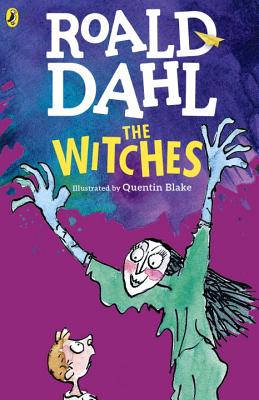
The Witches

witchesby Roald Dahl
First sentence: “In fairy-tales, witches always wear silly black hats and black cloaks, and they ride on broomsticks.”
Support your local independent bookstore: buy it there!
Content: It’s not as scary as I thought it would be, and surprisingly simple for the size. Heads up, though: grandma smokes a cigar. It’s in the middle grade (grades 3-5) section of the bookstore.

So, I remember reading this one at some point, and I had a violently negative reaction to it. I HATED it. So, I was a bit wary going in this time. But, since I picked this for the Roald Dahl book club, I needed a re-read going in.

And it’s…. weird. I was asked if it was “good”, and I said “It’s weird.” “Does that mean it’s bad? ” Nope. Just weird.

The basic plot? There are witches out there, and they look like us. Except they always wear gloves, and a wig (to cover their bald heads) and the have no toes. They hate children and make them disappear. They are, at all costs, to be avoided. So when our narrator (whose childhood sounds suspiciously like Dahl’s), accidentally ends up in a ballroom full of witches, he’s (understandably) terrified. Especially after he hears their master plan for the children of England: make a time-release mouse potion, put it in candy, and voila! No more children. They’ll all be mice.

Except our narrator doesn’t make it out in one piece: he’s caught and turned into a mouse. But, he can talk and he can still think like himself so he goes and convinces his grandma that he’s still her grandson. And informs her of the Grand Plan. Which they, unbelievably, thwart. But our narrator remains a mouse, which is just fine with him because then he won’t outlive his grandma.

Weird.

There are the usual Dahl themes: adults hating kids, and good kids being bullied (by the witches). But it really feels different from the other ones I’ve read. Matilda is darker, and Charlie is more didactic. I’m not quite sure what The Witches is other than… weird.  Was it supposed to scare kids? Was it supposed to just be amusing? (It wasn’t.)

This one’s going to be an interesting discussion at book group.

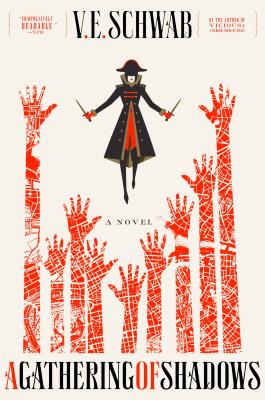
A Gathering of Shadows

gatheringofshadowsby V. E. Schwab
First sentence: “Delilah Bard had a way of finding trouble.”
Support your local independent bookstore: buy it there!
Others in the series:  A Darker Shade of Magic
Content: There’s violence, some mild swearing, and a couple of f-bombs. It’s in the Science Fiction/Fantasy section of the bookstore, but would be good for high schoolers as well.

It’s been four months since the end of Darker Shade and Lila has moved on. She secured a position on a ship (well, secured makes it sound like she wasn’t underhand in the dealings…) of a privateer. She’s enjoyed her time at sea, developing an intriguing relationship with the captain, Alucard Emery. Among other things, he’s taught her magic. And with the Essen Tasch — magic games between three countries — coming up, she’s intrigued. So much so, that she finds a way to get into the games.

Kell, on the other hand, has felt his life constrict. He is not trusted by the king, who has increased the guards around the king. He and Rhy are not prisoners, but close. So, when Rhy comes to Kell with an idea — compete in the Essen Tasch — Kell is intrigued. And, eventually, convinced.

A quick side note — much more than the action-packed first novel, this one felt like it was full of exposition. We learn about Lila learning magic. We read about Kell’s restlessness. But nothing much happens. And, I have to admit that I lost patience with that.

That said, I did finish it, and the ending was, well, a lot more exciting than the rest of the book. And I’ll probably read the next book.

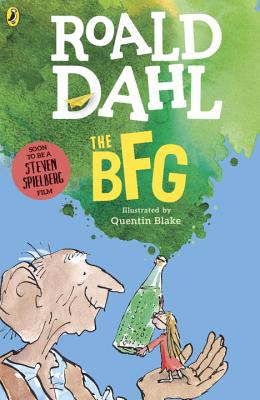
The BFG

thebfgby Roald Dahl
First sentence: “Sophie couldn’t sleep.”
Support your local independent bookstore: buy it there!
Content: There’s a small bit of violence, but for the most part, it’s easy enough for the youngest of the grades 3-5 set. It’s in the Middle Grade section of the bookstore.

Sophie is up late one night in her orphanage when she sees something coming down the street. That something turns out to be a giant, who plucks her out of the orphanage and takes her back to his land. He says it’s because he needs to keep her safe,  because there are other, bigger, badder giants around. And he’s not wrong: the giants back at the stomping ground ARE bigger, badder and meaner.

(And that’s where Dahl’s overall themes come in: the BFG is the “runt” of the pack and is constantly being picked on. He’s also more evolved, and smarter, and just better than those bullies.)

Sophie experiences life with the BFG, and together they decide that the other giants need to be stopped (mostly because they eat children; though the BFG’s argument for it was pretty persuasive…). So they go to the Queen (really, my favorite part), convince her of the existence of the giants, and get her help in stopping them.

Perhaps it’s just the order I’ve read these, but this one is now my favorite. I loved the Seuss-like wordplay that went on with the way the BFG talked. I liked the friendship between Sophie and the BFG, and I thought their solution to the problem was pretty ingenious. It’s a delightful book, much less dark than Matilda or as mean as Charlie. So far, this one is the best.

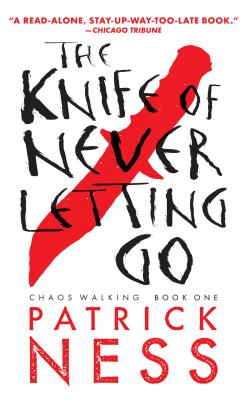
The Knife of Never Letting Go

knifeofneverby Patrick Ness
First sentence: “The first thing you find out when yer dog learns to talk is that dogs don’t got nothing much to say.”
Support your local independent bookstore: buy it there!
Content: There’s the anxiety factor plus a lot of violence plus the f-bomb a couple of times (though the main character says “eff” a lot). It’s in the Teen (grades 9+) section of the bookstore.

Todd is the last boy in Prentisstown in the New World. He’s waiting for his thirteenth birthday, which will come soon, and then he will become a man and join the other men in the town (and there’s only men). It’s an interesting place, this New World — there’s a virus that makes men’s thoughts (and only men, not women) audible, so not only is there no secrets, it’s chaotic hearing everyone else’s thoughts. But, as Todd is out gathering apples in the swamp, he encounters something he’s never experienced before: silence. Quiet. A gap in the Noise which turns out to be a girl.

Viola is part of a new wave of settlers to the New World, on the initial scouting ship. Her parents died in a crash, and when she finds Todd, she’s on the run from Aaron, who is Prentisstown’s fanatic religious leader. Then Todd is sent into exile and he and Viola are on the run, one step ahead of not only the insane Aaron, but the controlling mayor of Prentisstown and his army of fanatics.

There’s way too much to unpack in this novel in a blog post. Seriously. I’m glad I’m reading this as part of a book group, because I don’t think I could even begin to process it on my own. It’s a weird sort of mix between old-timey (the book is in a sort of dialect) Western and science fiction-y futuristic. It’s a survival story with a hint of dystopian. It’s weird and wild and gave me anxiety over and over again (!) and I practically read the whole 480 page book in two sittings. It’s engrossing and there’s so much to discuss. And even though it was written eight years ago, it’s still so very relevant.

My only complaint? The cliffhanger ending. ARGH. I’m just glad I can pick the next book up and read it right away, and I don’t have to wait for it to come out.

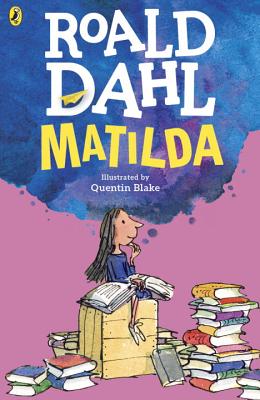
Matilda

matildaby Roald Dahl
First sentence: “It’s a funny thing about mothers and fathers.”
Support your local independent bookstore: buy it there!
Content: It’s a bit longer than Charlie, and a bit more complex. But, that said, I’d give it to a confident 8-year-old reader. It’s in the middle grade (grades 3-5) section of the bookstore.

So, I’ve read this one before, but it’s been years and years and years and even though I’ve watched the movie a bunch (it’s one of my girls’ favorites), I wasn’t quite prepared for how DARK Matilda is.

I mean, all the usual Dahl themes are there: a powerless, nice child (not poor, though that comes with Ms. Honey) is bullied (by her parents and other adults) and discovers something grand within herself in order to overcome. But, the adults are beyond awful. They’re abusive. The Wormwoods (who are hilarious in the film) are corrupt and neglectful. But, it was Miss Trunchbull, who I always condered just an annoyance, who really got me this time. She’s not annoying: she’s an abuser. And perhaps it’s where I am in my life, but that didn’t sit well with me. I’m not entirely sure why; Matilda and Ms. Honey have a happy ending, after all, and Miss Trunchbull (not to mention Mr. Wormwood) get their comeuppance. But, it kind of rang hollow for me.

That said, it’s also not as funny (or at least clever) as Charlie and the Chocolate Factory.  It was sweet — both Matilda and Ms. Honey are sweet characters amid all the lame, awful people — but it wasn’t clever. (Dark undertones!) I did enjoy it, but I’m not sure it’s my favorite. (Then again, I still have four more books to read this summer.)

The book group discussion, however, was fantastic! I had 20 kids ranging in age from 5 to 12, and they all had amazing things to say. One boy said he had read it eight times, and had some smart thoughts on it. As did many others. We talked about favorite characters and whether the Wormwoods were funny (yes) and whether Mr. Wormwood deserved the pranks (yes!). Ms. Trunchbull was deemed to be too mean to be funny, though one girl insisted that her parents would have believed her if she had told them what Ms. Trunchbull was doing. We talked a lot about the chocolate cake, and many pointed out that an 18-inch cake really isn’t that big. One girl said it was “just right”. And my favorite comments were when we were talking how Dahl makes ugly=mean and beautiful=good. One girl pointed out that ugly people can’t help being ugly and that they could be nice and beautiful people can be mean. And another girl said that maybe Dahl was just trying to make the character’s inward ugliness show outward. Both excellent.

So, maybe not my favorite, but it was a great discussion.


Charlie and the Chocolate Factory

charlieandthechocolatefactoryby Roald Dahl
First sentence: “These two very old people are the father and mother of Mr. Bucket.”
Support your local independent bookstore: buy it there!
Content: There’s one swear word (which caught me off guard!), but other than that, it’s okay. It’s pretty basic and is in the middle grade (grades 3-5) section of the bookstore.

It’s been a long time since I’ve read this; I’m not entirely sure when the last time I opened this one. Sure, I know the story, but I don’t know when I’ve interacted with the words last.

It’s weird. And kind of mean, if you think about it. Dahl sets up such an extreme: Charlie is beyond dirt poor and the others are so well off comparatively. Are Violet, Veruca, Augustus, and Mike spoiled, really? Or are they spoiled BECAUSE Charlie is their foil? He was such a crank, and that comes through loud and clear. The kids that aren’t Charlie are constantly in need of smacking, and Willy Wonka is downright rude to Mike Teavee often. Maybe he deserves it, and maybe it’s for humorous effect, but I was unsettled by it.

And what is Dahl trying to achieve here? Is he just telling a fantastical, weird story? Or does he have a POINT? (Maybe Mike Teavee’s song is the point:

“So please, oh please, we beg, we pray,
Go throw your TV set away,
And in its place you can install
A lovely bookshelf on the wall.
Then fill the shelves with lots of books,
Ignoring all the dirty looks,
The screams and yells, the bites and kicks,
And children hitting you with sticks —
Fear not, because we promise you
That, in about a week or two
Of having nothing else to do,
They’ll now begin to feel the need
Of having something good to read.
And once they start — oh boy, oh boy!
You watch the slowly growing joy
That fills their hearts.”)

Did I like it? Some of it, sure. I like that Dahl has a Seussian way with language, not letting non-existent words get in his way. But, I’m not sure I really care for this one (and the movies are both quite… weird) very much at all.

My book group discussion was pretty great. I had nine kids, the youngest was 5 (his mother was reading the books aloud to him; she came with as well) and the oldest were a couple of 10 year old boys who were almost too cool at first, but by the end were participating. We had a fun talk about favorite characters and themes and songs and what kind of candy they’d make (ones that looked like broccoli but tasted like candy!). And we designed our own golden tickets as we taste-tested chocolate.

IMG_6874

IMG_6876

It was fun! Next up: Matilda.

The Shepherd’s Crown

shepherdscrownby Terry Pratchett
First sentence: “It was born in the darkness of the Circle Sea; at first just a soft floating thing, washed back and forth by tide after tide.”
Support your local independent bookstore: buy it there!
Others in the series: Wee Free Men, A Hat Full of Sky, WintersmithI Shall Wear Midnight
Content: It’s perfectly appropriate for all ages; no swearing, some drinking by hard working adults, though it might be a bit complex, plot-wise for the younger set. It’s in the YA section (grades 6-8) of the bookstore.

I didn’t think the Tiffany Aching series needed another book to end the series, but since Sir Terry has passed away, and this came out, this one must be read. I did put it off, mostly because if I didn’t read it, the whole thing can’t end. Right?

It’s spare-er than the other Tiffany Aching books, mostly because Pratchett didn’t have as much time to fiddle with it. Still, it has a story with a decent plot, even if it feels somehow less full. Granny Weatherwax has passed on, making Tiffany  her successor, and so Tiffany is trying to balance being the witch of two steads. And her death created in the elf world: the queen is overthrown and the elves are back in the human world making mischief again. It’s a lot for one young woman to handle.

Thankfully, solutions come her way: Geoffry, the son of some lord or another, is much maligned at home, but he leaves and Tiffany takes him on as a helper. It turns out that he’s a great witch. And Tiffany takes in the elf queen once she gets thrown out, and discovers that sometimes the person you’ve always thought of as awful, may not be.

I loved it. I love Tiffany Aching so much anyway, with her practical witchiness (yes, there is magic, but being a witch in this world is such a practical affair). I loved the gender-bendiness with Geoffrey wanting to be a witch (not a wizard, which is what men Traditionally Do), and how the witches just accepted that. I appreciated that Geoffrey got a bunch of elder men, who were generally considered Useless, to help out with the Final Battle. And I loved the end. So much that I cried.

And while I am sad that there really won’t ever be any more Tiffany Aching books, I’m so very happy that Sir Terry thought up this one for us.

The Last Star

laststarby Rick Yancey
First sentence: “Many years ago, when he was ten, her father had ridden a big yellow bus to the planetarium.”
Support your local independent bookstore: buy it there!
Review copy sent to me by our publisher rep.
Others in the series: The Fifth Wave, The Infinite Sea
Content: It’s violent and intense; Yancey pulls no punches. There’s also a lot of (understandable) swearing, including f-bombs. It’s in the Teen section (grades 9+) of the bookstore.

If you can, read them all one right after the other; the impact of this one will be that much greater. Like the past two, I’m not going to go that much into plot; it’s really better if you just hit these as blind as possible.

I re-read my review for Infinite Sea, and my thoughts are mostly the same here. It’s intense. bordering on hopeless. Cassie and Zombie and Evan and Ringer and Sam are trying, against the odds, to prevent the end of the world. In many ways, it’s too late: the aliens have pitted us against ourselves:  if there’s no trust, there can be no civilization. But maybe, just maybe, they can prevent the world from completely imploding — Evan’s assured them that the aliens will start bombing the cities any day now — and keep millions more people from dying.

It was the hoping against hope that got me in this one. I read it slower; in small doses over several days this time because I couldn’t take the building hopelessness: will it work? There’s no glorious Independence Day or Men in Black climax here. Sure, it’s a small plucky (though increasingly small and increasingly desperate) team against incredible odds, but Yancey never shies away from the cost of those odds. I found that I appreciated it very much. It’s an incredibly intense series (I’m actually kind of sad the movie didn’t catch on the way Hunger Games did), and an powerfully written one.

I’m sad to see it end.