Isle of Blood and Stone

islefobloodandstoneby Makiia Lucier
First sentence: “The outing had been planned on a whim; an afternoon lesson up in the ills, away from the smoke and stink of the city.”
Support your local independent bookstore: buy it there!
Content: There is some mild swearing and violence. It’s in the YA section (grades 6-8) of the bookstore, even though the characters are 18/19 years old.

Eighteen years ago, the two princes of Island of St. John del Mar were kidnapped with the chief navigator and their nurse, never to be seen again. The king (and everyone, really) presumed them to be dead and went to war with a nearby island, Mondrago, ravishing it. Fast forward, and the king’s remaining son, Ulises, has become king, and his two friends, Mercedes — half Mondragan and Ulises’ cousin — and Elias, the son of the former chief navigator, have discovered some maps with a riddle about that fateful event 18 years ago. And, at the king’s command, Elias begins to look into it.

What he finds is a complex and tangled riddle, full of lies and information that will shake not only Elias’s beliefs, but perhaps the entire kingdom.

On the one hand: this was a compelling book, and a fantastic idea. I liked both Elias and Mercedes (who were roughly our narrators; it was written in third person, but we never followed Ulises around), and I loved the twists and turns as Elias uncovered information about the princes’ disappearance.

What held me back from really loving the book, however, was that I felt that Lucier told me what was going on rather than showing me. There was a LOT of exposition, and a lot of narrative, which isn’t necessarily bad, but what it did was keep me at an arm’s length. Like, Elias and Mercedes ended up falling in love (mild spoiler), but I had absolutely no connection to that. At all. There were strains of racism and sexism, but I felt like it was all at a distance, and never really connected with any of it.

Which is too bad. I really wanted to love this one.
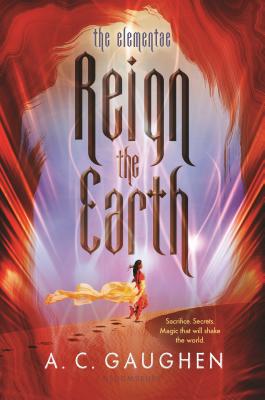
Reign the Earth

reigntheearthby A. C. Gaughen
First sentence: “There was a scorpion in my tent.”
Support your local independent bookstore: buy it there!
Content: There’s violence, including spouse abuse (both verbal and physical). Also, though the main character is 17, she marries a man 10 years older than her. It’s in the teen section (grades 9+) of the bookstore.

The basic plot: a desert girl, whose nomadic country has been at war with a bigger, more powerful, oppressive country, is married off to the king of the country in order to achieve peace. Said peace is only tentative as long as the king is happy (and he’s not often happy, for many reasons) and as long as desert girl keeps her magic powers a secret from her husband.

There’s more to it: including a prophecy and a resistance and a secret love, but really, that’s it.

I’m being a little snarky, but I did like this enough to finish it. I did have a big issue with this: the main character is married to an abusive man. It starts out with him raping her on their wedding night (he kind of couches it in “I don’t want you to be uncomfortable” but he doesn’t really take her comfort into mind) and it just escalates from there. Granted, our main character does, eventually, stand up to him (and he is the “bad guy” of the story), but I couldn’t help but wonder: is this really a book for teens? I don’t mind darkness in books, or even dealing with issues like abusive relationships, but this one felt more… adult than usual. I know the marriage has something to do with it, but I’m not sure that’s all. I don’t know if I can put my finger on it exactly.

Also: I feel like this one could have been better if it were an own voices story. Again, I’m probably nit-picking, but I felt like it was just “desert girl saves white oppressed culture” and not much else.

So, while I liked it enough to finish it, I didn’t love it.

A Winter’s Promise

winterspromiseby Christelle Dabos
Translated by Hildegarde Serle
First sentence: “It’s often said of old buildings that they have a soul.”
Support your local independent bookstore: buy it there!
Review copy provided by the publisher.
Content: The main character is engaged, but other than that there’s nothing “objectionable” (at least that I read). It’s in the teen section (grades 9+) but if a 6-8th grader is interested, I’d give it to them.

When my rep for Europa pitched this book, the first thing I told him was “the cover is awful”. Yes, it fits with the other Europa titles, but, really: what kid is going to want to pick up this book?

But it’s a huge deal in France, he countered. And it’s supposed to be sweeping and epic. So I picked up a few for the store, if only to support Europa’s first foray into young adult fiction. And then I nominated it for the Cybils, so I’d force myself to read it.

And…

Well…

I’m sorry. It’s awful.

I liked Dabos’ world building: she’s imagined a world where there are a bunch of floating “arks” populated by different families with different magical skills. I really  liked our main character, Opheilia’s, magical skill at reading items — she can tell the history of the owner through their items, and she wears gloves so she doesn’t accidentally read other people’s histories without their permission. But, Opheila herself was a huge pushover. I think she was supposed to be cheerily mousy, but instead I just got annoyingly wimpy. She’s been given in an arranged marriage (arranged by the heads of her family, I assume?) to Thorn, who is from the Polar ark (I think), and whose family’s skill has to do with illusion. Except, once on their ark, Sophie finds out that everyone is at each other’s throat and she’s in the middle of it.

At this point, I was more than 200 pages into a nearly 500 page book, and I bailed. It was just going nowhere too slowly for me. The only thing that was holding my attention was the world, and there wasn’t enough of that to make me care enough to keep reading. (And I thought Rowling was overly wordy!) So, I bailed.

But, I suppose, if large, very French, fantasies are your thing, then this one will be perfect. They’re just not my thing.

A Room Away From the Wolves

roomawayfromthewolvesby  Nova Ren Suma
First sentence: “When the girl who lived in the room below mine disappeared into the darkness, she gave no warning.”
Support your local independent bookstore: buy it there!
Content: There is a lot of swearing, including multiple f-bombs, and abuse that could be triggering. It’s in the Teen section (grades 9+) of the bookstore.

This one is going to be tough one for me to sum up, because I am not sure what, exactly, happened. The words were very pretty and I read the whole thing, but I, for the life of me, do NOT understand what happened.

There’s a girl — Bina — whose mother remarried when she was nine to a man with two daughters who were quite abusive to Bina. And so, the summer before Bina turns 18, her mother suggests she leaves. Bina goes to a place in New York City her mother had stayed when she was young, before Bina, the Catherine House. There are 14 girls in the house, where weird things happen, and they try to bring the ghost of Catherine back, and Bina’s super confused, and… I just lost the thread of what was going on.

I suppose this was meant to be a grand metaphor for something, and I’m sure there are people out there who like this atmospheric type of book with a hugely unreliable narrator, and I did finish it, to it’s not terrible.

It’s just that I need someone to explain it to me.

Dry

dryby Neal Shusterman and Jarrod Shusterman
First sentence: ”
Support your local independent bookstore: buy it there!
Review copy provided by the publisher.
Content: There are many intense situations, some reference to drinking and drug use (by adults, mostly), and violence. It’s in the YA section (grades 6-8) of the bookstore.

I will say this up front: this novel is TERRIFYING. The father-son team takes the plausible — what would happen if there was a severe drought in Southern California and then access to the Colorado River was entirely cut off — and turns it into a gripping, thriller-like survival ride, to answer the question: What would you do for access to water?

The story alternates viewpoints between Alyssa, who with her brother Garret, have to figure out what to do when their parents go missing; their neighbor Kelton, a son of a survivalist who has prepared for Times Like These. When things go from bad to worse — let’s just say their other neighbors aren’t forgiving of the fact that Kelton’s family has prepared — they go on the run, nominally to find a place to ride out the “crisis” and pick up two other kids — Henry and Jacqui — on the way. Interspersed are “snapshots” of how the wider community is reacting and gives the reader a bigger picture of how this is affecting the community as a whole.

Shusterman is an incredible storyteller, and he knows how to keep a plot going from page to page. There are funny bits and touching bits and terrifying bits (lots of those actually), and it all felt incredibly realistic. I could see this playing out — especially with the way society is in denial about climate change — pretty much exactly like this. I’ve heard it said that science fiction isn’t about predicting the future, but rather about what it’s happening in the present. If that’s true, then this should be a wake up call to take better care of the planet. Otherwise, this “prediction” might just become reality.

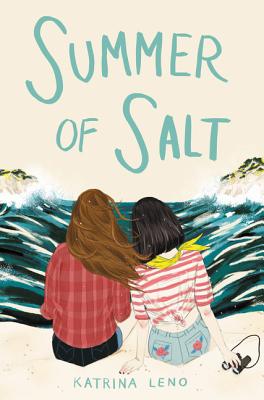
Summer of Salt

summerofsaltby Katrina Leno
First sentence: “On the island of By-the-Sea you could always smell two things: salt and magic.”
Support your local independent bookstore: buy it there!
Content: Lots and lots and lots of swearing, including f-bombs (which seemed really out of place to me; I don’t know why) and some teenage drinking. It’s in the Teen section (grades 9+) of the bookstore.

Georgianna and Mary are twins that have grown up on the island By-the-Sea, daughters of the Fernweh line of women who have, well, magic. It usually manifests at birth, but sometimes takes longer. One of their great-grandmothers, Annabella, has turned into a bird, and comes back every summer to nest and attempt to hatch babies. Except this year.

This is the year that Georgianna and Mary turn 18, the summer before they are destined to leave the island. And everything seems to be going wrong. It won’t stop raining. Mary’s acting strange. And Annabella hasn’t shown up. And Georgianna’s magic won’t manifest itself.

This was an odd book — more magical realism than anything else — but I found myself enjoying it. I loved the matriarchal family, I loved the little island and it’s support of the weirdness that is the Fernweh women. I loved the magic, and now ordinary it was. And I just enjoyed the way Leno told the story.

It was all very charming.

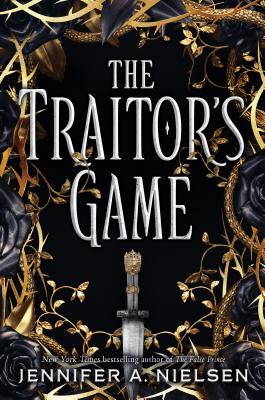
The Traitor’s Game

traitorsgameby Jennifer Nielsen
First sentence: “The truth of where I’d been for the past three years wasn’t what anyone believed.”
Support your local independent bookstore: buy it there!
Review copy provided by the publisher.
Content: There are some intense situations and violence. It’s in the young adult (grades 6-8) of the bookstore.

Kestra Dallisor is the daughter of the second most powerful person in the land. Which makes her highly valuable. She survived a kidnapping attempt three years ago, and has been in exile ever since. Now, as she is summoned back to Antora by her father, she is faced, yet again, with an impossible situation: she’s been kidnapped by rebels, her beloved guard held hostage, and they’ve laid before her an impossible challenge: recover the Olden Blade, the only thing that can kill the immortal dictator of Antora. And do it in three days.

She complies, of course, but not willingly. And the things she discovers as she searches for the Blade are going to turn her world upside down.

I thought this one was a lot of fun! I enjoyed Kestra’s determination and stubbornness and her desire to receive affection from her father. She’s smart and capable and it was quite delightful reading her banter with the other characters (no one was safe from her sarcasm). And there were a couple of twists in there that caught me off guard (happily so) and led the story in interesting directions. It’s the first in a series, so while it has a conclusion, it leaves it open for the story to take off in intriguing directions.

Highly recommended.

The Dark Descent of Elizabeth Frankenstein

darkdescentby Kiersten White
First sentence: “Lightning clawed across the sky, tracing veins through teh louds and marking the pulse of the universe itself.”
Support your local independent bookstore: buy it there!
Review copy provided by the publisher.
Content: There is some talk of violent acts, and one swear word. It’s in the YA section (grades 6-8) of the bookstore.

This book is being billed as a retelling of Mary Shelley’s Frankenstein, but I think it’s more a prequel: the story is of Elizabeth, who becomes a childhood companion of Victor Frankenstein, ostensibly to keep him company, but really to keep his anger and unusual tendencies in check. She is endebted to the Frankestein family for taking her in when she was a small child and basically raising her. And now that they are grown, she feels like Victor is all she has. If she doesn’t keep him in line, she will lose her whole life. So, when he disappears after going away to school, Elizabeth goes after him. And what she discovers is, well, the subject of the classic book.

What this really was (or at least the way I read it) about was the portrait of an abusive man and a woman’s response to it. Victor, if you’ve read the original, is not a nice person. And the way White wrote him, he was never a nice person. And Elizabeth was gaslighted from a very young age. Victor was her world, and the way White portrayed it, that was never a good thing. Or, maybe that’s just the way I read it. Either way, I was angry and disturbed and more angry. It was an interesting book, though: Elizabeth had a phenomenal growth arc, and there were some characters along the way who helped her realize just what an awful situation she was in.

In the end, though, I couldn’t get past the abusive relationship at the heart of it, and the book just made me angry. Maybe that’s a good thing?

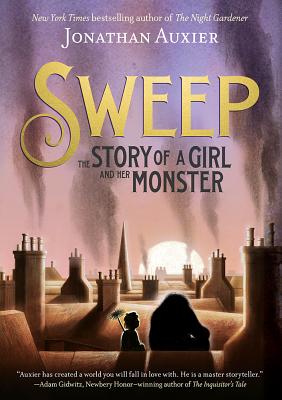
Sweep

sweepby Jonathan Auxier
First sentence: “There were all sorts of wonderful things a person might see very early in the morning.”
Support your local independent bookstore: buy it there!
Content: There are some scary moments, and some talk of death. Plus the prose just feels “older”. It’s in the middle grade (grades 3-5) section of the bookstore, but it could easily go older as well.

Nan Sparrow has been a chimney sweep her whole life. She started out with a man she called Sweep, until one day he just didn’t come back, and so she took up with her current master, Crudd. He, if you can’t tell from his name, isn’t terribly nice.

Then one day, the worst thing that can happen to a sweep happens to Nan: she gets stuck. They try to get her out, but nothing works, and so they try the Final Option: burning her out. She blacks out, and when she wakes up… she’s rescued. And there’s a creature there. She ends up calling him Charlie — he was made from a small piece of char that the Sweep left her — and it turns out he’s a golem.

It has a tough beginning, but after Charlie comes into the story, it settles down into small adventures: Nan tries to keep from getting caught — she is supposed to be dead, after all — and tires to find out more about Charlie and his purpose as Charlie himself learns more about the world. It’s very atmospheric (in all the best ways), as Nan and Charlie end up relying on each other. There is a couple of small sub-plots, dealing with the horrid conditions of chimney sweeps in Victorian England (and they are horrid) and with Crudd’s vengeance for Nan “escaping” her indenture. But, mostly it’s a charming little tale of Nan and Charlie and their friendship.

Auxier, when he was here for school visits, said that he considers himself more of a storyteller than a writer, and that shows: although his writing is elegant, it’s the storytelling that comes through. He knows how to tell a story to keep a reader reading, and to make the characters come to life. It’s a strange, sweet story and I adored every moment of this one (even the ending, which made me cry).

IMG_9782[1].JPG

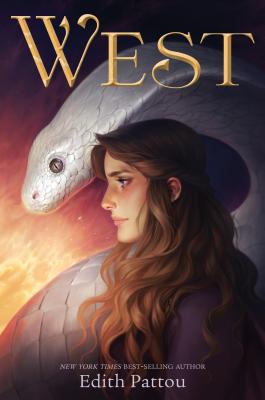
West

by Edith Pattou
First sentence: “I had placed the box, the one etched with the runes that contained the story of Rose and her white bear, in a quiet corner of my library.”
Support your local independent bookstore: buy it there!
Others in the series: East
Review copy provided by the publisher.
Release date: October 23, 2018
Content: There are some intense moments, and the main character is married with a baby, so it may not interest younger readers much. It will be in the YA section (grades 6-8) of the bookstore.

When I finished this — and don’t get me wrong: I loved it — I thought, “Well, that’s the best unnecessary sequel I’ve ever read.”  See: East (which I also loved) ended satisfyingly. Rose and the White Bear (spoilers, if you haven’t read it or don’t know the fairy tale) got their happily ever after. There was, really, no need for there to ever be a sequel.

And yet, here we are.

It’s two years after the end of East, and Rose and Charles are happy. They have an adopted daughter, Estelle, and a baby, temporarily named Winn. They have a good life in Fransk. Then they decide to go visit Rose’s parents, traveling separately, and Charles never makes it. Word comes that he died in a huge storm. But Rose determines that, no, he’s still alive, and her old arch-enemies, the Trolls, are behind it. So she takes off — leaving Estelle and Winn in the care of her family — to rescue her White Bear. Again.

It really was an enjoyable read, but I just couldn’t shake the whole unnecessary side of it. Why did Rose need to go again? I understand wanting to revisit this world that Pattou created, but I really didn’t need a rehashing of Rose’s story. It it, instead, had followed Neddy (which it did, for a bit, and I really liked those parts) or Estelle (and made it a really young adult book, rather than this weird feels-like-a-young-adult-but-the-main-character-is-an-adult book) I might have liked it more. Pattou couldn’t have even come up with a new antagonist; she had to resurrect the Troll Queen again. So, yeah, while Pattou’s writing is lovely, and the story is nice enough, it’s really all… unnecessary.

Though I suppose there will be fans who are grateful for it.