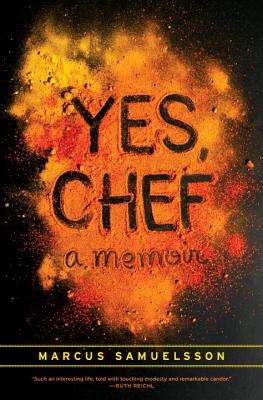
Yes, Chef

by Marcus Samuelsson
ages: adult
First sentence: “I have never seen a picture of my mother.”
Support your local independent bookstore: buy it there!
Release date: June 26, 2012
Review copy provided by my place of employment.

I am not really into the whole food “scene”. I love reading books about good food, I like cooking (but I’m a cook, not a chef, even though I worked in a restaurant for a year when I was a teenager), and I like the idea of good food, but when it comes to names of chefs, I’m pretty much limited to the really popular Food Network people.

So, before a Random House rep came into the store pitching hot books this summer, I  had never heard of Marcus Samuelsson. I think that was a good thing, however, because I was able to come to his story free of biases, open to whatever journey he was willing to take me on.

And it’s quite the journey: Born in Ethiopia, he, his mother and his sister contracted tuberculosis when Marcus was 2. His mother walked for days to get to a hospital, dying soon after reaching there, leaving the children orphaned. Luckily, there was an older couple in Sweden who were desperate for children, not caring what color or nationality they were, and they adopted both Marcus and his sister.

Samuelsson spends quite a bit of the book on his childhood and upbringing in Sweden, primarily because he firmly believes that this was the foundation for all his successes. His mother’s mother taught him to cook, in the classic Swedish style. His parents taught him the work ethic that made Samuelsson what he his today, and supported his journeys around the world, as well as his choice of career. These parts of the book are fascinating: from his stages (I guess that’s what they’re called) in Sweden, Switzerland, Austria, and New York before the ultimate stage in France and then back to America where he became — almost by accident — the executive chef of Aquavit. He is liberal with praise for the people who helped him, candid about the people who were jerks, he muses about the idea of race in the restaurant and food world. But always, always these reflections are centered around his food journey and his chasing the flavor around the world.

The latter third of the book, his time at Aquavit, his stint on Top Chef masters (and winning that competition), to his finding his birth family in Ethiopia and opening his current restaurant, Red Rooster, in Harlem are not as compelling as the first part, though they still hold interest. The time line gets a little fuzzy, and I felt like he was rushing through things, when I wanted him to linger, especially on the flavors and the tastes of the food he was creating.

Even with that slight drawback, it’s a marvelous foody memoir. Enough that I would love to step into his world, just to taste the dishes he made sound so delicious. Anyone up for a trip to Harlem?

Audiobook: Sports From Hell

by Rick Reilly
read by Mike Chamberlain
ages: adult
Support your local independent bookstore: buy it there!

Not content with being a writer for Sports Illustrated or ESPN — or perhaps it was bored with being a writer of normal sports — Rick Reilly decided to go on a quest: over the course of three years, he (and his lovely researcher/girlfriend, TLC) searched the world over for the World’s Dumbest Sport.

And because he’s a journalist, he felt the need to share it with the world, as well.

The sports range from the pretty cool (women’s football), to the retro (the Jart; remember those? If not, you didn’t grow up in the 70s and 80s), to the weird (ferret legging; that’s what he’s doing in the picture up there) to the “I wanna try” (Zorbing; seriously looks like fun), to the eye-rolling (his chapter-long rant on baseball), to the certifiably insane (bull poker). Not to be outdone, there’s a chapter on drinking games (did you know there’s a world series of beer pong?), on the world championship Rock, Paper, Scissors tournament, and the Finnish “sport” of Saunaing (or whatever they call it).

It’s a completely useless book — there’s really nothing of value in here, unless you want to impress people with your synonyms for vomit — but it’s entertaining. Or, at least, it tries very hard to be.

See, Reilly’s use of similes drove me completely batty. Literally. I laughed at them at first, but as the book wore on, I grimaced and eventually rolled my eyes. I wish I had the actual book in front of me, so I could write a few of them down; they were literally that bad. And all over the place. Which I found highly distracting.

The second distracting thing was Mike Chamberlain as a reader. He only had two
“voices”, and he would alternate between the two of them. And I have to admit that his inflection grated on me after a while; it was nice and chatty at first, but eventually, I kind of wanted to smack him.

Still, it wasn’t enough for me to give up the rubber-neck value of the book: the sports were so bad, I had to see what Reilly would find out next.

Oh, and for the record, the dumbest sport: chess boxing.

Drop Dead Healthy

by A. J. Jacobs
ages: adult
First sentence: “For the last few months, I’ve been assembling a list of things I need to do to improve my health.”
Support your local independent bookstore: buy it there!
Review copy provided by my place of employment.

The thing I love best about A. J. Jacobs is that he’s insane enough to try things that normal human beings don’t even consider. I mean, really: who would read the entire Encyclopedia Brittanica? Or spend a year living the Bible to the letter? Or going undercover as woman? (Actually, I haven’t read that one. Yet.)

Or how about spending two years becoming the healthiest man alive?

If anyone can go from intellectual, indoor-loving couch potato, to a lean, mean machine, it has to be A. J. Jacobs.

He organizes this one roughly chronological — giving us check-up updates from month 1 to month 25 — but also by body part. He spends a month on his eyes, his ears, his brain, his fingers, his stomach, his heart, his testicles (yes, you read that right), and right on down to his feet. He’s game to try just about everything — from cave man exercise (and diets!) to going OCD on toxins to BluePrintCleanse, though he didn’t go as far as plastic surgery — there really is no stone he leaves unturned. It’s a fascinating way to approach health, but also a trivia-inducing one. If I have become insufferable with “Did you know…” and “I read in Drop Dead Healthy…” statements, it’s only because this book is packed with so. much. information. And all of it interesting. It helps, I think, that his books are so readable: he’s self-deprecating, but not to the point where it’s annoying. He’s funny. And his wonderful, long-suffering wife (and adorable boys) play a role as well; he really is devoted to them, and they really are wonderfully tolerant of his insanity.

So, did I learn anything? Yes. There was possibly too much information thrown at me, but some did sink in. Will I incorporate anything I learned in my life? I don’t know. Perhaps. Was it an enjoyable way to spend my time? Most definitely.

Oh, and for the record: I think A. J. would be proud that I read this book entirely while on the elliptical at the gym. I hope so, anyway.

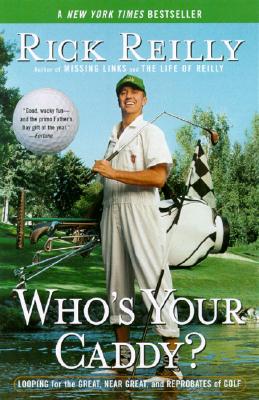
Audiobook: Who’s Your Caddy?

by Rick Reilly
read by Grover Gardner
ages: adult
Support your local independent bookstore: buy it there!

Yes, this is a sports book. Not just a sports book, but a GOLF book. I don’t play golf. (Hubby does. Sort of. Well, he goes golfing about once a year with his dad.) I don’t follow golf. I do know you hit a little ball with a stick and the lowest score wins. But that’s about it.

So, why the heck did I decide to listen to a golf book?

Well…. because I was in the mood for something completely different (you don’t get much more different than golf in my world), and because I think sports writing, when it’s good, is a lot of fun to read/listen to.

And you know what? This is some seriously good sports writing.

I was told, however, that because this is a sports book that’s 10 years old, it’s hideously out of date, and I shouldn’t be reading it. I didn’t care. I loved every minute Grover Gardner was talking at me (lovely, lovely reading voice, that man; I think a good part of why I loved this was because his reading was so phenomenal).

The basic schtick: Reilly — who writes for Sports Illustrated — decided that the best way to get to know golf — to really know golf —  is to be a caddy. So, he managed to finagle (con?) some of the best (and worst, and well, in-between) golf players into letting him caddy (or “loop” as I learned) a tournament for each of them. It’s basically one story after another of all the people he looped for, from Deepak Chopra and Donald Trump to Jack Nicklaus and David Duval, not to mention Jill McGill on the LPGA tour. Lest you wonder: yes, he did caddy at the Masters, but no, not for one of the top players. Yes, he did ask Tiger Woods (this was back when Tiger was really hot stuff; I mean, I’ve heard of him and I don’t know squat about the sport), but he turned Reilly down. And no, Reillly wasn’t any good. Sucked at being a caddy. Though I got the impression that he’s a pretty good golfer.

So, what made this go great? I laughed. Seriously laughed. Reilly made me interested in and got me to care about a sport that I know nothing about and will probably never pick up. Sure he dropped terms and names like nobody’s business, but it didn’t matter, because he was telling a story, and he knows how to tell a story in a way that will get even the most clueless readers interested in his subject.

No, I probably won’t pick up golf clubs (though he did kind of make me think maybe I could give a go, just to see what the fuss is all about). But I am going to hunt down more of Reilly’s stuff. He is really that good.

Reread: The Color of Water

by James McBride
ages: adult
First sentence: “As a boy, I never knew where my mother was from — where she was born, who were parents were.”
Support your local independent bookstore: buy it there!

About 30 pages into this book, I thought to myself: “I think I’ve read this before.” I had: my review went up on November 29, 2007. Interestingly enough, even though I didn’t remember much about the book, my reaction is still pretty much the same: it’s an interesting book, possibly and important book, definitely an uncomfortable book, but I think I’ll add that I’m not sure it’s a memorable book.

This part of my original review I still agree with:

I do have to confess that my feelings of being an interloper, though, were real. I felt like I was prying into someone else’s personal business, a place where I had no right to go. I still can’t place why I felt that way. [I think part of it, this time around is that I loathed Ruth’s father. Seriously loathed him.] I felt like it was too personal, too emotional, too close for me to truly enjoy. These people were real people. These things really happened. I feel this way often when reading books on the Holocaust, too. I can’t believe these conditions, these atrocities are really out there. It pushes me out of my bubble, and I react by feeling like an interloper. Like I’m not supposed to be there.

I still appreciate the chance to see into the lives people lead, especially if they make me uncomfortable. I probably would never have remembered this story, and the obstacles and challenges these people faced in their lives. For that, I am grateful. Sometimes book groups are good, if only to get you to reread books you don’t remember.

Factory Girls

From Village to City in a Changing China
by Leslie T. Chang
ages: adult
First sentence: “When you met a girl from another factory, you quickly took her measure.”
Support your local independent bookstore: buy it there!

 After living in China for a decade, Wall Street Journal reporter Leslie T. Change (who is Chinese; her father emigrated to Taiwan in 1948, when the revolution happened, and then from there came to the United States) decided that the whole idea of women (mostly) migrating from the villages in the country to work in factories in the cities was one worth pursuing. And writing a book about.

I’m so glad she did.

It’s a fascinating, rambling book, weaving in and out of time (I never really got a sense of how many years she spent hanging out with and shadowing the women she chose to focus on), including her family’s history as well as the current socio-economic state of China. She tries to generalize the lives of the women in the factories, and to a great extent it works because she focuses in on several women telling their individual stories, and how their lives have changed — for the worse and for the better — because of their choice to migrate and work at a factory. It made the book more personable, focusing on the few, and less just dry history, making the book more interesting and easier to read.

(As I side note, I’ve always wondered what the Chinese think about making all the chintzy holiday stuff we buy here in the U.S.)

On top of all that, it’s accessible book, and a quick read (even at 400 pages). Good for all those interested in the plight of women around the world.

Audiobook: The Kitchen Counter Cooking School

How a Few Simple Lessons Transformed Nine Culinary Novices into Fearless Home Cooks
by Kathleen Flinn
Read by Marguerite Gavin
ages: adult
Support your local independent bookstore: buy it there!

(Also a post for Weekend Cooking.)

I adored Flinn’s first book, The Sharper Your Knife, the Less You Cry, and was quite excited to tackle her next book.

Home from Paris and Le Cordon Bleu, author Flinn is wondering what to do with her life. She really has no interest in owning a restaurant, and is getting tired of people asking her when she’s going to open one (and on a similar line, when are she and her husband going to have a baby…). Then, in a grocery store, inspiration hits: she sees a woman whose grocery cart is full of processed foods, and the reason? Because she doesn’t feel she can cook. It’s intimidating. She doesn’t know how. It’s too hard. Thus, the Project is born: Flinn finds nine volunteers all who are generally insecure about cooking, and persuades them to come in for a series of lessons on cooking basics. Flinn’s goal: to give them the skills and confidence to cook and turn away from fast food and processed food.

I’ll tell you straight up: I learned a lot from this book. A lot. And that was listening to the audio version. I need to go out and purchase the book, so I can have it as a reference in my kitchen. She really does go over all the basics: knife skills, chicken, meat, vegetables, braising, roasting, soup, salad, vinaigrette… it’s all in there. And Flinn is a good teacher. I’m sure her nine volunteers learned a lot from the classes, but she was able to convey what was taught — with a few side trips, to Rome and some fancy dinner parties to raise money — through her words in a way that engaged and interested me. I ended up thinking about this as a practical Michael Pollan: while he spouts ideals (and good ones at that), Flinn actually gives people the tools to use in putting those ideals — eating real food, cooking with real ingredients — to use.

The woman who read the book grated on me at first; she has weird pauses in the middle of sentences that bothered me. Also: listening to recipes being read aloud isn’t that great, so I ended up skipping those. Even with those shortcomings (and they’re not even Flinn’s fault), it’s the best kind of food book: useful, interesting, yummy-sounding with dozens of good recipes that are easy to use. Hopefully, it’ll do for you what it did for me: inspire you to cook.

Amelia Lost

The Life and Disappearance of Amelia Earhart
by Candace Fleming
ages: 9+
First sentence: “On the morning of July 2, 1937, the coast guard cutter Itasca drifted on the Pacific Ocean, waiting… listening…”
Support your local independent bookstore: buy it there!

Like many people, I think, what I knew about Amelia Earhart was limited to her legend: she was the first woman pilot, and her plane was lost on her attempt to fly around the world.

What I didn’t realize was how much more there was to the story.

Fleming is a brilliant non-fiction writer for kids; she keeps the information simple without being simplistic, and manages to capture the nuances of her subject without ever wandering into territory that a 9-year-old couldn’t comprehend.

Which means that this book was absolutely fascinating. The chapters alternated between Amelia’s past and that fateful day when her plane was lost. Fleming really did her research, pushing past the legend and the fame to come up with a different portrait of Amelia Earhart. One of the things that most fascinated me was how, well, unqualified she was. She flew not really because of skill — often she didn’t take the time to learn things thoroughly — but because of determination. She was a feminist: she believed that just because she was a woman didn’t mean she shouldn’t do whatever she wanted to do. Including flying. She resisted the boxes that the time period wanted to put her in, and literally soared. No, she wasn’t the most talented, or even the most skilled, but she was determined, and that made up for a lot.

The other thing that fascinated me was how much she was famous for just being famous. She and her eventual husband, George Putnam, worked really hard at keeping her name in the papers, keeping her on the lecture circuit. Being famous was a full time job for them. I also didn’t realize how much of her image was done on purpose to create her image. She hid many things, and re-imagined others. I guess it goes to show that nothing is ever quite what it seems.

An excellent introduction to the life and legend of Amelia Earhart.

Sunday Salon: The State of the TBR Pile 5

We’re doing inventory at the store this weekend, and because of that I don’t have much time to read. (Not to mention the Oscars tonight! We finally have TV, so I’ll be watching.)

As it is, I’m in a bit of a reading slump. I have a huge pile…. and I don’t know what to read. I threw it out on Facebook and Twitter on Friday, but didn’t get much response, so I’m throwing it out again. What should I read next?

Before I Fall, by Lauren Oliver (because I ought to read something else by her)
Goliath, by Scott Westerfeld (because it’s about time)
Clementine and the Family Meeting, by Sarah Pennypacker (because I love Clementine)
Drop Dead Healthy, by A. J. Jacobs (ARC I begged for from work)
The Sherlockian, by Graham Moore(I wanted a mystery)
Kill You Last, by Tod Strasser (ditto)
The Grand Plan to Fix Everything, by Umi Krishnaswami (a MG book with an India connection)
A Monster Calls, by Patrick Ness (because it’s in the brackets for SLJ’s Battle of the Books)
The Floating Islands, by Rachel Neumeier (because I’ve heard good things about it, and it finally came in at the library)
Huntress, by Malinda Lo (because it sounded good)
Stupid Fast, by Geoff Herbach (because it won the Cybils YA Fiction this year)
Blood Red Road, by Moira Young (because it won the Cybils YA SFF this year)

What’s on your TBR pile?

Outcasts United

by Warren St. John
ages: adult
First sentence: “On a cool spring afternoon at a soccer field in northern Georgia, two teams of teenage boys were going through their pregame warm-ups when the heavens began to shake.”
Support your local independent bookstore: buy it there!

The thing I like best about St. John’s writing is that, no matter the subject, he really makes you care about it. Seriously. Granted, this one has a subject — a woman who creates soccer teams, and an outlet, for refugees in Clarkston, Georgia — that is easy to care about. But, St. John doesn’t do the predictable thing and make the bok Inspirational and Heart-Warming. No, he does the good thing, and makes the book interesting.

The focus is on Luma Mufleh, who grew up in Jordan loving soccer. St. John touches on, but doesn’t delve into Luma’s trouble with growing up in such a restrictive environment for girls. She comes to the U.S. for college, and much to her father’s disappointment, decides to stay. She tries a few things, coaching soccer on the side, before literally falling into creating teams for the boys of Clarkston.

Clarkston, Georgia was once a sleepy little southern town. However, over the last decade or so, it has become a place for refugees — from all over the world, but mostly Africa — to begin their lives in the U. S. You can imagine (and, unfortunately, the town lives up to that stereotype) how that goes over in the all-white, good-boy South. The problem is that because there isn’t much infrastructure for them, the kids were getting lost in the cracks, turning to gangs, drugs and violence.

Enter Luma’s soccer program. She’s not an easy coach — to his credit, St. John never glorifies her: she is harsh, she is unforgiving, she is tough, she is demanding. But above all, she is dedicated and she cares. Amazingly, this combination of toughness and caring works, especially for the younger kids. Not only does Luma give them a purpose, family and a place, she teaches them to win games.

As I mentioned before, it’s not an Inspirational book, and yet there is a message: one person can make a difference. It’s just not one that St. John beats you over the head with, thankfully. Instead, he found a good story, spent a while researching it, and told it in a compelling way. Which makes this one excellent book.