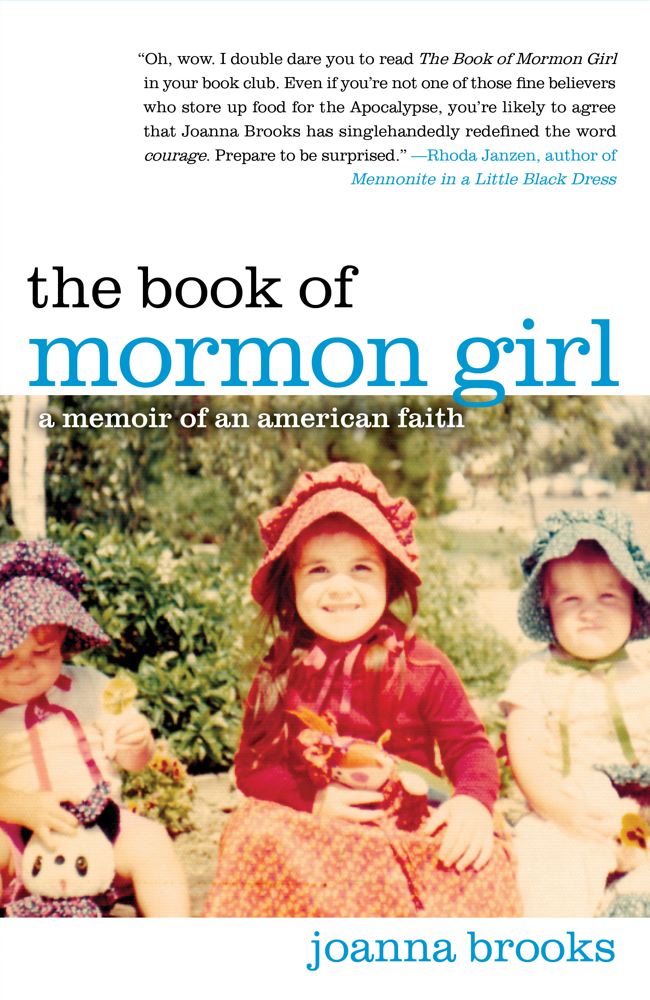
The Book of Mormon Girl

by Joanna Brooks
age: adult
First sentence: “On Monday nights, my father and mother gathered their four children around the kitchen table in our tract house on the edge of the orange groves and taught us how the universe worked.”
Support your local independent bookstore: buy it there!
Disclaimer: while I didn’t know Joanna at BYU, I knew of her. And my husband actually knows her. In fact, as the story goes, he asked her out once and she said no.

I am not Joanna Brooks. And yet, growing up Mormon in the late 1970s and 1980s, there were many elements of Joanna Brooks’ story that I recognized.

This story — which was buzzed about a bit back before the election when Mormons were having our “moment” — is basically that of Joanna’s childhood, growing up in Orange County, California. Her path to BYU, and then her path away from — what shall we call it? — orthodoxy, full activity, your typical Mormon life.

It’s nothing I didn’t know, or haven’t heard. The Monday night family meetings (ours were on Sunday afternoons, actually), the year’s worth food storage in the basement (which fully ruined me for store-bought canned peaches and pears. Not at ALL good.), the end-of-the world paranoia (that was mostly high school, when I was actually noticing it). All of it was instantly familiar to me.

And you can tell that Joanna has a fondness for her childhood, the way she was raised, and even the way the church was — to some extent — in our childhood. But, then we hit BYU.

(It surprised me that she is only a year older than I am. I thought she was older than that.)

I don’t know what BYU is like now, but she reminded me of all the reasons I disliked the place in the early 1990s. I wasn’t in the middle of everything — from the firings and excommunications to the protests — but I caught enough of it through my program — journalism rather than English — that I realized that the Church (the organization, not necessarily the doctrine) could be a not-very-friendly place for people who didn’t toe the line.

And it was this point where Joanna’s and my paths diverged, and where I found the book to dissolve into melodramatics. Yes, she was discriminated against, but I’m going to assert that it’s because she lived in the wrong places. I have often told my daughters — especially when they come home feeling excluded and belittled at church — that not everywhere is like here. That there are places — like my ward growing up in Ann Arbor — where people don’t always expect everyone to tow the conservative Republican line  like they do in, oh, Orange County, California. Or Wichita, Kansas, for that matter.

Maybe it was too personal for me, maybe it was too much like my own story, and maybe that’s why I finished it feeling unsettled. That said, I am glad that Joanna’s story (and mine, to a certain extent) is out there for people to read. Maybe it will make a difference, too.

A Jane Austen Education

How six novels taught me about love, friendship, and the things that really matter
by William Deresiewicz
ages: adult
First sentence: “I was twenty-six, and about as dumb, in all human things, as any twenty-six-year-old has a right to be, when I met the woman who would change my life.”
Support your local independent bookstore: buy it there!

When I saw this one a while back, I knew, as a professed lover of all things Jane, that I had to eventually read it. Thankfully, my delightful gift exchange partner, Holly, made that eventually sooner rather than later.

I didn’t quite know what to expect from a book like this, or who even it’s intended for. Other Janeites? The random public? Guys who should be reading Jane Austen? (Which they should.)

And the answer is: yes, all of the above.

Deresiewicz weaves his personal story of a 26-year-old, single, angsty Jewish male with analyses of all six of Austen’s books, giving each book a theme that helps him through a time period in his life. He doesn’t go chronologically with her works, but rather in the order that he read them, and with what fit with what period. It’s a book about Austen, yes, but it’s also a book about Deresiewicz’s growth as a person, and the role that Austen played in that.

Having read all the novels many times (though not recently; one of the things I realized while reading this is that it’s been a while since I’ve visited with Austen, and “a while” is too long), he didn’t really say much that I didn’t know. I’m not sure I’m going to look at her novels in a new light now, or anything like that. Perhaps, if I were less than an avid fan, I would have (I also want to give this to the guy at work who disdains all “chick fiction”, calling it “fluffy” and beneath his notice). At the very least, Deresiewicz succeeded in reminding me why I adore Austen.

A couple of quotes, because these stood out:

From the Northanger Abbey chapter (“Learning to Learn”): “Real men weren’t afraid to admit that they still had things to learn — not even from a woman.”

From Mansfield Park (“Being Good”): “To listen to a person’s stories, [Edmund] understood, is to learn their feelings and experiences and values and habits of mind, and to learn them all at once and all together. Austen was not a novelist for nothing: she knew that our stories are what make us human, and that listening to someone else’s stores — entering into their feelings, validating their experiences — is the highest way of acknowledging their humanity, the sweetest form of usefulness.”

For me, this was a delightful romp through familiar land: watching someone come to a realization that Austen and her small, domestic dramas and comedies really do hold valuable lessons for the rest of us, even 200 years later.

Cool Dead People

Obituaries of Real Folks We Wish We’d Met a Little Sooner
by  Jane O’Boyle
ages: adult

First sentence: “More than two million people die each year in this country.”
Support your local independent bookstore: buy it there!

There isn’t really much to say about this slim little collection of obituaries. Either you will be fascinated by reading about dead people — most of whom accomplished something, but weren’t really Big News — or you won’t.

Thankfully, I was. There were several people who caught my attention, from the woman who was responsible for publishing George Lucas’s novels, Princess Bride, and Mists of Avalon; to the brother of Jackie Robinson; to a stone mason who helped build Rockefeller Center; to Hitler’s secretary; to the second wife of Anne Frank’s father.

It’s not a really deep or profound collection, but it kind of made me reflect on what  people would say about me. It’s mostly just fascinating. There ought to be more of these out there.

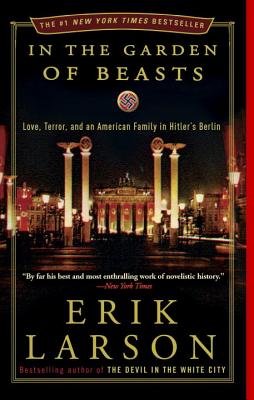
Audiobook: In the Garden of the Beasts

Love, Terror, and an American Family in Hitler’s Berlin
by Erik Larson
Read by Stephen Hoye
ages: adult
Support your local independent bookstore: buy it there !

I’ve not read any of Erik Larson’s work before, even though he (and this book) have been on my radar for a while now. So, when it came up as the November book at the Nook, I was more than happy to read it. (Or in my case, listen to it, since I didn’t really have the time to sit and read it.)

If you don’t know: it’s the story of William Dodd, the U. S. Ambassador to Berlin in 1933, just as Hitler was rising to power, and all that entails. And, it entailed a lot. First off, Dodd wasn’t that popular with the “Pretty Good Club”: the insiders (mostly Harvard grads) at the State Department who didn’t like Dodd’s conservation-minded ways. (He wanted to live within his salary? Shocking!) They undercut all of Dodd’s attempts at, well, diplomacy, and leaked things to the press whenever it served them to make him look bad. All they really wanted him to do — infuriatingly, to the reader, knowing what Hitler was capable of — is get Germany to make good on their debt to America.

The other part of the story (the “love” part) was about Dodd’s daughter, Martha, who was a bit of a manizer. (If a man can be a womanizer, then…) She was naive, silly, and very much in love with falling in love. So, as a result, she was married twice, divorced once, and had strings of lovers on her chain all at the same time. Can you tell yet that she really bothered me? Actually, what bothered me most was not all of that, but that she would play one lover off another. Or pine for their attention, only to push them away. It was most infuriating.

But, this book was fascinating. It did spawn a lot of thought and discussion: about the nature of evil, about relationships, about what could have been done, about politics.  And for that, reading (well listening to it — a side note: the audio was just fine. Maybe Hoye’s voice was a bit grating by the end, but not enough to turn me off) this is well worth the time.

Behind the Beautiful Forevers

by Katherine Boo
ages: adult
First sentence: “Midnight was closing in, the one-legged woman was grievously burned, and the Mumbai police were coming for Abdul and his father.”
Support your local independent bookstore: buy it there!

I don’t know if I’m the last person to read this one, but I do know that it was its nomination for the 2012 National Book Award that finally spurred me into picking it up. (You would think it was M’s desire to go to India for a year. But, no.)

For the twelve of us who haven’t read the book yet, this is Pulitzer Prize-winning journalist Boo’s foray into the world of Mumbai’s underbelly. She spent several years (from November 2007 to March 2011) in the Annawadi slum, near the Mumbai airport, getting to know the residents. She followed their ups and downs, painting a portrait of people who were desperately poor, and their attempts to do something about it, whether for good or ill.

It’s a desperate story, gritty and harsh, and yet it’s an incredible work of journalism. Boo’s affection for these people come through, and she manages to get them — individuals who have no qualms in lying to each other as well as police and the government — to tell an honest story. It’s one that made me think: about class, about globalism, about corruption, about India as a country.

Several quotes that struck me:

An aside in a larger discussion about the sections in Annawadi (yes, even the poor in India have classes): “In the Indian caste system, the most artfully oppressive division of labor ever devised, Dalits — once termed untouchables — were at the bottom of the heap.” (p. 42)

The parliamentarian who would represent Annawadians was hardly in doubt. It would be the incumbent from the Congress Party, Priya Dutt, a kind, unassuming woman who personified two historical weaknesses of the Indian electorate: for flimi people and for legacies.” (p. 230)

And what I think is at the heart of this book:

What was unfolding in Mumbai was unfolding elsewhere, too. In the age of global market capitalism, hopes and grievances were narrowly conceived, which blunted a sense of common predicament. Poor people didn’t unite; they competed ferociously amongst themselves for gains as slender as they were provisional. And this undercity strife created only the faintest ripple in the fabric of the society at large. The gates of the rich, occasionally rattled, remained unbreached, The politicians held forth on the middle class. The poor took down one another, and the world’s great, unequal cities soldiered on in relative peace.

Fascinating and thought-provoking.

Audiobook: Home

by Julie Andrews
read by the author
ages: adult
Support your local independent bookstore: buy it there!

I picked this one up for my commute audio book mostly because I like Julie Andrews. I’m not a huge fan or anything, but I like her well enough. She’s, well, nice and she’s aged so beautifully, and I have tons of respect for her, that I figured: why not read her memoir of her childhood.

And for the most part, it’s not a bad book. I especially enjoyed the audio form, listening to Julie (we’re on a first-name basis now that I’ve finished the book) tell stories about her parents (you can tell she adores her dad); her step-father, whose name she ended up with (he was quite creepy); her life in vaudeville (she ended up supporting her family for quite some time); her leap into Broadway (a bit of a fluke and a lucky chance); and her time with My Fair Lady and Camelot.

But, I didn’t love the book. I don’t think it was because her life lacked conflict; there was all sorts of ups and downs as she was trying to figure out who she was (other than that cute girl with the freakish voice) and how to make her way in the world. I also don’t think it was because she ended the book just as I though it was getting really interesting. No, it was because Julie Andrews can’t ever say anything truly bad about anyone or anything. Even her step-father, who really was quite creepy to her a couple of times (he gave her her first kiss, tongue and everything. Ew!), whom she was never really close to, she was unwilling to actually speak harshly about.

The other unintended side effect of that was that she tended to gush about everything. It was always “lovely” or “marvelous” or “exquisite” or “grand” or “delightful”, and sometimes all at once. I did get to the point in the book where I swore if she gushed about one. more. thing., I was going to toss it out the window. (I didn’t, even though she didn’t stop gushing.)

So, there you have it: Julie Andrew’s virtue of being nice to everyone is actually a fault when it comes down to it. At least in memoir writing.

Which is just too bad.

Food Rules: An Eater’s Manual

by Michael Pollan, illustrated by Maira Kalman
ages: adult
First sentence: “Eating in our time has gotten complicated — needlessly so, in my opinion.”
Support your local independent bookstore: buy it there!

I suppose this is kind of an unusual pick for me, since I’ve been on board with Michael Pollan’s philosophy (more or less) for years now. And so, in many ways, this little “eater’s manual” is kind of superfluous, at least for me.

But, since I picked it for my in-person book group (I’d wanted to pick Kitchen Counter Cooking School, but the library only has one copy, and I needed something more accessible), I figured I needed to read it.

And while I don’t think I learned anything new, this lovely illustrated, slim book was simply a joy to read. Pollan’s taken his whole philosophy and boiled it down to seven words — Eat food. Not too much. Mostly plants — and has 83 rules to help you follow that philosophy. In other words: he makes the complicated and long Omnivore’s Dilemma accessible for, well, ordinary people.

Which means that I hope people will read it, and we can have some good discussion. Because there are some good ideas in this book.

Oh, and as as aside: my favorite rule? I have three: #22, It’s Not Food if It Arrived Through the Window of Your Car; #57, If You’re Not Hungry Enough to Eat an Apple, Then You’re Probably Not Hungry; and #76, Place a Boquet of Flowers on the Table and Everything Will Taste Twice as Good.

Worth reading.

Dearie

by Bob Spitz
ages: adult
First sentence: “‘Now, dearie, I will require a hot plate for my appearance on Professor Duhamel’s program.'”
Support your local independent bookstore: buy it there!

I have to admit that I didn’t grow up as a Julia Child groupie. Oh, I knew who she was, but I wasn’t that into food (I was more into sports) or cooking, and what she did didn’t interest me. My parents may have watched her French Chef show — I don’t know — but it’s not like she was an influence in my upbringing.

Then I read Julie and Julia and, later, My Life in France, and I became an unabashed Julia Child fan. So, of course, when the new biography came out (on August 15, her 100th birthday), I had to read it. (Granted, I wasn’t going to read it just yet, but a friend thrust it in my hands and said it was due back at the library in 2 weeks, so, really, what else was I going to do?)

Spitz admits, in the acknowledgements, that he is not really an unbiased reporter of Julia’s life. He met her in 1992 and developed a bit of a crush on her through their interaction. So, when the opportunity fell into his lap to write a biography of her, he, of course, jumped at the chance.

This really is a comprehensive (and by default, huge, coming in at 530 pages) biography: from her early upbringing in Pasadena, California, through her stint with the OSS (which really is much less glamorous than it seems), through her marriage to Paul Child and their years in France (which Spitz kind of glossed over, but I didn’t mind, since I’d read about that already), and through all her various incarnations in television, up through Paul’s, and her own, death.

But Spitz is an excellent writer, and his enthusiasm for Julia shows. He really delves into her life, drawing her both in broad strokes (she really WAS manic, full of energy; at one point, I pointed out to Hubby that she must have been exhausting to know), and small details (the amount of work this woman did, basically up until she died, was simply amazing; also she LOVED men. Not like affairs, or anything: she was devoted to Paul; she just loved having men around.), which gave a more thorough picture of the real person behind the persona. (By the way, she adored the Dan Ackroyd Saturday Night Live skit.) Additionally, there was enough foodiness, especially later on, to keep the foody side of me happy.

It was the combination of my admiration for Julia (I admire her more the older I get; she started a completely new career at age 50, and made it work) and Spitz’s writing that made this book such a delight to read.

A must for any Julia Child fan. 

The Spice Necklace

by Ann Vanderhoof
ages: adult
First sentence: “This time, I bring my rolling pin to the Caribbean.”
Support your local independent bookstore: buy it there!

I read, and fell in love with Vanderhoof’s book of her first trip to the Caribbean,
Embarrassment of Mangoes, nearly five years ago. I didn’t even know there was a book about a second trip until a few months back, when someone pointed it out to me. Of course, I had to read it! And, unsurprisingly, I had much the same experience with this one that I had with the first book.

Ann and Steve returned to Toronto, to their “land-based” life, but after a couple of years, they realized that they missed the easy-going, food-saturated life they had in the Caribbean. So they did what they could to put things in order, got out their boat, Receta, and headed south again.

In many ways, this one covers much of the same territory as the first one did: there is food and friends and sunshine. But, knowing that, Vanderhoof was smart: the book (as evidenced by the title), is mostly about the spices native to the islands, and the many, many uses they have in everyday life. And because I don’t know much about the spices I eat, I learned a whole lot. Like how nutmeg is grown, and the fact that mace and nutmeg comes from the same plant. And that the islanders (especially on Trinidad) love their peppah HOT. I also learned a whole lot about rum (I had to turn to a friend to explain proof, just so I could understand why the 151 proof Saba Spice was so difficult to get down), and the ways in which rum really does permeate island culture.

My favorite island this time was Trinidad; Vanderhoof made it come alive, and made me curious about the African/Indian blend of cultures and cuisine they have there.  They also spent a lot of time in the Dominican Republic and Dominica, both islands would be fascinating to visit. Mostly, though, I envied their approach to seeing the world: parking in one spot for months at a time, soaking up the culture and the cuisine, meeting people, and learning about a place rather than just seeing it. I would (still) love to travel that way.

But the next best thing to a vacation is a well-written, food-heavy, travel book about an area. And this one is just the ticket.

My Life as an Experiment

by A. J. Jacobs
age: adult
First sentence: “Over the years, I’ve gotten a lot of suggestions.”
Support your local independent bookstore: buy it there!

It’s no secret that I really like A. J. Jacobs. Even so, I somehow missed this book when it came out. Unlike his other three books, this is a series of short vignettes, one month projects ranging all over the place from a month of trying to be like George Washington, to a month of outsourcing his life to India, to a month practicing being radically honest.

While it’s a fascinating and fun little jaunt — my favorite chapter was the rationality project — it lacked the depth that his longer books have. See: he’s really not all about the gimmick, at least not in his big books. Sure, they’re gimmicky, and they’re silly, but there’s a profoundness (profundity??) to them that was missing from these experiments. And because of that, they weren’t nearly as interesting as they could have been.

That said, I’m not sure I’d want to read a whole book about him outsourcing his life, or even being George Washington (though I didn’t learn a thing from that chapter, since Hubby’s a pretty big GW fan). They worked as vignettes, even if the depth and reflection isn’t there. They are funny (the naked one was pretty hilarious), and his wife is still amazingly tolerant (though he gives her a month of whatever she wants, and she quite abuses the power). It has all the elements of his books, just not to the extent that I have come to enjoy.

Upon reflection, this would be a really good introduction to the weird world that is A. J. Jacobs.