Audiobook: Bossypants

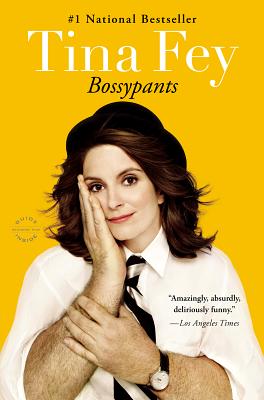
by Tina Fey
Read by the author
ages: adult
Support your local independent bookstore: buy it there!

I really don’t know why Tina Fey felt that she needed to write a memoir. Perhaps it’s because this is the last season of 30 Rock (I hope; I really can’t imagine the show without Alec Baldwin), and she wanted to try her hand at writing… something not television/movie related. That said, it’s a good book. She goes pretty much chronologically through her life: from a childhood in West Philadelphia, to college at the University of Virginia, to her time in Chicago with Second City, to her years at Saturday Night Life, to 30 Rock. In there, she fits her marriage and birth of her first child as well.

Like most comedy, it’s uneven. Some parts are horribly hilarious (like her Doomed Honeymoon), some parts she just lectures (about sexism in politics, for example) and the jokes fall flat (but perhaps they were meant to). That said, it was entertaining enough — Fey’s self-deprecating style is really pretty funny — to keep me sitting in the car listening long after I had gotten to where I was going. My favorite sections were about the development and production of 30 Rock, perhaps because I’ve been a fan of the show since it started. But, I found that’s where the biggest laughs were for me.

A note on the audiobook: on the one hand, I really enjoyed hearing Fey read her book. She did voices (her Alec Baldwin is really quite good), and we got the audio clip of her first Sarah Palin Saturday Night Live. She did mumble on occasion which bugged me until I checked the print version and realized that she was mumbling the asides. But she kept saying “check the pdf for this picture. Really. You won’t regret it.” I never did. I listen to the books in the car, and I’m not going to take the CDs out just so I can look at a picture. I did, however, check them out in the print edition. And they were, as she promised, quite hilarious.

So would I recommend the audio book for this one? Well, yes… if you’re like me and willing to check out the print edition for the extra laughs.

Maman’s Homesick Pie

by Donia Bijan
ages: adult
First sentence: “My mother had been dead eight days when I showed up in her kitchen.”
Support your local independent bookstore: buy it there!

This book is very much like a gumbo: it needs a little bit of everything to make it work. It’s one part cookbook — every chapter has a couple recipes from the kitchen of world-class chef Donia Bijan; one part memoir — it’s nominally Bijan’s story from Iran to France to the kitchen of her own restaurant; but also one part love story to her mother.

Bijan grew up in Iran, the third — and last — daughter of a doctor and a nurse. She was privileged there, going to a private international school, enjoying holidays on the Caspian Sea. Her family was on vacation in Spain when the revolution happened in 1978, effectively cutting them off from their country. For Bijan, her sisters, and her mother, this was a hardship, but also an opportunity: they emigrated to America, and took to their new lives. For her father, however, this became an obstacle that he never surmounted.

He also had issues when Bijan decided to major in French in college with the express goal of going to France to learn to be a chef. Her mother, on the other hand, supported her wholeheartedly. This was where the book fell apart for me. Her memories of childhood were sweet, and even her life in transition was interesting. However, by the time she got to France to learn cooking, I began to wish that there was more to this book. It felt like she was brushing over everything lightly, not wanting to deal with the negatives, or even with the hardships, not thinking about anything too much. All this is well enough, but I wanted more: more feeling, more depth, more descriptions of food, more of her life.

While I found it a pleasant homage to her mother and the way she supported Bijan in her endeavors, there wasn’t quite enough in it to make this book anything more than “nice.”

Seriously… I’m Kidding

by Ellen DeGeneres
ages: adult(ish)
First sentence: “Dearest Reader, Hello.”
Support your local independent bookstore: buy it there!

The point of this book, as Ellen so cheerfully tells us at the end, is for the reader to be happy. Well, considering that it’s Ellen DeGeneres, and that the book is really just a collection of amusing, if meandering and sometimes odd, thoughts and observations, I think I can safely say that, for me, the goal has been achieved.

This book made me, for a couple hours at least, happy. Or amused, at the very least.

It read very much like Ellen’s stand-up comedy: not laugh-out loud funny, but rather companionable, amusing, enough to get a smile or a even an occasional giggle. The book is really formatted as one very long dinner party conversation: there’s a bit about Ellen’s life and her experiences as a talk show host (she does get serious, but only briefly in small doses, and then backs off with a joke or two fairly quickly; the most serious she got was when writing about her experience as an American Idol judge), but mostly it’s just observations on everything from littering to manners to yoga to gardening. There’s no real coherent theme, there’s no overlying lesson, there’s no deep thoughts (even if there is a chapter on deep thinking).

But, for what it is — a congenial conversation between Ellen and her “readers”/fans — it’s a fun little book. Some of the chapters are quite funny (like the “Meditiation” chapter — about four blank pages followed by ” Ahhhhh. Doesn’t that feel better?”), others not so much (the one about writing Pro/Con lists kinda fell flat for me). In the end, though: it was an amusing way to spend an hour or so, and I’m not sad I picked up the book.

Which means, I guess, that Ellen did the job she set out to do.

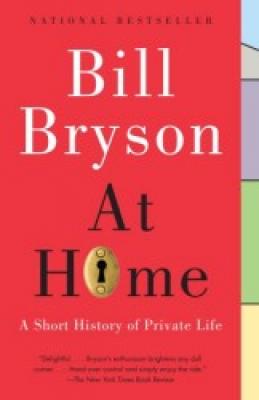
Audiobook: At Home

by Bill Bryson
read by the author
ages: adult
Support your local independent bookstore: buy it there!

When Bill Bryson and his wife moved back to England, they purchased a rectory built in 1851. I’m not sure if he thought much of it when he first moved in, but after living there a while, he started thinking about how little he knew about his house, and the history that surrounded it. Thank heavens for his curiosity, because out of it was born this book:  a fascinating history of the world without leaving the home.

Initially, that sounds a bit dry as well as overly ambitious: how can one tell the history of the world through the house? The short answer: you can’t. What you can tell is a general history of how homes came to be what we find them today in Great Britain and the U. S. Bryson ends up focusing on those two countries, as well as mainly on the 19th-century, giving the book a much less ambitious perspective. And because Bryson is a thorough researcher and a masterful writer, this book — which is stuffed full of facts and people you can’t hope to begin to keep straight — is downright fascinating. From the history of how tea came to be England’s national drink, to the Eiffel Tower, to indoor plumbing and the telephone, to the rise of the middle class, to sexual repression in Victorian England: this book seriously has it all.

I listened to this one on audio, which possibly wasn’t the best way to interact with this book. (That, and Bill Bryson sounds nothing like I thought he would.) I kept wanting to flip back chapters, to reread earlier passages, to find earlier references to the people and circumstances that he refers back to. He does do a well enough job reminding the reader about who or what things were, but I still wanted to go back and see it for myself. That said, the information itself was fascinating. (I also wish I could have marked things, because for the life of me, I can’t remember half of what I heard.)

It’s fascinating not just because history is fascinating, but because Bryson makes it so. It’s  his snide asides (said in a dead-pan voice, so we know that he’s poking fun), and his brilliant observations, and the sheer amount of research that he did to write this book that really makes this book worth reading.

Then again, I’m not sure Bryson can write a book that isn’t worth reading.

The Good, the Bad, and the Barbie

by Tanya Lee Stone
ages: 11+
First sentence: “When I was six, I wanted a Barbie more than I can remember ever wanting anything in my life.”
Support your local independent bookstore: buy it there!

First a confession: my mom wouldn’t let me have Barbies, and even though I played with them at friends’ houses, I never really wanted one (or at least I don’t have a lingering memory of that). Then I went to college, and became my own brand of feminist, and swore my girls would never have Barbies.

Then M turned three. And she desperately wanted one. After several rounds of fighting and discussion and saying no, we gave in on her birthday, and gave her one. Which was much loved. Then, Barbie multiplied. For, it seems, that one cannot have just one Barbie. They multiplied until I was sick of them and they stopped playing with them, so I tossed the whole lot when we moved to Kansas 5 years ago. Since then, they’ve multiplied again (it seems that you can’t give a young girl a birthday present that isn’t a Barbie), and while they don’t get played with often, I have made my peace with them and keep them around for the times when they are needed.

It seems my story isn’t unique.

I enjoyed this book for the history of Barbie, and Mattel, and how they came to be. There was a part of me that wished for more detail (the fact that Barbie’s inspiration was a German sex toy was glossed over here), but the book was geared toward the younger crowd. However, Stone did to an admirable job balancing the two sides of Barbie: those who love her and those who loathe her. I think I understand better now her appeal, not just to girls, but to women as they grow older. And while I still think there’s downsides to Barbie and her appearance, I admit that they’re more societal and less the fault of the toy. It was interesting, and well-written, full of lots of vintage (and otherwise) pictures.

Recommended.

Friday Night Lights

by H. G. Bissinger
ages: adult
First sentence: “Maybe it was a suddenly acute awareness of being ‘thirtysomething.'”
Support your local independent bookstore: buy it there!

I’m probably the last person on the planet to read this; I didn’t even know it existed until the movie came out several years back. Since then (and the highly recommended TV show, as well), I’ve known that I “should” read this one, especially since I consider myself a football fan. But it wasn’t until I read Rammer Jammer Yellow Hammer a few months back that I really got serious about reading this book.

You want to know what? It’s incredibly depressing.

If you’ve been living under a rock, the basic story is Bessinger moving to Odessa, TX; a small town in the late 80s that has gone through the boom and bust of oil. Bessinger moves there to follow the town’s main football team, The Permian High MoJo. However, while it’s a book about football, it’s not a football book. Bessinger follows the team throughout the season and highlights the games, but uses football as a springboard to talk about bigger issues: race, class, education, and most of all, the sense of entitlement (and pressure) that comes with being a high school football player.

Bessinger doesn’t paint a pretty picture about it all. Odessa was — one of the things I kept wondering was how everyone’s fared in the 23 years since the 1988 football season — obsessed with football. Perhaps unhealthily so. It was their life, their all, and I’m not talking about the players, either. In a town where there wasn’t much of anything: the industry being basically shut down (I seem to remember a statistic that at one point the unemployment rate in Odessa was at 20%, but I could be wrong), the educational system being basically average, the only hope for anyone — and really, we’re just talking about the boys, most of them white — was to be on their above-average, mostly winning football team.

And so most boys held the dream of playing for the Mojo.

But, even with the hope of something better — or perhaps they put all of their hopes into that promise — the boys didn’t go anywhere. Sure, they made it into the state playoffs, and got as far as the semi-finals. But, their lives, with the exception of the one who put his effort into his academics, didn’t go anywhere. And I found that depressing. Because it’s all for a game.

The other depressing thing was how little has changed in America in the last 23 years. In some ways, things have gotten better. But there was too much in the book that I could nod at and say, “You know, that’s still exactly the same.” We like to think we’ve made progress in race, in education, in our livelihood. But this made me wonder just how much has changed. I’m not sure much has; football is still more important in our lives than, say, a speech by the president on his plan to create jobs. While Rammer Jammer made me feel like I wasn’t enough of a fan, this book in many ways made me ashamed to support a game (a game!) that creates the kind of situations that were put out in this book. Those high school and college players we put so much pressure on to win? They’re boys. And this book is a weighty reminder of what pressure, stress, and too much privilege can do to boys.

And that’s depressing.

Poser

My Life in Twenty-three Yoga Poses

by Claire Dederer

ages: adult

First sentence: “Taking up yoga in the middle of your life is like having someone hand you a dossier about yourself.”

Support your local independent bookstore: buy it there!

Memoirs are an interesting breed of book. On the one hand, they are incredibly self-indulgent: anyone who thinks that their life is one that people are going to want to read about have to be at least a little bit arrogant. On the other hand, there are lives that are fascinating, and the writing is good enough to help even the most disconnected reader connect to the story the author is trying to tell.

In Poser, Dederer walks a fine line between those two memoir extremes. Sometimes, she is overly arrogant about her experiences and her plight; her insular liberal white enclave in North Seattle (and eventually Boulder, Colorado) has warped her perception of child raising (she feels guilted into attachment parenting; and feels guilty again when she doesn’t like everything that espouses), marriage (as a child of divorce, of a sort, she feels like everything needs to be perfect), and sacrifice (shopping at Trader Joe’s instead of Whole Foods) and makes the book unrelatable to anyone who doesn’t live or aspire to that life.

There was a moment, about halfway through, where I got fed up with Dederer’s self-pity and judgment of others and seriously considered abandoning the book. One can only handle so much whining from an author, after all.

On the other hand, when Dederer wrote about yoga, she was lyrical and often spot-on in her observations. She reminded me of things I need to remember in my own life and practice, simple things, like being present both physically and mentally. And that yoga is a process, not an end goal. In fact, some of the most interesting passages were her exploration of yoga’s place in western culture; whether or not yoga is, in fact, an exercise; and the connection between the movement and spirituality. One quote that I found to be particularly true:

I thought I would do yoga all my life, and I thought that I would continue to improve at it, that I would penetrate its deepest mysteries and finally be able to perform a transition from scorpion directly into chaturanga. But here’s the truth: The longer I do yoga, the worse I get at it. I can’t tell you what a relief it is.

So, for that reason alone, I found the book to be worth the time. Dederer’s life was fascinating, if a bit warped, and her writing excellent. But that wasn’t enough to carry the book. Thankfully, she had the yoga bits to pull the rest of it along.

(Oh, and can I mention that I adored the little yoga figures at the beginning of the chapters? So cute.)

Knucklehead

Tall Tales and Mostly True Stores About Growing Up Scieszka

by Jon Scieska

ages: 9+

First sentence: “I grew up in Flint, Michigan, with my five brothers — Jim, Tom, Gregg, Brian, and What’s-His-Name.”

Support your local independent bookstore: buy it there!

Although I have stories from when I was growing up, some which are quite funny, I have long since envied my husband’s stories. They’re so much more entertaining, rambunctious, and plain laugh-out-loud funny.

The reason? There were seven boys. I am convinced that while I adore my daughters, they will just never have the stories to tell that their father did. There is just something hilarious (in the long run; I’ve always felt sorry for my mother-in-law and what she had to deal with) about a heavily-male family.

Which means that this book is flat-out hilarious. With all the love he can muster, Jon Scieszka spins tales about his childhood. They’re short and sweet: no psychological analysis here, which makes them all the more funny. He covers everything from chores to peeing to school and road trips. He talks about his relationship with his older brother, Jim, and his parents. He touches on the differences found in big families, how the older set of siblings get treated differently than the younger set. It’s a sweet book, full of humor and affection.

I’m not sure what kids would be drawn to it; M only picked it up after she heard me laughing (and snorting) over it. And the fact that I made her read a couple of the stories because they were just too funny. But I’m not sure that C would ever read it. I do think boys would like it; it’s very much a boy story. The people who would appreciate it most, however, I think would be parents of boys. Shaking their heads at all the knuckleheaded things their sons do and have done, they can smile with love at their idiocy.

Hey, something good has to come out of raising boys. Right?

The Dressmaker of Khair Khana

Five Sisters, One Remarkable Family, and the Woman who Risked Everything to Keep Them Safe
by Gayle Tzemach Lemmon
ages: adult
First sentence:”I touched down in Afghanistan for the first time on a raw winter morning in 2005 after two days of travel that took me from Boston to Dubai via London.”
Support your local independent bookstore: buy it there!

Life is not easy in Afghanistan. It hasn’t been for a long time, now. Between the Soviet occupation, the civil war, the Taliban, and the U.S. retaliation, everyday life for Afghanis is difficult, to say the least. Especially for the women. Especially during the Taliban years, when they were essentially relegated to their homes; held prisoner in their own houses.

With the men and boys fleeing to Iran and Pakistan for work, and to avoid being force-drafted into the Taliban army, how do these women — some of them highly educated — provide for themselves and their families?

Lemmon focuses on one family — the five sisters of the title, but one, Kamila, in particular — who take the bull by the horns and, working within the Taliban’s rules, manage to find a way to thrive under the strict rules and foreboding environment.

On the one hand, what Kamila does in creating a sewing/tailoring business that provides merchandise to local stores and employs local women and girls truly is an inspirational thing. Her innovation and resilience is impressive; she worked within the bounds the Taliban set, and only once did she ever come close to going afoul of the Amr bil-Maroof, the police who enforced the strict morality code. Even then, she was able to talk her way out of things. Her faith and optimism are amazing; if she believed it could be done, she found a way to make it so.

However, it seemed that Lemmon was trying too hard to make the book inspirational. it’s hard to pinpoint, exactly (and it may work for some people), but it’s overall feeling was: “This is INSPIRATIONAL. Pay attention!” The blurbs on the back don’t help: this book will Change Your Life. (And given Greg Mortensen’s problems, having a big blurb on the cover by him doesn’t really help with the credibility.) Additionally, while it’s a non-fiction book and telling is to be expected, there was way too much telling and not enough showing. She told me that the women were scared by the Taliban; she never showed me. She told me that they worked hard, were stressed, and yet overcame all; she never showed me. The other problem was time: the movie covers 13 years, and yet reads as if Kamila achieved all this in a matter of months.

I’m sure there are better books about women under the Taliban, ones that show how resilient and strong they were in spite of everything. And while this is an impressive story, this book is not one of them.

Rammer Jammer Yellow Hammer

by Warren St. John
ages: adult
First sentence: “At some point in theLink life of every sports fan there comes a moment of reckoning.”
Support your local independent bookstore: buy it there!

First, a disclaimer: I am a college football fan. (University of Michigan Wolverines. Go Blue!) So, naturally, I was curious about this book. Sure, it’s about the Alabama Crimson Tide, but to a great extent football is football is football, and a fan’s experience is pretty much the same.

However, reading this book had two effects on me: first, it made me question my actual fan status. See: I’m not nearly the fan that these people are. St. John is a lifelong Crimson Tide fan and became interested in the psychology of sports fan. However, this is not a pop psychology book; rather, as St. John finds a crowd of fans (maybe it’s a Southern thing?) that follow the team during the season in their decked out RVs, it becomes more of a travel book.

At first glance, these fans are insane: who in their right mind would spend so much money (one man spent $1.4 million) on a traveling hallway just in order to be near the stadium of their favorite football team. But as the book progresses, you come to admire their dedication to the team and to the game. They are a community: granted, one that meets just for 12 weekends a year, but they have a common bond, which makes the temporary nature of the community irrelevant. They are fans in an intense, life-consuming way. And I wondered: if I wasn’t willing to put my allegiance to my team out there as loudly as they are, can I even really call myself a fan?

As the book goes one, I found myself respecting the RVers. They have a dedication to their team — to the game — that is unparalleled. They are fully invested in football, which is superficial, yes, but is also something that bonds people together. As St. John travels with the group (yes, he does buy an RV), he also focuses on the game itself. Though, he writes not from a technical aspect, but more from the experience as a fan in the stands. It’s a personal experience for him, though he does connect with people who are fans to a greater and fans who are fans to a lesser degree than he is. It’s an insightful book, lovingly written; a love story not just to the Crimson Tide, but to all sports fans everywhere.

Which brings me to the second thing the book made me want to do: actually go to a game again. There is something to be said about experiencing the game in a crowd of like-minded people, to be a part of all the fans cheering on their team, experiencing a win (or a loss) together as a group.

If you’re not a sports fan, I’m not sure why you’d pick up this book. But if you are, it’s a fantastic read.