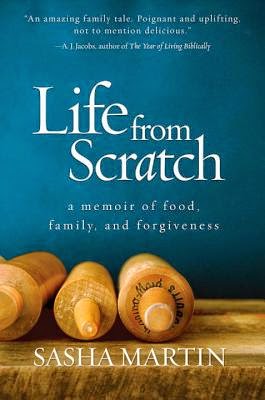
Life from Scratch

by Sasha Martin
First sentence: “This is not the book I meant to write.”
Support your local independent bookstore: buy it there!
Review copy picked up from the Random House rep.
Content: She didn’t have an easy upbringing and she doesn’t hold back on that. But, other than that, it’s suitable for anyone who’s interested in a culinary memoir. It’s in the biography section (for lack of a better place; it also fits in our creative non-fiction, which is kind of a catch-all) of the bookstore.

I know I’ve told y’all how much I love foody books How much they feed my soul, and how, when they’re wonderful, they just make me happy. Last time our Random House rep came to the store, he held this one out and said it’s a food memoir, I snatched it. I took too long getting to it, though: it wasn’t until it actually came in (the actual cover is so much more appealing than the ARC cover, trust me) and I actually read the first sentence, that I knew I would love this book.

Sasha had a hard life. Seriously. The daughter of a single mom struggling to get by in Boston, she and her older brother, Michael, didn’t know how hard their life was. They had Mom, they had each other and as far as they were concerned, things were good. Then the state decided that what they had wasn’t enough, and sent them into the foster system. Which, in the late-80s, was a terrible place to be. Sasha’s mom, however, was — is — an incredibly concerned and passionate person, and she fought to get them back. However, the state (I can see people’s objections to the state here) deemed their mother unfit, and decided that the kids needed to be raised elsewhere. Sasha recounts her mom sending out tons of letters, looking for a home for her children. And it was an old friend and her husband who took on the burden of raising the children.

You might be wondering what all this has to do with food? Well, the one thing that kept Sasha going throughout her life was a love of food and cooking. Her mother is Italian and Hungarian and she believed in the power of community coming together to eat, so very early on, Sasha helped out in the kitchen.

Her years with the friends weren’t happy. She missed her mother. Her brother committed suicide. Which propelled Sasha into a life of drinking and drugs and avoidance. The upside was that the family moved to Europe, so Sasha was exposed to culture there. So, when she finally landed on her feet, after years, in Oklahoma (I’m condensing here; there’s a lot going on), she decides that what she needs to do is cook her way around the world.

Sasha’s a compelling writer, telling her story with love and understanding, when no one would have faulted her for being bitter. She was angry at her mother for years, but somehow forged a new relationship with her. And I loved how this city girl found solace in a smaller community, finding the interesting and unique things about Tulsa. (She actually made Tulsa sound like a pretty cool place.) But the best thing, hands down, about this was the food. Sasha has a way of making the food leap off the page, of capturing not only the flavor of every day dishes, but also of the exotic ones she made from around the world.

It’s a delightful book, one that I’m sure will stay with me for a long, long time.
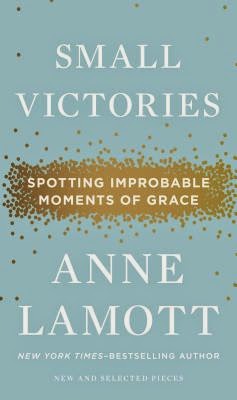
Audiobook: Small Victories

by Anne Lamott
Read by the author
Support your local independent bookstore: buy it there!
Content: She likes the word s**t, and drops about five f-bombs.  Which kind of caught me off-guard. It’s in the religion/philosophy section of the bookstore.

I’ve been curious about Anne Lamott for a while now; she’s an incredibly popular author at the store. I was in between audio books recently and discovered this one, and it was delightfully short. I figured audio was a good way to experience her.

This is basically a series of short reflections on life, God, and the intersection of the two. For the record: Lamott is a liberal, which I don’t mind at all, and was very against the invasion of Iraq in 2003. (Several of the essays are from around that time period.) She belongs to a church in northern California. She has a son, and lots and lots of friends, many of whom are suffering from serious illnesses. She has a good sense of humor, and is honest about her struggles with God, people, and just life in general.

In many ways, the words were just what I needed to hear: we’re all human, we’re all trying. God is in connecting with other people and reaching out to love them.

What I didn’t like so much, was Lamott’s reading of her own work. I understand why she needed to read her own words; it would have been odd otherwise. But Lamott read in such a way that it soundedlikeonereallylongsentancewithoutevertakingapauseorevenraisedorloweredhervoicewithsentenceinflection. When I concentrated to hear the words, I loved it. But her reading of them almost turned me off altogether. I’m glad I stuck it through to the end, for the thoughts and ideas. But, I wish Lamott had been a better narrator.

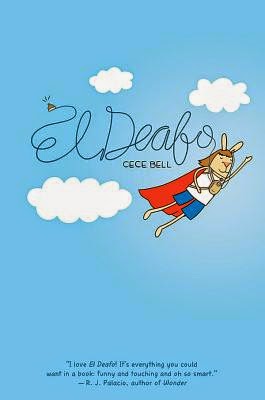
El Deafo

by Cece Bell
Support your local independent bookstore: buy it there!
Content: There’s a little talk of Love (she has a crush) but other than that, it’s quite accessible for the 3-5 grader. It’s in the middle grade graphic novel section at the bookstore.

This one has been on my radar for a long time, and (like too many other things), I can now say I Should Have Read it Sooner!

It’s the mostly-true (except for the part where she’s a bunny) story of Cece Bell, and her experiences as a deaf child in the 70s and early 80s. She lost her hearing due to a bout with meningitis when she was four, and as a result had to wear a hearing aid and use a Phonic Ear during school. It’s not something she really enjoys at first, even though she realizes it gives her a sort of super-power.

But, the story is really only incidentally about being deaf, it’s more about finding a way to belong and a friend. Bell is very practical about the friends she made, not sugar coating anything. But, it’s not a harsh book; on the contrary, it’s a very sweet and often hilarious story. And it’s good that it’s out there to remind readers that it’s because of our differences that life is interesting.

Very highly recommended.

Just Mercy

by Bryan Stevenson
First sentence: “I wasn’t prepared to meet a condemned man.”
Support your local independent bookstore: buy it there!
Content: It’s intense, and there are some graphic elements, as well as swearing. It’s not for the tender-hearted (I had to put it down several times and read other books because I couldn’t handle the nature of the story). It’s in the adult non-fiction sections of the bookstore.

This one has been on my radar for a while as one I’d need to get around to reading. But what really prompted me to pick it up was listening to Serial. The two don’t really have a ton in common, but there are similarities. Both deal with minorities being imprisoned, mostly unjustly. Both are difficult, at times, to listen to/read. Both are important.

Bryan Stevenson was a young lawyer from Harvard in the mid-80s when he went to Atlanta to do an internship there. He got involved with a death-penalty case in Alabama, where he determined that the man was accused falsely. Stevenson became involved in the case to the point where he started the Equal Justice Initiative, a group that advocates for people on death row, as well as for children and for those with mental disabilities who have been imprisoned for life.

I took away two things from this book: First, our justice system may work “as well as it can”, but that usually means “for those who can afford it.” If it wasn’t clear before, it’s clear after reading this: our system is broke. It favors those who are white, those who are healthy, and those who are well off. Especially in the South. It saddened and depressed me that this isn’t history. This is happening in my lifetime, not in some distant past.

The second thing is that Stevenson is an incredibly hopeful individual. He’s practical, yes. But he’s also hopeful, and Christian, and just Good to do this work for people society — people like me — have written off. It makes me want to go out and give everyone I meet a second, or third, chance. Yes, there are people out there who are beyond hope, but I think, especially after reading this, that there aren’t that many people who are completely unredeemable.

It was a tough book, emotionally, for me to read (it didn’t help that I went and saw Selma while reading this as well). I cried a lot. My heart broke. And I had to think about the way I treat and judge people.

I am grateful that there are people like Stevenson out there doing this work. And I’m glad he wrote this book if only to make people like me more aware.

Audiobook: Yes, Please

by Amy Poehler
Read by the author.
Support your local independent bookstore: buy it there!
Content: Amy likes to swear. A lot, but not excessively, and generally not gratuitously. She is also pretty frank about sex and her drug use. I’m not going to say it’s not for teens — whom I know make up some of her fan base — but know that going in. It’s in the humor section at work.

I have made an executive decision: all celebrity bios are better in audiobook form. Period. That is all.

I really wasn’t that interested in reading this one; I’d paged through it a couple times when it came in back in October, and I figured: this was one for the True Fans. (Which I am not. I’m more like a Passing-by Fan.) But even I couldn’t resist the opportunity to listen to Amy Poehler read her book.

And, for the most part, it was a lot of fun. It’s a meandering book, wandering through memories, observations, Deep Thoughts, and Pithy Comments. That worked for me for a while, but wore me down by the end. Thankfully, the last chapter was recorded live, which helped end the book on a high note.

Perhaps it’s because she comes from an improv background, but I felt Poehler (and the audiobook) was at its best when she strayed from the script and just riffed. The two minutes she and Seth Meyer went off (which I’m assuming is not in the book, though I haven’t checked) were brilliant. She operated under the guise that she was recording the whole thing in her own personal home audio booth, and that there was a party going on in the background. She chatted for a bit with Patrick Stewart, Kathleen Turner, and Carol Burnett which just made me happy. And hearing her parents’ Boston accents (actually, I loved it when Poehler’s came out too) was charming.

It was all the little extra things that made this book enjoyable. But in the end, that wasn’t enough for me to truly love it.

Audiobook: The Art of Asking

by Amanda Palmer
Read by the author
Support your local independent bookstore: buy it there!
Content: Amanda doesn’t check her language. There’s a ton of swearing, of all shades. And she’s pretty frank about pretty much everything. It’s in a couple of sections at the bookstore: self-help (which it really isn’t) and biography (where it fits a bit better).

When this book came in, the conversation with one of my bosses as I was shelving this went something like this:

Her: “I saw Amanda Palmer once. She was intense.”
Me: “I didn’t know who she was until she started dating Neil Gaiman.”
Her: “You know, she’s her own person.”

That last sentence really does sum up this book quite nicely: Amanda Palmer is, for better or worse, her own person. And she is not ashamed of any of it.

Nominally an expansion of her TED talk, it’s more a meandering look into what makes Amanda Palmer tick. On the surface, it’s not a book for everyone. Amanda is frank, which means that sometimes she (and her music) will rub you the wrong way. BUT, she is frank. Which means she’s honest, and that gives the book a refreshing clarity. She talks about a lot of things: her time as a street performer, her music, her relationship with Neil Gaiman, but at its heart, it comes down to one thing: she is interested in the connections between people and how we ask for things.

Because of who she is, this is framed in music terms: a musician asking her fans for support, help, love, money. But what she says — that there are ways to ask that isn’t begging, and that it’s the connections (what she calls the net) that makes asking possible — is applicable for just about everyone. It got me thinking about gifts and connections, and how we work at relationships, and about how I’m much too hesitant to ask for things. At one point, she says that asking without condition is a gift, because it allows the other person to give. That’s something that resonated with me.

I enjoyed the audio version of this quite a bit as well: while Amanda’s voice was sometimes difficult for me to hear (which is entirely my fault), I loved hearing snatches of her music (I prefer her later, ukulele songs to the Dresden Dolls stuff) and her Neil Gaiman voice (seriously: she had a slightly British affection when she had him talking. It was quite adorable). But, mostly, I felt like she was in the car with me, explaining her life view, and how, just maybe, it might make my life a little bit better.

Highly recommended.

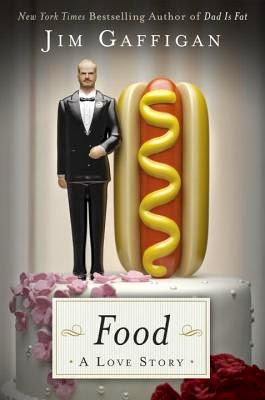
Audiobook: Food, A Love Story

by Jim Gaffigan
read by the author
Support your local independent bookstore: buy it there!
Content: There’s some mild swearing, but its quite seldom. It’s in the humor section of the bookstore.

I love food. I  love to laugh. And yeah, I kind of like Jim Gaffigan’s humor, though I’m new to it (and only in book form, having quite enjoyed Dad is Fat.) All that adds up to a “yeah, I guess I’ll pick up the audio version of his new book” mentality.

There’s really not much to say about this book beyond that it’s hilarious and a lot of fun to listen to. Gaffigan isn’t a foodie (he’s an “eatie”) and so there’s really not luscious descriptions of making food or of recipes (there is one — how to make a hot dog — and it’s quite hilarious) or how food changes lives. No, I imagine it’s just a series of stand-up bits (which is why I think this works better in audio. Plus he does voices, which end up adding to the humor) based on Gaffigan’s love of eating… everything. (And, yes, for those who are actually fans, he does have a chapter on Hot Pockets.)

Some highlights: the chapter on steak, or desserts, or breakfast foods, or on bacon. He hates vegetables and thinks kale is the worst thing ever. It’s really an every-person’s (read: non-food snob) tribute to the joy of eating. And the only down side? I often got hungry while I was listening to it.

Enjoyable, to say the least.

Two Transgender Books

I thought about reviewing them separately, but then I realized that the authors of the two books actually dated at one point, and I think Simon & Schuster kind of meant for them to be a pair. So, here they are, together.

Rethinking Normal
by Katie Rain Hill (with Ariel Schrag)
First sentence: “I really, really hate flies.”
Support your local independent bookstore: buy it there!
Content: There are a few f-bombs, and some frank talk about genetalia. Also, some frank talk about having sex, though it’s not graphic. That, and the subject matter (which isn’t necessarily not for younger kids, but maybe parents want to have a chat with the younger set while they read this), put this in the Teen section (grades 9+) of the bookstore.

Katie is a trans girl. Which means — if I get this correctly — she was assigned the male gender at birth, named Luke by her parents, and as she grew up, she felt increasingly at odds with her physical body. She didn’t feel “male”; she was attracted to males, but wanted them to see her as a woman. This is the story of her journey.

It’s not an easy one for her. For her first few years, she was okay, but as she grew older, she became depressed. She didn’t know what was wrong with her, or why she didn’t feel comfortable in her body. Why she wasn’t compelled to do traditional “guy” things. She went to therapists, but they didn’t help. Most just threw medication at her. It wasn’t until she was 13 that she discovered a transgender website that opened the doors to what she was experiencing. She found a support group, a doctor who was willing to take her seriously (turns out that she was intersexual; she had high levels of estrogen in her body and undeveloped ovaries as well as a penis), and she was on the path to becoming who she truly felt she was.

I was hoping, I think, for this to shed some light on transgender(ism? Can I say that?) for me. It didn’t; but then I think my expectations were too high. One person’s story is going to shed light on just that: one person’s story. And even though the writing style was overly casual (imagine Katie sitting down and just rambling her story at you), I was fascinating by her experiences. And ashamed; this was set down in Oklahoma, and unfortunately, the religious people Katie knew did not treat her well. That always makes me feel sad; I do hope that there would be more acceptance and charity and kindness in these sorts of stories.

I am glad Katie wrote this book, though. The first step to making the unknown more knowable is to learn someone’s story. And this book does just that.

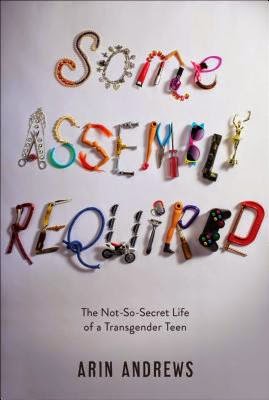
Some Assembly Required
by Arin Anderson (with Joshua Lyon)
First sentence: “Getting dumped at prom sucks.”
Support your local independent bookstore: buy it there!
Content: Same as above.

I didn’t have as positive an experience with this one. I’m not quite sure why, so this is mostly going to be me ruminating about why I bailed on this memoir, when I found the other one fascinating

First off, Arin is a trans boy, which means he was assigned the female gender (and had female body parts) when he was born. He struggled with this, but unlike Katie, his struggles seemed to come off as “I don’t like the clothes/pageants my mother is putting me in.” He was a tomboy as a child, even though he enjoyed the dance classes his mother insisted he take. He didn’t want anything to do with anything else about being a girl, and was repulsed when his body started to change.

I’m not asking for a justification or an explanation, but this seems weak to me. Especially in the light of the experiences Katie had. The way Arin presented himself (to me) came off as much more shallow. Or maybe it was because I’m a woman, and I had some of the same struggles with expectations and my body image. (I just turned feminist instead of trans, though…) I wanted to know what made his experience DIFFERENT from mine. How I could have a similar reaction to clothes/pageants/activities/my body changing and NOT be trans. Maybe I was expecting too much

Growing up in Oklahoma, Arin had a tough time. He came out as bi, and then trans, both of which were strongly rejected by the community, the religious school he was attending, and his mother.  (Of course, since religious people are closed-minded, duh.) In the end it was the the way these so-called Christians treated him that made me put down the book.

But, I also had to admit that my perception of Arin was skewed from the beginning; he shows up in Katie’s book, and while she isn’t cruel, he comes off as a whiny, clingy, needy boy. I couldn’t shake that image as I tried to read this one.

So, maybe the best thing is to pick one or the other, and immerse oneself in that individual story, recognizing that it’s just that: one individual story. Even so, it’s something that isn’t talked about much, and both of these books would be good for discussion.

Audiobok: Stiff

by Mary Roach
Read by Shelly Frasier
Support your local independent bookstore: buy it there!
Content: Um, Roach doesn’t mince her words when she talks about scientific stuff, and so some of this is kind of … gross. Fascinating, but gross. There’s a few mild swear words, but if you’re interested in dead bodies, go for it. It’s in the science section of the bookstore.

I picked this one out because I was in between audio books and because I really enjoyed Roach’s writing in Gulp. This time (it’s an earlier book), Roach takes a look into what happens to bodies after people die. From the ones that are donated to science — used in anatomy labs, for surgery practice, for research, etc — to the way the bodies decompose, you have to say that Roach is nothing but thorough.

On the one hand, this wasn’t the best book to listen to. Frasier did a good enough job narrating (though I had to keep reminding myself it wasn’t Roach talking; much of the book is in first person), it’s just that when you read about bodies decomposing, you don’t want to LISTEN to the words. Or at least I don’t. I never got physically ill, but it did make me queasy on a couple of occasions.

On the other hand, though: it was fascinating. Even if the book is 10 years out of date, it’s interesting to think about what can be accomplished through science after one dies. If anything, it got me thinking about what I want done with my body (though Roach pointed out that much of what is done with the body is decided not only by the deceased but by the family members) after I pass on. I think I was most swayed by one of the final chapters where Roach wrote about a woman in Sweden who was advocating for promession, which is a way of composting bodies. For some reason, this really struck a chord with me. I’d much rather be turned into earth and help a tree grow than sit in a graveyard. Shocking, I suppose. But my kids are on board with that (at least right now).

In the end, even though it was gross at times, I really enjoyed this one.

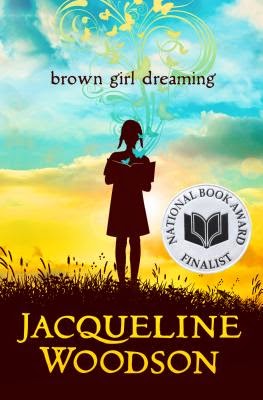
Brown Girl Dreaming

by Jacqueline Woodson
First sentence: “I am born on a Tuesday at University Hospital Columbus, Ohio, USA — a country caught between Black and White.”
Support your local independent bookstore: buy it there!
Content: There’s nothing objectionable. And it’s even an easy-ish read. Sure, it’s poetry, but it’s not difficult. Hand it to anyone with an interest in writing, kids, and history. It’s in our middle grade biography section at the bookstore.

I’m not quite sure where to start on this one. It seems We’ve (the collective we, here) been inundated by memoirs and biographies of celebrities, People of Note, and at first glance Jacqueline Woodson’s new book just falls into that pit of “celebrity” (of a sort) biographies.

Except, it’s not so much a biography or memoir as it is a reflection upon a childhood. Woodson makes her childhood an Everyperson experience, something that the reader can readily identify with, even if they didn’t have her exact same experiences.

Her childhood begins in Ohio, but mostly it’s spent in South Carolina, with her grandparents, and in Brooklyn, where her mother finally settled with Jacqueline and her brothers and sister. I kept trying to figure out the timeline (if she was born in 1963, then it must be…) but eventually, I just gave up and let myself get absorbed in the story.

And absorbed I was. Woodson wove historical elements into her story — sit-ins in the South; the way her grandmother felt about the way she was treated in stores by white people; music that was playing on the radio — all of which helped put her personal story in a larger framework. I could easily forget I was reading a memoir; it felt so much like a novel.

Part of that, too, was the form. Written in free verse, the memoir took on a lyrical quality. There were moments, especially toward the end, where I was moved by her insights not only in her life, but for Life in general.

One more thing: I appreciated her portrayal of religion. I get the sense she’s not a practicing Jehovah’s Witness anymore, but she portrayed the religion of her grandmother and her own childhood with respect. It was neither good nor bad; it was just a part of her life. And I found that refreshing.

Highly recommended.