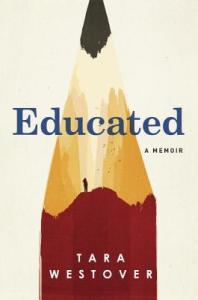
Educated

by Tara Westover
First sentence: “I’m standing on the red railway car that sits abandoned next to the barn.”
Support your local independent bookstore: buy it there!
Release date: February 20, 2018
Review copy provided by the publisher.
Content: There are some harrowing scenes of abuse and some mild swearing (no f-bombs). It will be in the biography section of the bookstore, but I think any junior or senior in high school may be interested in it.

I was handed this book because I’m the Mormon on staff, and because Westover grew up Mormon, in Idaho, everyone just assumed I needed to read it. Having finished it, I’m here to say that it’s not for those of us who are Mormon (though I think we’ll see some inherent criticisms of our culture, that others might miss), but it’s for everyone, in the way The Glass Castle is for everyone. Westover’s story is remarkable.

The basics are these: she grew up on a mountain in Idaho, the child of a fundamentalist/survivalist father who used religion as the reason to spurn the government. She was a wild child, helping out in the junkyard, avoiding books, until her older brother, Tyler, left and went to college. That spurred something in her, and she tried to go to school (they were all nominally “homeschooled”, which is code for “there are scriptures lying around the house if you choose to read them”) but consistently fell back into old habits. It wasn’t until she began being physically abused by her older brother that she felt a need to leave. She got into BYU (she studied for the ACT, and managed to get a good enough score), and once there learned just how far from “normal” her family was.

It’s a remarkable journey, not just because Westover got “out” of the situation she was in (though there really isn’t a resolution with her abusive brother, in the end, which while disappointing in a narrative setting, makes sense), but because of her reflections on education, class, money, religion, and the government. It’s an interesting line she walked, between her family and the education she received, first at BYU and then at Cambridge, but it is made so by her writing, her open, honest (sometimes brutally so) reflections on not just her family (she points no fingers) but also herself. This book feels like a work of therapy; like Westover needed to write it to understand herself, and by sharing it with the rest of us, we may understand not just her family, but ourselves as well.

I’m not sure remarkable is the best word for it. I was caught up in the story, my breath taken away (as a mother I was shocked and appalled: how COULD they let these things happen to their daughter!) and I was in awe that she found a way for herself.

Excellent.

Too Fat, Too Slutty, Too Loud: The Rise and Reign of the Unruly Woman

by Anne Helen Petersen
First sentence: “On November 8, 2016, I woke up early and said, to no one in particular,’I’m so excited to vote for our first female president!'”
Support your local independent bookstore: buy it there!
Content: There’s a lot of f-bombs. It’s in the Sociology section at the bookstore.

I picked this up after hearing an interview with the author on the It’s Been a Minute podcast (which is a fantastic podcast, by the way). It was a smart, interesting interview and I found myself wondering if the book was going to be as smart and as interesting.

And it was. Petersen looks at the representation of women in the media/popular culture through profiling ten celebrities she’s deemed “unruly”, literally not abiding by the set “rules” of culture. They each have a chapter and a reason why they’re unruly, ranging from Too Strong (Serena Williams) and Too Old (Madonna) to To Shrill (Hillary Clinton) and Too Slutty (Nicki Minaj). It’s an interesting look at each of these women’s careers, as well as the public perception of them. I thought it was fascinating. Some of the chapters are stronger than others (the Madonna chapter was actually more a critique of Madonna’s reactions to the cultural perception of her and a wish that she’d be better at resisting aging “gracefully”), but they’re all equally fascinating. There is a lack of people of color (Serena and Nicki are the only two), possibly because there’s a lack of women of color in the celebrity sphere… but I’m not the right person to judge that. I did find it a good, critical look at how we (men and women) perceive female celebrities and, by extension, how we perceive women in general.

A good read.

Sweet Spot

by Amy Ettinger
First sentence: “Family dinners in my house were a death match.”
Support your local independent bookstore: buy it there!
Content: I think there might be some mild swearing, but nothing significant. It is in the Creative Non-fiction section of the bookstore.

I knew I had to read this one as soon as it came in, mostly because it hits all my buttons: it’s good writing, mixing history and contemporary observations, and it’s about FOOD. In this case, ice cream. Bonus.

And it was a delightful read. Ettinger knows how to make one involved in the book (not just with recipes!), finding the words to describe the experience of eating ice cream. She’s become, over the years, an ice cream snob, on a continual search for the perfect cone (and the perfect ice cream eating experience). That leads her all over the place, as she looks into the ice cream industry. And it was fascinating. She discovered that it’s pretty difficult for local artisan shops to make their own ice cream base (and most have it shipped in from somewhere else) because of the pasteurization laws She discovered that the best frozen custard, hands down, is in Milwaukee, Wisconsin. She looked at ice cream truck turf wars in Brooklyn, at the frozen yogurt industry as well as what it takes to make an ice cream sandwich. She looked at corporate ice cream and artisan ice cream. And it make me, well, want ice cream, and to go searching myself for that perfect cone experience. (That said, my ice cream making has gone up since I started reading this. I recommend the Ample Hills Creamery book.)

It really is a perfect summer read.  Just expect to go looking for a perfect cone when you’re done.

Audiobook: Al Franken, Giant of the Senate

by Al Franken
Read by the author
Support your local independent bookstore: buy it there!
Content: There are six f-bombs in one chapter, mostly because there are two in the title of something Franken wrote and he said it three  times. It’s in the biography section of the bookstore.

I suppose, if you don’t know who Al Franken is, you probably won’t have any interest in this book. That said, I knew who he was, but wasn’t a huge fan.  But, I’d heard enough good about it that I decided to download the audio book.

Franken is in his second term as the junior senator from Minnesota, a former writer for Saturday Night Life, and a very, very smart writer. This book is basically a memoir of his time at SNL, his family life, his first election, and his thoughts on being in the Senate as a whole.

It’s a very smart book. And while it’s not always hilarious, it IS very funny. And insightful. Be aware that Franken is a Democrat, and so there’s definitely a partisan flavor to it (he blames Newt Gingrich, Rush Limbaugh, and Mitch McConnell for the current state of politics), but he also recognizes a need to work together, and has some good things to say about many Republicans (just not Ted Cruz). It’s insightful, interesting, and incredibly engaging.

And on audio? Very delightful. I loved listening to Franken read his words (I often enjoy celebrity memoirs more in audio) and thought it was a definite value-added to the book. He kept me engaged in the book, and I looked forward to turning it on whenever I got in the car.

A very, very good read.

A Walk in the Woods

by Bill Bryson
First sentence: “Not long after I moved with my family to a small town in New Hampshire I happened upon a path that vanished into a wood on the edge of town.”
Support your local independent bookstore: buy it there!
Content: There’s a lot of swearing including multiple f-bombs. It’s in the Creative Non Fiction section of the bookstore.

I read this, I think, when it first came out. Or soon thereafter. I don’t remember. I do remember liking it, quite a bit. But, something prompted me to pull it off the shelf and give it a re-read. Just to see if it held up.

In 1996, soon after Bryson moved back to the US from the UK (for a bit; he’s moved back across the pond again), he stumbled upon the Appalachian Trail, and decided (kind of on a whim) that what he really needed to do was hike the length of it. His high school friend, Stephen Katz, volunteered to go with him, and with some preparation (of sorts), they were off. It’s very much a “we’re out of our depth” book — neither Katz nor Bryson are experienced hikers, and the AT isn’t just a stroll in the woods. But, Bryson makes it thoroughly entertaining. Interspersed with the history of the AT as well as general observations (some are obviously outdated) about the state of nature in America, this one is definitely quintessential Bill Bryson. (In fact, if you’ve not read his books, this is a good place to start.)

Which means: it’s thoughtful, entertaining, funny, and interesting. And I’m happy to say that it’s held up these past 20 years and is as good as I remembered.

Audiobook: Make Your Bed

by Admiral William H. McRaven
Read by the author
Support your local independent bookstore: buy it there!
Content: There’s nothing that wouldn’t be applicable to anyone ages, say, 14 and up. It’s in the giftbook section (graduation, really) of the bookstore.

This slim book is based on a graduation address Admiral McRaven gave back in 2014 to the University of Texas at Austin. It’s a simple premise: 10 life lessons McRaven learned while training and serving as a Navy SEAL commander. It’s direct, no-nonsense, and incredibly insightful. The lessons really are easy: make your bed, work together, look at a person’s heart not their size, don’t lose yourself in adversity, and so on. In the book, he expounds on these points with stories from his experience as a SEAL, both in training and in combat. It’s excellent. (In short: it’s the military book I’ve been wanting to read.) McRaven reads his work, and he’s a good reader as well: he knows how to draw a listener in, and it gives it that personal touch that puts this short book (the audio was a little over an hour) over the top.

Audiobook: Paddle Your Own Canoe

by Nick Offerman
Read by the author
Support your local independent bookstore: buy it there!
Content: Oh, this is sweary. Lots and lots of all stripes and shades, including many f-bombs. He admits he swears like a sailor. Also, he’s pretty frank about sex. It’s in the humor section of the bookstore.

After finishing Good Clean Fun, I thought I’d branch out and read something more narrative from Offerman, especially since I really enjoyed listening to him read. So, I started with his first book, which (as was eventually revealed) was born out of his standup (“humorist”) routine, American Ham.  It’s basically a memoir of his growing up in a small Illinois town, doing theater in Chicago, moving to LA and meeting his wife, and just how he “made it”. The short answer? A lot of hard work and a little bit of luck. And some good teachers.

It was interesting to listen to; Offerman is a delightful reader (and has a great laugh), and so I was thoroughly entertained. I suppose I expected something more… useful… from a book with the subtitle “One Man’s Fundamentals for Delicious Living”, but mostly it was just entertaining. He did, in the last chapter, have some good advice for anyone who’s auditioning in the acting business, which I shared with C. But other than that, this was just fun.

And that’s not a bad thing at all.

Audio Book: Good Clean Fun

by Nick Offerman
Read by the author
Support your local independent bookstore: buy it there!
Content: There’s some mild swearing. It’s in the humor section (I think) of the bookstore.

This is, basically, Nick Offerman’s homage to Offerman Woodshop, his woodworker’s collective in L.A. It’s a portrait of the craftspeople who work there, as well as those people Nick has come across in his “career” (the acting just pays the bills) as a woodsmith.

So, no, it wasn’t the best book to 1) start reading Nick Offerman (I think I’m going to try Paddle Your Own Canoe next) or 2) listen to in audio. That said, Nick is delightful to listen to read a book (not as delightful as Neil Gaiman), and there were lots of delightful anecdotes about Nick’s colleagues, as well as his opinions about working with your hands (pro: I felt justified, since I really enjoy canning) and the joy of working with wood, specifically.

I do have to say that while listening to this, I kind of wanted to learn how to build things (not a new desire for me; I should have taken shop class). I enjoyed Offerman’s enthusiasm for the art of woodworking, and his sense of humor. Even though I wish it has more of a narrative, I still found it enjoyable to listen to.

Audiobook: Hillbilly Elegy

by J. D. Vance
Read by the author
Support your local independent bookstore: buy it there!
Content: There’s a LOT of swearing, including f-bombs. It’s in the biography section of the bookstore.

J. D. Vance didn’t have the best upbringing. That’s putting it mildly. The grandson of Kentucky to Ohio transplants, people who moved to work in factories to find a better life, he grew up in a small manufacturing town in southern Ohio. His mom, one of three kids, was a drug addict who bounced between guys, and so J. D. ended up with his grandma, whom he called Mamaw. He eventually found his way out of the poverty and abuse cycles, joining the Marines, going to Ohio State and Yale Law. But, as he points out in his memoir, his story is atypical.

It’s mostly Vance’s memoir of his childhood (insane as it is) and his family. But he also ties it into the larger issue of rural poverty. It’s something I’ve thought since the year we lived in Mississippi: it’s not (just) about race, it’s about class. And if we don’t do something about the working poor — and I don’t have the answers here — things will just get worse.

J. D. doesn’t have the answers either; just a lot of first-hand observations. The most striking of which is that interventions that happen in high school often come too late. They need to sooner. (Honestly, I saw a lot of our foster daughter in this story. And he’s right: if someone had intervened when she was younger, it would have saved her a world of hurt and trauma.) But it’s also complex: the politicians and agencies don’t always know or understand or assume things about the poor.

A fascinating book. And listening to him read it (he has a slight Southern twang) was a great way to experience this book.

Highly recommended.

The Tao of Pooh

taoofpoohby Benjamin Hoff
First sentence: “‘What’s this you’re writing?’ asked Pooh, climbing onto the writing table.”
Support your local independent bookstore: buy it there!
Content: It’s a primer on philosophy and the Tao Te Ching. If that sounds interesting, then it’s probably your speed. It’s in the Religion/Philosophy section of the bookstore.

Of COURSE one follows up Winnie-the-Pooh with The Tao of Pooh, right?

Right.

I’d read this once, a long time ago (probably after I was first married because the copy we have is Hubby’s), and honestly didn’t remember it much at all.

It’s an interesting hybrid of imitating the Pooh stories, an analysis of the stories and a comparison to the Tao Te Ching. I enjoyed the comparisons of Pooh to the principles of Tao, because it helped explain these admittedly foreign (at least to me) principles in a way I could understand. It reinforced the idea that meditation — the act of actively doing nothing — and being present in the moment are Good Things. And it reinforced the idea that not getting caught up in Ideas and letting your brain run away with itself is not healthy.

The only downside is that while Pooh (and sometimes Piglet) gets all the Praise, he kind of knocks Eeyore, Rabbit, and Owl, and I do have a soft spot for them. So it was kind of sad to see that, at least in the Way, they’re less valued.

Even so, it was a good reminder of helpful practices and good ideas that I needed.