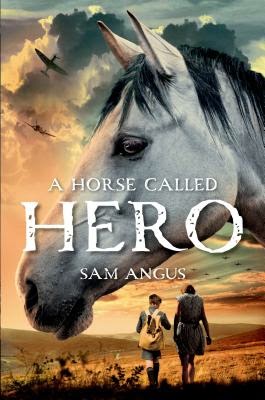
A Horse Called Hero

by Sam Angus
First sentence: “Wolfie stopped, distracted by the stacks of sandbags and newly dug trenches.”
Support your local independent bookstore: buy it there!
Review copy provided by the publisher.
Content: There’s really nothing objectionable for the target audience, though there are letters written in cursive, and I know my 3-5 graders would have problems deciphering those. There’s also several intense situations, so if you have a sensitive child, you might want to shy away from that.

Dorothy and Wolfgang Revel — they go by Dodo and Wolfie, however — are children in London the winter of 1940 when the German bombs start dropping. Their father is called up to serve in the army — he was a celebrated commander during World War I — and they are sent off to Northern England to live with strangers. They’re doing okay, until word comes back that their father was arrested for desertion. Then, they are outcasts in this strange place. That is, until they’re taken in by the school teacher. Whereupon Wolfie chances across a horse being born and adopts it for his own.

If you can’t tell my my enthusiastic summary of the first 50 pages (which is really all that is; this book covers an enormous amount of time), I am not a horse person. And, alas, this book did nothing to help with that. I kind of had hopes that this would be Inspiring and Uplifting and help me see what people find in horse books, but… no. I was bored. The basic plot revolves around Wolfie’s love for Hero The Horse and the kids’ concern about their father. There was an incident when Hero saved them after they got trapped in the bog, and another when Hero helped Wolfie get out of a mine after an explosion, but by then, I was so Bored because of the lack of Real Plot (and the extended time; Wolfie was 5 or so when it started, and 14 by the end), I was just skimming.

I am sure that there are kids who would Love this one, but I am not one of them.

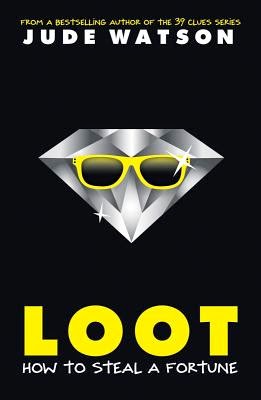
Loot: How to Steal a Fortune

by Jude Watson
First sentence: “No thief likes a full moon.”
Support your local independent bookstore: buy it there!
Content: The only think I can think of is that it’s a bit intense, action-wise. Probably on par with the Percy Jackson books. There’s no swearing, no romance. It’s happily in the middle grade (grades 3-5) section of the bookstore.

This book — combined with The Great Greene Heist (it’s a trend! Does two books make a trend?) — has gotten me thinking about the implausible versus the impossible. It is implausible that Jackson Green could have thrown together a crew to scam less-than-intelligent adults into exposing a blackmailing scheme. It is highly impossible, however, that 12-year-old March McQuin could have gotten together a crew in order to steal back 7 Moonstones that his illustrious thief father, Alfie, stole 12 years before. (Granted, the premise behind the Heist Society books by Ally Carter is also impossible.)

Impossible, however, doesn’t mean “bad”.

In fact, Watson has put together quite a ripping tale. After Alfie’s death during a heist in Amsterdam, March discovers he has a 12-year-old twin sister, Julia, that he didn’t know about. And then, at Alfie’s funeral, March and Julia are confronted by the woman from whom the moonstones were stolen. She’s offered them $7 million in order to steal them back. In a week. They’re up against incredible odds: Alfie’s old partner, who has just recently gotten out of jail, are after the stones as well.

Even though the premise is impossible, Watson does a fantastic job keeping up the pace. The chapters are short, the pacing quick, making it a perfect read for reluctant readers. Plus, it’s action-packed with chases (both in the car and on foot) and rooftop falls as well as planning and executing some pretty amazing heists.

No, it’s not a story that could actually “happen”. But it was still a lot of fun.

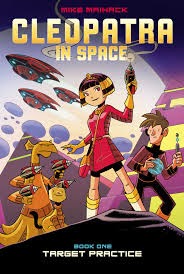
Cleopatra in Space

Book One: Target Practice
by Mike Maihack
Support your local independent bookstore: buy it there!
Content: There’s some violence, but nothing terribly graphic. What struck me is that there is a lot of exposition (with long words) in this one. I’m not sure if K understood everything that went on, but she got the gist of it. Which is what graphic novels are great at.

It’s her 15th birthday, Cleopatra (yes, that Cleopatra) doesn’t want to go through with her party. The ceremony, the pomp, the everything. So, she sneaks away from her tutor, and discovers a portal to a future time and place that is being besieged by a tyrannical dictator. The prophecies declare that she will be the Savior of the world, but first: she has to go to academy to figure things out.

It’s essentially a fish-out-of-water story; BCE girl meets futuristic technology. I liked how she found everything boring, until she got to combat training. She took to that immediately. She’s a girl of action, and she’s smart and tough — when it comes to combat. She’s not a scholar and that’s okay. The only thing that was a bit disconcerting was the whole talking cats. Cats in this world have evolved to the point where they kind of run things. And it’s a bit weird. But that just may be me.

In the end, it reminded me a lot of Zita the Spacegirl — both in the content as well as the artistic style — which is a good thing. And I’m curious to see where Maihack goes next.

Audiobook: Randi Rhodes Ninja Detective: The Case of the Time Capsule Bandit

by Octavia Spencer
Read by the author.
Support your local independent bookstore: buy it there!
Content: There wasn’t anything objectionable. I don’t know how it’d be reading it, but my 8-year-old followed the story pretty well while listening to it. We did have to stop the audio a few times to explain some things, however. It’s in the middle grade (grades 3-5) section of the bookstore.

I threw this in the audiobook pile mostly because I’ve seen it at the store and wondered if it was any good. (I know: celebrity authors. Ugh. But, sometimes they surprise me. Not often, though.)

Randi Rhodes is a die-hard city girl. She’s grown up in Brooklyn and loved every minute of it. Her family summers in Deer Creek, Tennessee, which is just about the right length of time for a city girl to spend in a boring, dull, small town. But the year after her mother dies (I called that pretty early on; I do get so tired of dead parents), her father, a mystery writer, packs the two of them up to live full-time in Deer Creek. Randi is not happy about this.

But, once there, she falls head-first into a mystery: the 200-year-old time capsule for the town’s Founder’s Day has been stolen. And they have 72 hours to get it back. Much against her over-protective father’s wishes, Randi (and her two new friends, D. C. and Pudge) decide that they are the only ones to solve the mystery.

It’s a pretty run-of-the-mill middle grade mystery book. Nothing too fantastic or brilliant; in fact, as an adult, I’ve seen all the tropes before. The banker is a Bad Guy, as is the power-grabbing Mayor. There’s a grumpy old man with a heart of gold, and a woman sheriff who’s a bit bumbling. (Though — spoiler — this isn’t a true middle grade novel, because by the end, you discover that the sheriff isn’t bumbling at all, but has instead figured out the mystery WAY before the kids ever did.) The best parts of the book are when Randi and her friends are out being detectives; the worst are the angsty tensions between her and her overprotective dad. I got extremely tired of the rants Randi went on about not being “understood.” (But that’s a parent speaking. I did appreciate that Randi was a non-girly girl; she was often ranting about how she wasn’t a princess and didn’t need protection. She’s a black belt in Tae Kwon Do, after all.)

In the end, it wasn’t anything special, though A and K enjoyed listening to it. But, it wasn’t absolutely horrible, either, and Spencer did an admirable job of narrating her book (which I would expect, with her being an actress and all).

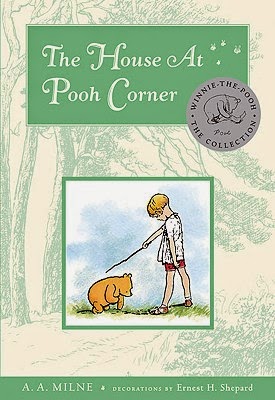
Audiobook: The House at Pooh Corner

by A. A. Milne
Read by: Stephen Fry, Judi Dench, Michael Williams, Geoffry Palmer
Support your local independent bookstore: buy it there!
Content: It’s Pooh Bear! Perfect for everyone.

I have read the Pooh Bear stories over and over to my children (as has Hubby), but still, when I saw this on the shelf at the library, I snapped it up. I never mind hearing the Pooh Bear stories again, if they are being read by a handful of really great British actors, it’s positively perfect.

And it really was. These are the later ones, the Tigger stories, and I loved (we all did!) hearing them again. Our realizations this time? Eeyore is such a delightful cynic. He made us laugh every single time. Piglet is such a Good person (or pig, as is the case) and no one appreciates it. Tigger is quite possibly high. Rabbit is the only one of the bunch who actually actively has machinations: he wants to Get Rid of some of the other animals (*cough*tigger*cough*). Owl is a complete fraud. Christopher Robin is God. And Pooh? He’s that delightfully clueless person that you can’t help but love. The full cast audio was an absolutely perfect way to do this book; the personalities came shining through with each reader.

And the last story, In Which Christopher Robin and Pooh Come to an Enchanted Place? It made Hubby and me both tear up. Growing up is such a bittersweet thing.

Delightful.

The Glass Sentence

by S. E. Grove
First sentence: “It happened long ago, when I was only a child.”
Support your local independent bookstore: buy it there!
Review copy provided by the publisher.
Content: There’s nothing objectionable or scary. It is, however, nearly 500 pages and it’s small type and that can be intimidating. (A was initially intimidated. I think I’ve convinced her to read it.) It’s also kind of slow-moving, with a lot of tricky names, so probably not the best book for a reluctant reader.

I think the best place to start with this one is Megan Whalen Turner’s quote on the back cover: “Not since Philip Pullman’s The Golden Compass have I seen such an original and compelling world built inside a book.”

That’s quite a lot for a book to live up to (MWT! Philip Pullman! Original! Compelling!) but you want to know something? She was right. So very, very right.

In 1799, something happened, and the whole world shifted. It came to be known as the Great Disruption, and what it did was cause different parts of the globe to be in different time periods. Europe was stuck in the middle ages, the Northwest Territory in a prehistoric ice age. What we know as the 13 colonies stayed in linear time, for the most part, though they never developed much farther than that. Past the Mississippi River and into Mexico is what is known as the Baldlands, a hodgepodge of raiders and outlaws, except for three cities which are known as the Triple Era, with people and creatures spanning 3000 years in the same place.

Pretty cool, no?

It’s no wonder that in this world explorers and map-makers are held in the highest esteem. And Sophie Tam’s uncle, Shadrack Elli, is one of the best. He’s been raising his niece ever since her parents — also explorers — disappeared. She’s learned to live without knowing about her parents, and she’s learned how to read the maps that Shadrack makes. So when he’s kidnapped, she’s really the only person who can save him.

The world is brilliant, and the use of maps and magic (of sorts, though kind of not really “magic” as you’re thinking about it; it’s more future techonology) are refreshingly unique. But, once the plot starts going (which, admittedly takes a while), it picks up and becomes one of those books you can’t put down. I was thrilled with the world, with Sophie and her friend Theo and their increasingly intense and urgent adventure. I thought that Grove captured an interesting balance between the older people — like Shadrack — and their expertise and the younger ones — like Sophie — who were able to see things in a new and different light. I loved the use of time and Ages and invented words; I haven’t seen this kind of  creativity in naming things since Harry Potter. I also loved that the “bad guy” wasn’t wholly evil. That while they did some morally questionable things, it wasn’t a pure black and white thing. There’s layers here: yes, it’s a middle grade fantasy adventure, but it’s also so much more.

I can’t wait for the sequel.

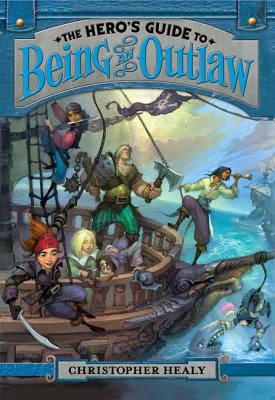
The Hero’s Guide to Being an Outlaw

by Christopher Healy
First sentence: “Outlaws have too many feathers in their hats.”
Support your local independent bookstore: buy it there!
Others in the series: The Hero’s Guide to Saving Your KingdomThe Hero’s Guide to Storming the Castle
Content: There’s some kissing, a bit of violence (and almost violence), and it’s long for a middle-grade novel. It’d be in the middle grade section (grades 3-5) of the bookstore; don’t let the length fool you; it goes fast.

I don’t even remember what our Fair Heroes were doing at the end of the second book. But, honestly: it doesn’t matter. I fell right back into the silly stupidity (and I say that with all loving kindness in my heart) of this book, snorting and giggling as The League of Princes (and the Ferocious Female Freedom Fighters — or FFFF) try to save the Thirteen Kingdoms from Lord Rauber’s (who they thought they killed in the last book) evil plan to take over the world.

The point to the book, I think, is not the plot. Sure, there is a plot: The whole gang is branded as outlaws because they were supposed to have murdered Briar Rose (sure, she’s annoying, but they wouldn’t literally kill her. Only figuratively) so everyone’s on the run and trying to prove their innocence. But the point is for the guys to be dorky (ah, Duncan), the girls to be awesome (bonus: pirate captain Jerica! Double bonus: Gustav trying to flirt), and for super-silly jokes and asides (like the prisoner Val Jeanval. Get it??). Yes, it was stupid. But, I love it.

Full of action (and stupid jokes), and perfect for just about anyone who doesn’t mind a bit of fairy tale adventure.

My Basmati Bat Mitzvah

by Paula L. Freedman
First sentence: “When Ben-o came over on Saturday for movie nigt, my dad answered the door wearing gray silk pajama bottoms and his Math Teachers Play by the Numbers T-shirt, an unlit pip clenched between his teeth.”
Support your local independent bookstore: buy it there!
Review copy snagged from the ARC shelves at my place of employment.
Content: There’s a lot of questions about religion and God in this. Plus some 7th-grade kissing. If we had it at the bookstore I’d probably waffle between putting it in the Middle Grade (grades 3-5) and YA (6-8) sections. It could easily go either place.

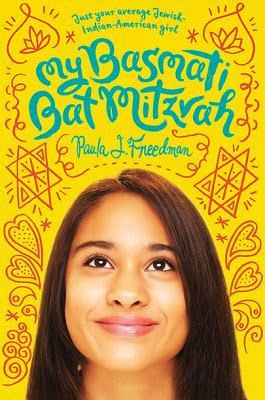
Tara Feinstein is your typical New York City middle schooler. She has two best friends, Rebecca and Ben-o (thusly named in fourth grade when there was a Ben D., even though he’s since moved away), and is looking forward to 7th grade. She’s been attending Hebrew School for the past few years — her mother, who is Indian, decided that Tara needed to get in touch with her Jewish (from her father) side — and is wondering whether or not to go through with her bat mitzvah in December. And like a typical middle schooler (at least one in my house), she has questions. About whether or not going through a bat mitzvah is somehow denying the Indian side of her. About whether or not there is a god. About why Ben-o is acting so strange and Rebecca seems to be hanging out with a girl that Tara just Doesn’t Like. Typical middle schooler stuff.

There really isn’t much overall conflict in this. Mostly it’s like life: a series of ups and downs. Tara and Rebecca accidentally ruin a priceless heirloom sari that Tara’s been given by her aunt. The new friend Rebecca has turns out to be a bit of a kleptomaniac. Ben-o turns out to like like Tara, but covers it up by hanging out with another girl, which is confusing to say the least. So, there is Drama (which, on the one hand, will make this book imminently relatable to everyone, but I was a bit Done With, only because there’s so much middle school Drama in my own house that it was a bit overkill for me).

What I did enjoy was the melding of the cultures. How Tara’s Indian aunt called Tara’s Jewish grandmother “Ruthie-ji”. Or that the grandmother would bring a matzoh ball soup to a Diwali celebration. Or the way Tara melded the two at her bat mitzvah: wearing a dress made out of the ruined sari and serving Indian food. What better way to celebrate the good things in all cultures and traditions? I also enjoyed her musings about God and the afterlife and religious traditions. It’s that which kept me reading in spite of my Drama overload. And it’s was those elements that made the book good (for me).

Graphic Novel Round-up, May 2014

Hilda and the Bird Parade
by Luke Pearson
Support your local independent bookstore: buy it there!
Content: It’s a bit intense at parts, with Hilda getting lost and some interesting monsters. But that’s it. It’s in the middle grade graphic novel section of the bookstore.

I don’t think this was a first in a series — googling Luke Pearson led me to a number of other Hilda titles. But it’s a perfect place to start. Hilda is a spunky, blue-haired girl who has been raised in the mountains before her mother moved them to Trolberg. Hilda doesn’t like the confines of the city, mostly because her mother never lets her go anywhere anymore.

Then, on the day of the Bird Parade, Hilda is invited out by some classmates. They take her to all of the (not-so) cool spots, but she bails on them when they start throwing stones at a raven. She rescues the raven, who 1) happens to talk, and 2) has amnesia. They wander the city and have adventures while the raven tries to get his memory back.

That plot summary doesn’t do Hilda any justice. It’s an absolutely adorable book. Sweet and fun, full of action and adventure as well as playing off of Norse myths (which seem to be the in-thing these days). I loved it, K loved it, Hubby loved it. I’m definitely going to get more Hilda books and see what other adventures she has.

Fairy Tale Comics
edited by Chris Duffy

Support your local independent bookstore: buy it there!
Content: Fairy tales, in their original form, are quite violent and weird. While this collection tones it down, there’s still some violence and weirdness. That said, K didn’t have any problems with it, though she didn’t “get” some of it. It’s in the fairy tale section of the bookstore, but I’m wondering if it’d get more exposure with the middle grade graphic novels.
Fairy tales are weird. (Or as the narrator in A Tale Dark and Grimm would say, “awesome”.) And what better way to showcase the weirdness than to get a bunch of illustrators to reinterpret ? different fairy tales in graphic novel form?
On the one hand, this is a terrific way to get reluctant/struggling readers interested in fairy tales. K picked it up, and thoroughly enjoyed perusing the pages, reading all the stories. Also, in its favor, there is a Japanese folk tale, a Br’er Rabbit story, and  tale from 1001 Nights, though it was too heavy on the Grimm for my taste. Even so, some of the tales were cleverly re-imagined — The 12 Dancing Princesses (Emily Carroll), Give Me the Shudders (David Mazzucchelli), Little Red Riding Hood (Gigi D. G.), and The Boy Who Drew Cats (Luke Pearson)  were among my favorites.

Others, though, were not as well done. Snow White (Jaime Hernandez) was just weird (then again, so is the fairy tale) and Rapunzel (Raina Telgemeier) disappointingly “borrowed” from Rapunzel’s Revenge/Tangled. I think I was also hoping for more of the unusual ones, Snow White and Rose Red or something from Hans Christian Anderson, or my favorite French tale The White Cat. It was very much, for the most part, the known tales retold, and while that was all fine and good, I was hoping for something… more.

The Lost Boy
by Greg Ruth
Support your local independent bookstore: buy it there!
Content: This has gone back and forth between the teen graphic novels and the middle grade graphic novels. It’s not as kid-friendly — it’s intense, and a bit difficult for the eye to follow — as some others we have in middle grade, but it’s a bit simplistic — it’s a straight-up fantasy-adventure — for teen.

When his family moves into a new house, Nathaniel Castle (just call him Nate) has no idea what’s in store for him. When, under a loose floorboard, he finds an envelope with his name on it next to an old-fashioned tape recorder, he can’t resist the odd message — Find Him — and the lure of a mystery. Little does he know that he will be dragged into solving a 50-year-old disappearance of a local boy, Walt, and be immersed in a world where dolls and insects talk, and a mysterious force called the Vespertine is trying to take over.

The art in this one is gorgeous: done in shades of black and white, it’s realistic, even in the fantasy elements. No cartoons here. And that gives it a seriousness that I don’t think the story would have otherwise had. It’s quite eerie and chilling in parts. That said, it’s also a straight-up adventure; the hero does win the day, with some help of his friend Tabitha, and all is happily-ever-after, even though there’s a slightly ominous coda.

I do hope Ruth writes another one, though. I’m quite fascinated by this world he’s created.

Explorer: the Lost Islands
edited by Kazu Kibuishi
Support your local independent bookstore: buy it there!
Content: There’s some weird stuff going on, but none of it is inappropriate for the younger reader. (K handled it just fine.) It’d be in the middle grade graphic novel section of the bookstore, if we carried it.

I picked this up solely because of Kibuishi’s name (why, yes, I AM waiting impatiently for the next Amulet installment) without knowing anything about it, or this series. (I guess it is a series, since this says Book 2 on it..) It turns out it’s a series of short stories from a handful of artists on a theme, this one being “islands”.

Like any other short story collection (see above!), it’s a wide range of stories ranging from the silly — a group of bunnies on an island who work until someone invents a robot that will do all of their jobs (but it has disastrous results) to the weird — Kibuishi’s Moby Dick-esque story or Chrystin Garland’s weird devil-party (I know there’s a term for this, but it’s escaping me. There were touching ones — particularly “Desert Island Playlist” from Dave Roman & Raina Telgemeir, that illustrates how the past, present, and future are all necessary in one’s life. Or “Loah” by Michel Gagne, which is a gorgeously illustrated story of how differences matter.

It’s a good solid collection, and it makes me want to hunt out the first one in the series to see what the theme and stories are. A great introduction, too, to a wide range of artists.

Mouseheart

by Lisa Fielder, illustrated by Vivienene To
First sentence: “The young rat prince knew he was taking a monumental risk.”
Support your local independent bookstore: buy it there!
Review copy given me by our Simon & Schuster rep, via my boss.
Content: There are some mild scary parts, and some mild violence, but really, it’s quite happy in the middle grade (grades 3-5) section of the bookstore.

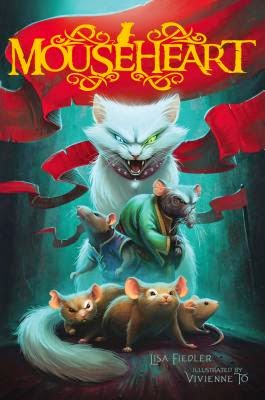
I have to admit that I was a little turned off by the cover. It just looks so…. I don’t know. Juvenile, maybe. Or lame, perhaps. But, either way, I was completely unprepared for the awesome found inside.

I do have to qualify the word “awesome”: if you don’t like fantasy or talking rats, you may not find this awesome at all. The thing is: usually I don’t either. I liked  The Tale of Despereaux well enough, and Mrs. Frisby and the Rats of NIMH okay, but I didn’t like Redwall, and I have studiously stayed away from the Warriors series. So, talking animals, not exactly my thing.

But the story of a pet-store bred mouse, Hopper, who — ends up beneath the subways of Brooklyn in the sewers — got to me. Perhaps it was his insecure optimism that won my heart over. Or the fact that his sister, Pinkie, was a bully and my mom-sense (kind of like Spidey-sense) kicked in. Or perhaps it was that he found a civilization of rats underground that has a tentative peace with feral cats. Or maybe it was the prophecy of the Chosen One, and the complications that brings.

What I really enjoyed was the way that Fiedler had the rats interact with the human world. How they taught themselves to read, and how Hopper figured out the subway system. How they used cast-off items (and some scavenged ones, too) to furnish their world. It was fantastic.

Maybe, too, I was just in the mood for a straight-up fantasy adventure with talking rats and a mouse with a heart of gold. I didn’t know that I was, but I found I couldn’t put this one down.