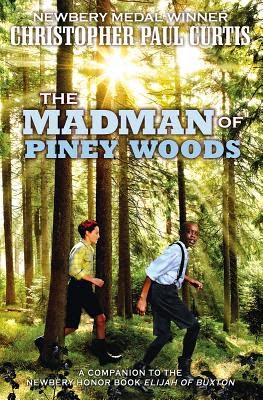
The Madman of Piney Woods

by Christopher Paul Curtis
First sentence: “The old soldiers say you never hear the bullet that kills you.”
Support your local independent bookstore: buy it there!
Content: There’s nothing, language wise. However, Curtis tackles some pretty heavy issues: slavery, of course; but also Irish immigration, abuse, racism. It’s in the middle grade (grades 3-5) section of the bookstore, but I would exercise caution about giving this to sensitive children. Good for discussion, though.

It’s 1901, and Benji is a pre-teen in the all-black town of Buxton, Canada. He has a couple of younger siblings that get on his nerves, a best friend who is a good orator, and is both an aspiring newsman and someone who loves the woods. Red is a pre-teen in the nearby town of Chatham. His grandmother was an Irish immigrant, and he’s positively scared of her wrath. He spends his days in school, with his friends — one of whom has an alcoholic, abusive father — and at home dealing with his grandmother.

They’re the most unlikely of friends, but when they do meet, they hit it off.

Which comes in handy the night that the Madman of Piney Woods — a local homeless black veteran of the Civil War — is shot. It’s up to Benji and Red to make everything turn out, if not okay, then at least better than it could have ended.

Perhaps I should have taken the time, once I figured out that this was set in the same place, to reread Elijah of Buxton. Maybe I would have connected to it better. But, I think the main problem I have with this one is that the plot took a long time to show up. It’s told in alternating chapters, one Benji (who was more interesting than Red), one Red. And it took FOREVER for them to meet. (More than halfway through the book!). Once they met, the plot picked up, and I was able to finish fairly quickly. I did appreciate that Curtis was exploring ideas and themes that are tough to manage: the way humans treat other people being the primary theme. It’s an important thing to expose kids to, and to do so with a bit of a mystery story (more or less) is a good thing.

But that wasn’t enough to make me love this book, even though I really wanted to.

Graphic Novel Round-Up, November 2014

I spent a Saturday recently just reading graphic novels to help me out of the slump. I think it might have worked; I feel much more interested in reading a full-length book now. Also, both A and K picked some of these up and found themselves completely engrossed. So, it’s a good batch.

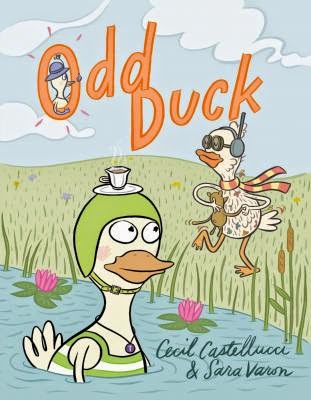
Odd Duck
by Ceci Castellucci and Sara Varon
Support your local independent bookstore: buy it there!
Content: There’s nothing. And the words/ideas are pretty simple. It’s good for reluctant readers as wel as those who just want a good, short story. It’d be in the middle grade graphic novel section of the bookstore.

Theodora is an ordinary duck. She does her ordinary duck exercises in the morning, goes for her ordinary duck walk (because she doesn’t like to fly), and reads ordinary duck books in the afternoon. She lives a nice, quiet life and is very happy.

That is, until Chad moves in next door. Chad is not an ordinary bird. He does not do his exercises in an ordinary way (if at all), He dyes his feathers weird colors. He does art (gasp)! Theodora is not happy. But then, come winter, she and Chad bond (because they don’t fly south). They discover that they have things in common, and that they really enjoy each other’s company. And that maybe being different isn’t so bad.

It’s a charming little graphic novel, full of adorable art and sweet little lessons, but it’s never heavy-handed or didactic. Perfect for younger and reluctant readers.

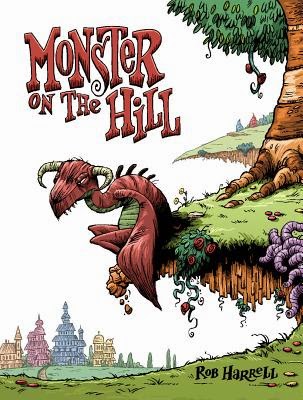
Monster on the Hill
by Rob Harrell
Support your local independent bookstore: buy it there!
Content: Linguistically, it’s more challenging. But it’s probably on par with the Amulet books, which means it’s probably good for 3rd grade and up. Content-wise, there’s some monster violence, but that’s it. It’d be in the middle grade graphic noel section of the bookstore.

In this version of 1860s England, there are monsters that terrorize every town. But never fear: that’s what the townspeople want. (Seriously.) But, in Stoker-on-Avon, they have a problem: their monster, Raymond, doesn’t do anything but moan and complain. It’s bringing the town down. So, the town leaders send the eccentric Dr. Charles Wilkie (and a street urchin, Timothy, hitches along for the ride) to convince Raymond to buck up and do his job.

This leads to a road trip, a lot of bonding, some lessons learned, and a giant battle against an unstoppable foe before everything is set to rights again.

This one had me eating out of the palm of its hand. I loved Raymond — he was delightfully pathetic — and his schoolmate, Noodles (aka Tentaculor) and their relationship. There was so much that had me just laughing out loud. True, there could have been a female character (just one? Please?)  or perhaps some diversity (though it was England in 1860-something), but for the most part, I found this simply charming.

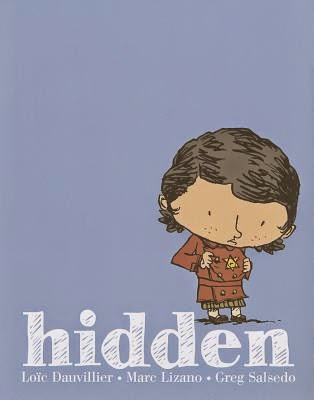
Hidden
by Loïc Dauvillier, Marc Lizano, and Greg Salsedo
Support your local independent bookstore: buy it there!
Content: It’s about the Holocaust, so there will definitely be things to discuss. It glosses over the worst of the horrors; there’s a passing image of a concentration camp survivor, as well as illusions to other horrors. Even so, it’s very kid-appropriate. It’s in the middle grade graphic novel section of the bookstore.

This one is your standard Holocaust fare. Mostly. Framed as a story a grandmother is telling her granddaughter about the time when she was a child, Dauvillier focuses mostly on the Resistance and the people in France who helped those who were Jews get away.

It’s a very tender story of a young girl, Dounia (the grandma) whose parents were taken to the concentration camps in 1942, near the end of the war. Even though Dounia hides during the inital raid, the neighbors (some of whom are part of the reistance), know they’ll be back, looking for her. So, they arrange for her to live with a woman in the country. In the act of escaping, the neighbor’s husband is caught, though he’s only arrested and released. He manages to find his way back to his wife and Dounia. Her main concern, though, is finding her parents again and so they keep looking, especially once France is liberated. Eventually, they do find her mother, and the story ends.

I liked this one well enough, but (possibly because it’s tamed down a bit) it lacks the emotional punch that other Holocaust books have. Still, it’s a good introduction to the topic.

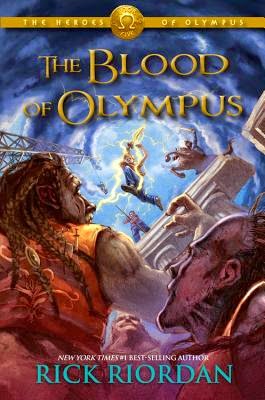
The Blood of Olympus

by Rick Riordan
First sentence: “Jason hated being old.”
Support your local independent bookstore: buy it there!
Others in the series:  The Lost HeroThe Son of NeptuneMark of Athena, The House of Hades
Content: There’s some mild kissing and lots of fantasy violence. It’s in the YA section (grades 6-8) of the bookstore, but it’s more than appropriate for Percy Jackson fans of all ages.

The doors of Hades have been sealed, but Gaea is awakening anyway. Our heroes have split up: seven on the Argo II trying to go get to Athens to stop Gaea, the other two (plus Coach Hedge) are shadow-traveling the Athena Parthenon to Camp Half-Blood as a goodwill gesture from the Roman camp to the Greek camp. Both sets are facing Great Odds: monsters and minor gods that have switched sides as well as Octavian and the Roman camp’s impending invasion of Camp Half-Blood. Will they be able to stop everyone in time?

It’s a good ending. Not a great ending, not a fantastic book, but a good, solid one. It was a nice send-off to characters I’ve come to know and love for 10 years. And I was more than happy to take this ride with them. I was glad that the unsung characters — Piper, Reyna, and especially Nico — got a chance to shine. I enjoyed the whole book well enough, but I REALLY enjoyed the Reyna/Nico chapters. I just felt like that was where the more interesting story was, with saving Camp Half-Blood and fighting Orion and Octavian, and they were just awesome. Period. Everything else paled in comparison.

I do have some theories about the end (which ticked off A, by the way) but I’m not going to go into my theories here. I have some complaints about the sort of writer Riordan’s become; he’s become much too much of a formula writer for my taste. But I understand the demands of publisher’s and fans and the constraints of storytelling and I’m still more than happy to give everything he writes a read.

I will be sad to see this series end; it’s been a good ride.

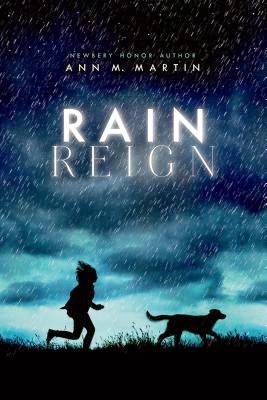
Rain Reign

by Ann M. Martin
First sentence: “I am Rose Howard and my first name has a homonym.”
Support your local independent bookstore: buy it there!
Content: There’s really nothing, and the words are mostly simple with lots of white space. It’s in the middle grade (grades 3-5) section of the bookstore.

Rose Howard is a 12-year-old fifth grader with high-functiohttp://www.thebooknut.com/2013/08/counting-by-7s.htmlning autism. Her mom ran of when she was two, and she’s been raised in a small New York town by her dad. (And her uncle, who’s much nicer than her dad.) She generally makes do in school, at home. Especially since her dad’s gone either at work or at the bar down the road.

He did pick up a dog for her, one day, though. Which she named Rain. And Rain keeps Rose company.

(There is a side bit about Rose loving homonyms but I felt that was more distraction than anything, and didn’t really add much to the plot.)

A big storm hits, the remnants of a hurricane, and knocks power out in the down. Rose’s father lets the dog out, and she never comes back. So, Rose and her uncle set to checking in shelters to find Rain. And when they do, they’re in for a surprise.

I’ve never read any Ann Martin before (yeah, I missed the whole Babysitter’s Club thing), and I really wanted to like this one. But I just… didn’t. Counting by 7s and Anything But Typical did the whole autism spectrum thing so much better. I didn’t care about Rose, I’m tired of missing mothers and bad fathers, and I just. didn’t. care.

That’s not to say it’s a bad book… I did like the way Rose narrated it, like she was writing a report. It was clever, but I found that the form got in the way of the substance. That’s not to say others (especially dog lovers) wouldn’t like it. But it wasn’t for me.

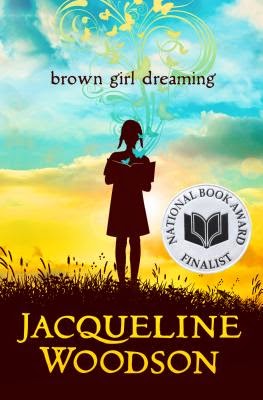
Brown Girl Dreaming

by Jacqueline Woodson
First sentence: “I am born on a Tuesday at University Hospital Columbus, Ohio, USA — a country caught between Black and White.”
Support your local independent bookstore: buy it there!
Content: There’s nothing objectionable. And it’s even an easy-ish read. Sure, it’s poetry, but it’s not difficult. Hand it to anyone with an interest in writing, kids, and history. It’s in our middle grade biography section at the bookstore.

I’m not quite sure where to start on this one. It seems We’ve (the collective we, here) been inundated by memoirs and biographies of celebrities, People of Note, and at first glance Jacqueline Woodson’s new book just falls into that pit of “celebrity” (of a sort) biographies.

Except, it’s not so much a biography or memoir as it is a reflection upon a childhood. Woodson makes her childhood an Everyperson experience, something that the reader can readily identify with, even if they didn’t have her exact same experiences.

Her childhood begins in Ohio, but mostly it’s spent in South Carolina, with her grandparents, and in Brooklyn, where her mother finally settled with Jacqueline and her brothers and sister. I kept trying to figure out the timeline (if she was born in 1963, then it must be…) but eventually, I just gave up and let myself get absorbed in the story.

And absorbed I was. Woodson wove historical elements into her story — sit-ins in the South; the way her grandmother felt about the way she was treated in stores by white people; music that was playing on the radio — all of which helped put her personal story in a larger framework. I could easily forget I was reading a memoir; it felt so much like a novel.

Part of that, too, was the form. Written in free verse, the memoir took on a lyrical quality. There were moments, especially toward the end, where I was moved by her insights not only in her life, but for Life in general.

One more thing: I appreciated her portrayal of religion. I get the sense she’s not a practicing Jehovah’s Witness anymore, but she portrayed the religion of her grandmother and her own childhood with respect. It was neither good nor bad; it was just a part of her life. And I found that refreshing.

Highly recommended.

Thursdays with the Crown

by Jessica Day George
First sentence: “‘You are not leaving me behind,’ Celie repeated.
Support your local independent bookstore: buy it there!
Others in the series: Tuesdays at the Castle, Wednesdays in the Tower
Content: There’s nothing objectionable, really. It’s a good book for both readers who love fantasy, and for struggling readers — lots of white space, and short chapters — who need action. It’s in the middle grade (grades 3-5) section of the bookstore.

When we last left Celie, Rolf, and Lila, they had just disappeared from Slene (along with Lulath and Pogue). No one knew where they went or why the castle sent them away.

As the book opens, Celie and her intrepid siblings and friends are stuck in a place they didn’t know existed. And they need to find the Glorious Arkower, the head magician, to go back to Slene. Except, things aren’t that simple. They discover that Rufus (Celie’s griffin) isn’t the only one; he’s got parents. Who happen to be the king and queen of the Royal Griffins. The motley crew manages to find and hatch a couple more griffin eggs (one for everyone!) and discover that the Glorious Arkower is… not so glorious. And things aren’t as simple. The question is: can Celie figure out a way to return back (and wake up!) the castle she loves?

This is such an adorable series, though I think it might be one that’s better read in one sitting. Sure, I fell pretty fast into the world (I haven’t read the other two in a while). But, I think I would have liked it more had I read them all in quick succession. Even so, Celie’s delightful, Lulath’s still my favorite, and I’ll happily spend time in Slene with them for as long as George wants to write about them

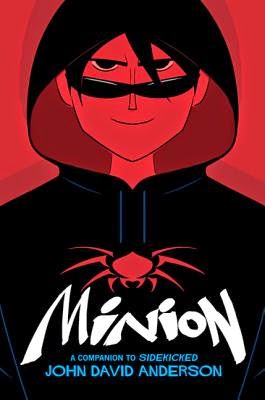
Minion

by John David Anderson
First sentence: “I want you to know, right from the start, that I’m not evil.”
Support your local independent bookstore: buy it there!
Others in the series: Sidekicked
Content: There’s really nothing objectionable, and I ended up putting these in the Middle Grade (grades 3-5) section of the bookstore. It still feels slightly older than that, however. I just can’t place why.

Michael Morn is a villain. His adoptive father is one of those mad scientist types, who invents boxes that do… well, stuff. Like scrambling all the cameras, or maybe blowing up. And so the duo have committed crimes. Nothing extravagant, mostly just bank robberies when they needed the money.

But Michael also has a secret: he has unusual powers of persuasion. When he looks someone in the eye, he can compel them to do something. Sure, it has to be within the realm of possibility, but he can do it. So far, he and his dad have kept that power under wraps, only using it when they really have to. But with the arrival of The Dictator — a true super-villain — and his nemesis, the Comet, Michael’s life is about to change. And not necessarily for the better.

I remember liking the companion book to this, Sidekicked, but even so, when I picked this up, I wasn’t quite sure what to expect. On the one hand, it’s a very clever take on superheroes and super powers. I like the world that Anderson has created, where being super isn’t necessarily an unusual thing and superheroes aren’t necessarily saviors of the world. And where villains are just people trying to scrape by.

That said, I felt that this one was missing something: A concrete ending, for starters. I won’t give anything away, but it left more questions than answers by the end. And it didn’t feel like a real middle grade (or even YA) novel, either. Michael did stuff, sure, but mostly he was reacting to the adults around him, and spent more time being their pawn (from this father, to the crime boss his father worked for, to The Dictator, in the end) and didn’t actually do anything. It felt like an elaborate set-up without much of a pay-off.

That said, it wasn’t bad either. Or, at least, not bad enough to put down. But it wasn’t satisfying in the end.

The Princess in Black

by Shannon Hale and Dean Hale, Illustrated by LeUyen Pham
First sentence: “Princess Magnolia was having hot chocolate and scones with Duchess Wigtower.”
Support your local independent bookstore: buy it there!
Review copy provided by the publisher.
Release date: October 21, 2014
Content: Yeah, there’s nothing but good fun here. And it’s simple enough for the younger set. It’ll be in the Beginning Chapter Book (grades 1-2) section of the bookstore.

Princess Magnolia has a secret. She’s a superhero, rescuing innocent and unprotected goats from the Big Bad Monsters. The thing is: princesses aren’t supposed to be superheroes. They’re supposed to be princesses. Right?

Well, aside from the stuffy Duchess Wigtower, no one tells Princess Magnolia she can’t. So, even though the Duchess is trying to snoop into Princess Magnolia’s business, she finds a way to sneak out of the castle to go whip those pesky monsters into shape.

As an aside, yes, Princess Magnolia is white. (Shannon Hale has said that’s partially for marketing reasons — if I heard her correctly — and partially because she’s modeled on Hale’s daughter, who is blonde and blue-eyed.) But the goat boy is not, and Hale promises further diversity (of race, at least) in the next book. (In fact, she showed us at KidlitCon a mock-up of the drawings, and they’re quite gorgeous.)

Liberally and cheerfully illustrated, this short chapter book was a delight to read, Hilarious and silly and just perfect for those who can’t get enough of Kate DiCamillo’s Mercy Watson series. (Same sort of humor and silliness as those as well.)

If Princess Magnolia has any other adventures, I’d love to read them.

The Iron Trial

by Holly Black and Cassandra Clare
First sentence: “From a distance, the man struggling up the white face of the glacier might have looked like an ant crawling slowly up the side of a dinner plate.”
Support your local independent bookstore: buy it there!
Content: There’s some intense violence at the start, but nothing worse than, say, Harry Potter. It’s in the middle grade (grades 3-5) section of the bookstore. We’ll see how the series goes; it might change.

Callum has grown up believing that magic is bad, that the mages at the Magisterium only put their interests in front of the students, that his leg which was injured as a baby and never healed right was the fault of the mages. His father — once a mage himself — has told Call this among other things. So when Call gets summoned for the Iron Trial — the selection process for the Magesterium — his father tells him to throw the entry. And, because Call is only 12 years old, he tries. And fails. He gets into the Magesterium and is exposed not only to the dreaded magic, but also the story of his past that his father never told.

I’m just going to come out and say it: it’s Harry Potter. The similarities are really numerous — a boy raised as an outsider finds out he’s magic, he has a special calling, he was at the death/disappearance of the Enemy and has a connection to him (um… bit of a spoiler, there. Sorry.), the story takes place over a school year, he has two friends (a boy and a girl), there’s a rich snob bully boy, and on and on.

Except, for all the similarities, it works. I’ve been looking for a (good) Harry Potter read-alike for years, and this one — Black and Clare are superb writers in their own right — fills the bill. The world building is solid, the magic interesting. And there’s a bit of a twist that caught me off guard. So, even though there’s solid Harry Potter similarities, it’s definitely worth reading.

I Kill the Mockingbird

by Paul Acampora
First sentence: “My mother’s wheelchair does not fit through the bathroom door, and I don’t know what to do about it.”
Support your local independent bookstore: buy it there!
Content: There’s nothing objectionable, but it feels a bit old for the section it’s in (middle grade, grades 3-5) but it’s not really quite old enough for the YA section (grades 6-8). It’s kind of one of those in-between books.

It’s the summer before high school, and Michael, Lucy, and Elena have a summer reading list they’re assigned. None of them really wants to do it, partially because they’re the sort of precocious readers who read Dickens in 8th grade, and partially because, well, no one like summer reading.

One of the novels on the list is To Kill a Mockingbird, and Lucy comes up with a brilliant (or so they think) idea to get people reading and talking about this classic: what if we made the novel scarce. Not steal it from libraries or bookstore, but just reshelve it so no one can find it. (As a bookseller: *grumble*) And then start a web campaign — iKILLtheMOCKINGBIRD.com — to feed it.

What they’re surprised at (and I don’t know why they would be), is how well it works. It goes viral (thanks to Wil Wheaton) and To Kill a Mockingbird starts disappearing from shelves all over the country.

It’s not just all about their viral marketing scheme (which I doubt would work. It’s plausible, if improbable), though. Lucy’s mother is in remission from her bout with cancer, which stresses Lucy out. And she and Michael might be going from friends to more-than-friends, which is awkward for both of them.

On the one hand, this was a sweet little book. There were some funny bits — the scene near the beginning where Lucy and Elena are doing a Nativity shoot for Lucy’s mom had me laughing — and some sweet bits. I liked that it was religious without being preachy (which will go over well in my heavily Catholic town). My problem is that I really didn’t feel it had a specific audience. It’s a bit old for my 5th grader, who won’t understand the whole viral bit or even the discussion about the novel. But it feels a bit… young… for an 8th grader, who would understand those things.

Even with that qualm, it was a good, quick read.