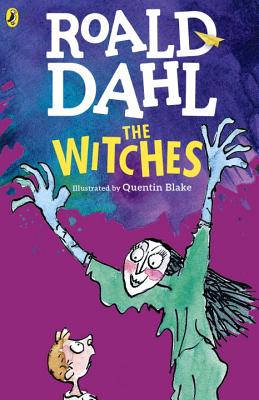
The Witches

witchesby Roald Dahl
First sentence: “In fairy-tales, witches always wear silly black hats and black cloaks, and they ride on broomsticks.”
Support your local independent bookstore: buy it there!
Content: It’s not as scary as I thought it would be, and surprisingly simple for the size. Heads up, though: grandma smokes a cigar. It’s in the middle grade (grades 3-5) section of the bookstore.

So, I remember reading this one at some point, and I had a violently negative reaction to it. I HATED it. So, I was a bit wary going in this time. But, since I picked this for the Roald Dahl book club, I needed a re-read going in.

And it’s…. weird. I was asked if it was “good”, and I said “It’s weird.” “Does that mean it’s bad? ” Nope. Just weird.

The basic plot? There are witches out there, and they look like us. Except they always wear gloves, and a wig (to cover their bald heads) and the have no toes. They hate children and make them disappear. They are, at all costs, to be avoided. So when our narrator (whose childhood sounds suspiciously like Dahl’s), accidentally ends up in a ballroom full of witches, he’s (understandably) terrified. Especially after he hears their master plan for the children of England: make a time-release mouse potion, put it in candy, and voila! No more children. They’ll all be mice.

Except our narrator doesn’t make it out in one piece: he’s caught and turned into a mouse. But, he can talk and he can still think like himself so he goes and convinces his grandma that he’s still her grandson. And informs her of the Grand Plan. Which they, unbelievably, thwart. But our narrator remains a mouse, which is just fine with him because then he won’t outlive his grandma.

Weird.

There are the usual Dahl themes: adults hating kids, and good kids being bullied (by the witches). But it really feels different from the other ones I’ve read. Matilda is darker, and Charlie is more didactic. I’m not quite sure what The Witches is other than… weird.  Was it supposed to scare kids? Was it supposed to just be amusing? (It wasn’t.)

This one’s going to be an interesting discussion at book group.

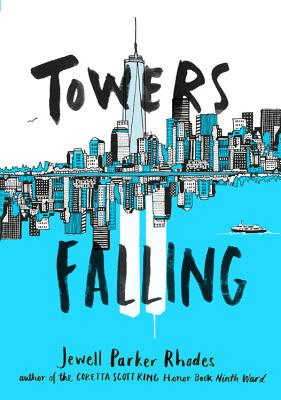
Towers Falling

towersfallingby Jewell Parker Rhodes
First sentence: “Pop groans.”
Support your local independent bookstore: buy it there!
Release date: July 12. 2016
Content: It’s simple enough that the younger set can understand it but complex enough that it won’t bore the older kids. It’ll be in the Middle Grade (grades 3-5) section of the bookstore.

Deja is starting over at a new school, but not by choice. Her family was evicted from their home in Brooklyn, and they’ve moved into a homeless shelter closer to Manhattan. It’s not a happy situation; her father suffers from headaches and can’t hold down a job, and her mother — an immigrant from Jamaica — can only work so many hours.

So, when Deja’s new school starts studying the terrorist attacks on the World Trade Center on 9/11, Deja wonders what on earth it has to do with her. But, as the weeks and months go on — and she learns more about the attacks that happened before she was born — she and her friends Ben and Sabeen learn that no one is unaffected by history.

Rhodes is doing a couple of things here: first, she’s telling the story of the towers falling for kids who may not know anything about it. Sure, it’s not super distant history, but there are still kids who aren’t really familiar with it. And I’m not sure how much it’s being taught in schools (C got it a lot, A got a lesson or two in 5th grade, and I’m not sure anyone at school has brought it up for K) anymore. So, there definitely is a need for a reminder. But, Rhodes has gone bigger than just “hey kids, this happened” history. She’s encompassing issues of kids being homeless, of religious tolerance (Sabeen is Muslim, and she and her family face discrimination because of that), of diversity. She strikes a nice balance in the book between teaching the kids and preaching to them, and  manages to be diverse and moral-centric without being didactic and moralistic.

It’s definitely a book worth checking out.

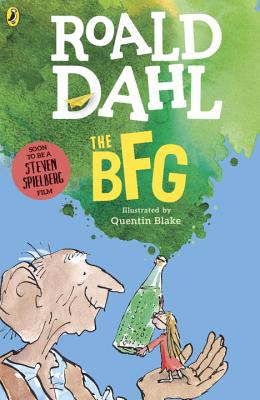
The BFG

thebfgby Roald Dahl
First sentence: “Sophie couldn’t sleep.”
Support your local independent bookstore: buy it there!
Content: There’s a small bit of violence, but for the most part, it’s easy enough for the youngest of the grades 3-5 set. It’s in the Middle Grade section of the bookstore.

Sophie is up late one night in her orphanage when she sees something coming down the street. That something turns out to be a giant, who plucks her out of the orphanage and takes her back to his land. He says it’s because he needs to keep her safe,  because there are other, bigger, badder giants around. And he’s not wrong: the giants back at the stomping ground ARE bigger, badder and meaner.

(And that’s where Dahl’s overall themes come in: the BFG is the “runt” of the pack and is constantly being picked on. He’s also more evolved, and smarter, and just better than those bullies.)

Sophie experiences life with the BFG, and together they decide that the other giants need to be stopped (mostly because they eat children; though the BFG’s argument for it was pretty persuasive…). So they go to the Queen (really, my favorite part), convince her of the existence of the giants, and get her help in stopping them.

Perhaps it’s just the order I’ve read these, but this one is now my favorite. I loved the Seuss-like wordplay that went on with the way the BFG talked. I liked the friendship between Sophie and the BFG, and I thought their solution to the problem was pretty ingenious. It’s a delightful book, much less dark than Matilda or as mean as Charlie. So far, this one is the best.

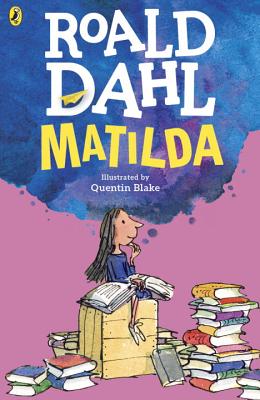
Matilda

matildaby Roald Dahl
First sentence: “It’s a funny thing about mothers and fathers.”
Support your local independent bookstore: buy it there!
Content: It’s a bit longer than Charlie, and a bit more complex. But, that said, I’d give it to a confident 8-year-old reader. It’s in the middle grade (grades 3-5) section of the bookstore.

So, I’ve read this one before, but it’s been years and years and years and even though I’ve watched the movie a bunch (it’s one of my girls’ favorites), I wasn’t quite prepared for how DARK Matilda is.

I mean, all the usual Dahl themes are there: a powerless, nice child (not poor, though that comes with Ms. Honey) is bullied (by her parents and other adults) and discovers something grand within herself in order to overcome. But, the adults are beyond awful. They’re abusive. The Wormwoods (who are hilarious in the film) are corrupt and neglectful. But, it was Miss Trunchbull, who I always condered just an annoyance, who really got me this time. She’s not annoying: she’s an abuser. And perhaps it’s where I am in my life, but that didn’t sit well with me. I’m not entirely sure why; Matilda and Ms. Honey have a happy ending, after all, and Miss Trunchbull (not to mention Mr. Wormwood) get their comeuppance. But, it kind of rang hollow for me.

That said, it’s also not as funny (or at least clever) as Charlie and the Chocolate Factory.  It was sweet — both Matilda and Ms. Honey are sweet characters amid all the lame, awful people — but it wasn’t clever. (Dark undertones!) I did enjoy it, but I’m not sure it’s my favorite. (Then again, I still have four more books to read this summer.)

The book group discussion, however, was fantastic! I had 20 kids ranging in age from 5 to 12, and they all had amazing things to say. One boy said he had read it eight times, and had some smart thoughts on it. As did many others. We talked about favorite characters and whether the Wormwoods were funny (yes) and whether Mr. Wormwood deserved the pranks (yes!). Ms. Trunchbull was deemed to be too mean to be funny, though one girl insisted that her parents would have believed her if she had told them what Ms. Trunchbull was doing. We talked a lot about the chocolate cake, and many pointed out that an 18-inch cake really isn’t that big. One girl said it was “just right”. And my favorite comments were when we were talking how Dahl makes ugly=mean and beautiful=good. One girl pointed out that ugly people can’t help being ugly and that they could be nice and beautiful people can be mean. And another girl said that maybe Dahl was just trying to make the character’s inward ugliness show outward. Both excellent.

So, maybe not my favorite, but it was a great discussion.


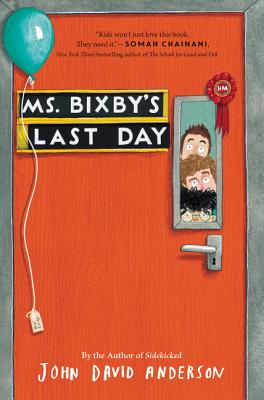
Ms. Bixby’s Last Day

msbixbyby John David Anderson
First sentence: “Rebecca Roundabush has cooties.”
Support your local independent bookstore: buy it there!
Review copy provided by the publisher.
Content: It’s about sixth graders, and it’s a little more mature in content for the younger set. That said, it’s in the Middle Grade section (grades 3-5) of the bookstore.

Everyone has one elementary teacher (I hope) that they remember fondly, that made school a fantastic experience. Mine was my 5th grade teacher, Ms. Westenskow, who cross-country skied to school one winter day, who  made the Revolutionary War interactive, for whom we would all do anything for. I don’t know what’s happened to her over the years (we moved after 5th grade and I started over), but I still remember fifth grade fondly.

Ms. Bixby is that teacher, the one who believes in the potential of each child, the one who reads cool books, the one who is cool, and who makes learning fun. And friends Topher, Steven, and Brand are among those three. So, when Ms. Bixby gets diagnosed with pancreatic cancer it devastates them (and the class, but these guys are our narrators) and after she leaves before the class-planned party, these three boys decide to take Ms. Bixby’s last day to her.

And thus begins our adventure. Skipping school on a Friday, the boys head out to get Ms. Bixby the things they think she needs: a good book, an excellent cheesecake, wine, and McDonald’s french fries. None of them are easy to get, but that’s part of the fun of this book.  It’s one part adventure, one part reminiscing as we get to know Topher, Steve, and Brand through the chapters they narrate, and it’s one part love story to the power of a great educator.

And, yes, I cried. But I felt that the book earned those tears, which is always a good thing.

Excellent.

Charlie and the Chocolate Factory

charlieandthechocolatefactoryby Roald Dahl
First sentence: “These two very old people are the father and mother of Mr. Bucket.”
Support your local independent bookstore: buy it there!
Content: There’s one swear word (which caught me off guard!), but other than that, it’s okay. It’s pretty basic and is in the middle grade (grades 3-5) section of the bookstore.

It’s been a long time since I’ve read this; I’m not entirely sure when the last time I opened this one. Sure, I know the story, but I don’t know when I’ve interacted with the words last.

It’s weird. And kind of mean, if you think about it. Dahl sets up such an extreme: Charlie is beyond dirt poor and the others are so well off comparatively. Are Violet, Veruca, Augustus, and Mike spoiled, really? Or are they spoiled BECAUSE Charlie is their foil? He was such a crank, and that comes through loud and clear. The kids that aren’t Charlie are constantly in need of smacking, and Willy Wonka is downright rude to Mike Teavee often. Maybe he deserves it, and maybe it’s for humorous effect, but I was unsettled by it.

And what is Dahl trying to achieve here? Is he just telling a fantastical, weird story? Or does he have a POINT? (Maybe Mike Teavee’s song is the point:

“So please, oh please, we beg, we pray,
Go throw your TV set away,
And in its place you can install
A lovely bookshelf on the wall.
Then fill the shelves with lots of books,
Ignoring all the dirty looks,
The screams and yells, the bites and kicks,
And children hitting you with sticks —
Fear not, because we promise you
That, in about a week or two
Of having nothing else to do,
They’ll now begin to feel the need
Of having something good to read.
And once they start — oh boy, oh boy!
You watch the slowly growing joy
That fills their hearts.”)

Did I like it? Some of it, sure. I like that Dahl has a Seussian way with language, not letting non-existent words get in his way. But, I’m not sure I really care for this one (and the movies are both quite… weird) very much at all.

My book group discussion was pretty great. I had nine kids, the youngest was 5 (his mother was reading the books aloud to him; she came with as well) and the oldest were a couple of 10 year old boys who were almost too cool at first, but by the end were participating. We had a fun talk about favorite characters and themes and songs and what kind of candy they’d make (ones that looked like broccoli but tasted like candy!). And we designed our own golden tickets as we taste-tested chocolate.

IMG_6874

IMG_6876

It was fun! Next up: Matilda.

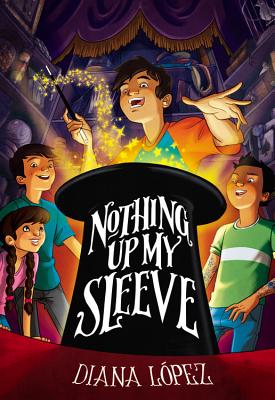
Nothing Up My Sleeve

nothingupmysleeveby Diana López
First sentence: “Z could always find a reason to feel cursed.”
Support your local independent bookstore: buy it there!
Review copy provided by the publisher.
Content: It’s bigger font on small pages, so even though it looks thick it goes fast. It reads very much like a Wendy Mass story, with short chapters, alternating viewpoints, and a lot going on. There’s a slight not-quite-romance (a couple of the boy main characters “like” the girl, but it goes nowhere). It’s in the middle grade (grades 3-5) section of the bookstore.

Z, Dominic, and Loop have been friends for a long, long time. Which means their friendship is one part they like each other and one part competitive. And so when, one hot Texas summer, they discover a magic shop and enter a competition, it becomes somewhat of a tension-creator. They spend the summer working on their magic tricks, but what starts out as just fun becomes more tension-filled. Will their new hobby ruin their friendship?

The good things first: this is full of diversity. Yay for making Texan kids Latin@! And giving them real-world problems: Dominic’s parents are divorced, Z is the youngest of a big family and is always getting ignored, and Loop just found out the man he thought was his biological father isn’t. Plus the way López writes about magic is really neat. She explains the tricks, so you can get a sense of what’s going on, but she doesn’t give away any (well, not many, anyway) of the secrets of the trade.

My big problem was that I felt sorry for Z, who was pathetic, and I felt Dominic was a bit annoying, but Loop and Ariel (she’s the daughter of the magic shop owners) were so annoying I wanted to smack them. Maybe I should give López props for making me care enough to want to smack the kids, but I found them annoying. Which means I really didn’t care too much about how it all resolved. I finished it — it wasn’t really bad — but I didn’t love it. (It really wasn’t bad. It just wasn’t great either.)

Maybe I just wasn’t the right person for it.

Counting Thyme

countingthymeby Melanie Conklin
First sentence: “When someone tells you your little brother might die, you’re quick to agree to anything.”
Support your local independent bookstore: buy it there!
Review copy provided by the publisher.
Content: There’s a slight bit of romance (no kissing, just like likeing), but otherwise, it’s great for 4th grade on up. It’s in the middle grade (grades 3-5) section of the bookstore.

Thyme has a good life: a best friend, a home near her grandmother in sunny San Diego. But her younger brother has a rare form cancer, and an opportunity for a new treatment has opened up in New York City. Suddenly, Thyme’s good life is taken away from her: in the middle of her sixth grade year her family up and moves. To say she’s not happy with this is an understatement.

It doesn’t help that home isn’t the best place. The treatment is hard on her younger brother, which puts everyone on edge. Her older sister is lobbying for more freedom, which terrifies her mother. And Thyme is just trying to find a place to fit in at school; it’s so very different from home. Which is where she’d rather be.

Cancer books are a dime a dozen, it seems like, so it takes something different to make one stand out. Told from the perspective of a sibling rather than the cancer patient helps. But it’s really the fish out of water theme that makes this one stand out for me. Sure, Conklin captures the stress cancer treatment puts on a family and how difficult it is for everyone, not just the cancer patient. But the parts I liked better were the ones where Thyme was torn between her old life and making a new one. That feeling of being in two places, of having to start over when you move is one that’s hard to capture. And I think Conklin did that well. I liked the variety of people — from the grumpy downstairs neighbor to the Italian babysitter to the friends the Thyme made at school — that populated the book.

A good read.

It Ain’t So Awful, Falafel

aintsoawfulby Firoozeh Dumas
First sentence: “Today’s Sunday and we’re moving, again.”
Support your local independent bookstore: buy it there!
Review copy provided by the publisher.
Content: There’s no swearing (well, maybe a mild one) but the subject matter — middle school and the Iran Revolution in 1978 — might be a little mature for the younger set. It will be in the middle grade (grades 3-5) section (or the YA — grades 6-8 — section, I haven’t decided) of the bookstore.

I was in third grade in 1981 when the American hostages in Iran were released and I have a vague memory of it. Nothing substantive, just some hazy images of me seeing the news on TV. I don’t know much else about that, and even though I’ve read a bit about the Iranian revolution, that’s one aspect that I didn’t know much about.

Zomorod Yousefzadeh is in America because her father has a job with an oil company in California. They’ve been here before, when Zomorod was younger, but now she’s going into 6th grade, and she wants to turn over a new leaf. Be more American. So, she changes her name to Cindy and sets out to make new friends. It’s not easy being Iranian in California in the late 1970s (most people either think she’s Mexican, or ask her if she owns a camel. The answer is no to both), but eventually, Cindy figures things out. And then the Iranian revolution happens, and suddenly the home she and her parents thought they could go back to is no longer there. Add to that, Americans were taken hostage, and suddenly Cindy and her parents find themselves subjected to anti-Iranian sentiment. Her father loses his job. Garbage is left on their doorstep. Kids at school tell her to “go home”. It’s not easy.

Loosely based on Dumas’ life, this novel not only captures a slice of history (fairly accurately, but without being kitschy) but also manages to be timely as well. I found myself thinking about how Americans reacted to Muslims after 9/11 (or now, really). Or how immigrants are treated in general. It’s a good thing to see American life from the perspective of an immigrant, and to find out that we’re equal parts good and bad. (Which really isn’t a surprise.) Dumas also manages to capture the awkwardness of middle school with grace and humor. There were some actual laugh-out-loud parts. She definitely understands middle school, with all its ups and downs. And it was delightful to read a book where the parents weren’t bad or sick or dead.

It’s definitely an excellent read.

The Terrible Two Get Worse

terribletwogetworseby Mac Barnett and Jory John
First sentence: “Welcome back to Yawnee Valley, its green hills and cows, cows, cows.”
Support your local independent bookstore: buy it there!
Others in the series The Terrible Two
Review copy pilfered from the ARC shelves at my place of employment
Content: It’s silly, but (mostly) harmless. It’s in the middle grade (grades 3-5) section of the bookstore.

Niles and Miles are back, pranking the poor unsuspecting citizens — well, mostly one — of Yawnee Valley. They have gotten so bad, that the principal of their school gets fired — well, put on indefinite, unpaid leave — and his super-strict father takes over the school. He cancels everything, and effectively puts a stop to Niles and Miles’ pranks. (The best way to do that is to pretend the prank doesn’t happen. It’s the reaction that makes it a prank.) In essence, he makes Miles and Niles into “normal” students. But, because that would be a boring book, Miles and Niles team up with their former arch-enemy to kick the current principal out, and get their mojo back.

Huh. Writing that out, I sounds ridiculously stupid. (Maybe because it is…) But that’s the point, really. It lacks the cow facts of the first one that I really enjoyed, but other than that, the stupid, stupid humor of Barnett and John are back. I’m not sure it’s as funny as the first one (I liked the prank war that escalated, mostly), but it had it some moments that were pretty funny. It’s a good addition to this silly series, and I know it’ll appeal to those Wimpy Kid fans who are looking for something different.