Amulet: Escape from Lucien

by Kazu Kibuishi
First sentence: “There’s a real comfort in being a nobody like me, Master Griffin.”
Support your local independent bookstore: buy it there!
Others in the series: The Stonekeeper, The Stonekeeper’s Curse, The Cloud Searchers, The Last Council, Prince of the Elves
Content: There’s a lot going on, and sometimes the vocabulary is a bit challenging, but K (who’s 8) loves these books, so I’d say it’s good for a strong 2nd or 3rd grade reader. It’s in the middle grade (grades 3-5) graphic novel section of the bookstore.

I’ve been saying for years that I ought to break down and buy this series. And K discovering them this summer gave me the perfect excuse. However, I didn’t go back and reread the past ones before I dove into the new one. So, I’m still a bit behind on the story, but that’s my fault now.

Things are coming to a head and getting more desperate for Emily and the band of rebels. The Elf King is still in power, but his son, Trellis, is learning things and gaining power and confidence. But while we learn things about Max (he’s the Saruman figure) and his backstory, this book really belongs to Emily’s brother Navin, who is a pilot with the resistance, and is sent with his classmates (kinda sorta; he ends up tagging along because of reasons) to the city of Lucien, which has been bombed out and completely taken over by the “shadows”, evil blobs that possess people and turn them, well, evil. Their job: to see if there are any survivors, and to turn on the beacon, sending out a signal for help.

I really don’t have anything new to add to my thoughts on this series. Still gorgeous. Still not coming out fast enough. I’m still going to buy the next one when it comes out next year. I adore this series.

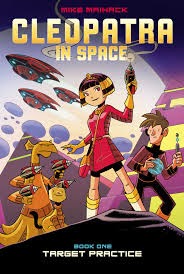
Cleopatra in Space

Book One: Target Practice
by Mike Maihack
Support your local independent bookstore: buy it there!
Content: There’s some violence, but nothing terribly graphic. What struck me is that there is a lot of exposition (with long words) in this one. I’m not sure if K understood everything that went on, but she got the gist of it. Which is what graphic novels are great at.

It’s her 15th birthday, Cleopatra (yes, that Cleopatra) doesn’t want to go through with her party. The ceremony, the pomp, the everything. So, she sneaks away from her tutor, and discovers a portal to a future time and place that is being besieged by a tyrannical dictator. The prophecies declare that she will be the Savior of the world, but first: she has to go to academy to figure things out.

It’s essentially a fish-out-of-water story; BCE girl meets futuristic technology. I liked how she found everything boring, until she got to combat training. She took to that immediately. She’s a girl of action, and she’s smart and tough — when it comes to combat. She’s not a scholar and that’s okay. The only thing that was a bit disconcerting was the whole talking cats. Cats in this world have evolved to the point where they kind of run things. And it’s a bit weird. But that just may be me.

In the end, it reminded me a lot of Zita the Spacegirl — both in the content as well as the artistic style — which is a good thing. And I’m curious to see where Maihack goes next.

Graphic Novel Roundup, June 2014

I discovered that 1) I’m reading more graphic novels than usual right now. Perhaps because I’m picking up a bunch for K at the library due to summer reading. Her goal is to read 36 graphic novels by the end of July. She’s read 15 so far. And 2) I really like these graphic novel roundups. Here’s what I’ve been reading this month.

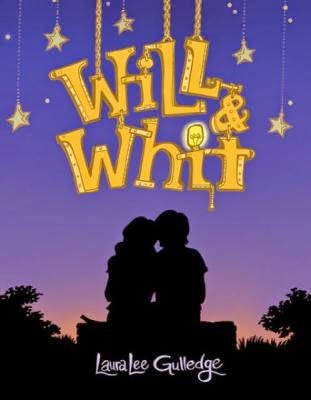
Will & Whit
by Laura Lee Gulledge
Support your local independent bookstore: buy it there!
Content: The cover is misleading; it’s not a romance. Not really. Thematically, it’s a little mature — it’s in the teen graphic novel section — but I’d give it to an interested 10- or 11-year-old.

The Will in the title is Wilhelmina Huckstep,  girl whose parents died in an accident recently, the summer before her senior year. She’s living with her aunt, who runs the family antiques store. The Whit in the story is Tropical Storm Whitney which causes the entire town to lose power, thereby creating a situation where everyone has to be unplugged from their technology and interact with each other. It’s delightfully drawn, and balances the dark — Will grieving for her parents and trying not to be a burden — and light — her wonderfully eclectic friends, and the Penny Farthing carnival they put on. There is some romance, with a couple of Will’s friends, but it was very sweet and not at all central to the plot. A delightful summer read.

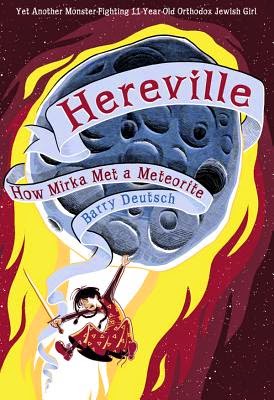
Hereville: How Mirka Met a Meteorite
by Barry Deutsch
Support your local independent bookstore: buy it there!
Others in the series: How Mirka Got her Sword
Content: There’s nothing. I’d let K read this, though she might be a bit confused with the Yiddish words. It’s in the middle reader graphic novel section.

Mirka has her sword, but she longs for more adventures. Instead, she’s stuck at home, knitting berets (its the only thing she can knit) because she’s grounded. Her stepmother, Fruma, just wants her to make reasonable choices. But Mirka is impulsive — something I love about her — and as soon as she could, she went back to the troll for her sword, craving something More. Then the troll sends a meteorite to earth, and the witch changes it into another Mirka. Suddenly, Mirka’s got someone she hast to share her life with. It’s complicated, and Mirka learns that adventures sometimes aren’t all they’re cracked up to be.

Like the first, this one is a delightful mix of Orthodox Judiasm and fantasy. And it works wonderfully. I adore Mirka, I love learning about her life, and I love the adventures Deutsch gives her. Fantastic.

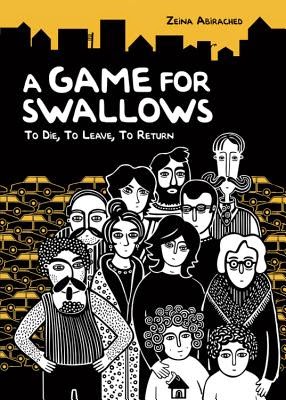
A Game for Swallows
by Zeina Abirached
Support your local independent bookstore: buy it there!
Content: There’s some talk of war and killing, so thematically it’s pretty intense. But, I wouldn’t object to giving it to a 10- or 11-year-old, if they expressed interest. It would been in the teen graphic novel section.

I know absolutely nothing of the Lebanese civil war that happened in from 1975 to 1990. I was a teenager in a small town in America, and it just wasn’t on my radar. But, thanks to Abirached, I have gotten a glimpse into what life was like for those going through it. The book takes place entirely in one night in the foyer of the apartment of two children as they wait for their parents to come back from their grandparents’ house. It shouldn’t be that big of a deal, but in East Beirut, full of shelling and snipers, it is. The foyer is the only safe place in the apartment, and their neighbors — from the young(ish) handyman to the older couple to the former French teacher to the older woman who has been a nanny for a family for 65 years — congregate there in the evenings. The mood ranges from celebratory — they make a cake and enjoy a game of Scrabble — to tense — when they find out that the children’s parents had left an hour earlier and had still not arrived. It’s a picture to how life goes on in the face of war, in the face of uncertainty and in the face of death. Done in very stark black-and-white drawings, it’s a very simple and powerful tale of human resilience.

Graphic Novel Round-up, May 2014

Hilda and the Bird Parade
by Luke Pearson
Support your local independent bookstore: buy it there!
Content: It’s a bit intense at parts, with Hilda getting lost and some interesting monsters. But that’s it. It’s in the middle grade graphic novel section of the bookstore.

I don’t think this was a first in a series — googling Luke Pearson led me to a number of other Hilda titles. But it’s a perfect place to start. Hilda is a spunky, blue-haired girl who has been raised in the mountains before her mother moved them to Trolberg. Hilda doesn’t like the confines of the city, mostly because her mother never lets her go anywhere anymore.

Then, on the day of the Bird Parade, Hilda is invited out by some classmates. They take her to all of the (not-so) cool spots, but she bails on them when they start throwing stones at a raven. She rescues the raven, who 1) happens to talk, and 2) has amnesia. They wander the city and have adventures while the raven tries to get his memory back.

That plot summary doesn’t do Hilda any justice. It’s an absolutely adorable book. Sweet and fun, full of action and adventure as well as playing off of Norse myths (which seem to be the in-thing these days). I loved it, K loved it, Hubby loved it. I’m definitely going to get more Hilda books and see what other adventures she has.

Fairy Tale Comics
edited by Chris Duffy

Support your local independent bookstore: buy it there!
Content: Fairy tales, in their original form, are quite violent and weird. While this collection tones it down, there’s still some violence and weirdness. That said, K didn’t have any problems with it, though she didn’t “get” some of it. It’s in the fairy tale section of the bookstore, but I’m wondering if it’d get more exposure with the middle grade graphic novels.
Fairy tales are weird. (Or as the narrator in A Tale Dark and Grimm would say, “awesome”.) And what better way to showcase the weirdness than to get a bunch of illustrators to reinterpret ? different fairy tales in graphic novel form?
On the one hand, this is a terrific way to get reluctant/struggling readers interested in fairy tales. K picked it up, and thoroughly enjoyed perusing the pages, reading all the stories. Also, in its favor, there is a Japanese folk tale, a Br’er Rabbit story, and  tale from 1001 Nights, though it was too heavy on the Grimm for my taste. Even so, some of the tales were cleverly re-imagined — The 12 Dancing Princesses (Emily Carroll), Give Me the Shudders (David Mazzucchelli), Little Red Riding Hood (Gigi D. G.), and The Boy Who Drew Cats (Luke Pearson)  were among my favorites.

Others, though, were not as well done. Snow White (Jaime Hernandez) was just weird (then again, so is the fairy tale) and Rapunzel (Raina Telgemeier) disappointingly “borrowed” from Rapunzel’s Revenge/Tangled. I think I was also hoping for more of the unusual ones, Snow White and Rose Red or something from Hans Christian Anderson, or my favorite French tale The White Cat. It was very much, for the most part, the known tales retold, and while that was all fine and good, I was hoping for something… more.

The Lost Boy
by Greg Ruth
Support your local independent bookstore: buy it there!
Content: This has gone back and forth between the teen graphic novels and the middle grade graphic novels. It’s not as kid-friendly — it’s intense, and a bit difficult for the eye to follow — as some others we have in middle grade, but it’s a bit simplistic — it’s a straight-up fantasy-adventure — for teen.

When his family moves into a new house, Nathaniel Castle (just call him Nate) has no idea what’s in store for him. When, under a loose floorboard, he finds an envelope with his name on it next to an old-fashioned tape recorder, he can’t resist the odd message — Find Him — and the lure of a mystery. Little does he know that he will be dragged into solving a 50-year-old disappearance of a local boy, Walt, and be immersed in a world where dolls and insects talk, and a mysterious force called the Vespertine is trying to take over.

The art in this one is gorgeous: done in shades of black and white, it’s realistic, even in the fantasy elements. No cartoons here. And that gives it a seriousness that I don’t think the story would have otherwise had. It’s quite eerie and chilling in parts. That said, it’s also a straight-up adventure; the hero does win the day, with some help of his friend Tabitha, and all is happily-ever-after, even though there’s a slightly ominous coda.

I do hope Ruth writes another one, though. I’m quite fascinated by this world he’s created.

Explorer: the Lost Islands
edited by Kazu Kibuishi
Support your local independent bookstore: buy it there!
Content: There’s some weird stuff going on, but none of it is inappropriate for the younger reader. (K handled it just fine.) It’d be in the middle grade graphic novel section of the bookstore, if we carried it.

I picked this up solely because of Kibuishi’s name (why, yes, I AM waiting impatiently for the next Amulet installment) without knowing anything about it, or this series. (I guess it is a series, since this says Book 2 on it..) It turns out it’s a series of short stories from a handful of artists on a theme, this one being “islands”.

Like any other short story collection (see above!), it’s a wide range of stories ranging from the silly — a group of bunnies on an island who work until someone invents a robot that will do all of their jobs (but it has disastrous results) to the weird — Kibuishi’s Moby Dick-esque story or Chrystin Garland’s weird devil-party (I know there’s a term for this, but it’s escaping me. There were touching ones — particularly “Desert Island Playlist” from Dave Roman & Raina Telgemeir, that illustrates how the past, present, and future are all necessary in one’s life. Or “Loah” by Michel Gagne, which is a gorgeously illustrated story of how differences matter.

It’s a good solid collection, and it makes me want to hunt out the first one in the series to see what the theme and stories are. A great introduction, too, to a wide range of artists.

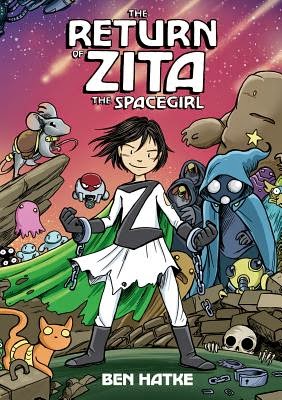
The Return of Zita

by Ben Hatke
Support your local independent bookstore: buy it there!
Others in the series: Zita the Spacegirl, Legends of Zita the Spacegirl,

The last words (if you haven’t read the other two, go do it now) of Legends of Zita are “Gotcha!” And so, we find Zita, at the opening of this one, in front of the Court of Dungeon World, being “tried” for her “crimes”. But, then she finds out that the leader of the dungeon world — who also happens to be a Screed — is planning on getting a jump crystal and taking over Earth. Which means: he must be stopped. Though how on earth is Zita supposed to do this when she’s stuck in the deepest dungeon on the Dungeon World?

Well, with her friends of course.

In some ways, this is a crowded book: everyone Zita has met since the beginning of her adventures shows up. Sometimes, that’s a wonderful, surprising thing. Other times, it seems a bit forced. But I’m not sure how much I cared. Zita has heart and spunk, and I could plausibly believe that everyone (!) would come to her rescue and aid. The art, as always, is fantastic; it may not be sweepingly gorgeous,but Hatke knows how to blend text and illustration to make the action move forward, and to build intensity. And it’s accessible to the kids, which is what really matters. (K said: “You know how many times I’ve read this since we got it? TEN TIMES!”)

It’s a bittersweet ending, with Zita having to leave her friends. And I like how Hatke handled that as well. It’s such a superb series, from start to end. It makes me happy to be able to pick it up and read it all straight through  now, without having to wait.

Primates

The Fearless Science of Jane Goodall, Dian Fossey, and Birutė Galdikas
by Jim Ottaviana & Maris Wicks
Support your local independent bookstore: buy it there!
Content: There’s nothing objectionable, content wise. There is, however, some text in cursive, which may make it difficult for younger readers to read. Also, A found the format confusing, since it bleeds from one story into the next. It’s in the middle grade (grades 3-5) graphic novel section at the bookstore.

This one caught my eye when it came into the store, because honestly? A graphic novel about women scientists: how rare is that. Granted, it’s the same famous women scientists (we ALL know Jane Goodall, right?), but still. Women, animals, science: I’m there.

It’s a loose (read: slightly fictionalized) retelling of how Goodall, Dian Fossey, and Birutė Galdikas became the sort of scientists they did. It was full of information on how they all met Louis Leakey and how he sent them out to observe and study chimpanzees, gorillas, and orangutans in the wild. Their styles were vastly different: Dian was the most emotionally involved in her study, I think, and the most passionate about her work. That said, Birutė went the most native; her husband left because she devoted too much of her time to the orangutans purely for the sake of studying them.

I think that’s what fascinated me most about these women. They weren’t in it for recognition or even for purely the sake of science.They were in it because they loved the animals, they wanted to understand them,  and ultimately protect them from ignorance through educating the world. I admire that.

As for the format, I mentioned that A found it difficult to follow. I didn’t, but then I’m an adult. It made me a little sad, though, that she did, because if the kids find the book hard to follow, they won’t be inspired by these women’s stories. And that makes me sad. Perhaps it would have been better to do this in three books, but I enjoyed seeing the connections between these women. I don’t know if I was inspired, but I was at least interested. And that counts for a lot, I think.

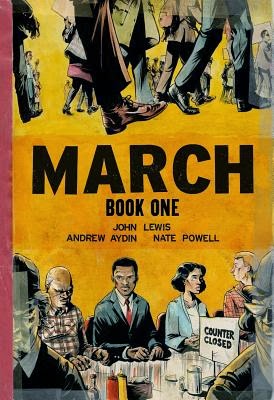
March (Book One)

by John Lewis, Andrew Aydin, and Nate Powell
First sentence: “John, can you swim?”
Support your local independent bookstore: buy it there!
Content: The only objectionable thing in the book is the use of the “n” word (which doesn’t make the white Southerners look good at all). The library has it filed under adult graphic novels, but I think I’d put it with the teen ones. I’m sure even a curious 10- or 11-year-old would get something out of this one as well.

I picked this up because it made the SLJ’s Battle of the (Kids) Books contenders list and I like to (try to) read as many as I can before the competition starts. Like every year, I found a wonderful book I’d have never picked up otherwise.

This is a slim graphic memoir, telling the first part of Congressman John Lewis’s story. (For the record, Hubby knew who Lewis was; I did not.) This volume starts with his childhood in Alabama, and goes through the Nashville sit-ins that he participated in. My favorite thing about this memoir was the framing: It opens with Lewis waking up the morning of Obama’s first inauguration, and the story unfolds as Lewis is remembering his path to D.C. as he tells it to a couple of constituents who have stopped by his office.

It’s your pretty typical Civil Rights story: sharecropper parents save money for their own farm. After an exposure to a different way of doing things (he visited his uncle and aunt in New York City for a summer), child wants an education, rather than be stuck at home doing what his parents do. (I loved the bits about raising chickens, though.) He feels a call to be a preacher, and ends up at American Baptist Theological Seminary in Nashville. There is an interesting aside here: Lewis wanted to go to college in Alabama, closer to home, and actually met with Dr. Martin Luther King, Jr. and his lawyers to talk about segregating Troy State. In the end, though, Lewis’s family didn’t want to chance the backlash, so he stayed in Nashville.

He was very influenced by the school of non-violent protests, and he got involved with a group that organized the sit-ins in Nashville in 1959. I think this was the most moving part of the book; the abuse and hurt that Lewis and his friends endured just so they could have the same services as the white people in Nashville was pretty brutal. This volume ends just after the Nashville mayor decrees that all businesses should be integrated. I’m quite interested to see where Lewis’s story goes from here.

I loved the format as well: there aren’t enough non-fiction graphic novels (at least that I’ve read), and the art — done in stark black and white — adds to the intensity of the story. I’m glad I picked this one up.

Bluffton

My Summers With Buster
by Matt Phelan
First sentence: “Life in Muskegon, Michigan was quiet.”
Support your local independent bookstore: buy it there!
Content: Nothing. Nada. Not a bit. Perfectly fine for graphic novel/history buffs of all ages. Resides in the middle grade (3-5th grade) section of the bookstore.

The thing I like best about Matt Phelan — aside from his gorgeous art; it’s so very unlike anything else being drawn out there — is the way he takes historical events (like traveling around the world, or the Dust Bowl) and turns them into something… intriguing.

This time out is probably the most successful — for me, at least — of his books. It’s about the summers Buster Keaton and his family spent on Lake Michigan outside Muskegon. Now, in spite of being a Michigander (of sorts; I claim it mostly because my parents are still there), I’ve never been to that side of the state, and had no idea that Buster Keaton (!) summered on the lake.

And that discovery was part of the overall charm of the book. It’s nominally about a local boy, Henry, and his dislike of being “stuck” in Muskegon (even in 1908) and how dull, ordinary, everyday it all was until the day when the vaudeville performers showed up. Henry goes out to their compound by the lake, affectionately name “Cobwebs and Rafters”, and becomes intrigued by the antics of Buster. They become friends, of a sort, pulling pranks, playing baseball, but Buster refuses to teach Henry any of his “tricks”. That doesn’t stop Henry… determined, he tries out things on his own. (And doesn’t succeed terribly well. I think this was done to emphasize just how talented Buster was.)

My only complaint is that I don’t think Phelan quite knew how to end it. Instead of being the story of one summer, it’s the story of many summers over the course of many years. Henry grows up, stays put, and opens a movie theater. I’m not quite sure what the purpose of this was. Maybe to show that Buster grew into someone famous? Perhaps. It did take away from the fun of the first summer, the joy of meeting someone new, someone unique.

It’s worth taking a look at for the art, though. And for the joy of that first summer.

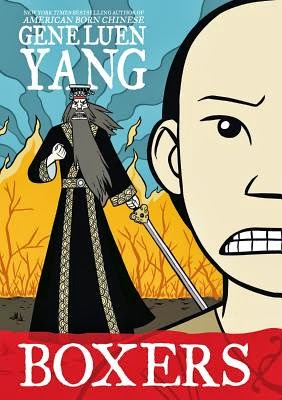
Boxers & Saints

 by Gene Luen Yang
ages: 13+
Support your local independent bookstore: buy it there!

I didn’t quite know what to expect going into reading Gene Luen Yang’s newest graphic novels. I did know that they were a pair, and I read them back-to-back. But what I got…. wow. I think, after I turned the last page, the best comparison would be a Zhang Yimou movie. Both sweeping and intimate, these graphic novels pack a powerful punch.

They center around the Boxer rebellion in China which culminated in the summer of 1900. In Boxers, we follow the story of Little Bao, a third son of a village peasant. He’s not respected, and his older brothers push him around a bit. He loves opera, and he spends all his free time watching it, which doesn’t help his situation at home any. He does long for respect, and gets his chance when a young man by the name of Red Lantern shows up. Red Lantern teaches the village men kung fu, and ends up taking Little Bao under his wing. This becomes crucial when Red Lantern is killed by the imperial army, and Little Bao takes over his duties as leader of the rebellion. Their mission? To enact justice in behalf of those who are being bullied.

However, what starts out as justice soon becomes a crusade to rid the land of foreigners, mostly Christians, and those Chinese who have converted. Little Bao becomes increasingly more ensconced in this crusade, and increasingly more uncomfortable with it. Along the way, he meets Vibiana, a Christian convert.

In Saints, we see Vibiana’s side of the story. We discover that her conversion to Christianity is more an act of desperation rather than true devotion. A fourth daughter of a deceased father, she is often neglected and beaten at home. She finds refuge in the home of Dr. Won, the village acupuncturist, who introduces her to Christianity. Soon afterward, she sees visions of Joan of Arc, which she doesn’t understand but finds comfort in. After one particularly brutal beating, Vibiana leaves her family and goes to work in a Christian orphanage, which is where she meets Little Bao.

I shouldn’t have to say this, but these stories are both tragedies. And yet, possibly because of this, there is much to think about. I love the tagline on the backs of these: “Every war has two faces.” Yang does a superb job not only showing the horrors of war, or the decisions of a leader, but also that there are many different sides to a story, and that every truth is a valid one. The ending is tender and horrible, and left me wondering about the nature of faith, devotion, and fanaticism.

In short: brilliant.

Blankets

by Craig Thompson
ages: adult
First sentence: “When we were young, my little brother Phil and I shared the same bed.”
Support your local independent bookstore: buy it there!

I’ve been curious about this one for quite some time. Possibly because I enjoyed Persepolis quite a bit, and this is a similar idea: a graphic novel memoir (even though this one says that it’s fictionalized). It’s basically the story of Thompson’s
childhood and his first love.

I’ve been telling myself that I’ve been wanting to read it just to see what the fuss is about.

And…

I was kind of underwhelmed. While there were elements I did like — like Thmpson’s forced Christianity, that he eventually left; and I appreciated that the True Love didn’t last — mostly I was left unsatisfied in the end. Perhaps it was the fault of the medium, but I didn’t feel connected to anything that was going on; I was more a distant observer of events.  Which means: while it was enjoyable, it lacked the power I wanted from it. (Perhaps, also, it was a case of too high expectations.)

And even though I enjoyed the artwork — it was quite lovely in spots, and I thought it served the story well — it wasn’t enough for me to be truly enthusiastic about the story.

Which is kind of too bad.