Bluffton

My Summers With Buster
by Matt Phelan
First sentence: “Life in Muskegon, Michigan was quiet.”
Support your local independent bookstore: buy it there!
Content: Nothing. Nada. Not a bit. Perfectly fine for graphic novel/history buffs of all ages. Resides in the middle grade (3-5th grade) section of the bookstore.

The thing I like best about Matt Phelan — aside from his gorgeous art; it’s so very unlike anything else being drawn out there — is the way he takes historical events (like traveling around the world, or the Dust Bowl) and turns them into something… intriguing.

This time out is probably the most successful — for me, at least — of his books. It’s about the summers Buster Keaton and his family spent on Lake Michigan outside Muskegon. Now, in spite of being a Michigander (of sorts; I claim it mostly because my parents are still there), I’ve never been to that side of the state, and had no idea that Buster Keaton (!) summered on the lake.

And that discovery was part of the overall charm of the book. It’s nominally about a local boy, Henry, and his dislike of being “stuck” in Muskegon (even in 1908) and how dull, ordinary, everyday it all was until the day when the vaudeville performers showed up. Henry goes out to their compound by the lake, affectionately name “Cobwebs and Rafters”, and becomes intrigued by the antics of Buster. They become friends, of a sort, pulling pranks, playing baseball, but Buster refuses to teach Henry any of his “tricks”. That doesn’t stop Henry… determined, he tries out things on his own. (And doesn’t succeed terribly well. I think this was done to emphasize just how talented Buster was.)

My only complaint is that I don’t think Phelan quite knew how to end it. Instead of being the story of one summer, it’s the story of many summers over the course of many years. Henry grows up, stays put, and opens a movie theater. I’m not quite sure what the purpose of this was. Maybe to show that Buster grew into someone famous? Perhaps. It did take away from the fun of the first summer, the joy of meeting someone new, someone unique.

It’s worth taking a look at for the art, though. And for the joy of that first summer.

Boxers & Saints

 by Gene Luen Yang
ages: 13+
Support your local independent bookstore: buy it there!

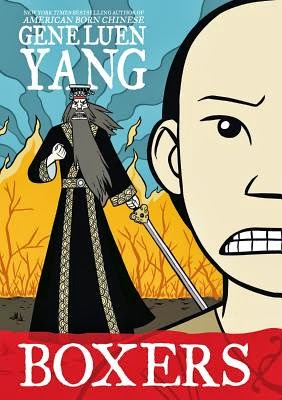
I didn’t quite know what to expect going into reading Gene Luen Yang’s newest graphic novels. I did know that they were a pair, and I read them back-to-back. But what I got…. wow. I think, after I turned the last page, the best comparison would be a Zhang Yimou movie. Both sweeping and intimate, these graphic novels pack a powerful punch.

They center around the Boxer rebellion in China which culminated in the summer of 1900. In Boxers, we follow the story of Little Bao, a third son of a village peasant. He’s not respected, and his older brothers push him around a bit. He loves opera, and he spends all his free time watching it, which doesn’t help his situation at home any. He does long for respect, and gets his chance when a young man by the name of Red Lantern shows up. Red Lantern teaches the village men kung fu, and ends up taking Little Bao under his wing. This becomes crucial when Red Lantern is killed by the imperial army, and Little Bao takes over his duties as leader of the rebellion. Their mission? To enact justice in behalf of those who are being bullied.

However, what starts out as justice soon becomes a crusade to rid the land of foreigners, mostly Christians, and those Chinese who have converted. Little Bao becomes increasingly more ensconced in this crusade, and increasingly more uncomfortable with it. Along the way, he meets Vibiana, a Christian convert.

In Saints, we see Vibiana’s side of the story. We discover that her conversion to Christianity is more an act of desperation rather than true devotion. A fourth daughter of a deceased father, she is often neglected and beaten at home. She finds refuge in the home of Dr. Won, the village acupuncturist, who introduces her to Christianity. Soon afterward, she sees visions of Joan of Arc, which she doesn’t understand but finds comfort in. After one particularly brutal beating, Vibiana leaves her family and goes to work in a Christian orphanage, which is where she meets Little Bao.

I shouldn’t have to say this, but these stories are both tragedies. And yet, possibly because of this, there is much to think about. I love the tagline on the backs of these: “Every war has two faces.” Yang does a superb job not only showing the horrors of war, or the decisions of a leader, but also that there are many different sides to a story, and that every truth is a valid one. The ending is tender and horrible, and left me wondering about the nature of faith, devotion, and fanaticism.

In short: brilliant.

Blankets

by Craig Thompson
ages: adult
First sentence: “When we were young, my little brother Phil and I shared the same bed.”
Support your local independent bookstore: buy it there!

I’ve been curious about this one for quite some time. Possibly because I enjoyed Persepolis quite a bit, and this is a similar idea: a graphic novel memoir (even though this one says that it’s fictionalized). It’s basically the story of Thompson’s
childhood and his first love.

I’ve been telling myself that I’ve been wanting to read it just to see what the fuss is about.

And…

I was kind of underwhelmed. While there were elements I did like — like Thmpson’s forced Christianity, that he eventually left; and I appreciated that the True Love didn’t last — mostly I was left unsatisfied in the end. Perhaps it was the fault of the medium, but I didn’t feel connected to anything that was going on; I was more a distant observer of events.  Which means: while it was enjoyable, it lacked the power I wanted from it. (Perhaps, also, it was a case of too high expectations.)

And even though I enjoyed the artwork — it was quite lovely in spots, and I thought it served the story well — it wasn’t enough for me to be truly enthusiastic about the story.

Which is kind of too bad.

Bone 1 and 2

Bone 1: Out from Boneville
Bone 2: The Great Cow Race
by Jeff Smith
ages: 10+
Support your local independent bookstore: buy it there!

Bone has been around for YEARS and I’ve heard that I should read it for YEARS, but I’ve put it off. Don’t ask me why.  But, on a whim a while back, I threw Bone 1 and Bone 2 in my library pile, just to see what the fuss is all about.

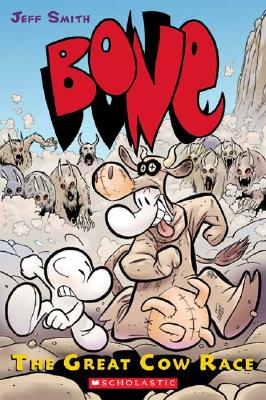
The story is basically about these three Bone cousins: Fone Bone, Phoney Bone, and Smiley Bone. Phoney has a propensity to come up with get-rich-quick schemes, and one involving bad prunes got him run out of town. Fone helps him get away; Smiley is along for the ride (not being very bright). They get lost in a desert, and end up crossing over some mountains into a valley far away from Boneville. They get separated, and you follow Fone through the winter. He makes some friends — most notably a red dragon, whom no one seems to believe exists — and some enemies — most notably some rat-like creatures who are always chasing him. (Except they disagree on how to cook and eat him; one seems to be fixated on putting him in a quiche.) Eventually, Fone meets Thorn — a beautiful girl — and she takes him back to her Grandma Ben’s place. They run into Phoney and Smiley in town (they’ve taken up with a tavern owner as his employees, since they don’t take the money Phoney has tucked away).

In the second, there’s a bit with a fair and Fone falling for Thorn (and being jealous of this hunky but kind of stupid boy she falls for). And Phoney and Smiley try to rig the great cow race so they’ll get rich (quick). But, of course, things don’t go right: the race is interrupted by legions of rat creatures, who seem to be working for a hooded man who is after Phoney Bone for some reason. And Thorn keeps having dreams about a cavern and the dragon Fone has made friends with.

I enjoyed these. I’m not sure I loved them, but I recognized the appeal. There’s humor and suspense, and I liked how Smith has multiple story lines going on at once.  I liked the drawings, the cartoonish quality of everyone (Grandma Ben was my personal favorite). And yes, I’ll probably pick up the rest just to see where the overall story line is going. Maybe I’ll learn to really love them.

Giants Beware!

by Rafael Rosado and Jorge Aguirre
ages: 9+
Support your local independent bookstore: buy it there!

This won the Cybils Middle Grade Graphic Novel award this year, and so I knew I had to read it. I ordered one in at the store on Charlotte’s recommendation but no one seemed to be interested in it (though I tried to sell it). Good for me, though: the library didn’t have a copy so I bought it and brought it home.

And everyone who’s picked it up has loved it, from Hubby all the way down to A.

The basic story: Claudette is a bloodthirsty young girl living in this town in the shadow of giants. She wants giant blood, and will do anything to get out there and get at them, even though she knows the dangers (her father, the town blacksmith lost both his legs and one of his arms in the Forest of Death). Determined, she convinces her younger brother Gaston (a budding chef, and a swordmaker want-to-be: “I’ll call it Gaston’s Sword and Sweets Shop.”) and her best friend Marie (a princess in training) to sneak out of their town and go giant  hunting. What they find is an Adventure in the grandest sense.

It’s an absolutely delightful graphic novel. It’s got bright and bold colors, and nothing (not even the Forest of Death) is terribly frightening, making it great for the youngest of readers. It’s also terribly funny (we all loved Gaston best), and worth reading over and over again (as A has done).

I’d love to read more of Claudette’s adventures, but barring that (yay! A Graphic novel that isn’t a series), I’ll be happy to read more of what Rosado and Aguirre offer up.

Nathan Hale’s Hazardous Tales: One Dead Spy

by Nathan Hale
ages: 9+
Support your local independent bookstore: buy it there!

I suppose if your name is Nathan Hale and you are an illustrator, it’s probably inevitable that you do a graphic novel series on American History. And,  as part of that, do one on the Revolutionary War spy, Nathan Hale.

On the one hand, I found this graphic history to be highly entertaining. Hale framed the story around the execution of Revolutionary Hale, allowing him to tell his story to the hangman and a lone British soldier. They weave in and out with commentary and gallows humor (har har), but get all the basic historical facts in there. It’s history and at times it’s entertaining.

On the other hand, though, it’s cluttered. It’s not laid out very well — chapters would sometimes start in the middle or near the end of the page. I found it really hard, visually, to get into the story, to keep track of each of the players. Half the time, I didn’t know whether or not Hale was even a part of the action. It didn’t draw me into the story, and it sure didn’t often keep me there.

It’s a good idea, telling history in graphic novel form, making it more accessible to the younger kids that way. I just wish it could have engaged me more.

Teen Boat

by Dave Roman and John Green
ages: 12+
First  sentence: “Every night it’s the same dream.”
Support your local independent bookstore: buy it there!

There are superhero stories, where a person has Great Powers and has to Save the World or Something Else Important. And everything, for the most part, is Good and Evil and Right and Wrong. 

And then there’s Teen Boat.

His superpower? Turning into a small yacht.

His life? Is pretty much the life of your ordinary, average high school boy: he’s crushing on the cute girl, his best friend thinks he’s clueless, he get detention, he has to get a job. Nothing Superheroish here.

It also doesn’t help that he turns into a boat at the most inopportune times. (Internal inconsistency alert: can he turn into a boat at will? Well, sometimes. And sometimes he can’t. But he also can turn into a boat against his will when water touches his internal nautical activation button, which happens when he gets water in his ear. It doesn’t really make sense.) What his life is, really is a balancing act between his abilities and his desires. With random pirates.

The best word for this book? Silly. Ridiculous. In the best possible way. Teen Boat (or TB for short) (that’s really his name) is a fun character, very much the awkward teen boy, put in absolutely insane situations. (I was serious about the pirates.) I do have to admit that it wore on me after a while; by the end I was rolling my eyes more than laughing. But even with that, it was still a fun — well, silly — read.

Prince of the Elves

Amulet, vol. 5
by Kazu Kibuishi
ages: 10+
First sentence: “You’ve never heard about the Great Erlking?”
Support your local independent bookstore:buy it there!
Others in the series:The Stonekeeper, The Stonekeeper’s Curse, The Cloud Searchers, The Last Council

To catch you up (this is as much for me as it is for you):

Emily and Navin’s father died in a car crash, and their mother has been kidnapped. They follow her into this strange world, and discover that their grandfather was a stonekeeper, a role that has passed on to Emily. In this world, the Elf King is a tyrannical ruler, someone who needs to be overthrown. Except he, too, is a stonekeeper, something which gives him unlimited power. It’s up to Emily, Navin, and the friends they collect to work together to overthrow the king.

Up until now, the books have been about Emily learning about her powers, and the kids making and collecting friends as part of the resistance. But (finally!), in this one, I felt like the plot was actually moving forward again. We’ve got an actual physical bad guy, rather than a distant one (kind of like the difference between Sauron and Saruman). We’ve got a battle. We’ve got a gorgeous two-page spread of a monster attacking a ship. (Seriously: it’s amazing.) We’ve got a backstory explaining how the Elf prince became exiled and how the bad guy became the bad guy. We’ve got (some) ANSWERS.

And, as always, my thoughts on the book are the same: gorgeously drawn, brilliantly plotted, and the next one can’t come out soon enough. (I think I need to break down and buy these!)

Legends of Zita the Spacegirl

by Ben Hatke
ages: 9+
First sentence: “Zita the Spacegirl!”
Support your local independent bookstore: buy it there!
Others in the series: Zita the Spacegirl

Picking up right where the first installment left off…

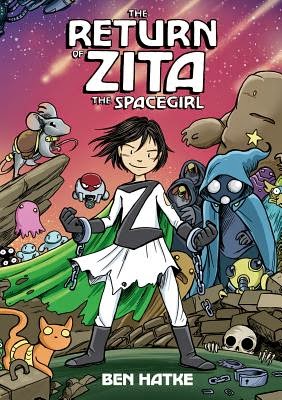
Ever since saving the planet from the asteroid (sorry, mild spoiler there), Zita has rocketed to Fame. She’s flying with Piper and her robot friends from planet to planet, signing autographs, looking for a jump crystal so she can return home.

Then, on one far-reaching planet, she discovers a robot that is such a big fan that it dresses up like her. Then it really kind of looks like her. Then, while Zita and Mouse are off enjoying the circus, it takes her place, leaving her stranded yet again. She steals (well, “borrows”) a spaceship, which puts her on the wrong side of the law, and manages to get rescued by non other than Pipers ex (girlfriend? wife?), who helps Zita catch up with Piper and the impostor robot on a planet that needs saving from the Space Hearts.

A pause right here: the Space Hearts? So very clever. Evil hearts (yes, really) that attack a planet until its completely devastated, controlled by a Queen Heart. Too cool for words.

Like Zita, this one is colorful, creative and a whole lot of fun to read, from the oldest person in my house (yes, Hubby did pick it up) down to the youngest. Zita’s a great heroine, and there are some surprising twists and turns as we follow her adventure and her ultimate quest to get home. Another quick side note: I didn’t pick up the first before diving into this one — I know: silly — but I didn’t need to. Hatke got me up to speed quite quickly, and I was able to take off and enjoy this story.

But much like the Amulet series, the next one can’t come out fast enough for me.

Stickman Odyssey: An Epic Doodle

by Christopher Ford
ages: 11+ (though my 8 1/2 year old read it and quite enjoyed it)
Support your local independent bookstore: buy it there!
Others in the series: The Wrath of Zozimos

Admittedly, I read these backwards, this one being the first in the series, and Zozimos’ backstory. So, if you’re going to do this right: you need to read this one first. But, even if you don’t, it’s still quite a fun read.

I’m gathering from the title and the back that this is basically the story of The Odyssey in simplified graphic novel form. In his quest to return to Sticatha, Zozimos washes up on the shore of a country where a beautiful princess is being protected by her father from a horrible prophecy. Zozimos ends up in the dungeon, before going on several adventures to prove his worth. Along the way, he meets a couple of people — the frog man, Atrukos, and the strong man, Praxis — who help him. Actually, that’s the big Lesson to be Learned: that even though Zozimos is all sorts of awesome (well, not really), he needs his friends in order to Get Things Done.

The good news: you don’t have to know the original epic in order to enjoy this one. It’s one adventure after another, with lots of sword fighting, humor, a wee bit of romance, poop jokes, and friendships. I’m sure boys will love this one, but I have to say that both C and A really found it to be all sorts of fun.

As did I. Here’s to more Stickman adventures.