Audiobook: Let’s Explore Diabetes with Owls

by David Sedaris
read by the author
ages: adult
Support your local independent bookstore: buy it there!

A long, long time ago my frend Wendy dragged me (literally; I had no idea what was going on) to see David Sedaris live. I had a blast; he was hilarious, and I couldn’t wait to read some of his writing.

Except. I didn’t laugh when I read his essays. Which lead me to believe one thing: Sedaris is better when he reads his writing than when I do.

And I was right.

I picked up the audio book of his latest group of essays, and I actually found them funny. Some more so (Obama!!!!! or The Cold Case) than others (the stories on the last disc were pretty weird; though there’s satire about the “slippery slope” of having gay marriage legalized that’s pretty topical). I think I laughed the hardest on the ones where he recorded before a live audience; something about other people laughing made me laugh as well.

I don’t really have much else to say about this one. It’s quintessential Sedaris, with his trademark irony and dead-pan humor. Which means, if you like that kind of thing, you’ll like this. I’d just recommend listening to it.

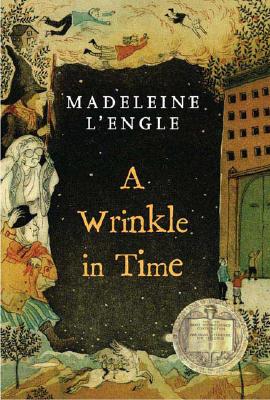
Audiobook: A Wrinkle in Time

by: Madeline L’Engle
read by the author
Ages: 7+ (listening)
Support your local independent bookstore: buy it there!

I threw in a bunch of audiobooks on our recent trip to Michigan, hoping that we’d listen to a couple as we went. Turned out that we only listened to one, and that this was the one everyone seemed most excited for.

I really don’t have much to add with this reread from the last time. I was expecting the religion, and while I sat musing for a while that the idea of sameness as the Great Evil is a very American idea (though I liked this quote — and I paraphrase — “Alike does not mean equal.” True.), I mostly just let the story flow over me and didn’t engage with it very much.

So, I’m going to give you my girls’ reactions:

K, who is 7, spent much of the book wondering what was going on. She did get the basic content of the book, but often said, “The words don’t mean anything to me.” We had to stop frequently to explain things to her.

A, really enjoyed it. In fact, out of all of the girls, she’s the one who was the most interested in the whole story. She really liked Meg, thought Charles Wallace was charming, and may (or may not; she’s not telling) have ended up with a little crush on Calvin (though he is no Percy Jackson).

C, was the most interested in starting the book, but by the end was complaining that Meg was TOO HYSTERICAL. “Can’t she just shut up and do something already?” That is an interesting perspective: the girls in our middle grade fiction have become more confident and more assertive than they used to be. I’m not saying that Meg is a shrinking violet; just that she does burst into hysterics quite often.

M, who had read it before (“Is this the one with the huge brain?”) was charmed again (“Oh be quiet! Awkward kid flirting; it’s so amusing.”), but not really thrilled.

And Hubby kept comparing it to Harry Potter: Cal is Ron, definitely. But we debated whether Meg was Harry or Hermione. We decided that Meg was probably Harry and Charles Wallace was Hermione. Everything relates to Harry Potter these days, doesn’t it.

Oh, a bit on the narration: I loved hearing Madeline L’Engle — pronounced lengle as opposed to la engle; I didn’t know that — narrate her book. While it wasn’t as mesmerizing as Neil Gaiman’s narrations of his books are, it still was quite charming.

Not a bad way to introduce several of my kids to the series, at any rate.

Audiobook: Emma

by Jane Austen
read by Michale Page
ages: adult
Support your local independent bookstore: buy it there!

After I finished listening to this one, I went back and read what I wrote after finishing last time and I pretty much still feel the same way. Mr. Knightly is still practically perfect (and still only Jeremy Northam in my mind), Emma is still silly and snobbish, Harriet is still under-served in this story (and quite silly as well). It’s still quite amusing, and very, very true to life.  Austen really is a master observer, and

The reading was fantastic as well. I had issues with his voices at first — can’t quite seem to let my movie voices go — but as it went on, I fell in love with the way he portrayed everyone. The character that stood out to me the most this time around was Mrs. Elton; Page captured her perfectly in all her snobby pretentious absurdity. Miss Bates was more annoying when listening to the book; I realized that most of the time I just skim what she’s saying, instead of listening to every single detail. I’ve never been worse for it, either.

Do I think it’s Austen’s best work? Possibly. Did I get anything new out of this re-read? Not really. But I thoroughly enjoyed revisiting Emma again.

Audiobook: The Castle of Otranto

by HoraceWalpole
Read by Tony Jay
ages: adult
Support your local independent bookstore: buy it there!

 It starts out on as a happy day for Manfred, the lord of the Castle Otranto. His only son, Conrad, is going to be married to Isabella. However, right before the wedding, Conrad is mysteriously killed by falling helmet. Weird, right? That’s only the beginning: Manfred, distraught, does the only thing possible (huh??) and decides that, to insure his lineage will go on, he will marry Isabella. (Yeah, Manfred does have a living wife. And a daughter.) Isabella (rightfully) escapes (go girl!) with the help of a peasant, Theodore. Whom Manfred locks in the tower. Theodore’s rescued by Matilda, Manfred’s daughter (you’ve gotta love the pluck of these girls. The novel was published in 1764), and sent off to help Isabella. After almost nearly killing her father (who appeared out of nowhere, really), they head back to the castle to confront Manfred and the ghosts that have been haunting him.

It’s a melodramatic, over-the-top novel. But, I really had a great time with it. The best part of this one was the narrator. Jay was fabulous. I found myself gripped in the thralls of what I would have otherwise  found to be a boring, hard to understand novel. I found myself listening in the car because Jay was so captivating.

And that made all the difference for me.

Audiobook: An Abundance of Katherines

by John Green
read by Jeff Woodman
ages: 14+
Support your local independent bookstore: buy it there!

I picked this up on a whim,  partially because Laura (all my good ideas come from her!) suggested the YAckers read another John Green book, and partially because I’ve been trying to get this guy at work to read John Green, and I suggested this one. I figured it was due for a reread. Or listen in this case.

After going back and reading my initial review, I realize I don’t have much to add. It’s still a great mix of nerdiness, humor, and Deep Thoughts, though I think John (I can call him that, right? Being a Nerdfighter and all?) has gotten better at meshing the Deep Thoughts into his books  and they come off less as Deep Thoughts and more as, well, just thoughts. I didn’t remember the bit about the footnotes; I’m assuming Woodman read them, but they just came off more as asides, which I didn’t mind at all.  Speaking of Woodman, I thoroughly enjoyed his narration; he got the voices just right, and the girls — always an issue with me with male readers — weren’t simpery. Hassan was still my favorite character, hands down; it was nice to have a religious character — an Islamic one at that — who wasn’t preachy. Not to mention the fact that he was overweight but not obsessive about it.

I do think, in the end, that although this is John’s funniest book (all the fugs made me laugh), it’s not my favorite anymore. (I’ve remembered it that way for the longest time.) It’s charming, it’s sweet, it’s fun, but it lack the depth that he has in his other novels. Perhaps I should try pushing Paper Towns on the guy at work (he’s one of those literary fiction sorts). He might like that one better.

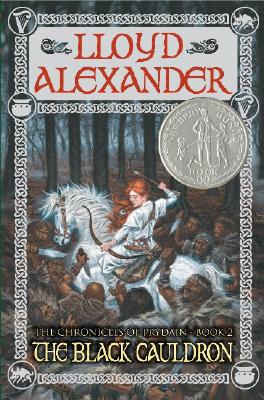
Audiobook: The Black Cauldron

by Lloyd Alexander
read by James Langton
ages: 7+
Support your local independent bookstore: buy it there!
Others in the series: The Book of Three

I picked this up because I thought the kids would want to listen to it (and they didn’t have Book of Three) on our recent vacation. But, when we put it in, there was much complaining and whining. And a couple of the kids, after listening to the first disc, said they were lost and confused. I guess after Harry Potter, even the simplest of books are boring. Either that, or The Black Cauldron starts out  too slow, and there are too many characters to keep straight. Which does make sense.

The plot is simply this: Taran is still the Assistant Pig Keeper at Caer Dallben, even though he’s fresh from his journey with Gwydion. He’s basically content (though he still longs to do things “men” do), but that changes when Gwydion shows up with a bunch of other lords and military men to hold a council. Their agenda: going after Arawn’s black cauldron and destroy it so that he doesn’t make any more of his undead cauldron born soldiers.

Sounds easy enough: go into Annuvin, get the cauldron, and get out. Except it isn’t that easy: someone has already come in and gotten the cauldron, and now it’s missing. So, the band — including Taran and his faithful friends, Fflewder Fflam (the reader actually said it “Flewdur Flam”! And here I was thinking it was some weird Welsh pronunciation), Princess Eilonwy, and Gurgi — splits up, and sets out looking for the cauldron.

Taran and his bunch get saddled with the most annoying character in the book: Ellidyr. He’s the worst kind of character: and annoying, proud, brat who thinks he’s too good for everything. I wanted to smack him whenever he came around.

Which brings me to the narration. I actually liked the was Langton read the book — he gave Eilonwy a slight Scottish accent, which suited her nicely (and she wasn’t terribly whiny, either), and he made other characters suitably menacing.  And while I thought his Gurgi was off at the beginning, the way Langton portrayed him grew on me over the course of the book.

One more thing: as I listened to the story, it occurred to me just how much Alexander drew on Tolkein’s world to create this little series of books. It’s not just the similarities in names or the magic, but the whole feel of the book. The quest that Taran has to go on. The fact that he’s mostly reactive rather than proactive (much like Frodo). The Big Evil Bad Guy lurking in the background with the Lesser Evil Bad Guy that they have to deal with immediately. It’s not a bad thing that this book felt a lot like Lord of the Rings. It’s just an observation.

I remember these books being some of my favorites as a kid. And while I’m not sure I ever found them brilliant, this one, at least, is still a good, entertaining adventure tale.

Audiobook: Harry Potter and the Prisoner of Azkaban

by J. K. Rowling
read by Jim Dale
ages: 9+ (Listening 6+)
Support your local independent bookstore: buy it there!

I could have sworn I had a review of Prisoner of Azkaban on here, but I only found a smallish blurb about the whole series here. But, I guess, I read this before the blog, and I haven’t gotten around to a reread until now.

The reason for picking this particular Harry Potter? Well, we went to the Wizarding World of Harry Potter for our family vacation a couple of weeks ago, and figured since we were going there, we needed to read a Harry Potter book. And since this is the next one in the series for K to read (her dad’s read her one and two), that’s where we started.

My thoughts, since everyone knows the plot already:

Out of all the books, this one is one of the tightest, I think. As they go on, they become more meandering and Rowling tries to pack so much in.

That said, at the end, when Sirius and Lupin confront Peter Pettigrew, there is an awful lot of monologuing. I know that Rowling needs to give us a whole bunch of information that existed before the story even started, but still. It slows the story down.

I really, really dislike the way Jim Dale reads Hermione. She’s a capable, smart girl, and every time she opens her mouth, Dale makes her sound like a whiny brat.

I adore Lupin as a character. That is all.

Hubby and I got into a discussion about adult figures in middle grade books. It was started because we realized that Dumbledore is a Really Bad Headmaster. He’s terrible at his job. Don’t get me wrong: I adore the character, but think about it: he’s neglectful, he’s bad at enforcing rules, and he plays favorites like no other. But then, if  Dumbledore were good at his job, there wouldn’t have been a story.

I think the lack of Voldemort in the story actually helps the book. It’s not as Dark and Foreboding as some of the others. 

It’s still one of my favorites of the Harry Potter series.

And I’d really like — for comparison’s sake — to hear the Stephen Fry audio versions. I wonder if he can do Hermione any better.

Audiobook: Fragile Things

by Neil Gaiman
read by the author
ages: adult
Support your local independent bookstore: buy it there!

I decided, upon finishing listening to this, that I wouldn’t mind if Neil Gaiman came and narrated my life. He has such a wonderful reading voice, spellbinding on its own, that he could be reading my grocery list, and I would listen, captivated.

But, thankfully, I didn’t have to listen to my grocery list, which would have gotten quite tedious after a while. Rather, I got a collection of some fascinating, some entertaining, some disturbing Gaiman stories. I didn’t love them all, but the ones I liked, I really liked. I think, perhaps, that I like Gaiman in short doses — I absolutely love his stuff for kids — rather than his long novels. So, a collection of stories and poems was just about my speed.

Some of my favorites? “A Study in Emerald,” his take on a Sherlock Holmes story which is weird and wild, and has an absolutely brilliant twist at the end. Or “October in the Chair,” a delightful story personalizing the months of the year and their gathering where they each take turns telling one story, and the story that October (it’s his year) tells. Or “How to Talk to Girls at Parties,” which is a mundane awkward boy party until you realize that they crashed a party of alien girls. Or “Sunbird” which is about an epicurean club who have basically tried eating everything there is to eat. Except for the sunbird. Or, the poem “Instructions”, which is one of my favorite picture books.

Sure, there were some missteps (I had issues with ” The Problem of Susan” and another story, where the sex just felt gratuitous), but for the most part, I thoroughly enjoyed listening to this one. Then again, it may have been because I’d listen to Gaiman read anything.

Audiobook: Pride and Prejudice

by Jane Austen

read by Josephine Bailey
ages: adult
Support your local independent bookstore: buy it there!

I’ve already reviewed Pride and Prejudice here on the blog, so I’m not going to do that again. (Though, looking back, my review really isn’t much of a review.) I picked this one up again because I was inspired to do a reread of all of Austen’s works by A Jane Austen Education.  But, I decided to do something different: listen to it on audio book. (In fact, between that and listening to To Kill a Mockingbird, I’ve decided that I’ll try to listen to classics this year. We’ll see how that goes.)

So. Thoughts.

The narrator was good. Though her Lady Catherine and Mr. Darcy were wrong. I mentioned that to M, and she said that’s because I’ve watched the A&E movie too many times and Colin Firth will always be Mr. Darcy, and no one else will do. She’s right, you know.

I know some of the lines well enough that I can say them right along.

The humor came out really well when I was listening. I catch it when I read, but I actually laughed aloud when listening and that’s something I don’t usually do when I read it.

One of the themes I caught this time was how much appearance matters. They’re always talking about the way people look — whether they give off a good impression, whether they have “goodness” in their “countenance” — and that sat uneasily with me. I try very hard not to judge on my first impression, though I do have to admit that it’s a human trait: we all do it. Even if we think we don’t. The more I think about it, the more I think the original title of this one — First Impressions — is almost more accurate. There’s a lot in here about judging and being judged for they way people (not only yourself, but your family) acts in public. And the sad thing is that it’s still applicable.

It’s still a delightful read, after 200 years and multiple rereads (on my part, anyway). It doesn’t get much better than that.

Audiobook: Madame Bovary

by Gustave Flaubert
read by : Donada Peters
ages: adult

So,  thought I’d listen to the classics this year. And, since I’ve never read Madame Bovary, I figured why not listen to it? I admit that I had no idea what it was about going in, and also that the back blurb was singularly unhelpful.

That said, even though Donada Peters sounds vaguely like Judy Dench, I found myself highly — HIGHLY — bored with listening to this one. After a while, Peters voice began to grate on me, and I just bailed. Nothing — not a single thing — about the story was drawing me in. Not the characters, not the writing, and definitely not the narration.

So, that leaves me with this: was it the translation? Was it the audiobook? There has to be a reason this is considered a classic. Should I give it another try?