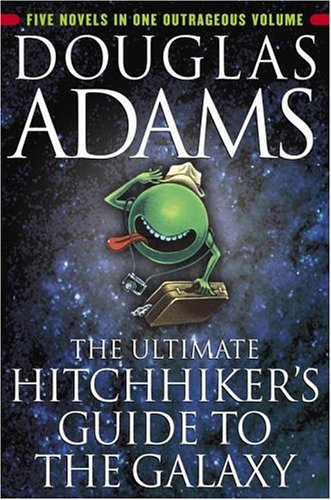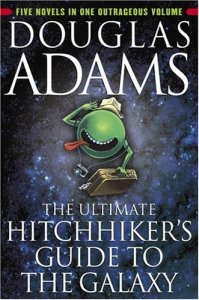
The Hitchhiker’s Guide to the Galaxy

by Douglas Adams
ages: 12+ (though the older you are, the more likely you’ll get the jokes)
First sentence: “Far out in the uncharted backwaters of the unfashionable end of the Western Spiral arm of the Galaxy lies a small unregarded yellow sun.”

For the Try Something New mini challenge over at Things Mean a Lot, I was paired with Laura of State of Denmark. We went back and forth a bit on what genre to read, and then what book to read, and we finally decided on the cult classic The Hitchhiker’s Guide to the Galaxy. Laura and I sat down to chat about it last night. Be sure to drop by her blog to see her take on the book and our conversation.

me: So, what did you think of it?

Laura: Hmm… well, I definitely found it funny and caught myself chuckling and laughing on several occasions, but I never felt the burning desire to just keep reading. I actually abandoned it for two weeks.

me: You know, me either. I’ve read it before; back when I was in high school, and parts of it have made it into family lore. But, I think it’s much funnier talking about it, than actually reading it. You know it was originally radio scripts, right?

Laura: Yes, I did see that and I can see how it probably was really successful in that way. I would listen to it no problem.

me:
But it just didn’t work as well in novel form for you?
Laura: No, that’s not it at all. I liked it when I was reading it; it just wasn’t one of those “have to keep reading” books. He is really funny… reminds me of Kurt Vonnegut
me: I’ve read Vonnegut, but it’s been a while. In what way?

Laura: I guess just in the sense that he sort of mocks the absurdities of life. The randomness of it all.

me: I can see that. Though I’m not sure Adams was going for any social commentary. I think he was just being silly. I could be wrong… Either that, or he’s poking fun at the superiority people seem to have. The dolphins show up in this book, right? So long and thanks for all the fish and all that? (It’s been a week, and already I can’t remember!)

Laura: Yeah, and the mice who really rule the world but have tricked us all.

me: The mice were funny. I liked the mice… and Arthur’s defensiveness about his brain. Did you have a favorite part, or character?


Laura:
I loved the part when they are talking about all improbabilities and then Arthur makes the comment that there are an infinite number of monkeys outside who want to talk about their Hamlet script they’ve worked out.


me:
That was funny. (I’m giggling thinking about it.)

Laura: I liked the really depressed robot… I can’t think of his name right now

me:
Marvin! He’s the best part of the movie… Alan Rickman’s his voice, and he does a superb job.

Laura: Yes, I loved poor Marvin. I just ordered the movie. How about you?
me: I think my favorite scene was in the end when Marvin hooked himself up to the cop’s ship, and it committed suicide. That made me laugh.

Laura: Absolutely. That’s the next thing I was going to say: about the suicidal ship.

me:
I liked the idea that even though Marvin was so supremely depressed, he still managed to help them. Even though he didn’t care whether they lived or died.
Laura: I also really liked the history of figuring out the meaning of life
me: Yeah. That’s actually one of the things that has made it into family lore. You say to my dad, “I have a question” and he says “42”. Every time.

Laura:
That’s great. I need to use that one with my students.

me:
That would be funny. I wonder if they’d get the reference.

Laura: A select few maybe.


me: Have any of them read Hitchhikers? Or is it really an 80s geeky thing?

Laura: Not that I know of. I think it is more of an 80s thing, but I definitely have some that would get a huge kick out of it. When I was in college it seemed like everyone but me had read it, now, not so much.

me: It feels like a 70s/80s book. I’m not sure I can pinpoint why.

Laura:
It’s very campy.

me: It is campy. And very silly. But generally those things are timeless. Though, I’m not sure I could come up with an example off the top of my head.

Laura: It was originally written in 79.

me: I also harbor a soft spot for Zaphod Beeblebrox. If only because his name is so fun to say.


Laura:
The names were a hoot

me: Found this anecdote… “Slartibartfast: I thought this character should be a dignified, elderly man, weighed down with the burden of a secret sorrow. I wondered what this sorrow should be, and thought perhaps he might be sad about his name. So I decided to give him a name that anybody would be sad to have. I wanted it to sound as gross as it…”
Laura: Nice, I love that. And I would have to agree, Slartibartfast is a pretty gross sounding name…
me: “…possibly could, while still being broadcastable. So I started with something that was clearly completely unbroadcastable, which was PHARTIPHUKBORLZ, and simply played around with the syllables until I arrived at something which sounded rude, but was almost, but not quite, entirely inoffensive.” Sorry, the text box was too small for the quote.
Laura: ha!

me:
It is too funny. There’s also a long note on the sperm whale that dies near the end. But I won’t type that out.

Laura:
Where did you find this? I need to check it out.

me: Hubby has the original radio scripts for Hitchhikers, and it’s from the notes in that. (For the record, I’ve only read the novel, though…) When I pulled out the book, he pulled out the scripts, and read that one out loud to me.

Laura: Ahhh, so has he read the whole series?
me: I think he’s read the first three or four of the trilogy. There’s five in all. The first two — Hitchhikers and The Restaurant at the End of the Universe — are the best.

Laura: I love that it is a trilogy with five books

me:
I know; it cracks me up. I wonder if you could find a copy of the radio scripts now, or if it’s gone completely out of print?

Laura: I work part-time at a bookstore and I can do some research on that one. So overall, how would you rate this book? What did you think of it in terms of science fiction? For me, this is about the extent of my science fiction knowledge I think. I can’t name one other sci-fi book I have read, unless you count Stephen King… which I haven’t read since high school.

me: I don’t actually think it’s properly science fiction. I’ve read Orson Scott Card and Ray Bradbury and Isaac Asimov, all of which I think of as science fiction. Douglas Adams is a comedian in space. Which isn’t a a bad thing… it’s just not properly genre.

Laura: I like that explanation. A comedian in space.

me: I guess it would make him hard to classify in a library or bookstore: where do you shelve his books?

Laura:We have a shelf titled science fiction/fantasy and that’s where he lives.

me:
It works. He’s not really humor, either. Not properly.

Laura: Yeah, sometimes he wanders over to fiction as well

me: So, are you going to find The Restaurant at the End of the Universe?
Laura: not right now. I’m putting that one on hold for a little while, but I wouldn’t say I am not going to read it ever either. How about you? You’ve read that one?

me: When I was a teenager. I only remember one part, and that’s the talking cow (“Hi, I’m your dinner tonight”) at the restaurant. That and the one line: You are so unhip it’s a wonder your bum doesn’t fall off. Aside from that, the book is unmemorable. Or it’s just been too long. My favorite Adams is The Long, Dark Tea-time of the Soul. Dirk Gently’s the main character and he meets the Norse gods. Quite funny.

Laura: I will have to check it out.

me: It might be funnier on audio book, sometime when you’re on a long road trip.

Laura:
Yeah, that was what I was actually thinking about this one. I should listen to it on the way to work each morning.

me:
Well, next time around. It’s been a pleasure chatting with you! :)

Laura: Yes, this was fun and thanks for the little tidbits from the script; they were great.
me: My pleasure. Have a great evening!

Laura: You, too!

Rose Water and Soda Bread

by Marsha Mehran
ages: adult
First sentence: “Mrs. Dervla Quigley, perpetual widow of James Ignatius Quigley, was the self-proclaimed arbiter of all that was decent and holy in the coastal village of Ballinacroagh.”

I had high hopes for this one. I wanted to like it as much as I loved Pomegranate Soup, I wanted to be captivated by the Aminpour sisters again, to be transported by the food and the tastes and the atmosphere of it all. I was happy to jettison it to the top of my reading pile (due to a 14 day checkout rather than the normal 4 week period), and happily began.

I don’t know if it was my mood, or if it was the book, but I just couldn’t get into it. All the elements were there: Marjan was still cooking, and her sisters Bahar and Layla were still as exotic as ever. But there was something off. Bahar was less sad, finding solace in religion — she converts to Catholicism — but in her devotion to a new religion, becomes intolerant, which was disturbing. Marjan finds love, and in so doing, loses the magic that she had in the previous book; she is often scatterbrained and at loose ends trying to make everything work. She is also trying to face her past — she was in love before, and was arrested during the Iranian Revolution — as well as deal with this stranger that washed up on the beach and that their Italian landlord, Estelle, has taken under her wing. And Layla; all she’s interested in is finding a moment to have sex with her boyfriend. She lost her magic, her appeal and became a (uninteresting) teenager. I didn’t like most of the minor characters, either: Dervla was irritating, Father Mahoney was superfluous, and the rest of the town isn’t worth mentioning.

I did, however, like the new characters: Julian, Marjan’s love interest, whom I spent the whole book anxious that he not turn out to be a cad. And the mysterious girl who washes up on the beach; she was fascinating (Is she mermaid? How did she get pregnant? Why was she trying to abort the baby? How did she end up on the beach?) and mysterious, though I have to admit that the mystery got a bit old. It wasn’t until the final third of the book that I even became interested in the story enough to really care. But the final third was interesting and the ending was nice. And the food, while not as wonderful as the first book, was okay.

Maybe it wasn’t my mood, after all.

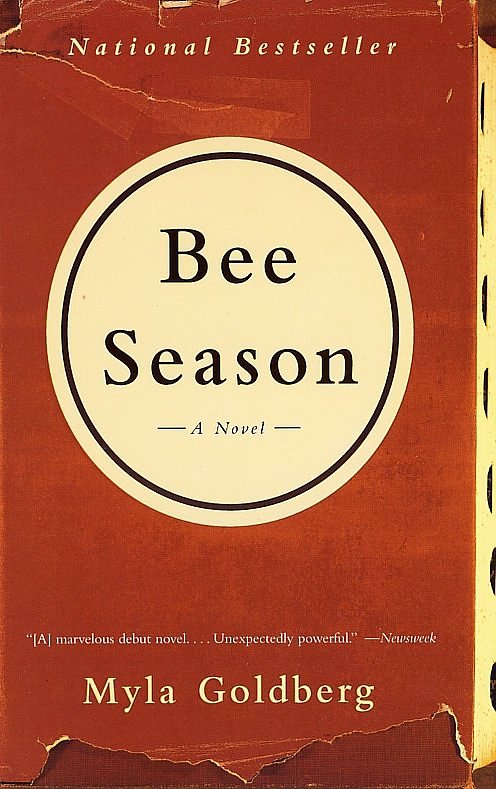
Bee Season

by Myla Goldberg
ages: adult
First sentence: “At precisely 11 a.m. every teacher in every classroom at McKinley Elementary School tells their students to stand.”

Ever have the experience where a book starts out relatively promising — not great, but good, and with potential — and so you keep reading. Then, about halfway through, you start wondering where this is all going, but because of the initial promise, you keep going. Then, a few dozen more pages later, you realize that the book is going nowhere slowly, and so you start skipping around (say, reading the end just to see if it’s good or not). But, then, you read something that is mildly confusing or interesting (how on earth did she come to make that decision? Or, why is she doing that!? Or, is she completely nuts, or am I reading this wrong?), and so you go back and begin plodding through again. But, by the time you make it to that interesting decision or situation, it’s no longer intriguing. In fact, by the time you finally close the book, you’re tearing your hair out, wishing you would have just stopped halfway through, lamenting the time that you can’t get back. In fact, the more you think about it, the worse the book is, the more annoyed you are that you’ve even attempted it. In fact, you wonder why you even try adult fiction, if this drivel is all there is. Granted, that will probably wear off in a day or so, but right now, right after finishing it, you just want to go and scrub your brain out with a good Hilary McKay book.

Ever read a book like that?

(I just did.)
(More coherent thoughts are over at the Jewish Literature Challenge Blog.)

Chocolat

by Jeanne Harris
ages: adult
First sentence: “We came on the wind of the carnival.”

I finished this a couple of days ago, but put off writing a review because I wanted to watch the movie again, mostly so I could compare the two. But, alas, the planets/stars/karma aligned against me, and I wasn’t able to get a copy. Not willing to wait another week until I could get one (that whole bad memory thing), I’ll just have to write my impressions of the book, and save the whole comparison thing for later.

Vianne Rocher and her daughter Anouk move into tiny, drab, sober, religious Lansquenet on Mardi Gras. Vianne decides that her services are needed in this village, and sets up a chocolate shop, La Praline. Because the world that Harris has set up is a magical one, Vianne is possessed with the ability to know each of the villiagers Favorites, and fairly quickly wins not only customers, but loyal friends. This rankles the villiage priest, Pere Reynaud, who is hell-bent on keeping his flock in what he determines is a straight line.

It sounds like a greater conflict than it really is. The chapters alternate between Vianne and Reynaud narrating, and by the end of the book, I didn’t trust either as a narrator. Reynaud is despicable as a priest, more set on his right way rather than actually being a Christian. Vianne, on the other hand, is more set on finding the path of happiness through indulgence and freedom of desire. The book sets the Church up as wrong and oppressive, and Vianne as right and the way to True Happiness. Which isn’t entirely bad, since Vianne does some admirable things — things that a priest should have — while in town. However, I got to the point where I felt that because she was actively working against Reynaud, fool that he was, she provoked him in ways that were unnecessary. I felt like the “true” story, as well as the moral center, was somewhere in between the two narrators. (Then there’s the whole deal with Roux, the riverboat gypsy, but since I think I need to see the movie to fully formulate my thoughts on him, I think I’ll have to give him a pass.)

While the writing was captivating at times, I suffered from the same problem I did in Dear Julia: too many French names, not enough lush description. Please, please, describe the smells, the textures, the tastes of the chocolate, not just the names. Harris is better at this, for she does delve into that at times, but not enough for my taste. I do have to admit that at times I was reminded of Isak Dineson’s story” Babette’s Feast”, but there are quite a few stories about a woman’s ability to work magic, and therefore change, through food.

That’s not to say that the book is bad; I did enjoy it, for the most part. A friend of mine, when I told her I was reading this one, said that while she liked the book, she thought the movie was better. Perhaps this is just really one of “those” books.

Matrimony

by Joshua Henkin
age: adult
First sentence: “Out! Out! Out!”
Review copy from the author.

This is a quiet novel. I think that’s the best way to describe it. A sweeping portrait of everyday life, focusing on the ebb and flow of the relationship of Julian and Mia from the time they met as freshmen in college through to the birth of their first baby nearly 20 years later. There’s drama — divorce, infidelity, deaths — but, the novel doesn’t focus on the drama, but rather how that drama affects everyday life.

That’s not to say that the book was boring. It wasn’t. Rather, it was often just ordinary. Julian and Mia meet, live together, go to grad school, have a falling out, get back together, move to the Big City, and have a kid. Every day things — dealing with who’s going to wash the dishes or the stress of graduate school — took the forefront. But I think that was the purpose; to find the elegant in the every day. Sometimes, though, I thought that the scenery — Ann Arbor for much of the book — took the forefront. Like Julie, I found it difficult to get past the descriptions of the cafes, streets, or everyday workings of Ann Arbor in the book. The Fab Five? (You’re really from Ann Arbor if you know who they are.) The Art Fair? The Arboretum? The Diag? Zingermans? Caribou Coffee? It’s all there. I think the only thing he didn’t mention was The Rock at the corner of Hill and Washtenaw. I don’t know why this got in the way for me; perhaps it’s because I’m from the Ann Arbor area, though it’s been nearly 20 years since I lived there. But in a sense, I felt like Henkin was trying to showcase the town, which is all fine and good, but it seemed to get in the way of the story.

In general, though, I liked the book, the quietness of the book. I liked that the characters were all generally likable, even if they weren’t always doing likable things. I liked Julian’s struggles as a writer — how it was a struggle for him to find the novel that was waiting inside him (though I have to admit I often found it a bit pretentious, I felt like telling him to just do it already). And, as the title suggests, there’s much about the give and take in a relationship — being committed to each other, supporting each other’s dreams. I liked that it wasn’t perfect, that there were times when Julian and Mia had problems and fights and couldn’t seem to get things quite right. But, on the other hand, they weren’t horribly messed up with horribly messed up families, dealing with back-biting and dischord in their lives. It was refreshingly… well… normal.

In the end, while there was nothing really to shout about, nothing really that bowled me over enough to say “Wow, this book is great,” it was a good read.

Captain Alatriste

by Aturo Perez-Reverte
ages: adultish
First sentence: “He was not the most honest of pious of men, but he was courageous.”

Call this one the Spanish The Three Musketeers. It’s 1623, Madrid, Spain. Alatriste is a former soldier, who has taken to dueling for hire to keep money in his pockets. He is hired one night by some unknown men, high-born from what Alatriste can tell, to take out two Englishmen. Alatriste doesn’t — mostly because one begs for mercy for the other man — and as a result saves the life of the Prince of Wales. This is not a good thing for Alatriste — for the people who wanted the Prince dead are now after Alatriste’s life. Our narrator through this journey is Inigo Balboa, son of a former soldier and collegue of Alatriste and who has become a protege of sorts to the good Captain.

I liked this book, mostly because it felt like (and made references to) The Three Musketeers. Same time, same feel, similar characters (the Duke of Buckingham, who plays a role in Dumas’ work, makes an appearance, and Richelieu is talked about) — from the noble, yet misguided soldier, to the young impetuous lad (though not as impetuous as d’Artangnan), to the corrupt Church official… it’s all there. I liked the narrator, too. He was circular in his telling (I never could figure out who he was telling the story to; he would call them”Your Mercies”), jumping forward and backward in time, and talking so much about the history of Spain that I felt like Madrid and its people were almost another character. But when the action got going — as it occasionally did — it really got going. (Which, in many ways, is also like The Three Musketeers.)

I knew it was the first in a series when I started it, though I thought it would stand on its own more. It doesn’t end in a cliff hanger, but so many storylines and threads are started in this book, and never resolved, that it’s almost imperative that one read the next book. If only to find out why Inigo keeps calling Angelica a “Devil” because she never really did anything…

I’m just not sure how much I care. I may find myself a couple months down the line thinking about it and wondering what the next step in the story is, though. It’s definately one to mull over. Either that, or I’ll just watch the movie, which I didn’t even know existed. Anyone know anything about it??

Breathing Out the Ghost

by Kirk Curnutt
age: adult
First sentence: “Let me tell you about the time your grandfather took a sledgehammer to the car.”

Um, no.

No, no, no.

That’s what I should have said when they asked if I wanted to be a part of this book tour. My gut instinct said no, and I should have listened.

It’s not the book, really. It’s a well-written book, and it’s because the characters are so well drawn that I’m having such a violent reaction to it. If it were anything less, I could brush it off, shrug and roll my eyes at it. But I’m not able to. This one got under my skin, dragged me down and that is not something I want or need in January when I’m already dragging because of the weather.

See, Colin St. Cloud’s son was kidnapped and murdered. By a creep, a pedophile, a sick man named Dickie -Bird Johnson. And St. Cloud can’t let it go. His life has gone to hell; he’s spending it driving around the country, half of the time high on speed, looking for his kid and others, hoping, for what exactly? Redemption? Closure? I’m not sure he even knows. And then there’s Robert Heim, the P.I that St. Cloud hired to help him track down the person who took his son. He ended up on probation because St. Cloud and the case engulfed his life. And now, a year after the incident, he’s on the road again — abandoning his family and a decent, if unrewarding job — in order to track St. Cloud down and finally close the case. And — because two tortured people aren’t enough — there’s Sis Pruitt, dealing with her own ghosts because her only daughter was brutally raped and murdered seventeen years before. The three converge in Sis’s town in Indiana, because another boy has gone missing, where they’re forced to face their ghosts and their pasts.

Enough cheer for you yet?

It was a harsh novel. Brutal. I had to skip sections because I have a faint heart, and I don’t want to know about the people out there who will take, violate, kill my girls. Perhaps it hit too close to home: yes, I let my children play outside alone. I do know where they are, basically, but I believe in a measure of freedom. This could happen to me. These characters could be me. And. I. Don’t. Want. To. Face. That. Reality. (Granted, it did it’s job: I may not let the girls outside by themselves for a very. long. time.)

So. Go check out the rest of the tour; others have really liked the book for its stark nature, and powerful storytelling. Perhaps you are less faint of heart, and can handle a book about grief and death and hopelessness in the face of the most horrible thing as a parent you can think of. As for me, I’m going to go read something happy now.

The rest of the tour:
Monday, January 5th: Diary of an Eccentric
Tuesday, January 6th: Ramya’s Bookshelf
Wednesday, January 7th: The Sleepy Reader
Thursday, January 8th: Crime Ne.ws, formerly Trenchcoat Chronicles
Monday, January 12th: Savvy Verse and Wit
Tuesday, January 13th: Educating Petunia
Wednesday, January 14th: Michele- Only One ‘L’
Friday, January 16th: Anniegirl1138
Monday, January 19th: Caribou’s Mom
Tuesday, January 20th: Lost in Lima, Ohio
Wednesday, January 21st: A Novel Menagerie
Monday, January 26th: Catootes
Wednesday, January 28th: Bloody Hell, it’s a Book Barrage!
Thursday, February 12th: She is Too Fond of Books

A Christmas Carol

by Charles Dickens
ages: well, everyone should read it or have it read to them

I read this, for the first time, back in sixth grade. It was sitting on the shelf in the classroom, and I was intrigued by it. But, other than that, I don’t remember much about the book itself. Because, even though we own a copy, I haven’t read it since then. Oh, sure, I’ve seen the movies (we own several, and Hubby makes sure we watch at least two or three versions every year), so I know the story. But my aversion to Dickens has kept me from reading the book all these years.

And you know what: I liked it.

I don’t think I’m in love with the book, like Hubby (who considers it almost scripture). But, I was surprised how much I enjoyed reading it. (Look: a Dickens book I like! Amazing! I won’t go so far as to say there’s hope for his other books, though. I think I liked it mostly because it was short, and I didn’t have enough time to get irritated with Dickens.) Everyone knows the story, so I won’t bother summarizing it. The movies have mostly done a decent job with the book, capturing the feel and message of the book. The only thing that really stood out for me was how much I liked Dickens as a narrator. A couple of quotes that I smiled at:

The curtains of his bed were drawn aside; and Scrooge, starting up into a half-recumbent attitude, found himself face to face with the unearthly visitor who drew them: as close to it as I am now to you, and I am standing in the spirit at your elbow.

If you should happen, by any unlikely chance, to know a man more blest in a laugh than Scrooge’s nephew, all I can say is, I should like to know him too. Introduce him to me, and I’ll cultivate his acquaintance.

He’s a nice guy, this Dickens narrator.

I’d like to say that I’d read it over and over, every year. Because I do think there’s worth in the book: there’s a good message that one needs this time of year, to remember those less fortunate than us, to remember that Christmas is about giving and sharing and family.

But then, I could just watch the movie (one of them anyway, mostly likely The Muppet Christmas Carol, since that’s the one the girls like best) and get the same message. Kind of sad, isn’t it?

So… what’s your favorite Christmas Carol movie adaption?

Persuasion

by Jane Austen
ages 14+

I was going to be good, and just read a chapter or two of this book in the evenings before bed. I thought that I could be patient, drawing out the story of Anne and Captain Wentworth for a couple of weeks. Not so, my friends. I managed that for a couple of nights, and then I was just sucked in. There are so many things to love about this little book, and I found that I just couldn’t put it down.

It’s not as funny as some of her books, and it lacks the popularity that others have. Everyone wants to hear about Darcy and Lizzy, or even Elinor and Marianne, but Anne’s plight? She’s not often given much thought. (Which is actually her lot in the book.) But this one: it’s my personal favorite.

Sure, Anne’s a bit of a pushover — she’s so incredibly kind and sweet and her family is so snobby and crass and mean to her — but she comes by her nature honestly. She borders on the annoying (really, how wonderful can a person be?) but I don’t think she quite gets there. She’s honsetly good-natured. And she’s honestly sweet. And I honestly feel for her, especially when she’s at Uppercross and Wentworth shows up, the first time in 8 years that she’s seen him. The last time being when she dumped him, on the advice of her dead mother’s friend, Lady Russell. Austen so perfectly captures the awkwardness of the situation: Anne being all nervous and fidgety — she still loves him after all, and has no idea what he thinks of her; he, all cold and aloof — his pride was wounded after all, and he thinks he’s over her.

But what really makes this book for me is the end. Austen penns the most romantic letter — from Captain Wentworth to Anne — ever written. It makes no sense out of context, but every time I read it (and it’s been quite a few), it makes my heart flutter, and I have to keep reading until the very satisfying conclusion. It’s raw pent-up emotion, it’s desire, it’s heartache, it’s hope… all in two paragraphs on page 214. It gets me every time. This book is the best one of Austen’s because it’s a re-finding of love lost, it’s the rekindling of hope, rather than the blush of first love. Anne and Wentworth were torn apart — by pride, prejudice, situation, class… all of which are Austen themes in her other books — and yet they overcome all in order to be together.

It’s beautiful.

How the Garcia Girls Lost Their Accents

by Julia Alvarez
age: adult

Look, a non-Cybil’s book! (And an adult one at that!) I’ve been reading this at nights (by eliminating my TV watching — only one hour of the John Adams miniseries and a 1/2 hour 30 Rock this week…) for my on-line book group. It wasn’t earth shattering, but I did like parts of it.

The four Garcia girls are the daughters and granddaughters of a fairly powerful clan in the Dominican Republic. However, their father, Carlos, was involved in a plot to overthrow the dictator Trujillo, they have to flee to the United States. There, they try to adjust: Papi finding new patients, Mami taking the lead because she went to school in America for a few years. The girls — Carla, Sandi, Yolanda and Sofia — each make their own way, for better or for worse.

The real “gimmick” of this book is that it’s told backwards. You find out how the girls fared, before you find out how they got to where they ended up. It worked for me, at times, but I think, ultimately, it was more confusing than intriguing. I kept having to flip back to figure out which girl ended up which way (the copy I read had notes in the margins just for that purpose; initially, I was annoyed, but by the end, I was grateful). I think I would have rather a story told with flashbacks to their Dominican childhood.

There was much good about the book, though, especially when it addressed the immigrant experience. Alvarez captured both the initial intrigue of the unknown (near the end of the book, the children would long for the new and unexpected and fascinating things brought back for them from the States) to the challenging and finally accepting of their new culture. I enjoyed some of the individual stories, too, from the descriptions of the compound in the Dominican Republic, to the experiences of each of the girls.

In the end, though the thing that struck me most was that Alvarez writes with honesty and with love for the characters and both their countries. The book made me think about all the immigrant experiences, and the challenges they face when they arrive in a new country. Which is something worth thinking about.