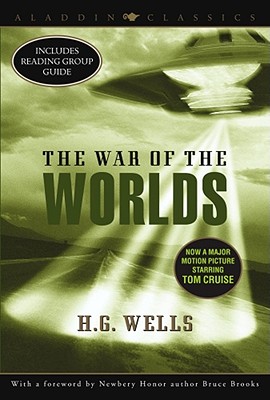
 by H.G. Wells
ages: adult
First sentence: “No one would have believed in the last years of the nineteenth century that this world was being watched keenly and closely by intelligences greater than man’s and yet as mortal as his own; that as men busied themselves about their various concerns they were scrutinized and studied, perhaps almost as narrowly as a man with a microscope might scrutinize the transient creatures that swarm and multiply in a drop of water.”
Support your local independent bookstore: buy it there!
This review comes to you in two parts.
Part one:
Yawn.
I could not, could NOT, make myself get interested in this book. Sure, it’s supposed to be gripping and scary, and the introduction by Orson Scott Card made it sound like a contemporary commentary, which I suppose most end-of-the-world novels are. But this book lost my interest for two reasons: first — and this surprised me — it’s written in the first person, past tense. We know from the start that our narrator, whatever his name is (strike two), will survive because he’s writing this as though it’s happened, done and gone. No sense of immediacy, no suspense, no thrill, at least for me. The second reason is evidenced in the first sentence. Blame it on Twitter, blame it on my reading YA books, but whatever the reason, I found wading through these sentences to be incredibly… boring. Which didn’t do anything to help the already dismal situation.
Then… part two:
After the Martians attacked, killed most everyone off, and settled in to “rule” the earth, I found myself fascinated in the book. Nothing changed, yet everything changed. I found myself fascinated by our narrator’s will to survive and the various stages of madness around him. I found myself thinking about The Stand, and how the second half of that book was more interesting to me as well. Perhaps I’m not so much a lover of end-of-the-world fiction, as I am interested in how society all plays out after the end of the world. Which, I suppose, feeds into my interest in dystopian fiction. Who cares how the world ends, really? The fascinating stuff is the rebuilding, the surviving, the changes that society goes through after the fall.
So, this book was kind of a wash for me in the end.