Audiobook: One More Thing

by B. J. Novak
read by the author
Support your local independent bookstore: buy it there!
Content: lots of language, both mild and strong. Most of it unnecessary, but I don’t think I expected anything less. Is in the adult fiction section of the bookstore, but I bet older teens would like it.

I picked this up because people at work were raving about it. Said it was hilarious. And I decided that I need some humor in my life. So, even though it’s by an actor I’ve never heard of (I didn’t watch The Office, though he was the “other guy” — the one that I didn’t recognize – in Saving Mr. Banks), I figured why not give it a try.

It says it’s “stories and more stories” but I think it’s more “jokes, observations, and a couple of stories.” There were 64 in the book, and sometimes that felt derivative. Not that I minded: some of the shortest stories were some of the funniest ones. Novak is a great narrator, by the way, and he got a whole bunch of other celebrities to help him out, though he used Rainn Wilson and Mindy Kahling the most

My favorite of the whole book was “The Something by John Grisham,” where John Grisham’s newest novel gets published with his place-saving title instead of a “real” one. I was guffawing at the idea that Grisham’s novel would not only get published with such a bad title, but get rave reviews. Just because he’s John Grisham. (I suppose there’s a poignant commentary there on publishing and fame, but I was laughing too hard to find it.) I did like “No One Goes to Heaven to See Dan Fogelberg”, which is an imagining of what Heaven will be like, and how, maybe, we won’t want to spend time with people we didn’t know well in life, even if they are family. Some of them — like the “Comedy Central Roast of Nelson Mandela — made me uncomfortable, and I thought Novak’s humor was more mean than observant. But, for the most part, like in Wikipedia Brown and the Case of the Missing Bicycle” — a spoof on Encyclopedia Brown — or “Bingo” — where three cousins are vying to win Bingo at a resort, only to lose to their grandpa — or “Closure” — where a girl whose boyfriend has broken up with him gets absolute closure I was highly amused. And the discussion questions at the end of a couple stories, as well as the end of the book, I thought were a nice touch.

It’s like David Sedaris without the sardonic undertones.

I’m not sure I would have liked this as much if I hadn’t have listened to it. (Much like me and David Sedaris, come to think of it.) There’s something about hearing jokes, as opposed to reading them, that makes the humor work better for me. It’s not a deep book, or one that’s going to stay with me for a long time. But it was amusing, and it did make the drive back and forth to work enjoyable.
Audiobook: The Art Forger

by B. A. Shapiro
read by Xe Sands
Support your local independent bookstore: buy it there!
Content: All kinds of swearing, plus some explicit (but not graphic) sex. Definitely deserves to be in the adult fiction section.

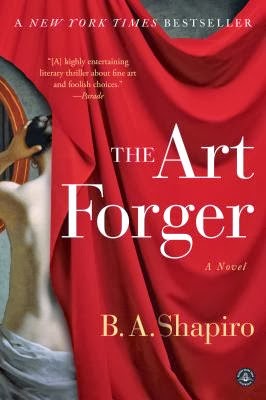
Claire Roth is three years out of grad school, and she’s been blacklisted as an artist. It was a bit of a big deal with one of her professors whom she was having an affair with (and who ended up killing himself). But now, when the owner of the most prestigious art gallery in Boston — Aiden Markel of Markel G — comes to her with a Degas — no, the Degas from the 1990 Gardiner heist — asking her to create a forgery of it, she can’t refuse.

Well, she could have. But then we wouldn’t have a story.

This, in many ways, is a story of obsession and compulsion, and because I watch White Collar (which is a quite fantastic show, that) I was already familiar with the idea of how art becomes a compulsion. That said, I still don’t… get it. The depth of obsession, the idea of owning something priceless. It’s just paintings on a wall, right?

That said, I really enjoyed the journey Shapiro took us on. The initial journey of Claire’s painting the forgery, the gradual unfolding of how she became blacklisted, the relationship between her and  Aiden, and the unraveling of all their best-laid plans. Shapiro had a lot of different threads going, and she kept me wondering how they all fit together.

Which does lead me to the end. It all felt too tidy for me. She did manage to wrap everything up with a bit of an idealistic bow (it is fiction after all), and I’m not quite sure I’m satisfied with the way she did that. But that said, getting there was such an intriguing ride, I’m not unhappy I took it.

One note on the audiobook: while Sands was a good narrator — I loved that she did all the voices, though her men all sounded the same — she made Claire often out to be simpering. And that grated on me. Not enough to bail on the book, but I didn’t see Claire as someone who was insecure and simpering. Indecisive and unsure of herself, perhaps. But not simpering.

That’s just a personal problem, though, and only with the audiobook. The book itself was quite fascinating.

The Crane Wife

by Patrick Ness
First sentence: “
Support your local independent bookstore: buy it there!
Review copy given me by the Penguin rep.
Content: Multiple f-bombs and other language, some off-screen sex. Rightly sits with the adult fiction at the bookstore.

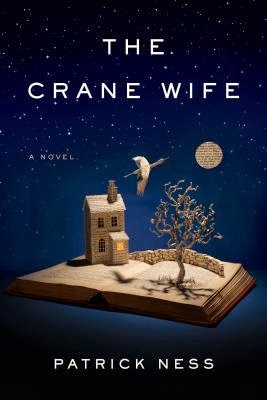
George is your very typical kind-of-loser guy. He’s divorced (nine years) with a child (who’s in her 20s) and can’t seem to keep a relationship (he’s too nice; they always break it off, but he’s always friends with them after). Even though he’s the owner of a print shop, he’s a bit of a pushover, letting his one employee, Mehmet, push him around. But, because he’s nice, because he’s George, when a crane with an arrow piercing its wing unexpectedly lands in his suburban London backyard in the middle of the night, he helps it out.

The next day, a woman named Kumiko shows up in George’s print shop. And suddenly, George’s life — and the life of his daughter, Amanda — are irrevocably changed.

Yes, this is a fairy tale. A very charming, sweet, wonderful fairy tale. Ness divides its time between George, Amanda, and Kumiko’s tales, but does so in a way that doesn’t feel awkward or forced. But it’s not just a fairy tale — or at least not just a one-dimensional fairy tale — art (in this case, paper cuttings) and a slight Japanese-inspired tale within a tale play major roles, which gives the book depth and substance.

But what I enjoyed most with this one was Ness’s use of the language. The fact that one of his characters, Rachel (who is very confused and not at all nice), speaks entirely in questions. Or the way he uses “…” to represent silence. Or the way George and Amanda think of themselves. And descriptive sentences like “He loved physical books with the same avidity other people loved horses or wine or prog rock.” (60) or “Stories do not explain. They seem to, but all they provide is a starting point. A story never ends at the end.” (141-142) or “She stopped, her face scrunching up in some really, really unattractive crying.” (161) There were others, but those are the ones that I marked.

It did all the things I want a book to do: it gave me characters to care about, and transported me away from the dreary winter months. It delighted me, and made me wish I was even a tiny bit artistic.

Delightful.

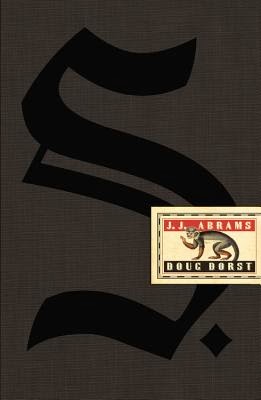
S.

by J. J. Abrams and Doug Dorst
First sentence: “If found, please return to the workroom B19, Main Library, Pollard State University.”
Support your local independent bookstore: buy it there!
Content: Language, including lots of f-bombs. And some violence. It’s in the adult section of the bookstore.

The thing that piqued my interest about this book was the buzz about the form. We had a sample copy and I perused through it. The format — a book published in 1948, stolen from a high school library, with notes scribbled in the margins — was intriguing. Enough so, that I bought myself a copy for Christmas, and eagerly dove in. It IS an intriguing concept, reading someone else’s notes, figuring out the story as you go.

It’s an incredibly layered book: the “book” is one Ship of Theseus, written by the mysterious V. M. Straka. A book where the main character, S., has amnesia, and goes on a journey to figure out who he really is. In doing so, he finds out that he was involved with some shady figures. The second layer is the work that a disenfranchised grad student, Eric, is doing to figure out the real identity of V. M. Straka. All that’s really known about him is that he was involved in this mysterious organization, the S. Eric gets help on this quest from a struggling undergrad, Jen, who finds Ship of Theseus laying in the stacks and begins a conversation. Which brings me to layer three: Jen and Eric’s story. They work together, and over the course of the book, develop their own relationship.

I realized fairly early on that the layers were too dense for me. I couldn’t hold everything in my mind, for starters. I ended up giving up the main Ship of Theseus story, partially because it was boring, but also because I just couldn’t keep multiple storylines in my head. Call it being out of practice, or lack of interest, but I just couldn’t do it. But there was also the fact that the story’s told  inside out and backward. I did think that maybe if I had read it in shifts — read Ship of Theseus first, then the inked-comments, then maybe it would have made sense.

So, in the end, this was all form and no substance. In the end, all the thrills, chills, and mystery They were promising weren’t there. It was a simple story, one that tries to give grad school a mystique and make it cool (it doesn’t succeed). It did succeed in being a homage to paper books — there’s no way this would make a decent e-book. But it wasn’t much else.

And in the end, I found that disappointing.

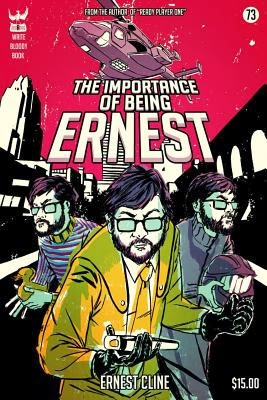
The Importance of Being Ernest

by Ernest Cline
First sentence: “I started writing and performing poetry in the mid-90s when I moved to Austin, TX.”
Support your local independent bookstore: buy it there!
Content: Chock full of sex talk (no actual sex, though), f-bombs, and other swearing.

I’m going to start a review — granted this is more a reaction than a review; then again, most of my “reviews” are “reactions”, I’m just being up front about this one — the way I’m not supposed to and say: I dislike poetry.

I don’t “get” it, I don’t particularly like it, and even though we have a shelf of poetry books — collected best-ofs as well as the Shel Silverstein/Jack Pretlusky ones parents are supposed to have — I rarely crack them open.

And so when my manager — who usually is spot-on pinpointing taste and books people will like — suggested I give this one a shot (because I really did love Ready Player One) I didn’t jump up and say, “Sure! I’d love to!”  It was only as we were paring down the inventory after Christmas when she said she thinks it’s worth a shot, and couldn’t I please give it a look over so maybe we can sell it? Please?

So I did.

And.

It’s Geeky poetry. There’s that.
But I’m not sure I’m the target audience.
And they are really foul. Like REALLY. Foul.
I’m not one to get turned off by language, usually,
but I did this time.

Some of the poems — most notably
“When I Was a Kid” —
made me laugh.
And “Nerd Porn Auteur” was spot-on
about smart girls
even though it made me blush.

But some of it was just
very Geek Gamer Guy
which I’m not.
And I don’t care enough
about poetry
in order to care enough
about Geeky Gamers
to like/get/understand
this collection.

That said,
I guess I know who I
can sell it to now.

The Rosie Project

by Graeme Simsion
First sentence: “
Support your local independent bookstore: buy it there!
Review copy snagged off the ARC shelves at work.
Content: A ton of f-bombs, a character who has multiple one-night stands (because he wants to have sex with women from every country of the world), a lot of alcohol consumption (granted, all the characters are in their 30s). Thematically, I could see this having older-teen appeal, but it sits in the adult fiction section at the store.

Someone at work — my boss, perhaps — described this to me as a “romantic comedy.” Nothing of substance, really, but generally enjoyable. But because of the way the characters are, I kind of came to think of this as Sheldon gets a makeover.

Don Tillman is a genetics professor at an unspecified university in Melbourne, Australia. He’s got a brilliant mind, but his life revolves around… routines designed for efficiency. He wears Gortex shirts because they work for both regular life and exercise. He has a designated meal plan — lobster every Tuesday, for example — that enables him to both 1) minimize shopping and 2) free his mind to think instead of having to focus on cooking.

Granted, his idiosyncrasies — I liked that even though in the first chapter Don gives a speech to an Aspergers conference, it’s never stated outright that he’s been diagnosed on the autism spectrum — have made it difficult for him to have a relationship. As in: he’s never had one. He’s never had a second date. At age 38, he’s decided that it’s not only his inability to figure out social situations, but also his inability to find someone he’s compatible with.  So, he initiates the Wife Project: a survey designated to weed out unacceptable potential partners.

Then Don’s best friend Gene (who’s a real jerk, on so many levels) sends Rosie in. Don initially thinks Rosie is a candidate for the Wife Project, but it turns out it’s something more. She’s looking for her biological father, and wants Don’s help. Thus begins the Father Project, to which Don happily agrees. And although Rosie is far from “acceptable” as a prospective partner, Don finds that… well… opposites attract.

So, did it live up to the book talk? In some ways, yes. It was a very sweet book. Don was likable in the same way Sheldon is: you like them, but they drive you nuts. For the record: Don is much less abrasive than Sheldon. But since that’s the extent of my experience with Aspergers, I’m not even going to venture to comment on how Simsion treats it. That said: I get the feeling we’re supposed to be laughing at Sheldon, but I never felt like we were supposed to laugh at Don. It felt more inclusive than that.

I was disappointed that it wasn’t snort-milk-out-your-nose funny. There was only one scene — when Don and Rosie take over making cocktails at an event — that made me actually laugh out loud. But I did smile a lot. And I did like the dynamic between Don and Rosie, which offset the fact that Gene is a complete jerk. (And that’s being nice.) And I did think the ending was endearing.

So, yeah: it’s worth your time.

Absolution by Murder

by Peter Tremayne
First sentence: “The man had not been dead long.”
Support your local independent bookstore: buy it there!
Content: Murders, all off screen, and a lot (a LOT) of historical information to wade through. A novel for people with patience and time and a passing interest in Seventh Century Ireland/England/Catholicism. Nothing untoward (aside from the dead people) though.

This book is about a lot of things:
1. The mid-seventh century.
2. Early Catholicism in medieval England and Ireland.
3. The history of convents/monasteries in that time period.
4. The Saxon-Irish animosity of the time.
5. Saxon traditions that someone Irish would find despicable.
6. A woman court advocate in Ireland.
7. Solving a murder.

This book (I know I skipped the plot. It goes like this: there was a murder. They solve it. There’s 200 pages of incidental historical information.) has the same problem that many of the fantasy books I read have: there’s too much world-building (in this case, it’s medieval Great Britain) and not enough, well, plot.

I had the same problem I had with Deborah Harkness’s Shadow of Night: I felt like Tremayne (who is a professor of Celtic history) thought: “I’ve got ALL this historical information I NEED TO SHARE. Let’s see HOW MUCH I can put in this book!!” and then he proceeded to cram it ALL in. There was a plot — the abbess is murdered and Sister Fidelma (she’s the Irish woman court advocate) and a Saxon male (for the sake of balance) solve it. But I felt like the murder — which is really supposed to be the PLOT of the whole book — was incidental to the history. And I realized (even though I finished this one) that if I really wanted to read a book about medieval Great Britain, I’d find a non-fiction one.

Audiobook: Longbourn

by Jo Baker
read by Emma Fielding
Support your local independent bookstore: buy it there!
Content: There is some talk of sex, but it’s vague and not at all explicit. And some mild swear words. It’s in the general fiction section at the bookstore, mostly because that’s the way it’s marketed. If a 15 year old were interested, I’d give it to them.

This is, to be frank, Pride and Prejudice fanfiction. All the familiar settings — Longbourn, Pemberly, London — are there, as are the familiar characters — Lizzie, Jane, Mr. and Mrs. Bennett, Bingley and Wickham (Darcy not so much).The difference is that it’s really only the bare bones of the P&P and the story is told from the points of view of three servants: Mrs. Hill, the housekeeper; Sarah, a maid; and James, a footman.

It basically follows the plot arc of P&P, though the concerns are not the concerns of Lizzie and Jane. And, honestly, I was expecting to love visiting that story from the perspective of the downstairs help. However, I was in for a surprise: unlike Austen’s witty observations on human character, Longbourn is a very pedantic book: every day is get up, do the work, collapse in bed. It’s also a dirty book — literally, there’s dirt, blood, pig slop, mud, you name it; Baker doesn’t whitewash the 19th-century.

There’s a slight love triangle between Sarah, James and Mr. Bingley’s footman, and while it goes somewhere, it feels kind of superfluous. I never really connected with the help; Baker didn’t make me care about all the work they were doing, or how annoying Mrs. Bennett was, or what a creeper Wickham was. And so, when at the beginning of volume 4 (I think; listening to it kind of throws off those things), I got backstory on Mrs. Hill and James, I was more than annoyed. First, at the timing — why wait until most of the way through the book? — but secondly because Mrs. Hill and James were not who I cared about or was interested in.

And then it just kind of petered out at the end. Baker kept the story going past the end of P&P, through the marriage of Lizzie and Darcy and even later until everyone is Old. I didn’t care. I wanted to care, but I was just Tired of the story.

I finished it. But I’m thinking that I shouldn’t have. Which is too bad.

(A note on the reader: she was fine. She was interesting. But it wasn’t enough to make me really like the book.)

Audiobook: Sense & Sensibility

by Jane Austen
Read by: Wanda McCaddon
Support your local independent bookstore: buy it there!
Content: Aside from Willoughby being a bit of a cad (!), there really isn’t anything improper in this one. The main obstacles are with the length and the language and the pacing.

The last time I read this one, five years ago, I ended up liking it. At least more than I did the first time I read it. Well, call me fickle, but I’m back on the “not so much” side of things. Perhaps it was the reader of this audiobook — she had a slightly grating voice; or perhaps it was that I was trying to listen to this driving back from Austin and it kept putting me to sleep. Either way, I was underwhelmed by this Austen novel.

This time, while I was amused at parts, and even laughed aloud once or twice, mostly I just kept thinking how poorly Austen plotted. It took too long to get started, it took too long to get events rolling, and it went on long after it could have ended. None of which is a crime; there are many adult books that suffer from the same issues. But I found myself irritated with it this time around. I wanted the story to be tighter, more streamlined. And while I enjoyed Austen’s trademark wit, I wanted more of it and less, well, austerity.

It’s not a bad book; it’s just not one of my favorite Austen books. I wouldn’t recommend listening to it, however. That was just a bad experience.

Audiobook: The Lowland

by Jjumpa Lahirir
read by: Sunil Malhotra
Support your local independent bookstore: buy it there!

I admit that I picked this up solely because M is currently in the part of India where this is set. I thought: Kolkata, Bengali… I should see if I could learn a little more of where M is staying for the next school year. Other than that, I really had no expectations.

It’s a much more political work than I was expecting. While, nominally it’s the story of the relationship between two brothers, Shubash and Udayan Mitra, Lahriri uses the background of the political unrest and Communist movement in India as a backdrop. The two brothers, who were close as children, grow apart as Udayan (the younger) gets involved with the Naxalite movement and Shubash heads to Rhode Island to pursue a PhD. Udayan gets married to Gauri (which Malhotra alternately pronounced Godi and Gori, so I had to check on the spelling) and then ends up killed by the police. When Shubash comes back for the funeral, he takes pity on Gauri, mostly because she’s pregnant, and marries her, bringing her back to the US.

That is the first third of the book. At which point, I was left wondering: What on earth is Lahiri going to do with the rest of the novel? Well, much like Khaled Hosseini’s And the Mountains Echoed, Lahiri explores the ramifications of those decisions. We follow Shubash and Gauri, and later Gauri’s biological daughter, through the years to present day (when Shubash is 70, and Gauri s in her mid-60s), and experience the fallout. Because there is fallout, and it’s not pleasant.

As I mentioned to people that I was reading this, their first question was “Do you like it?” Well…. no. And yes. It wasn’t bad enough to abandon. Malhotra was a delightful reader, capturing both Indian and American accents well. Perhaps it was him who kept my interest in the book going, because I was constantly annoyed at the characters. Gauri could never get past her dead love and move on with her life. And right up to the end, she never thought about the consequences for her actions, acting impulsively. But the thing that really infuriated me was Shubash’s insistence that because he wasn’t the sperm donor for Gauri and Udayan’s daughter, that he wasn’t her father. He. Raised. The. Girl. He was there for her when her mother abandons her, and yet he still questions whether or not he’s her father. *grumble* Biology isn’t what being a parent is about.

Maybe that was Lahiri’s point, in the end. Because, after finishing the last disc (a very unsatisfying ending, by the way), that’s what I got out of it. Family is what you make, and loving and caring for other people is the way to happiness.

So maybe it was a good book after all?