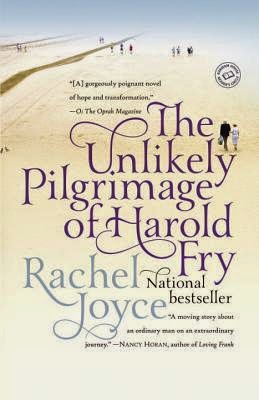
Audiobook: The Unlikely Pilgrimage of Harold Fry

by Rachel Joyce
Read by: Jim Broadbent
Support your local independent bookstore: buy it there!
Content: There are a couple of characters with foul mouths and swear quite a bit (including multiple f-bombs), but that’s it. It’s also a book about aging, life, death, and marriage, so I’m not sure how interested younger people would be in it. It’s in the adult fiction section of the bookstore.

I don’t really know what inspired me to pick this one up; I suppose it’s because I’ve heard a lot about it over the months it’s been out, but I guess I needed a journey story, because this one hit home,

Harold Fry is 65 years old and has just retired from 45 years as a salesman at a local brewery. He doesn’t have much to do, and he and his wife, Maureen, haven’t had much of a marriage in 20 years. So, mostly he just sits around. So, when he gets a letter from Queenie Hennessy, a colleague he hasn’t seen in 20 years, that she’s dying of cancer, he sets out to mail a letter back to her. And then just keeps walking.

A girl in a garage inspires Harold: perhaps if he walks the 600 miles from his home in Kingsbrige to were Queenie is in Berwick-Upon-Tweed, perhaps she will live.

What Harold didn’t count on was how much his walk would change his life.

I completely empathized with all the characters in the book. Sometimes, Harold struck home, with his need to do something to feel productive. Sometimes, it was Maureen, with her frustrations about the stagnation of their marriage — though there’s more to that story, which is slowly revealed over the course of the book. And it was a testament to the kindness of strangers. Harold started out spending money and staying at hotels, but over the course of the 87 days he walked, he increasingly became more dependent on other people. And they didn’t disappoint; sure, there are unkind people, but Joyce seems to be affirming that most people in this world are decent.

It did get a bit meandering in the middle, but I was so enthralled with Broadbent’s narration, I didn’t mind. He was spot-on with all the characters, from the Scottish nuns in the hospice to Maureen’s irritation, to the 70-something next door neighbor, Rex, who turns out to be a gem.

I loved it.

Dollbaby

by Laura Lane McNeal
First sentence: “There are times you wish you could change things, take things back, pretend they never existed.”
Support your local independent bookstore: buy it there!
Content: One of the protagonists is a teenage girl, and there’s a lot of good historical information. There’s nothing truly objectionable, so even though this is in the Adult Fiction, I wouldn’t hesitate giving it to an avid teen reader who showed some interest.

I picked this one up because a couple of people at the bookstore have been raving about it. “It’s funny,” they said, “If you liked The Help, then you’ll love this one.”

I liked The Help well enough, and I figured it’s the South, set in New Orleans, during the whole Civil Rights movement. I like quirky characters. This one will surely be a good book.

Well… Not so much. Yes, it is set in New Orleans in 1964, when our main character, Ibby (short for Liberty) is dropped off at her grandmother’s house. Her father had recently died in a freak accident, and Ibby’s mother can’t handle being a single parent. Ibby’s grandmother, Fannie, is one of those eccentric Southern ladies, who believes in being proper and feisty and doesn’t trust anyone except her help, who are pretty much like family. (But heaven forbid if her granddaughter takes up with a colored man.)

This just didn’t do anything for me. Sure, it’s got those quirky Southern characters, but that’s about it. The plot was lacking, and I didn’t connect with the characters at all. Maybe I’ve been gone from the South for too long, but I wasn’t even entertained by the quirkiness. Or horrified by the racism. Mostly, I was just… bored.

I ended up skimming the second half of the book, just to find out what happens. Books like these make me wonder if I’ve been ruined for adult books after all.

The Vacationers

by Emma Straub
First sentence: “Leaving always came as a surprise, no matter how long the dates had been looming on the calendar.”
Support your local independent bookstore: buy it there!
Content: There are a dozen (or so) f-bombs, some graphic talk about sex and some actual sex (which isn’t graphic). It’s in the adult fiction section of the library.

The Posts are falling apart. Their marriage is suffering because of Jim’s affair (with a woman younger than his son). Their 28-year-old son, Bobby, is a loser. And their daughter, Sylvia, who has just graduated and is off to college, hates living with her parents. So Frannie does the only thing she knows how: rents a house in Mallorca (an island off of Spain) and forces everyone — including her best friend Charles and his husband, as well as her son’s girlfriend — on vacation for two weeks.

It’s such an adorable fantasy. You know? Life is falling apart, so let’s rent a beach house and miraculously everything will get better. Not real life. Or at least my real life.

It was very voyeuristic, this book. I really didn’t care much about Jim’s inner life, or his lust for the editorial assistant he had an affair with. Or Bobby’s relationship with Carmen (who I liked, in spite of the book’s efforts to make me despise her). Or even Sylvia’s inner angst and obsession with losing her virginity. (Which she does, on the beach, to a beautiful Mallorcan boy.) No: the people I was most interested in were Charles and Lawrence because they were the most stable, the most reasonable, the most… well, likable. They were trying to adopt a baby, and there were some struggles with belonging. But if the whole book had been from their perspective, it would have seemed much less snobby. Annoying.

The thing that really kept me reading, however, was that Straub did a wonderful job capturing place and food. Maybe not perfectly, but enough that I was interested in knowing more about Mallorca and I could almost imagine the food.

It’s too bad that I had to experience such a lovely place and read about such lovely food with such crass characters.

Landline

by Rainbow Rowell
First line: “Georgie pulled into the driveway, swerving to miss a bike.”
Support your local independent bookstore: buy it there!
Review copy nabbed off the ARC shelves at my place of employment.
Content: It’s all about marriage, so I don’t know how appealing it would be to teenagers. It’s also full of f-bombs and illusions to sex and drinking (but no actual, I don’t think). It’s in the adult fiction section of the bookstore.

After 15 years of marriage, Georgie and Neal are broken. Well, Georgie doesn’t really like to think they are; she loves her husband and her two  young daughters. But she’s gone all the time, writing for a popular TV sitcom. Neal stays home with the kids, and does a fantastic job, but increasingly it seems like it’s not enough for him. And so when an opportunity comes for Georgie, and her best friend Seth, to pitch a new show — their own show — just after Christmas, Neal digs his heels in. They were supposed to go to his mom’s house, in Omaha. And now Georgie is putting work first, again. So, he packs up the kids and takes them, leaving Georgie stranded a week before Christmas.

But then, Georgie discovers that her old yellow landline phone connects her to a Neal in the past, one the year they got engaged. And maybe, by talking to Neal-in-the-past, she can figure out what is wrong in the present.

Rowell is a talented writer; don’t get me wrong. There were some fun moments, and some beautiful turns of phrase in this book. But, I think she writes better about falling in love than about staying in love. There wasn’t much drive, much reason to stay connected to this book (and I didn’t cry!), much reason to care about the characters. It all felt very rote, very run-of-the-mill, and not at all fresh or original. Perhaps we were supposed to think it was, since Georgie is the breadwinner and Neal is the stay-at-home parent, but it felt like the same old conflicts with just a role reversal. And perhaps there was growth, but I just didn’t feel it. They are both self absorbed and unfit for each other, and although Rowell wanted us to believe that love is “enough” she never gave me enough proof to convince me that, in the case of Georgie and Neal, it would be.

Not bad, but not great, either.

The Lost

by Sarah Beth Durst
First sentence: “For the first hundred miles, I only see the road and my knuckles, skin tight across the bones, like my mother’s hands, as I clutch the steering wheel.”
Support your local independent bookstore: buy it there!
Content: The publisher is marketing this one as fiction, but I think it’s because the main protagonist is 27. There’s some mild swearing, and lots of kissing, but other than that, nothing. I’d give this one to a teenager who is interested.

I’ve had a difficult time getting into adult fiction lately. Too often, I picked it up and it’s just Words and no Plot or Characters or anything interesting. But, I saw that Sarah Beth Durst (whom I love) had an adult book (!) out, and I figured if there was an adult fiction book I’d love, it’d be one written by Durst.

I was right.

Lauren Chase is in a holding pattern in her life. She’s given up on her art to get a practical job because her mother has been diagnosed with cancer. But on this particular day, the day in which the book starts, her mother is off to get Bad News, and Lauren can’t handle it. So she runs away. And finds herself in Lost. A place where all the lost things go, once you arrive in Lost, you’re pretty much stuck. Until you find the thing you lost, and then the Missing Man can send you back.

Except the Missing Man, when he saw Lauren, bolted. Which means, she’s got half the town out to get her, and has to figure out how to survive. Thankfully, she has Claire, a precocious 7-year-old, and Peter, who is the Finder, to help her.

It sounds a little trite, writing it all down, like it’s been something that’s been done before. But Durst made it new and fresh for me. Told from Lauren’s point of view, we got her panic when she initially encountered Lost, as well as her confusion and determination as things got worse for her. And the end, while open for the intended sequel, also gave me a sense of closure.

Perhaps I’m just a genre-fiction reader, but I found reading this one to be so much more enjoyable than many of my other forays into adult fiction. Which is something that made me very happy.

The Chocolate Thief

by Laura Florand
First line: “Sylvain Marquis knew what women desired: chocolate.”
Support your local independent bookstore: buy it there!
Review copy snagged from the ARC shelves at my place of employment.
Content: Very little swearing (in English; perhaps if I knew French, this would be higher), but it’s most definitely a Blush Book. I may never think about climbing stairs the same. It would be in the adult fiction section of the bookstore, if we carried it.

I was pursuing my TBR shelf, looking for something light to read, when my eye caught this. I remember a bunch of YAckers loving it (and plus: CHOCOLATE and PARIS), so I picked it up. It is most definitely light and fluffy. And sexy. And not much else.

Cade Corey is the daughter of a Hershey’s-like family. They’re in the basic chocolate bar business, and own a huge percentage of the market. While she’s not the CEO, she’s being groomed to take over the company. But what she really wants is Parisian chocolates. Artisan chocolates. Sylvain Marquis’s chocolates, since they’re the best. But she quickly discovers that while money can buy a whole lot it can’t buy her Sylvain. He’s much, much too proud of his French chocolates and much much too disdainful of her American crap. So, she does the only logical thing (right.): breaks into his store, and pilfers through his chocolates, tasting, eating, leaving hints of herself behind.

Which totally turns him on.

From there, the plot is immaterial. It’s all sex. sex. sex. and then more sex. Mostly tastefully written (but not-off screen) sex. And there’s chocolate. Descriptions of luscious, rich, delicate, expensive chocolate. I found myself craving chocolate while I read, so I think Florand did her job. I did have issues with the way that Cad wanted Sylvain to control her… part of me rebelled at the idea of a man being SO in charge of sex, of wanting to master a woman, but to each their own. It did what I wanted to do: transport me to Paris (not enough of that, though), indulge me in chocolate, and be eye candy.

I have no interest in reading the others, though. And I may need some non-fiction to follow up on all that candy. But it was enjoyable while it lasted.

Audiobook: The Cuckoo’s Calling

by Robert Galbraith
read by Robert Glenister
Support your local independent bookstore: buy it there!
Content: None of the murders are grisly — they’re all alluded to — and there’s some talk of sex, but none actual on screen. However, the language is very adult (including many, many f-bombs), and for that reason, it’s in the mystery section (well, also because it’s a mystery) of the bookstore.

Cormoran Strike is hard up on his luck. Retired from the military due to an accident in which he lost part of his leg, and recently broken up with his posh, upper class girlfriend, the only thing Strike has is his private detective practice. And even that’s not doing terribly well. He can’t afford the temporary secretary that’s shown up, and he’s pretty sure he’s going to default on the loan his estranged (but famous) father gave him.

Things are looking pretty down when John Bristow, adopted brother of supermodel Lula Landry walks in Strike’s office with an incredible story. Bristow claims that the police have it wrong: that Landry’s death was not a suicide as originally thought, but rather murder. Someone pushed her off her third floor balcony to her death. The question is: who?

I really didn’t have expectations going into this one. I knew it was J. K. Rowling but I don’t really read many mysteries, so I wasn’t dying to get to this one. But, when I saw the audio book, I figured it was worth a try. I didn’t love it, but I was intrigued by it.

Perhaps it was because I knew it was Rowling before I went in, but I could tell that it was Rowling’s work. The way she described things (and because it’s audio, I don’t have a handy example) felt similar to the Harry Potter books. That, and she really does have a gift for names. The plotting was good as well; she kept up a good pace, and even though there were some bits that weren’t vitally necessary, it wasn’t under-edited. And the twist at the end didn’t come out of nowhere; something which was incredibly important to me.

I did feel like she under-utilized the administrative assistant, Robin. She gave us background on her, and made her a sympathetic character, but really didn’t have her do much of anything. I kept waiting for a grand Robin Moment that never quite came. The narration was excellent; I was impressed with the range of accents and voices that Glenister could do; perhaps one of the reasons I stayed interested in the book was because his narration was so compelling.

That said, it was a good, solid mystery. Nothing too spectacular, but nothing mundane or pedantic. Which means it’s just about right.

So Long a Letter

by Mariama Ba
First sentence: “Dear Aissatou, I have received your letter.”
Support your local independent bookstore: buy it there!
Content: It’s pretty serious and deals with issues of infidelity and polygamy and out-of-wedlock pregnancy. But there’s no swearing, sex, or violence. It’d be in the adult section of the bookstore.

Recently widowed, Ramatoulaye sits down to write a long letter to her best friend about all the events that led up to Ramatoulaye’s husband’s death. It was a happy story:  for 25 years, they were happily married. Ramatoulaye spent her life in devotion to her husband, bearing 12 children. Then one of his daughter’s friends caught his eye, and he woos her, and takes her as a second wife (as is permitted in Islam). That simple act wrecks Ramatoulaye, but she manages to survive as a single mother.

It’s a slim novel, and an interesting one. I didn’t particularly like the format –why, if she’s writing to her best friend, would Ramatoulaye need to recount her friends’ history (which was much like her own; her husband took a second wife. The difference is that Aissatou left her husband)? It didn’t make sense to me, logically, some of the things Ramatoulaye included in her letter. That said, if when I was able to get past that, I found the story was simultaneously enlightening and disheartening.

Enlightening, because that’s an area of the world I know very little about. And through Ramatoulaye, Ba brings to life the ordinary lives of Senegalese women. And disheartening because they have so few rights, as we have come to think of them. I read this book in the middle of the #WeNeedDiverseBooks campaign, and this is a prime example why I need to read more books like this. In my privileged home in my privileged country, it’s easy for me not to think about Senegalese women and their lives. But books like these help me. It helps that Ba is a good writer (aside from the format, of course), and was able to draw me into Rmatoulaye’s life.

And that’s what makes this book worthwhile.

The Storied Life of A. J. Fikry

by Gabrielle Zevin
First sentence: “On the ferry from Hyannis to Alice Island, Amelia Loman paints her nails yellow and, while waiting for them to dry, skims her predecessor’s notes.”
Support your local independent bookstore: buy it there!
Review copy is the one that’s being passed around the bookstore staff.
Content: There’s a lot of language, including a handful of f-bombs. I would give it to a bookish teenager, if they expressed interest.

A.J. Fikry is the owner of Island Books on Alice Island (off the coast of Massachusetts), and it’s not something he’s terribly fond of. In the twenty-one months since his wife’s accidental death after an author event, he’s become increasingly more reclusive and cranky. Then two things happen: someone steals his first edition copy of Tamerlane, by Edgar Allen Poe and someone leaves a two-year-old girl on the doorstep of the bookstore. The first is significant because selling Tamerlane was A. J.’s retirement fund. Without it, he’s stuck on the island, running this bookstore, for the unforeseeable future.  The second is significant because it changes his life.

He is a reluctant father, mostly because his wife was pregnant when she died, and he hasn’t quite gotten over the loss. But his daughter, whom he names Maya Tamerand Fikry when he finally adopts her, gets under his skin and the skin of the community. It’s through concern for her (and for A. J. as her father) that the bookstore finds a second life. As does A. J. Through taking care of Maya and getting involved in the community, he finds that running a bookstore isn’t half bad. Even if you sometimes have to sell pulp fiction in order to carry the literary fiction.

It’s really a love song to community and to bookselling, and the connection between the two. And even though I didn’t find it to be deep or meaningful, I did (as a bookseller) relate to it, finding it charming. It was one of those books where you like everything, wanting to live next door to these quirky characters because they’re so interesting. However, it lacked the emotional punch at the end that I think Zevin was going for; I wasn’t even the tiniest bit sad. (Maybe that’s more me than Zevin. Even though I liked the characters, I didn’t feel emotionally connected enough to be moved.)

In the end, though, it was simply delightful.

Cloud Atlas

by David Mitchell
First sentence: “Beyond the Indian hamlet, upon a forlorn strand, I happened on a trail of recent footprints.”
Support your local independent bookstore: buy it there!
Content: There is some language, including strong language in some of the chapters, and some implied sex. It’s in the adult fiction section at the bookstore, and I think, while there are some kids who might like this, it’s a good place for it.

I won’t say that I had high expectations going into this. Or that I really wanted to read it. Actually, after S., I kind of didn’t want to have anything to do with adult fiction for a good long while. But, this was our book group pick, and I’m a good book group member, so I picked it up.

I’m not even going to try a plot summary; mostly because I’m not sure there is a plot. There are multiple plots. And, even though I kind of liked some of them, they’re not worth recounting. It’s because this book isn’t about plot. It’s about Style and Meaning. And it doesn’t even really pretend (unlike S.) to be anything else.

But that’s what infuriated me. Aside from the stories stopping halfway through (very annoying, that), I wanted there to be some real connection between the individual stories. (Mostly because it’s a “novel” rather than a collection of stories.) But there wasn’t. Sure, the previous story is referenced in the next as a book or a movie (Symbolizing The Interconnectedness Of Our Existence or something Deep like that), but I wanted a character to travel through time. Or it to be someone’s descendant. Or something like that. And so, I spent too much of my time trying to figure out how the stories interconnected.

Plus, I’m not a careful reader. I miss details. And if you miss details in this, you loose Meaning and Substance.

I was game to finish the book, reading it as it’s “supposed” to be read (I did, briefly, contemplate jumping and finishing each individual story before moving on.), but I bailed when I got to the “middle” story, not just because I was increasingly frustrated with the book, but because of this: “I watched the clock’s tickers that mornin’ too tll Abbess came back from her augurin’ an’ sat ‘cross from me. She telled me Old Georgie was hungerin’ for my soul, so he’d put a cuss on my dreamin’s to fog their meanin’.” I. Don’t. Like. Dialect. I find it hard enough to read in the most normal of circumstances, but to throw dialect on me, in addition to all the other frustrations, was the straw that broke the camel’s back.

I bailed. I did go and check on Wikipedia to see what I missed, and I found that (at least according to them) I didn’t miss much.

THIS is why I read kids’ books.