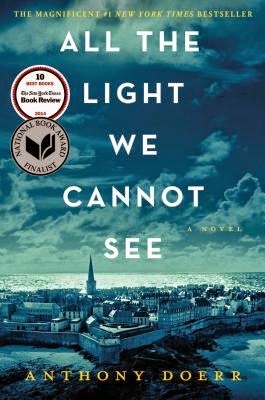
All the Light We Cannot See

by Anthony Doerr
First sentence: “At dusk they pour from the sky.”
Support your local independent bookstore: buy it there!
Content: There is some graphic (read: Nazi) violence and about a half-dozen f-bombs. It’s not a difficult read, even for it’s length, and if there’s a teen interested in WWII, it would be a good one to give. It’s in the adult fiction section of the bookstore.

I’ve kind of been avoiding this one. It was a slow build, but eventually EVERYONE was reading this. And we all know how much I love reading books that everyone is reading. (Not.) At least when it comes to adult books, anyway. I just don’t trust Everyone. (No interest in Gone Girl. Or The Girl on the Train. At. All.)

But this was picked for my in-person book group, and so I was kind of obligated to read it. I didn’t go in expecting much of anything, so I was pleasantly surprised when the chapters were short. And the story was engaging. And that the 500+ page book wasn’t one that was going to bog me down.

In fact, if I dare say this: I enjoyed it. Immensely.

This is, at its simplest, the story of two kids, a blind French girl and an orphan German boy, during World War II. Werner, the boy, is an orphan resigned to growing up in this mining town, working the mines, even though he’s a technical genius. Then, he gets drafted into the German Army, which in 1939 isn’t the happiest place. Marie-Laure is a French girl, living in Paris, with her father who works at the Museum of Natural History. When the Germans invade, they end up in Saint-Malo with Marie-Laure’s great-uncle Etienne. Then her father gets called back to Paris and goes “missing”. Their stories meet, finally, in August 1944, when the town of Saint-Malo is set on fire.

The story, however, is immaterial in this book. No, what’s important, I think are the characters. They way they interconnect with each other, with themselves. And the little acts of goodness — of light — that thread throughout the book. It’s a very dark time, World War II, but this is an incredibly hopeful book. Its short chapters are lyrical and evocative, and the suspense building up to August 1944 — every section or so, Doerr gives us a glimpse of what is happening — is palpable.

My only real complaint is that I could have done without the two epilogues, one in 1974 and the other in 2014. I felt no need to know what the characters were up to after the story ended, and it felt forced and not nearly as emotional as the rest of the book. But that’s a small complaint in the wake of the story.

Trigger Warning

by Neil Gaiman
First sentence: “There are things that upset us.”
Support your local independent bookstore: buy it there!
Review copy snagged from the ARC shelves at my place of employment.
Content: This collection is fairly tame, ranging from simpler stories to more complex ones. I’d give it to anyone who has the attention span long enough to get through the stories and who likes short works of speculative fiction. It’s in the science fiction/fantasy section of the bookstore.

I like Neil Gaiman’s writing. I do. I even actually think I like his short stories better than his longer works of fiction. But I think what I like best is listening to the audio of him reading his work. It’s only then that I feel I “get” what he’s trying to say.

Which means, that while I enjoyed this work of short fiction — and I did love some of the stories immensely. Namely, “The Thing about Cassandra” and “The Truth Is a Cave in the Black Mountains” and “A Calendar of Tales” (September fits me quite nicely) and “The Sleeper and the Spindle”. All were elegant and lovely and charming and thoroughly enjoyable.

But there was something missing. And, thinking back on it, that something was Gaiman reading his own stories, enrapturing me with his interpretation of the written word.

Perhaps, then my enjoyment would have crossed over into love.

Audiobook: Funny Girl

by Nick Hornby
Read by Emma Fielding
Support your local independent bookstore: buy it there!
Content: Aside from the dozen f-bombs (entirely from 2 characters), this one is relatively tame. And because it deals with a character in her early 20s, it probably will have some good teen crossover. It’s in the adult fiction section of the library.

Several things conspired to actually get me to read an adult book (shock!). One, I had just finished my previous audiobook and was looking for something new. Two, the Pop Culture Happy Hour podcast (which I have come to love) announced that they were doing a book group discussion of this one in March. And three, I figured I should read Nick Hornby sometime, and this seemed like a good place to start.

It’s 1964, and Barbara Parker is looking at a bleak future. Sure, she just won the Miss Blackpool title but she wants MORE out of life. She wants to be like her heroine, Lucille Ball. So she returns the title, and takes off for the big city, hoping for her break. And, after some bad scrapes and name change — she’s Sophie Straw now — it eventually comes in the form of a BBC TV sitcom, Barbara [and Jim]. She becomes famous, with all the strings that are attached to that, as well as the ups and downs.

On the one hand, I have to admit that I found this a very male-centric, sexist, chauvinistic book. Barbara/Sophie is reduced to her looks (blonde, curvy, busty), as are all of the women in the book. The men drive the action, and Sophie is just reacting to them, much of the time. It’s also incredibly homophobic, even though one of the characters — Bill, a writer on the series — is definitely gay, and another — Tony, Bill’s writing partner — is probably bisexual. This really bothered me, until I realized that Hornby was being true to the time period. The 1960s, especially the mid-1960s when it’s set, was incredibly sexist and homophobic. This proved true by the end of the book, when the characters (and Hornby) were much less annoying.

I also felt like it went on too long, especially the ending. I didn’t really feel a need for the huge epilogue-y ending chapters; I felt the book could have ended when the series ended, and I wouldn’t have missed a whole lot.

That said, I did find it entertaining. I wonder if that had a lot to do with Fielding’s narration. She was a brilliant narrator, working in regional accents and speech affectations so I could get a sense not only of who was speaking but of their character. Sophie’s Blackpool accent, especially, endeared me to her in a way I don’t think would have come through on the page. And it was sometimes laugh-aloud funny. Not consistently, and not enough, but it was there.

I’m not sure I liked it enough to read another Hornby (unless there’s one that you strongly recommend?) but it wasn’t an unpleasant experience either.

The Calligrapher’s Daughter

by Eugenia Kim
First sentence: “I learned I had no name on the same day I learned fear.”
Support your local independent bookstore: buy it there!
Content: It’s pretty long and involved, and some off-screen sex (both married and extra-marital). It’d be in the adult section of the bookstore.

Najin Han was born in 1910, soon after the Japanese invasion (I suppose) of Korea.The daughter of a talented calligrapher, she was supposed to be raised in the traditional manner: to be a servant to men, without the education or opportunities men have.

But, because her mother was Christian, and because Najin was curious, she ended up having more opportunities than she “should” have. She went to school, learned both English and Japanese.She spent time in the exiled court (thanks to some terrific maneuvering from her mother and a well-placed aunt). She got trained to be a teacher and a midwife. So when her husband — an arranged marriage, of course — goes to America for theological training and she gets stuck in Korea, she has Options.

Based on her parent’s lives, Kim writes a fascinating story about life in early-20th century Korea. There was much I didn’t know, from the way the Japanese took over the Korean culture, trying to suppress it to the fact that Christianity was in Korea fairly early on.

I enjoyed reading this one, though there were times that I skimmed — I didn’t care when Kim switched into other points of view; Najin’s story was the one I was most interested in — but for the most part I found this to be a fascinating portrait of a country and time we don’t hear much about.

The Bishop’s Wife

by Mette Ivie Harrison
First sentence: “Mormon bishop’s wife isn’t an official calling.”
Support your local independent bookstore: buy it there!
Review copy snagged from the ARC shelves at my place of employment.
Content: There’s a few instances of mild swearing, but it is a murder mystery, and there are some pretty adult situations at the end of the book. It’s in the mystery section of the bookstore.

When this one came into the store, I knew I needed to read it. First, because I have enjoyed Harrison’s fantasies in the past, but mostly because, as the bookstore’s resident Mormon, I was interested in seeing what this one was about.

It’s published by Soho Crime, a division of Penguin/Random House, and it’s being touted as a mystery. Which, on one level, it is.

Our main character is Linda Wallheim, the wife of a bishop of a small Draper, Utah, ward. Her children are mostly grown and gone; her last boy is a senior in high school. She still hasn’t gone back to work, and so one of the tasks her husband gives her is to go visit people he feels need extra help and care. That’s how Linda gets mixed up in not one, but two tricky situations in the ward. One is the disappearance of a woman who left behind a husband and a 5-year-old girl. This is the really messy one, that doesn’t end well at all. The other is support to a woman whose husband is dying, and whose first wife died in what turns out to be a long-hidde murder. Linda is over her head, true, but she perseveres, and manages to solve both.

That’s the simple explanation. But, as mysteries go, this one is pretty pedestrian. I went through a couple of suspects before I settled in on who eventually committed the murder. And so, at the end, I wasn’t surprised, but that’s okay. See, for me, this book was a lot less about the murder and a lot more about Harrison’s portrayal of Mormon women.

Perhaps it’s because I’m the right age, the right target audience, the right sensibilities, but I was thoroughly drawn in by Harrison’s portrait of all the varying opinions, ideas, thoughts, and beliefs of members of the church. She shows that there are good people who are doing good things there are crazy people doing crazy things, there are dangerous people doing evil things. There are people who believe strongly, there are people who are questioning but still want to believe, there are people who don’t believe any more. Harrison also does a fantastic job of putting our religion (she’s LDS too, obviously) out there in a way that’s accessible to people who aren’t familiar with our faith. She’s most interested in the roles women play in the church, and in each other’s lives, and that’s what spoke the most to me.

I’m not quite sure who else would enjoy the book, though,. I tweeted Harrison when I finished, and she admitted she’s been getting a lot of flack for the book, which (unfortunately) doesn’t surprise me. But, I do hope this book finds readers and creates discussion.

Because it’s worth thinking about.

Fables for Our Time

by James Thurber
First sentence: “Once upon a Sunday there was a city mouse who went to visit a country mouse.”
Content: There’s nothing overt, and no swearing. It’d probably end up in the poetry section of the bookstore.

I think I’ve vaguely heard of Thurber before this book was picked for my in-person book group. But I’d never really paid him much attention. So I didn’t really have any expectations going into this.

It’s a series of short fables followed by illustrated poems (the poems are by other people). Pretty simple, right? The fables are pretty standard: animals doing human-like things. But the twist was that they had pretty… unusual… morals.

Things like “It’s not so easy to fool little girls nowadays as it used to be.”

And: “Early to rise and early to bed makes a male healthy and wealthy and dead.”

And: “Never allow a nervous female to have access to a pistol, no matter what you’re wearing.”

And: “The male was made to lie and roam, but woman’s place is in the home.” (The title of that one was “The Stork Who Married a Dumb Wife.”)

And at that point, I decided that Thurber — no matter what time period he’s writing in (the 1930s) is horribly sexist and doesn’t deserve to be read.

That’s a bit harsh. I get that these are satire (which I have a hard time with, anyway), and that they’re supposed to be stereotypes. But STILL. I was more impatient than amused. Stop it already with the sexist crap.

Dear Committee Members

by Julie Schumacher
First sentence: “Dear committee members, Over the past twenty-odd years I’ve recommended god only knows how many talented candidates for the Bentham January residency — that enviable literary oasis in the woods south of Skowhegan: the solitude, the pristine cabins, the artistic camaraderie, and those exquisite hand-delivered satchels of apples and cheese…”
Support your local independent bookstore: buy it there!
Content: It’s very much an adult book in sensibility; not to mention about a half-dozen f-bombs dropped in frustration throughout the novel. It’s in the adult fiction section of the bookstore.

This one has been on my radar for a while; I even was given an ARC by the publishing rep when they came to talk about the lineup a long while back. I just didn’t get around to it until my book group foist it upon me, saying the same thing everyone else did: It’s hilarious. You’ll love it.

It’s the story of Jay Fitger, a tenured English professor at a small liberal-arts college in the Midwest, told entirely through his letters of recommendation (and other letters) for various people. At the outset, it’s a brilliant work of fiction: you get a thorough sense of Jay and the kind of professor (and person!) he is through the letters. Also, you get a sense of not just the passing of time, but also the kind of responses he’s getting, without seeing those. These are entirely one-sided letters, and yet I felt like I got a complete picture of everyone in Jay’s life, from his ex-wife and ex-girlfriend (both on campus) to the woman he had an affair with and modeled a despicable character in one of his (bad) novels after. I knew these people (at least on the surface) from the way Jay wrote to them (and about them) in his letters.

But that wasn’t enough for me to love this one. No, I didn’t find it funny because it hit too close to home; my husband is a professor in a small department in a struggling liberal arts college in the Midwest, and the things Jay was dealing with were just too familiar to be funny. In fact, I think this book is funnier the further away from academia you are. (Or at least the English department; the person who chose the book is a biochemistry professor.) But for those of us in the humanities, or at struggling small colleges, it’s just not funny. It’s Truth. And, at least for me right now, Truth wasn’t what I wanted to read.

The Bridge of San Luis Rey

by Thornton Wilder
First sentence: “On Friday noon, July the twentieth, 1714, the finest bridge in all Peru broke and precipitated five travelers into the gulf below.”
Support your local independent bookstore: buy it there!
Content: There’s really nothing, but because it’s a classic, it would be in the adult fiction section of the bookstore.

For my in-person last month, we wanted to read a classic. We looked at this huge long list of modern-day American classics some guy put up (I can’t remember right now who it was or why), and chose this one (mostly because it was the shortest). I know very little about Thornton Wilder; I’ve seen Our Town a couple of times (and never really “got” it) but that was the extent of my knowledge.

This story is a short one, a series of short vignettes about five people who died in a (fictional) bridge collapse in Lima, Peru in 1714. They were loosely interconnected, and the framework is about this monk who spent time researching their stories. I think it was supposed to be about the randomness of life and death, that both good and people can die at any moment and how it really doesn’t matter how you live your life.

Whatever.

Seriously. That’s how I ended up feeling at the end. I read the words, but none of them registered in my brain. I didn’t connect with any of the characters, the plot was nonexistent. I do have to admit that it may have been me (why else would it be on all the “you must read” lists?), because this isn’t the first book lately that I’ve gone “huh?” when I’ve finished. Slumps will do that to you.

Or maybe it’s the book. Either way, I finished it, but that’s about all I can say.

Raging Heat

by Richard Castle
First sentence: “Nikki Heat wondered if her mother hadn’t been murdered what her life would have been.”
Support your local independent bookstore: buy it there!
Others in the series: Heat Wave, Naked Heat, Heat Rises, Frozen Heat, Deadly Heat
Content: These aren’t for the younger fans of the TV show. Grisly murders (though not terribly descriptive), off-screen sex, and lots of f-bombs puts it squarely in the adult mystery section at the bookstore.

I don’t know if I have anything new to say. I still enjoy these books for their own sake; although this one had highlights from both season 5 AND 6, it’s really it’s own beast. The mystery had me guessing, as Heat and Rook wandered the streets of New York and Long Island looking for the murderer of a Haitian immigrant. It was a pretty messy mystery, with lots of characters involved (both on the murdered end — there ended up being 4 or 5, I think — and as the murderers) and while I probably could have figured it out, I didn’t. I just sat back and thoroughly enjoyed the twists and turns.

I also enjoyed the tension between Rook and Heat as they tried to balance life, work, and romance. If you follow the show, you’ll figure out where the book character’s relationship is going, but it’s a satisfyingly bumpy ride. (I especially enjoyed it when Heat lost her cool and dumped a bottle of Tequlia in Rook’s lap. He really did deserve it.)

All I can say is I’m glad the show’s back on, so I can get a preview of the next book.

A Beautiful Blue Death

by Charles Finch
First sentence: “The fateful note came just as Lenox was settling into his armchair after a long, tiresome day in the city.”
Support your local independent bookstore: buy it there!
Content: It’s actually quite tame, and not at all difficult to read. It’s in the mystery section at the bookstore, but it’d be good to give to a teen who really likes Sherlock Holmes.

It’s 1865, London, and Charles Lenox is one of those aristocratic men who like dabbling in things. He’s mainly a collector of maps and a bit of an explorer, but his hobby (and possibly passion) is being a detective. And, because it’s that sort of book, he’s much better at it than the bumbling, arrogant, unobservant Exeter, a member of the Scotland Yard.

Sounding familiar? It should. because Charles Lenox is just a much nicer Sherlock Holmes.

The murder in question is that of Prudence Shaw, a former maid of Lenox’s next-door neighbor and BFF, Lady Jane Grey. Scotland Yard (and her current employer) are calling it a suicide, but Lenox knows differently. She’s been poisoned by a rare (and expensive) poison called bella indigo. The question is: who did it, and why. (Well, duh. Isn’t that always the question?)

I thoroughly liked Lenox; as a character, he was charming and intelligent and just a pleasure to be around. I really liked his relationship with Jane, how it wasn’t a romance, but a real honest-to-goodness friendship. What I lost patience with, however, was the mystery. While I didn’t figure it out (I’m not good at those things), I wasn’t surprised at the end (which is probably a good thing). But, by the end, I had lost interest in the whole murder thing. And then it went on for several chapters after the final reveal, chapters I ended up skipping.

It wasn’t a bad mystery, just not one I was super enthused about. Liking Lenox as a Sherlock Holmes knock-off wasn’t enough to make me enthused.