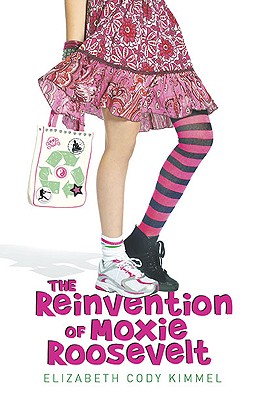
 by Elizabeth Cody Kimmel
ages: 11+
First sentence: “What goes through people’s heads when they come up with names for their kids?”
Support your local independent bookstore: buy it there!
Moxie Roosevelt Kipper has spent the first 13 years of her life regretting her name. It’s such a big name to live up to, and she’s not been exactly anything more than ordinary in her small town. Now, going in to eighth grade (her small town school doesn’t go past seventh), she’s been accepted into a boarding school on a music scholarship, and she has a chance to become different.
To reinvent herself.
She goes about this by deciding, in some hilarious turns, to put on different personalities depending on the situation she’s in or person she’s with. This, predictably, causes problems: can you be a Detached, Unique, Coolly Knowing Individual (code name: DUCKI) with your uber-hip roommate, and a Mother Earth Goddess (code name: MEG) with the Buddhist ashram-raised girl across the hall and make it all work? Well, of course not. And things get sticky for Moxie before she figures out what she really wants to be.
It’s a cute book, if a bit precious with the whole boarding school setting. It taps into the insecurities of every tween/pre-teen/teen girl: how can I get people to like me? And what is my personality, really? And is it okay if I’m not just like everyone else? It’s a bit over-the-top with the lying and experimenting, but mostly with humorous results.
And in the end, it gets its point across: being yourself is just fine.
(Just for the record: because this is a Cybils nominee, I’ve been asked to make sure y’all know this is my opinion only, and not that of the panel.)