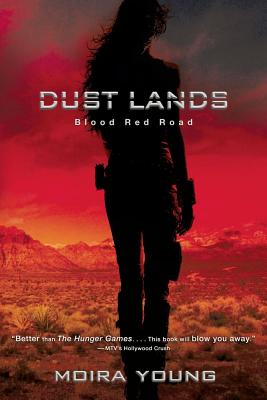
Blood Red Road

by Moira Young
ages: 15+
First sentence: “Lugh got born first.”
Support your local independent bookstore: buy it there!

This one took a while for me to get into. In fact, I read the first quarter, then put it down for a good week before picking it up again (and then, only because I didn’t want to return it to the library unread — since I had already started it — and I couldn’t renew it). But, once I got halfway through, I was in, hook, line and sinker.

It’s the future, and because of some undetermined event, the world as we know it has dissolved into chaos. Saba and her family, twin brother Lugh and little sister Emmi along with their father, live out in the middle of nowhere, going nowhere, basically existing. That is, until four men come and forcibly take Lugh away. Well, that doesn’t sit well with Saba, so after her father dies (which is pretty much right away), she takes Emmi and heads off to get Lugh back. Actually, she tries on several occasions to ditch Emmi, but the little girl is tough and won’t be left behind.

The world they discover is not a happy place. They spend a month in Hopetown where Saba is a cage fighter (which is as grim as it sounds), before they manage to escape. From there they have to make it to the hidden valley in the mountains where the king (who is certifiably insane) has Lugh hostage, preparing to kill him as a human sacrifice on midsummer day. Which, by this point, is right around the corner.

It’s a tough book to get into — there are no quotations marks, and it’s written in dialect, which always throws me for a loop — but I have to admit that Young knows how to write action (there are many intense moments) as well as romance (seriously). She’s given us a strong reluctant heroine, someone who leads without knowing it, inspiring greatness in both herself and those around her.

All of which makes me curious to see where Young is going to go in the next book.

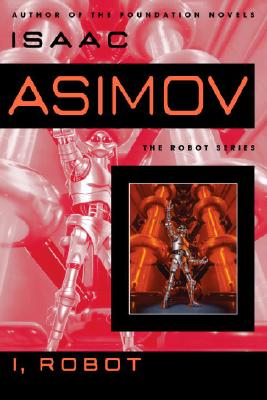
I, Robot

by Isaac Asimov
ages: adult (ish)
First sentence: “I looked at my notes and I didn’t like them.”
Support your local independent bookstore: buy it there!

This is one of those books that I’ve always heard of but never had gotten around to reading. I can’t really tell you why; it just never seemed like something I’d be interested in.

Thank heavens for book groups.

Framed as an interview with retiring robopsychologist, Dr. Susan Calvin, it’s a series of interconnected short stories detailing the evolution of robotics in the “future”. It’s an interesting look into what Asimov thought our future would be like, and the prevalence of robots in society.

I’m not quite sure what to say about the book other than I really, really liked it I thought it was fascinating to read about what Asimov though the future would be like. I liked the character of Dr. Calvin; she was an interesting person to frame the book around, smart and capable (if a bit cold), and gave the book a good grounding. In fact, the stories went down better for me than short stories usually do, mostly because they seemed like chapters in something larger.

That said, two of my favorite stories were “Liar”, in which a mind-reading robot just tells humans what they want to hear; and “Little Lost Robot,” in which a robot goes missing, hiding in the midst of a bunch of other robots that look exactly like it. I found it fascinating the things the psychologists and scientists go through to figure out which one is the missing robot.

But my favorite was one near the end, “Evidence,” where a man is running for mayor of the region, but there are allegations against him: he’s a robot. The point is to prove he’s not. It’s a fascinating look at the line between robotics and humanity, and the issues about whether or not it’s ethical for a robot to actually “act” human.

It’s a good work, one that stands up to the test of time, even if there were moments when I cringed at the 1950s-ness of it all. Even so, I’m glad I had the chance (finally!) to read it.

Hex Hall

by Rachel Hawkins
ages: 12+
First sentence: “Felicia Miller was crying in the bathroom.”
Support your local independent bookstore: buy it there!

Back in the fall, I was invited by the lovely Laura at A Jane of All Reads to participate in a book group. We read YA books, snark quite a bit, and then post about it on our blogs (so you all can be jealous?).

This month was mine to be Keeper of the Book, and the one out of my nominations that was chosen was the “smart magical nonsense” of Hex Hall.

So: the basic plot for those of you with your heads under rocks…. Sophie Mercer is a witch. She’s been raised for the past 16 years by her human mom, but after a prom night gone bad (don’t ask), she’s shipped off to juvie for Prodigium (that is: fairies, witches and shapeshifters): boarding school Hex Hall. There, she makes a best friend in Jenna, her pink-loving vampire roommate; develops a wild crush on the hottest warlock on campus, Archer Cross; makes enemies of the only other dark witches (read: the popular girls); and eventually crosses paths with a demon. Part boarding school story, part teen crush, part mystery, and all sorts of awesomeness, Hex Hall is quite the fun read.

This is what the three of us who read it (and Demonglass and Spell Bound) had to say about it (spoilers, obviously, ahead):

Me: So… I’ve finished both Hex Hall and Demon Glass, and I’m trying to figure out a way to get Spell Bound without having to buy it (if I can find one of the two copies we’re supposed to have it at work, I’m going to check it out there). So, if y’all want to start discussing any (or all?) of the trilogy, be my guests. 🙂

Sya: I have it on my kindle and plan on reading it before the hex hall discussion.

Donna: I’m almost done with mine. I’m ambivalent. I’m entertained but I’m not blown away by it or anything…. Just finished and read the teaser for the next book. If there’s more Cal, I may read on. He’s awesome. Overall the whole book reminded me a bit of Mari Mancusi’s titles in tone and voice but not as satirical. Entertaining but still not blown away. Did like the ending though.

Sya: I think that that’s kind of the point – it’s solidly entertaining without being even remotely challenging. And yes, there’s quite a lot more Cal in book two and he’s particularly swoonsome on a regular basis.

Me: I agree with Sya: it’s good, fluffy, magical chick-lit. I don’t think it’s supposed to blow you away. And I agree, too, Donna: the ending was quite good. Did you see any of it coming? Also: what think ye about the love triangle nonsense (it develops more in book 2)?

Sya: I think the love triangle is a bit of a non starter… It’s not been played up as that much of a plot point as far as I can see (I’ve just started the third book) so far.

Melissa: Oh, good. Actually, I was worried about that (in the third book); I didn’t want it to become your typical YA-we-can’t-just-have-one-love-interest thing.

Sya: I really am right at the beginning of the third one so out could come into play. Will keep you posted.

Me: Thanks! (I really do need to get my hands on that one…) I have higher hopes than mediocre YA tropes for it.

Donna: I saw the big baddie ending up being someone close to Sophie. I just didn’t have it pinned down as who. As for Alice, she didn’t sit right although I didn’t see the entire thing coming. It’s not too often I see something coming full force. When I do then it’s really bad! I didn’t even realize there was a love triangle, unless you count Elodie-Sophie-Archer. And I found it slightly hypocritical of Archer to rank on Sophie’s name for the ‘ie’ when he’s dating the Cliff Notes version of Melodie.

Sya: I kind of figured that Alice didn’t have the best of intentions but I was still taken aback by the ending and liked the way it set things up for book two. On the love triangle front, it’s a bit more prevalent in the third book but still in a sort of background way and doesn’t detract from the rather exciting and sinister story.

Me: Donna: “And I found it slightly hypocritical of Archer to rank on Sophie’s name for the ‘ie’ when he’s dating the Cliff Notes version of Melodie.” HA! I totally agree. Sya: Rather exciting and sinister??? I need to find that one.

Sya: I just finished it. I thought it was completely awesome – such a lot of fun and actually even a wee bit moving in places. Great way to end the series.

We kind of got off-topic there. Back to Hex Hall…

Sya: I’m not quite sure what thread I should be posting my Hex Hall thoughts so I’m jumping in here. I thought the book was great. I read it for the second time for this discussion and followed it up with the second and third in the series. And I really enjoyed the whole lot. Sophie is a fun and believable protagonist, pleasingly flawed and endlessly entertaining. The mean girls are particularly fun to read and Archer is a bonafide hottie – played by Ethan Peck in my head (also, Sophie’s dad? Totally Richard Armitage. Obvs). Cal is also rather scrummy and I actually really liked his character arc as the trilogy continued. In fact, I was pleased that in a trilogy that is essentially light reading the characters really did display some depth. The plot itself kept me reading and while I could see that Alice wasn’t all she seemed, I didn’t really see the whole demon-family thing coming. The writing was fluid and pleasingly visual – I had a really good sense of what Hex Hall looked like – and all in all I’d recommend these books. Will be interested to see what Rachel Hawkins comes up with next.

Me: I agree about the depth of the characters. In my mind, these are a lot like Ally Carter’s books: a lot of fun, but smart, engaging fun. Entertaining, without making you feel guilty. And proof that brain-candy doesn’t have to be written badly, or just hit the same note over and over and over again. I also like that it’s basically clean, geared toward the age group, without pandering and talking down.

Donna: I grew a little tired of Carter’s Gallagher girls books but that quirk kind of wore off. I’d have to keep reading the HEX HALL series to see if I’d feel the same way but since I’m more amenable to this Mancusi-ish quirk it might have more staying power for me. The GG series kind if got away from me and went a little too quirky.

Me: Mancusi-ish quirk”??? And I wasn’t thinking so much Gallagher girls as Heist Society, which I like better, anyway. (*sigh* Hale. *swoon*)

Donna: Mancusi is really over the top but in a way it’s really palatable for me. It’s probably totally personal as she and I share a Lost Boys love and she satirizes current camps to no end so the joke ran longer for me. Haven’t read Heist Society and I think I got to book 2 in GG before I didn’t feel much of a need to keep reading. I may have read three.

And that ends our discussion… we get a little scatterbrained when talking, no? Have you read Hex Hall (or any of the sequels — my reviews coming next week)? What did you think?

(Participants in this discussion: Sya @ The Mountains of Instead and Donna @ Bites)

Rules of Civility

by Amor Towles
ages: adult
First sentence: “On the night of October 4th, 1966, Val and I, both in late middle age, attended the opening of Many Are Called at the Museum of Modern Art — the first exhibit of the portraits taken by Walker Evans in the late 1930s on the New York City subways with a hidden camera.”
Support your local independent bookstore: buy it there!

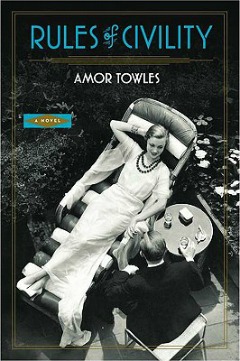
The thing that first drew me to this book (aside from the catchy cover), was that someone at work called it “Gatsby-esque.” Adoring all things Gatsby, I figured that I would (eventually) need/want to read this one. So, when it came through at the library, I snatched it, hoping to be thoroughly engrossed by it.

And I was. Sort of.

The setting is New York City, 1938. Our main character, Kate Kontent (the emphasis is on the second syllable), is a working girl from Brighton, trying to make ends meet. She rooms at a boarding house and there makes friends with Eve Ross, who has slightly higher ambitions. They’re out for a night on the town, when they meet — almost by accident — Tinker Grey: young, handsome, rich, suave. They both pounce, grasping at the chance to get out of the dead-end they’re in.

The book follows Kate’s year: one in which, either directly or indirectly because of Tinker, she gets a new (and better) job, dates a couple of rich socialites (while all the while pining, deep down, for Tinker), and watches as Eve managed to nab Tinker and swing into his lifestyle with ease. It’s a remarkable year, if only for the changes, and revelations it brings in Kate’s life.

It’s Gatsby-esque for the time period (roughly) and the love of jazz (again, roughly), but it’s missing all the other things — regret and fate as well as Gatsby’s elusiveness — that makes The Great Gatsby great. But, even though the characters are rich and reckless, with their lives and their money, there lacks a certain gravitas about it that would help give it a center. Perhaps it’s because Kate is really the least interesting person in the book: Tinker, Eve, and eventually her friends Wallace and Bitsy are all far more elegant and interesting. Once in a while Kate shows some class — like her love of books, and their organization system — but it wasn’t enough for me to truly care about the ups and downs of her year. And the end, the final twist and reveal, fell flat as well.  Perhaps it was because by that point, I was really quite past caring.

I make it sound worse than it was; there was enough to keep me going, since I actually did finish the book. But, it’s not enough to make me love it.

Two for the Circular File

Huntress
by Malinda Lo
ages: 15+
First sentence: “She saw a beach made of ice, and she felt her heart breaking.”
Others in the series: Ash

I really enjoyed Ash, and so I was quite looking forward to this prequel, of sorts. Set in the same world, but centuries before, it’s the story of two girls, a warrior and a seer, who are chosen to go on a mission to the fairy realm. I really don’t know much more than that, because I bailed about 100 pages in. It wasn’t the characters; I found Kaede, the warrior, to be fascinating, though Taisin, the seer, was a bit cloying. It wasn’t their gayness; it’s so matter-of-fact that it wasn’t even an issue, really. I’m thinking it was something about the pacing: it was taking so long for the story to get started that I lost interest before it even began. It was all language and no plot, and I decided that I had better things to read with my time.

The Final Four
by Paul Volponi
ages: 13+
First sentence: “Just because the game clock has stopped, don’t believe for a single second that the hearts of the ten basketball players on the court have quit pounding.”
Review copy provided by the publisher.

This one was easy to pinpoint why I didn’t finish it: I didn’t like the format of the book. The story is of four basketball players: two from each team, Michigan State and Troy University (ha, the Spartans vs. the Trojans), that have made it to the NCAA final round. It alternates between the actual game, and the histories of the four players, as well as the paths they took to get there. But it’s not a straight-forward story: there are TV broadcast transcriptions, newspaper articles, journal entries. I think for some people, this would enhance the reading experience. But for me, I found it distracting, and the whole arc of the story hard to follow. Chalk this one up to being the wrong audience for the book.

Audiobook: Castle in the Air

by Diana Wynne Jones
Read by Jenny Sterlin
ages: 12+

Support your local independent bookstore: buy it there!
Others in the series: Howl’s Moving Castle

Abdullah is a mediocre carpet merchant in Zanzib, living a terribly boring life. Sure, his daydreams are exciting, full of princesses and beautiful gardens, but his life? It’s just selling carpets and dealing with his father’s first wife’s relations. That is, until a stranger comes by and sells Abdullah a magic carpet.

The first night he has it, he goes to sleep on it and wakes up in the garden of Flower-in-the-Night, a smart, yet naive (and very sequestered) princess. Abdullah, of course, falls instantly in love. Everything was supposed to be happily ever after, but a powerful djinn kidnaps Flower-in-the-Night, and Abdullah’s life suddenly gets more complicated. There’s a cranky genie, a trip to Ingary, falling in with a bitter Strangian soldier, and finally, a castle in the air where Abdullah has to save 30 princesses from their fate of being brides of an evil djinn.

It’s the perfect kind of fairy tale (which is, of course, what DWJ is known for): romance, adventure, humor, magic; sweeping grand panoramas that captivate you fully. No, Howl and Sophie aren’t in this one (well, hardly at all), but that’s really just fine: Abdullah, the pompous flatterer and coward that he is, made up for that. I was constantly rolling my eyes at him — the way that Sterlin made him sound was quite grating at first — but that didn’t mean I didn’t like him. On the contrary, he was quite enjoyable to go on an adventure with, even if he was lovesick and heartily silly.

Sterlin (aside from the grating-at-first Abdullah) was a stellar reader, doing voices for all the different characters and keeping me entertained throughout the story. I’m glad I picked this one as an audiobook; it was definitely an enjoyable way to spend a commute.

Before I Fall

by Lauren Oliver
ages: 14+
First sentence: “They say that just before you die your whole life flashes before your eyes, but that’s not how it happened for me.”
Support your local independent bookstore: buy it there!

Samantha (Sam to her friends) Kingston has it all: popularity, three best friends, a hot boyfriend. Not bad for a senior at Thomas Jefferson High. Then one night, everything goes wrong and she’s killed in a car accident. (Trust me: that’s not a spoiler.) Then she’s given the Groundhog Day treatment (to Oliver’s credit, she tipped her hat in that direction with a mention), and forced to live the last day of her life over (seven times), until she gets it “right”.

I’ll get straight to it, since most of you have already read this one: I hated Sam. I hated her friends. I hated her boyfriend. And yet, I couldn’t put the book down. I think we’re supposed to hate Sam at the beginning (while I never really liked her, I didn’t hate her as much by the end), we’re not supposed to like the person she is or the choices she’s making. Because, honestly: she and her friends were the girls I despised in high school. They were, as another character says, bitches. (Sorry. There really is no better word.) So, that I actually could tolerate Sam (though I understood her friends by the end, I didn’t like any of them, and wondered why Sam would hang out with them) is a marvel of good writing.

There’s a lot to think about in this one, too. Choices, especially in regards to friends. As M pointed out, why Sam turned her back on the nerd she was in order to be “popular.” (That’s a crime in M’s mind. I don’t blame her.) And then the progression of learning that she went through. For the record: day five was my favorite.

Was it a comfortable, happy read? No. Was it a good one? Well, surprisingly, yes. There’s a lot to think about, and while you’ll probably hate the characters too, I bet you won’t be able to put it down either.

Karma

by Cathy Ostlere
ages: 13+
First sentence: “How to begin.”
Support your local independent bookstore: buy it there!

It’s 1984 and Maya (to her mother; Jiva to her father; she’s half Hindu, half Sikh) is growing up in nowhere Manitoba. It’s not the best place; the town is small enough and isolated enough that Maya and her parents stand out.  And not in a good way. Even so, it’s “home” to Maya, even if it isn’t to her parents.

Her mother dies, and Maya and her father decide to take her ashes back (“home”) to India. They get to New Delhi just as Indira Gandhi is assassinated by her Sikh bodyguards, which sets off mass violence and murder of Sikhs. Her father, being one, finds that his life is suddenly in peril, and leaves fifteen-year-old Maya (!) in their hotel to fend for herself. This, of course, is not a good thing: the hotel is attacked, Maya sees a man murdered before her eyes, and has a complete psychological breakdown. She is thankfully rescued by a kind doctor, who ships Maya off to her family to recover. Except that doesn’t help. Not really. Except she meets Sandeep, a fellow rescue — they saved him from certain death once his parents had been killed — and somehow, he makes all the bad things she’s discovering about the country of her heritage better.

A heartbreaking novel in verse, Karma looks at difficult issues — religion-based violence, suicide, arranged marriages, preconceived notions of both women and Westerners to name a few — but does it in a way that is neither heavy-handed or preachy. As a reader, you come to care about both Maya and Sandeep — two-thirds of the book is narrated by Maya; one-third by Sandeep; both are imperfect people, and while neither sets out to make a difference in the world, they both do.

It’s an intriguing book: a haunting, lyrical story that will make you think.

The Floating Islands

by Rachel Neumeier
ages: 12+
First sentence: “Trei was fourteen the first time he saw the Floating Islands.”
Support your local independent bookstore: buy it there!

The world: a large country, Tolounn, whose only art is war. A small country, The Floating Islands, which are technically part of the Tolounn empire, but have been nominally independent for 200 years. There’s magic —  mages and dragons and flying men (called kajuraihi) — and the books goes for an ancient feel, with boats and horses, though it has steam-powered engines.

The characters: There’s Trei, half Tolunnese and half Islander, which makes him an outcast, at least in Tolounn. He relocates to the Islands after his family’s death, mostly because his father’s family won’t take him and his mother’s will. There he meets his cousin Araene, who is a brilliant chef and chafes against the really strict rules for girls: she wants to be able to follow her passions. (Who wouldn’t?) It turns out that she has an affinity for magic, and the mage school pulls her in; however, since she’s a girl it means she needs to go out as a boy. While she follows her passion, Trei follows his: to be a kajuraihi. Both of them will have roles to play in the conflict between the Islands and ; both will help determine not only their fates, but the fate of their country.

There are other minor characters, boys from the mage school and boys from the kajuraihi school, including Prince Ceirfei, a nephew to the Island king.

While it wasn’t a bad story, or even poorly written (it’s pretty good on both accounts), I really wanted this book to be more than it was. I had a hard time keeping all the characters and places and terms (*sigh* Why is it when some fantasy writers create a whole new world, they feel a need to create a new language along with it?) straight, and eventually stopped trying for pronunciations. I also expected it to be more about Trei and Araene, and their determination to make their way against all odds. Instead, it turned out to be more about the conflict between the two countries, and everything else was swept aside. So, by the end — when there were still 60 more pages to the book — it felt really anti-climatic. I wanted everything to be stronger, more forceful, more gripping. It was nice, but that’s about it. (I feel bad for saying this because it really was a nice read. Not terrific, but nice.)

So, maybe this one was just a victim of my expectations. That does happen sometimes.

Something Like Fate

by Susane Colasanti
ages: 12+
First sentence: “I never meant for it to happen like this.”
Support your local independent bookstore: buy it there!

I don’t read a lot of chick lit, really. Though I do know good YA chick lit when I see it.

This was not it.

Things against it:

The whole idea of Fate, that Two People (in this case Lani and Jason) are Supposed to Be Together in spite of everything (including the fact that Jason is dating Lani’s best friend, Erin). Ugh.

Dumping one’s girlfriend VIA LETTER (really??? People still do that??).

The stilted dialogue.

He’s like, “Whoa.”
“What?”
“That can’t be right.”
What?
“What time did you say you had to be home?”
My stomach sinks. “Eleven. Why?”
“It’s one fifteen.”
“Shut Up.”

The really lame homophobia of the school that comes out of nowhere and goes nowhere and really has no point with the rest of the book.

The bashing the pro-environment philosophy over my head. (I consider myself a bit of a tree-hugger, and I was turned off. C’mon, do it subtly!)

The incredible cattiness of Erin and the rest of the freaking school (calling her slut, her so-called close friends refusing to talk to her, creating a web site just for bashing her) after it comes out that Lani and Jason had been dating. All summer. Seriously???

The pat ending.

Bottom line: read Maureen Johnson’s books instead.