Audiobook: The Kitchen Counter Cooking School

How a Few Simple Lessons Transformed Nine Culinary Novices into Fearless Home Cooks
by Kathleen Flinn
Read by Marguerite Gavin
ages: adult
Support your local independent bookstore: buy it there!

(Also a post for Weekend Cooking.)

I adored Flinn’s first book, The Sharper Your Knife, the Less You Cry, and was quite excited to tackle her next book.

Home from Paris and Le Cordon Bleu, author Flinn is wondering what to do with her life. She really has no interest in owning a restaurant, and is getting tired of people asking her when she’s going to open one (and on a similar line, when are she and her husband going to have a baby…). Then, in a grocery store, inspiration hits: she sees a woman whose grocery cart is full of processed foods, and the reason? Because she doesn’t feel she can cook. It’s intimidating. She doesn’t know how. It’s too hard. Thus, the Project is born: Flinn finds nine volunteers all who are generally insecure about cooking, and persuades them to come in for a series of lessons on cooking basics. Flinn’s goal: to give them the skills and confidence to cook and turn away from fast food and processed food.

I’ll tell you straight up: I learned a lot from this book. A lot. And that was listening to the audio version. I need to go out and purchase the book, so I can have it as a reference in my kitchen. She really does go over all the basics: knife skills, chicken, meat, vegetables, braising, roasting, soup, salad, vinaigrette… it’s all in there. And Flinn is a good teacher. I’m sure her nine volunteers learned a lot from the classes, but she was able to convey what was taught — with a few side trips, to Rome and some fancy dinner parties to raise money — through her words in a way that engaged and interested me. I ended up thinking about this as a practical Michael Pollan: while he spouts ideals (and good ones at that), Flinn actually gives people the tools to use in putting those ideals — eating real food, cooking with real ingredients — to use.

The woman who read the book grated on me at first; she has weird pauses in the middle of sentences that bothered me. Also: listening to recipes being read aloud isn’t that great, so I ended up skipping those. Even with those shortcomings (and they’re not even Flinn’s fault), it’s the best kind of food book: useful, interesting, yummy-sounding with dozens of good recipes that are easy to use. Hopefully, it’ll do for you what it did for me: inspire you to cook.

Pride and Prejudice and Zombies

by Jane Austen and Seth Grahame-Smith
ages: adult(ish)
First sentence: “It is a truth universally acknowledged that a zombie in possession of brains must be in want of more brains.”

I avoided this book when it was all the rage a few years back for one reason: zombies. I really don’t do zombies. That, and I really like Jane Austen and I suspected that I probably wouldn’t be amenable to a mash-up of one of my favorite books.

I was right, on both counts.

For my mother-daughter book group (they’re in 6th and 7th grade), one of the girls picked the prequel to this one, Dawn of the Dreadfuls, as her book choice for this past month. (By the way, the discussion was quite good, even though no one finished it, or even liked it.) I decided here was my chance to see what everyone was talking about, and chose to read this one.

I didn’t finish it, and I didn’t like it. Partly because of the zombies, true. It’s not exactly for the squeamish. The basic plot is that of Pride and Prejudice, except the countryside is swarming in zombies, and the Bennet sisters are skilled zombie killers. They have to be in order to survive.

Which brings me to my second issue: they just smashed zombies into P&P, without a thought to characterization, plot, or even if it would work in Austen’s work. Which it doesn’t. (For me.) Adding zombies changed the characters, and instead of having charming, witty, loveable Lizzy, we’re left with this weird, strange, honor-bound, vengeance-seeking woman. Who beats Darcy up when he proposes to her. (Which is completely out of character. Even if he deserves it.)

So, while I can see the humor in it and the appeal of it, no, it didn’t work for me. Now I know.

Putting Makeup on the Fat Boy

by Bill Wright
ages: 14+
First sentence: “When I was twelve, I convinced my mother to let me do her makeup for Parents’ Night.”
Support your local independent bookstore: buy it there!

Carlos Duarte is a genius at makeup. Seriously. And he knows it. He has dreams and ambitions to be a makeup artist to the stars, and it all starts with a job at Macy’s FeatureFace makeup counter.

Granted, that doesn’t mean it’s going to be easy. He has to work part-time after school at the day care center, because his mother’s dry cleaning manager job doesn’t pull in quite enough money. His older sister, Rosalia, is dating a guy who is truly the scum of the earth. And even though Carlos is good enough (and confident enough) to get the FeatureFace job, he doesn’t count on having a manger who is a first-class jealous jerk, bent on thwarting Carlos every step of the way.

The best thing about this novel, I think, is Carlos’s resilience. In the course of the novel, he’s dumped on, picked on, loses one of his best friends (through a mistake he made), gets beaten up, deals with the pettiness of his boss, and the boy still keeps on ticking. This makes him sound like the energizer bunny, and he’s not. But, even though this boy faces more challenges than you can shake a stick at (being a gay teenin NYC isn’t the cakewalk that you would suppose it is…), he is hopeful and optimistic and confident that he can do what it takes to be successful. It was ….well…. if not inspiring, then at least affirming. And as a reader, you liked Carlos (in spite of all the makeup talk, for me, at least), and you wanted him to succeed, to find that right guy, to have that happy ending.

Wright is smart enough to not give it to us, though. While the ending isn’t quite happy, it is hopeful, which is better. It’s not all wrapped up in a nice little package; it’s messy and complicated, like life. But, mostly because of Carlos’s attitude, it’s full of a hope that he can — and will — do great things.

The Grand Plan to Fix Everything

by Uma Krishnaswami
ages 8+
First sentence: “Dolly Sing’s fabulous face floats across the screen of the TV in the family room.”
Support your local independent bookstore: buy it there!

Dini is in love with Bollywood movies. She loves the music and the scenery and the stars. Especially Dolly Singh. Even though she really loves everything about the movies, they are just that, movies: fictional, far away in India, which is a place to visit not to stay.

Then her mom tells her that they will be moving to a village in India, Swapnagiri. For two whole years. It’s traumatic! How can Dini leave her best friend, Maddie? How can she adapt to living in a small village instead of big Tacoma Park, Maryland? How can she make new friends? And she doesn’t even have a chance of meeting Dolly because Swapnagiri isn’t anywhere near the Bollywood capital of Mumbai.

And yet, almost like a Bollywood film, things seem to work out. There’s a girl close to Dini’s age that may be an okay friend — though Dini would never, ever forget Maddie. There seems to be some sort of Bollywood magic at work when they find out that Dolly is actually staying in Swapnagiri. And, maybe, just maybe, Dini can work some magic herself and get Dolly and her estranged fiance back together again.

The key to this one, if you haven’t already noticed, is Bollywood. It really is a Bollywood movie in book form: magical, sweet, a bit of humor, with everything all nice and tidy wrapped up in a neat little bow. There are no song-and-dance numbers, but music does play a role. And Dini is our perfect Bollywood heroine: sweet, kind, and yet not quite perfect. She does mess things up, but she’s doggedly determined to make the best of things.

Cute and sweet, it’s a good one to hand to hand to girls, especially ones who are Bollywood fans.

Amelia Lost

The Life and Disappearance of Amelia Earhart
by Candace Fleming
ages: 9+
First sentence: “On the morning of July 2, 1937, the coast guard cutter Itasca drifted on the Pacific Ocean, waiting… listening…”
Support your local independent bookstore: buy it there!

Like many people, I think, what I knew about Amelia Earhart was limited to her legend: she was the first woman pilot, and her plane was lost on her attempt to fly around the world.

What I didn’t realize was how much more there was to the story.

Fleming is a brilliant non-fiction writer for kids; she keeps the information simple without being simplistic, and manages to capture the nuances of her subject without ever wandering into territory that a 9-year-old couldn’t comprehend.

Which means that this book was absolutely fascinating. The chapters alternated between Amelia’s past and that fateful day when her plane was lost. Fleming really did her research, pushing past the legend and the fame to come up with a different portrait of Amelia Earhart. One of the things that most fascinated me was how, well, unqualified she was. She flew not really because of skill — often she didn’t take the time to learn things thoroughly — but because of determination. She was a feminist: she believed that just because she was a woman didn’t mean she shouldn’t do whatever she wanted to do. Including flying. She resisted the boxes that the time period wanted to put her in, and literally soared. No, she wasn’t the most talented, or even the most skilled, but she was determined, and that made up for a lot.

The other thing that fascinated me was how much she was famous for just being famous. She and her eventual husband, George Putnam, worked really hard at keeping her name in the papers, keeping her on the lecture circuit. Being famous was a full time job for them. I also didn’t realize how much of her image was done on purpose to create her image. She hid many things, and re-imagined others. I guess it goes to show that nothing is ever quite what it seems.

An excellent introduction to the life and legend of Amelia Earhart.

March Madness for Book Lovers

Forget basketball: the event of the month is SLJ’s Battle of the (Kids’) Books!

In which the past years’ best books for middle and teen readers are pitted against each other, to vie to become the Big Kahuna!

(Or you could just watch this…)

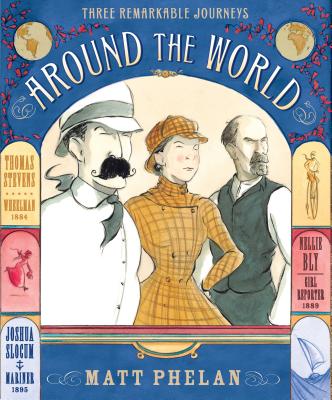
The fun starts on Tuesday with Match 1: Amelia Lost vs. Anya’s Ghost, with Matt Phelan judging.

Who do I think will take it all?? I’m actually terrible at all this (though I do have my bracket pined up and ready for filling in — with my choices circled), but I’m rooting for Daughter of Smoke and Bone (go Laini!), with Okay for Now as a close second. The best part, however (and the reason this is so much fun), is reading the judges opinions.

And just because I love this, I’ll be back with wrap-ups every Sunday for the next few weeks… (I hope!)

A Discovery of Witches

by Deborah Harkness
ages: adult
First sentence: “The leather-bound volume was nothing remarkable.”
Support your local independent bookstore: buy it there!

Although I liked this one quite a bit — more than I was expecting, actually — by the end of it, I was quite torn. So, let’s just say, up front, that my enjoyment of this one was tempered by some hangups.

The good:
I loved the world that Harkness created. It’s basically our world, except it’s inhabited by vampires, witches, and daemons. They’re generally brilliant, generally long-lived, and generally go unnoticed by humans. Our main character, Diana, is a witch who, ever since her parents’ deaths when she was 7, has shunned her magic. She’s a historian of 17th-century science, which means she dabbles in Alchemy. She’s pretty content with her life. Until she meets Matthew. Who is a vampire.

Which brings me to good point number 2: Harkness has a debt to owe to Stephenie Meyer, but she one-ups her. Matthew is 1500 years old, which makes him incredibly fascinating. (And I suppose it’s kind of creepy that a 1500 year old would fall in love with a 37 year old?) There’s a lot of history in this book, and no accident that Diana, as a historian, is fascinated by Matthew.

The bad:
It’s still True Love, and while it’s not as stifling as Edward and Bella’s love, it’s still pretty sappy. (What is it with vampires and a reluctance to have sex?) There’s also that element of over-protectiveness that drove me batty in the Twilight series. The only difference is that Diana can — and does — hold her own as a witch, though it takes her most of the book to do so. She also struggles against Matthew’s edicts, which helps with the whole damsel-in-distress thing. That, and the fact that she’s in REAL danger as opposed to supposed danger helps temper Matthew’s irritating behavior.

The good:
The plot is intriguing and complex: there’s a lost manuscript that all the “creatures” (as they call themselves) are longing to get their hands on. But, more importantly, there’s the forbidden love (really?) between Diana and Matthew: it seems the creatures aren’t suppose to cross-mate because of an age old (like centuries) covenant that the creatures made with each other. This leads to a lot of things, the most important being an impending “war” between the creatures who are okay with Diana and Matthew’s love and those who are not.

The bad:
On some levels, the idea of anyone being able to love anyone they want is a good story. But my main complaint with this book is that it’s 576 pages, and they don’t get to the point until the last 1/4. The plot pacing is bad as well: it’ll be interesting, then Harkness will divert into pages and pages of wine, food and romancing (M contended that if she cut out all the bits about wine, she would have lost about 75 pages…), none of which had anything to do with the plot. More than once, I nearly lost patience with the book.

That said, I’m invested now, and I’m interested in where Harkness is going to go with the sequel. Hopefully, it won’t be nearly as long. (Then again, she’s a historian, so I’m not really expecting a more tightly written book. Just hoping.)

The Mighty Miss Malone

by Christopher Paul Curtis
ages: 9+
First sentence: “Once upon a time…”
Support your local independent bookstore: buy it there!

Deza Malone has a pretty good life in Gary, Indiana. She loves school, she has the best big brother in the whole world (so what if he can’t spell or write? He has the most beautiful singing voice), and her mom and dad love her to pieces.

Sure, it’s the middle of the Great Depression, and her dad is out of work, but they’re making it. It’s tough, but they’re making it.

Then her dad decides to go on a fishing trip to Lake Michigan, and everything changes. Her dad goes missing for a few days, and when he comes back, he’s different. Then, he decides that what he really needs to do is go to Flint, Michigan, to look for work. He takes off. And because families are supposed to stick together, Deza, her mother, and her brother uproot themselves from wonderful Gary and head to Flint to find him.

There are many good things about this one (there’s a reason Curtis has a Newbery and an Newbery Honor to his name), but chief among them is Deza’s voice. From the opening pages, you get a sense of this girl, and I dare you not to love her. She’s a smart girl, observant, and creative. She’s fiercely loyal to her family and her friends, and yet she can adapt and make new friends pretty easily. Sure, the book brushes on darker issues of poverty, of homelessness, of racism. (I was disappointed at how racists the Michiganders were. Seriously. What good is integrated schooling if you are just going to write off the black kids? Ah… and that’s the crux of the situation, isn’t it?) But even though it deals with some heavy issues, the book is never heavy, depressing, or down. Deza’s interminable spirit lifts the whole book and lets it soar.

Which makes it a pretty good read.

And Now… A Giveaway!!

I feel kind of silly doing this for a couple of reasons. 1) Because I haven’t read the book. Yet. And 2) Because I won the opportunity to do this from the Little, Brown Publicity department… not that there’s anything wrong with them (*waves*), it’s just that I’ve never done a publisher-sponsored giveaway before.

BUT.

I do adore Wendy Mass (*waves*), I love her writing, and I’m willing to support anything she does (within reason. I mean, if she wanted to sell my children, I may have issues with that.)

That said: I have the lovely opportunity to give away this:

and this:

Cool, no?

To enter: fill out this form anytime between now and Sunday, March 11th. I’ll have random.org select a winner and let you know. Unfortunately, it’s open to U.S. residents only.

Audiobook: The Spellman Files

by Lisa Lutz
Read by Ari Graynor
ages: adult
Support your local independent bookstore: buy it there!

I first heard about the Spellmans through Jen Robinson who blogged about them a few years ago. She mentioned that they’re for people who love quirky characters, and since I’m all for that, I stuck it on my TBR list and let it sit.

One of the things I’m doing through my audiobook listening is going back through my age-old lists and finding ones that have been sitting there forever to listen to. This one definitely qualifies.

Twenty-eight year old Isabel Spellman grew up working in her parent’s PI buisness. Which means that she’s excellent at stakeouts, can pick a lock with the best of them, and has absolutely no respect for the privacy of others (yes, she really did run a credit check on ex-boyfriend #6). However, when she meets Daniel (ex-boyfriend #9), things get a little, well, sticky. After he breaks up with her, she decides she’s had Enough. But, before she’s allowed to quit the family buisness, her parents give her a 12-year-old cold case to “solve”. And, before that’s solved, a case closer to home pops up, one that may be the most important of Isabel’s life.

Okay, that makes it sound all dark and dangerous, and honestly: it’s not. This book is mostly an introduction to the Spellmans and all their quirkiness (why, yes, Mom does hire out someone to stake out Isabel, not to mention bugging her apartment). Mom and Dad don’t really play much of a role (except as ominous yet loveable background players); the more important figures in Isabel’s life are her lawyer brother David, her Uncle Ray, and her teenage sister Rae. Between the four of them — and the back-and-forthing they do — they drive what plot there is.

And there really isn’t much of one. It didn’t seem to matter, though: I was captivated by Isabel’s voice (and Graynor’s reading of her), her observations of her ex-boyfriends, the cases, and her family. It was a lot of fun to listen to.

That said, there is one glitch: I didn’t realize until the very end (when the credits said “adapted by”) that this was an abridged novel. Nooooo! Now I’m going to have to get the book and read it: I want to know what I missed!

In spite of that, it was quite an entertaining way to spend my time.