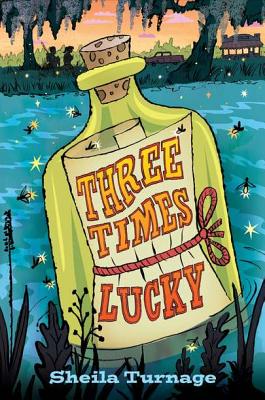
Three Times Lucky

by Shelia Turnage
ages: 9+
First sentence: “Trouble cruised into Tupelo Landing at exactly seven minutes past noon on Wednesday, the third of June, flashing a gold badge and driving a Chevy Impala the color of dirt.”
Support your local independent bookstore: buy it there!
Review copy provided by the publisher.

It was all just being in the wrong place at the wrong time. See, Mo (that’s short for Moses; and yes, she is a girl) LoBeau’s (emphasis on the second syllable because it classes it up) friend Dale (Earnheart Junior III) just wanted to borrow Mr. Jesse’s boat, and then decided to return it for a “finders fee.” It wasn’t Dale’s fault Mr. Jesse turned up dead.

Honest.

(It has occurred to me that I’ve read a number of middle grade books with dead people recently. Must be a trend…)

From there, of course, Mr. Jesse’s murder (It’s not grisly, at all. Promise.) turns the tiny, rural, North Carolina town of Tupelo Landing upside down. And Mo and Dale are smack dab in the middle of it. To clear Dale’s name, they set out trying to solve the mystery, and are thwarted at every turn by Detective Joe Starr, the adult who’s (really) working the case. Mo and Dale keep at it, though, because the whole case somehow seems to involve the Colonel and Miss Lana, the two people to whom Mo, an orphan, is closest.
Honestly: I’ve read my share of Southern novels, and so I figured it was just another run-of-the-mill, murder-mystery-light/Southern thing. But I couldn’t put it this book down. In addition to murder, this book has everything: drama, car racing, suspense, plucky kids, arch-enemies, robbery, unrequited love, and karate.  It’s everything Southern, but the pecan pie. (And I’m sure that would have shown up, had the book been set at Thanksgiving instead of during the summer.) There’s a little something for everyone here, which makes any book appealing.

But the real reason to fall in love with this book — as I did — is because Turnage has created a wonderful couple of characters in Mo (“My heart leaped like the cheerleader I will never be.”) and Dale (“Dale may not know much from the classroom, but his recess skills are legendary.”). In fact, all the characters, from Miss Lana (“I passed the wigs to Miss Lana, completing her Hollywood Through the Ages collection. Miss Lana has a flair for drama.”) and the Colonel (“Miss Lana says hugging the Colonel’s like hugging a turning plow.”), down to Mayor Little (“We always choose a Little for mayor in case a television crew ever comes to town. Littles like to talk and they’re naturally neat; even their babies dress good.”) and aspiring lawyer Skeeter (“Rumor has it she’s already written to Matchbook University for a paralegal course under an assumed name. She won’t say if that’s true or false, only that unsubstantiated rumor won’t hold up in court.”) pop off the page, and it’s entirely because of the way Turnage writes.

It’s also the small-town, rural Southern feel: kids biking everywhere, technology limited because coverage is spotty, rusted cars on lawns. It’s a place caught out of time, perfect for two kids to have the adventure of a summer. And perhaps to learn a little bit about themselves, and the meaning of family, in the process.

For us, it means an perfectly charming book. Period.

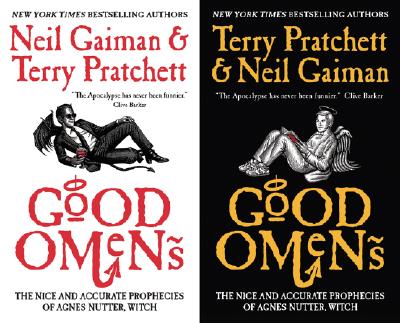
Good Omens

by Terry Pratchett and Neil Gaiman
ages: adult
First sentence: “It was a nice day.”
Support your local independent bookstore: buy it there!

This is one of those “everything but the kitchen sink” kind of books. There’s witches (who carry bread knives around for protection, because that’s the sort of witch they are) and witch hunters. Prophetesses (well, one: who wrote the Nice and Accurate Prophecies of Agnes Nutter, which is surprisingly correct) and anti-Christs (well, one. He’s eleven.). Demons and angels. Not to mention the four riders of the Apocalypse, as well as several telephone salespeople.

And all are headed toward Lower Tadfield. Because, of course, that’s where the End of the World/The Great War/Impending Doom is going to take place.

I adore Gaiman and Pratchett separately, so I figure together (and, yes, it was about time I read this book!) they’d be brilliant. And they were. So much so, that I think I missed a good 60% of the jokes. Completely. It’s not that I didn’t like the book: I did. I laughed at parts, I kept turning pages, I did love bits and pieces of it. But really (and Hubby says it’s because I haven’t seen The Omen, nor do I have plans to), I felt like I was sitting in on a conversation where I got some of what was being talked about, but was, for the most part, left completely out to pasture.

Which means, although it’s brilliant (I really did like the forward and afterward in my 2006 edition), it’s not my favorite Gaiman or Pratchett.

The Statistical Probability of Love at First Sight

by Jennifer E. Smith
ages: 13+
First sentence: “There are so many ways it could have all turned out differently.”
Support your local independent bookstore: buy it there!

Hadley Sullivan is being forced to go to her father’s second marriage. To a woman (That British Woman) she’s never met. In London. It’s not a happy idea, and when all sorts of little things go wrong, she ends up missing her flight. Which means making it to the wedding will be tough.

Then she meets Oliver. In the airport. They strike up a conversation, and it turns out that they’ll be sitting next to each other on the plane.  They end up talking on and off the entire flight, and by the time they land in London, Hadley’s starting to wonder: could this attraction be something… more?

For long-term readers of my blog, you know that I have Issues with True Love and Love at First Sight and Fate. And this book deals with all three. So, by any measurement, I should have hated it. But I didn’t.

I think it was possibly because the book isn’t wholly about True Love. Sure, Hadley meets Oliver, they fall into… something… but it’s really about her relationship with her father, whom she hasn’t forgiven for divorcing her mother a year ago. It makes the book a bit angsty, but for me, her struggles to understand and accept her father’s decision, to realize that he’s not Evil (and neither is her stepmother) balanced out the sappy of the True Love.

Except, it wasn’t sappy. It felt more natural — and even though Hadley’s hunting down Oliver when in London seemed improbable, I could still believe it — and because the book only took place over 24 hours, it made it less cloying. It was really a book about beginnings, sweet and tender. Sure, maybe Hadley and Oliver’s relationship will work out for Forever, or maybe it’ll fall apart once school starts, but that’s immaterial. It’s a beginning. It’s a story.

And that’s honestly the best part.

Sunday Salon: State of the TBR Pile 8

A new month: a new pile.I do have to confess, that my pile was down to three books (She Walks These Hills, The Sherlockian, and My Life as an Experiment), and so I picked up any and all books that looked interesting the last time I was at the library, so my pile didn’t look so lonely. Yes, I am hopeless.

Yes, Chef, by Marcus Samuelsson (because I was in the mood for something foody, and I happen to have this ARC from work)
Breaking Stalin’s Nose, by Eugine Yelchin
The Book of Three, by Lloyd Alexander (because I’m due for a re-read)
She Walks These Hills, by Sharyn McCrumb (no longer for my in-person book club — we abandoned because of one f-bomb — I’m still curious about it.)
The Returning, by Christine Hinwood (because I like the cover)
Ghost Knight, by Cornelia Funke (because Charlotte liked it)
The Books of Elsewhere: The Shadows, by Jacqueline West(because it’s about bloody time I read these)
The Books of Elsewhere: Spellbound, by Jacqueline West
Sloppy Firsts, by Megan McCafferty (because Sya in my book group said it was good, I think.)
The Sherlockian, by Graham Moore (this poor book; will I ever read it??)

What’s on your pile?

Audiobook: Cinder

by Marissa Meyer
Read by: Rebecca Soler
ages: 12+
Support your local independent bookstore: buy it there!

Cinder is a cyborg — part human, part machine — which puts her at the fringe of the New Beijing society. She’s just a mechanic, even if she is a good one, and just barely tolerated by her stepmother and stepsisters. (Well, one of her stepsisters, Peony, is her friend. The other, not so much.)

Then, once day the crown prince Kaito shows up at her booth, dragging an android that needs to be fixed. And Cinder’s world — for better and for worse — is changed forever.

I should get this out of the way for all of you who haven’t read it: yes, this is a first in the series. I somehow missed this fact, and so by the end of the book, when it was clear that it wasn’t going to be wrapped up in one story, I was pretty frustrated. I think, if I had known this would go on longer, I would have been less impatient with the story.

Because, really: it took too long to tell. I know it didn’t help that I figured out the twist a little ways into Book 2, but really: this story could have been told sufficiently in one book; making it a series just felt forced to me.

That said, there were elements I did like: I liked Cinder’s android friend, Iko, and Cinder’s relationship with her. I liked Cinder, and the way her cyborg elements helped, enhancing her as a character. I liked the doctor (I don’t remember his name; since I listened to it.), and his role in the story. I liked the world that Meyer built: part dystopian, part fairy tale. I did like the way she was morphing the Cinderella story into something else: the basic elements were still there, but melded quite well with the world that Meyer created. I loved the reader: she was brilliant, and her reading made the story pop.

I guess, in the end, the positives of the book outweigh my frustration at the story taking too long to tell.

Ilium

by Dan Simmons
ages: adult
First sentence: “Rage.”
Support your local independent bookstore: buy it there!

There are books and then there are Books. Ones that throw their heft around, demanding things (heaven forbid!) of you as a reader. This is one of Those Books.

To be fair: I don’t think I’m smart enough for this book. For starters, there’s just so bloody much going on. It’s got Greek mythology, dystopian post-apocolyptic societies, Proust, Shakespeare (in more ways than one!), magic, technology, robots, some weird species called morovecs, and Little Green Men on Mars.

The plot, you ask? Well, there’s three:

  • On Mars, the Gods of Olympus are re-enacting (possibly) the Iliad, using dead 20th- and 21st- century scholars to observe and predict the action. 
  • On Earth (possibly), there is a group of friends who end up setting off to find the post-humans (no, I’m not quite sure what they are, either) and end up meeting a 1400-year-old Jewish woman who leads them to an asteroid above earth where the post-humans are supposed to be. Along the way, one of the party gets eaten by a dinosaur (or maybe that happens first?) and they meet Odysseus.
  • There are two moravecs (robotic entities, mostly scholars of Earth, that live on the moons of Jupiter) sent on a mission to figure out why Mars has been terraformed.

 For me, the Iliad one was the most interesting, and really what kept me reading the book. Then came the dystopian-human-Earth one. I do have to admit, that for a good half of the book, I skimmed the moravec chapters. I can only take so much Proust. That said, I kept hoping the three plots would converge and start to make sense. They do end up converging — and honestly, about two-thirds of the way through, it got really interesting — but I’m not sure about the making sense part.

See, the entire book, all 570 pages of it, was an elaborate set up for the next book, Olympos. (I’ve never read the Iliad: is it just a huge set-up for the Odyssey?) Which really, really frustrated me. I wanted some sort of ending, some sort of resolution, and I’m left hanging in a major way. So, I’m torn: do I want to read yet another Book (it’s 690 pages, for heaven’s sake!) just so I can figure out what the whole story was about? Or do I just cut my losses and walk away?

I’m leaning toward the latter.

May 2012 Round-up

It’s the end of May??? Already????

Sometimes, I really do wonder where the time goes.

The kids are out of school, the weather’s heating up (well, not today; it’s a lovely sort of coolish today), and my reading is turning to, well, fluff.

Oh, and if you haven’t signed up for Mother Reader’s 48 Hour Reading Challenge, what’s keeping you?

And if you’re off to BEA this weekend, have a fantastic time!

And for this months reading:

My favorite, hands down, no questions:

Bitterblue

I waited nearly three years for this one, and Kristin Cashore didn’t disappoint.

And the Middle Grade:

Cold Cereal
Searching for Dragons

Summer of the Gypsy Moths

And the YA (mostly fantasy!):

Demonglass

Hunger Games (reread)

Insurgent

Purity

Spell Bound

Between Shades of Gray

Girl of Fire and Thorns

Adult fiction/Non-Fiction (because there’s only one of each):

Drop Dead Healthy
True Sisters

Audiobooks:

The Lady of Rivers (audiobook) (DNF)
Sports from Hell (audiobook)

And… Graphic Novels:

Amulet: The Last Council
Around the World 
Fables: Deluxe Edition, Book One

What were your favorites this month?

Audiobook: The Lady of the Rivers

by Philippa Gregory
Read by Bianca Amato
ages: adult

So, I have loved Philippa Gregory in the past. The intrigue, the sweeping historical drama, the women behind the kings. And, this one has such a pretty cover (though I like the hardcover one better). So, I got the audiobook and started to listen to it, hoping for that same grandiose, sweeping world that I love from Gregory.

And what I got was a petulant, whining brat.The story is of Jacquetta, a French girl married to the Duke of something or other, who wants her for her “powers” (they never really manifest into anything, and peter away after a while; it would have been better had they gone somewhere and did something). They never consummate their marriage, and when he dies, she ends up with his squire, Richard Woodhouse (I think. I never really cared that much.) From there they go to England, have tons of babies, serve the king (who is a total douche), and then I gave up.

I do have to admit that perhaps a lot of my feelings about this have to do with the person reading the book. She. Drove. Me. Batty. Seriously. What may have come off in print as strong, or at least caring, came off as petulant and whiny. And the plot was moving a glacially slow pace; nothing happens for pages and pages and pages. (I checked the print book: I bailed at 190 pages.) I felt the plot spinning in a hamster wheel: going around and around but never moving forward. (I think reading MG/YA books have completely spoiled me for long, complex, SLOW plots. I can’t stand them.)

On the other hand, maybe the 15th century just isn’t as interesting or sexy as the Tudors are, and there’s nothing that Gregory could have done to make it interesting. Which is a distinct possibility.

Either way, I couldn’t hack this one.

Purity

by Jackson Pearce
ages: 15+
First sentence: “When I said it, I didn’t mean it.”
Support your local independent bookstore: buy it there!

Two things first: I still really like Jackson Pearce’s writing. And I’m completely the wrong audience for this.

Because from the get-go, the premise — a girl, who has made promises to her mom on her death bed, doesn’t want to make a promise of “purity” to her father (at a Princess Ball) and so sets out to have sex in the five weeks before the dance in order to create a loophole — screamed idiotic to me. SCREAMED it.

I kept wanting to shake Shelby: talk. to. your. dad. Okay, sure, I know that most teenagers don’t actually talk to their parents, unlike mine, but really: communication is so underrated. I know the whole point of the book was so that Shelby would learn to Love, and to Understand her father, and there was bumbling and missteps along the way. In no way does this book make sex out to be all that (and then some), but even that didn’t save the book for me.

Because, in so many ways, I felt this was Done. Do we really need another book like this? I wanted Pearce to do something new, something fresh, and I feel like we got a Cliff Notes version of a Sarah Dessen book, which really disappointed me.

That’s not to say people won’t like this one. It’s just not my cup o’ tea.

Insurgent

by Veronica Roth
ages: 14+
First sentence: “I wake with his name in my mouth.”
Support your local independent bookstore: buy it there!
Others in the series: Divergent

(Warning: if you haven’t read Divergent, go do that now. There will, obviously, be spoilers for Divergent in this review.)

Tris, Tobias and their friends are on the run. After successfully — sort of — stopping the Eurdite faction and their plan to exterminate the Abnegation faction, and the city government, they’re hiding out, regrouping. Their faction, Dauntless, has all but dissolved: half have defected to Eurdite, basically becoming their thugs, the other half is hiding out in the Candor faction. Then there’s the “factionless”: those without a place to belong. In this fight which pits Knowledge and Brawn against Truth and Selflessness, it seems those whom everyone has been ignoring are suddenly quite important.  But the important thing is this: Tris and Tobias (and their friends) make their way through most of the factions, assessing and trying desperately to figure out what Jeanine (the leader of Eurdiate) wants so badly with the Divergent, so badly that she will kill for.

The action picks up immediately where Divergent leaves off which is both a strength and a weakness. A strength because for this story, there isn’t a need for months in between plot lines. The action is too intense, too immediate for that. And Roth finds a way to build on the ideas of Divergent, taking the plot lines in intriguing directions. The weakness comes if you, like me, haven’t read Divergent immediately proceeding. Roth wastes no time on exposition, no time on explanations: if you don’t know what’s going on, tough luck.

That said, she does weave bits of information into the chapters, enough so that I was able to remember the basic story of Divergent by the time I was half way through. (It’s just getting to that point!) But, eventually, this story kicked in, and I no longer needed past information — admittedly, I did get tired of Tris and Tobias’s clandestine smooching, which lacked both intensity and passion — to carry my interest. The story is very much a middle-of-a-trilogy: things need to happen, pieces need to move, revelations need to come out (though, honestly: I felt the Big Reveal was a bit forced), in order for the story to move forward. There’s a lot of running around from faction to faction (on the plus side: you get to see the insides of all the factions), recruiting people, trying to understand what the Ultimate Purpose is here. Much like Katniss, Tris spends the book trying to recover from Bad Deeds She Did, though she’s a much more pro-active character than Katniss is. However, everything seems too cut-and-dried, too much like jumping through hoops. I wanted there to be more surprises. (There were a few; Roth, I think, revels in making characters who will do both “good” and “bad” things, within the space of a few chapters.)

I’m not sure it’s as good as Divergent was, but since it left us on a bit of a cliff-hanger (Roth does know how to write an ending!), I’ll have to leave my ultimate judgement until the next book comes out.