Two Middle Grade Verse Books

I read these two back to back while getting my hair done a while ago. And since they were so similar in style and tone, I figured I needed to review them together.

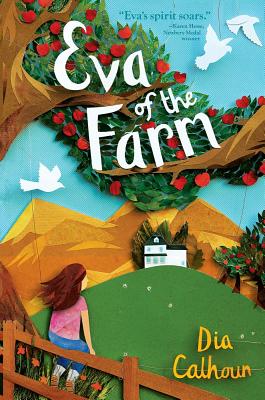
Eva of the Farm
by: Dia Calhoun
ages: 9+
First sentence: “On top of the hill, I lean against the deer fence and write a poem in the sky.”
Support your local independent bookstore: buy it there!

Twelve-year-old Eva lives on her family farm in Eastern Washington. For the most part, she’s been happy, but tough times have hit the area, and things are Changing for her. Her best friend’s family lost their farm and had to move to Seattle, and they’ve grown apart in the months since. And since finding out her family’s finances — not to mention the mounting medical bills from her younger brother’s illness — were more than precarious, Eva’s been trying to find ways to help, to find Hope in her life again.

For the most part, the book is a lovely verse novel. I liked that Calhoun tackled the plight of small farmers, and how hard it is to keep the small family farm going in this era of Big Farm. I enjoyed the imagery, and I especially liked the relationship Eva has with the Bead Woman, and the things about Hope and Love she learns. The thing that didn’t work for me was the poetry within the poetry. See, Eva’s a poet, and her poetry played a big role. But I almost felt like it was overkill: to have a novel in verse, and then throw in extra poetry. It just didn’t work for me. (And, yes, I skipped all the poems.)

But, otherwise, it’s a lovely little book.

Looking For Me
by: Betsy R. Rosenthal
ages: 9+
First sentence: “I’m just plain Edith.”
Support your local independent bookstore: buy it there!

This one is a slim historical book about a large Jewish family in Baltimore based on the author’s mother’s life. Edith is number four in a family of 12 children, growing up during the Depression. Her father is remote, trying to make ends Follow my blog with Bloglovinmeet running a diner. Edith doesn’t really know who she is: she’s always being bossed around by her older siblings and being expected to take care of her younger ones. She doesn’t think she’s the brightest person (she doesn’t know all the big words, and she can’t spell terribly well). But she has a good heart.
 
While enjoyable, Looking for Me lacked the emotional punch that I wanted from this story. Maybe it had something to do with the form — though usually, verse novels don’t turn me off — but, I wanted more from this one. There’s a death that wracks the family, but I felt… nothing. I wanted to feel pain and hurt, and hope when Edith began recovering, but I was kept at a distance by the novel, and I found that ultimately disappointing. Also, while she got the business and crowdedness of a big family, she missed, somehow, the deep friendship and love that exists in a family that large.

It wasn’t bad, but it wasn’t brilliant either.

Follow my blog with Bloglovin

No Crystal Stair

by Vaunda Micheaux Nelson
ages: 12+
First sentence: “Everybody keeps saying be satisfied with Jesus’s lvoe, and he will give us our daily bread.”
Support your local independent bookstore: buy it there!

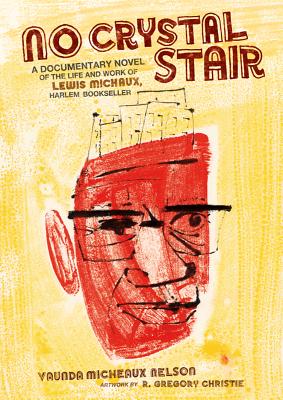
The subtitle for this one goes like this: “A documentary novel of the life and work of Lewis Michaux, Harlem bookseller.” It’s not really  nonfiction, though it looks and feels like nonfiction (with documents and pictures and “interivews” from people). It’s about someone I feel like I should have known about: Lewis Michaux, the owner of National Memorial Bookstore that was a fixture in Harlem until it went out of business in the mid-1970s. Many of the major players of both the black literary world and the Civil Rights movement spent time in Michaux’s bookstore, thinking and talking and reading.

The book follows Lewis and his family — his parents, and a couple of his brothers — through most of the 20th century, beginning in 1906, through his many failed ventures to his inception and success in the bookstore. It’s fascinating to read and think about: Lewis’s big thing was that black people can’t stop being Negros — that is, defined by white people — until they know their history. Which means: they need to read. And read about their people.

It got me thinking about the need for this even today. I’m not sure the issue has gone away, even though we don’t talk about it in those terms. People need to read about the Other (boys about girls, whites about people of color), but people also need to read about themselves, to know their history, and by knowing thier history, they can know who they are. Lewis really was a visionary in that regard.

The only thing I didn’t like about the book was that it was a “novel.” It’s mostly factual (the author’s note at the end talks about what is and what isn’t), but the fact that it’s categorized as fiction disappointed me. I know it was done for practical reasons — there wasn’t enough information out there about Lewis to make a non-fiction book out of — but, I felt kind of let down by the novelization.

That doesn’t mean the book isn’t worth reading; it is. It got me thinking, and that’s the best thing a book can do.

A Tangle of Knots

by Lisa Graff
ages: 9+
First sentence: “The line for the number 36 bus out of Hattiesburg, Mississippi, was the longest at the station.”
Support your local independent bookstore: buy it there!

In this town, in this reality, there are people who have Talent. A special ability to be good at something — matching orphans to families, for example; or spitting perfectly; or getting lost; or tying knots. Or like Cady: baking the perfect cake for the perfect person.

Ten-year-old Cady has been with Miss Mallory’s Home for Lost Girls longer than anyone else. Mostly because even though Miss Mallory’s Talent is for matching people, she hasn’t quite yet found the right  match for Cady. So, they spend their time together, Miss Mallory matching people and Cady baking cakes that are just exactly perfect for people. That is, until a series of coincidences (or are they?) set things in motion that result in a lost boy, a perfect match for Cady, six St. Anthony’s suitcases, a perfect peanut butter recipe, and a disastrous baking competition.

On the one hand, Graff’s book is sweet and magical. The huge cast are all, for the most part, charming and likeable, doing delightfully quirky things. I also have to admit a soft spot for books that involve food, and this one does not disappoint on that level. There are recipes to try, and yummy cakes to read about.

That said, I feel like I’ve read this story before. I’m not quite sure where or which one, but I couldn’t shake the feeling that I have experienced this story before. Maybe not with the exact sequence of events, but an girl with a talent to bake, a baking contest, a giant in a gray suit somewhat channeling events, the happily-ever-after? It was all very, very familiar. That, and I just didn’t feel like the conflict — the grumpy Owner who was lurking in the background — was enough to counteract the fluff. It felt like a dinner of cake and ice cream, which is all fine and good, but lacks the substance necessary to make a filling meal.

It’s not that it was a bad book; it wasn’t. It just was… unsatisfying. Which made me a little sad.

Giants Beware!

by Rafael Rosado and Jorge Aguirre
ages: 9+
Support your local independent bookstore: buy it there!

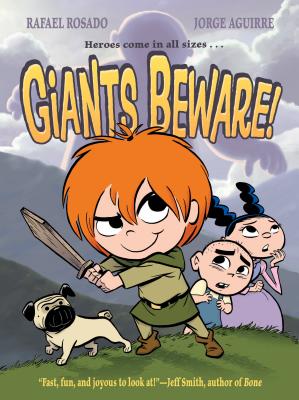
This won the Cybils Middle Grade Graphic Novel award this year, and so I knew I had to read it. I ordered one in at the store on Charlotte’s recommendation but no one seemed to be interested in it (though I tried to sell it). Good for me, though: the library didn’t have a copy so I bought it and brought it home.

And everyone who’s picked it up has loved it, from Hubby all the way down to A.

The basic story: Claudette is a bloodthirsty young girl living in this town in the shadow of giants. She wants giant blood, and will do anything to get out there and get at them, even though she knows the dangers (her father, the town blacksmith lost both his legs and one of his arms in the Forest of Death). Determined, she convinces her younger brother Gaston (a budding chef, and a swordmaker want-to-be: “I’ll call it Gaston’s Sword and Sweets Shop.”) and her best friend Marie (a princess in training) to sneak out of their town and go giant  hunting. What they find is an Adventure in the grandest sense.

It’s an absolutely delightful graphic novel. It’s got bright and bold colors, and nothing (not even the Forest of Death) is terribly frightening, making it great for the youngest of readers. It’s also terribly funny (we all loved Gaston best), and worth reading over and over again (as A has done).

I’d love to read more of Claudette’s adventures, but barring that (yay! A Graphic novel that isn’t a series), I’ll be happy to read more of what Rosado and Aguirre offer up.

SLJ Battle of the (Kids’) Books, Week 1

I’m going to TRY (emphasis on try, since next week is spring break, and I’m on vacation), to comment on the BoB matches every Saturday during the rounds. We’ll see what happens.

A side note: in the midst of all this, Roger Sutton at Horn Book is critiquing the judges themselves. It’s quite a fascinating (and fun) supplement to this battle.

Round 1, Match 1: Bomb vs. Wonder (my pick: Bomb)
What I liked that Kenneth Oppel said about Wonder:

“Interestingly, no adults are given voices in the novel: not Mom or Dad or Auggie’s principal. But Palacio knows that in a kids’ world, grown ups can provide occassional back-up, but aren’t there on the front lines.”

“While Palacio doesn’t shy away from showing us the cruelty that kids are capable of, the mood of the novel is faultlessly kind-hearted, optimistic, almost utopian. My only general quibble is that Wonder’s characters are all perhaps a little too wise and noble, and exude so much emotion that I felt relatively little of my own.”

And what he said about Bomb:

“Best of all, Sheinkin’s book is filled with all those small details that are the lifeblood of the best stories — and the details that novelists kill for when creating fiction!”

” Fascinating subject matter, and swift vital writing make Bomb a joy to read.”

His decision? Bomb. Do I agree? Of course. Mostly because while I liked Wonder well enough, Bomb was edge-of-the-seat gripping for me. Spies! Science! And written in such a way that made both accessible and interesting. Even with it’s Issues and Good Message, Wonder just couldn’t hold a candle to that.

Round 1, Match 2: Code Name Verity vs. Titanic (my pick: Code Name Verity)
I couldn’t find a really stand-out quote by Margarita Engle about Code Name Verity,  but she did say this:

“By contrast, Code Name Verity does not make an organized impression. The rambling style is one more commonly found in adult novels than those meant for young people.  It is a first person story, but the identity of the narrator keeps changing, as she writes a long, baffling confession (or accusation, or diversionary puzzle, or secret code—we’re never sure which).”

But, for me, her description of Titanic really made me want to read it (I haven’t yet, even though it’s on my TBR pile):

“Hopkinson writes like a gentle encyclopedia, presenting so much information in such an incredibly organized fashion that at times it is actually possible to forget that there will not be a hopeful ending for most of the endearing real-life characters who are described, quoted, or portrayed through vignettes of specific moments:  the arrival on deck, reading a book at bedtime, or bailing icy water out of an overcrowded lifeboat.  My favorite aspect of this book is the emotional impact of all the combined bits and pieces.”

Her decision? Code Name Verity. Do I agree? Of course. If you haven’t read this one yet, you ought to.

Round 1, Match 3: Endangered vs. Three Times Lucky (my pick: Three Times Lucky)
What Kathi Appelt said about Endangered:

“It doesn’t happen very often, but once in a while, I enter a book on page one, and when I exit that book, I feel like I’ve come to see something about the world that I didn’t know, or I didn’t think I knew.  It feels like I’ve trued something that needed truing.  Endangered was one of those books. “

And the reason I adore Three Times Lucky (I wish I could get more people to read this book!):

“When I read the lines out loud in Mo’s story, my heart sang.  I loved the cadences, the idiomatic speech, the lyricism embedded throughout this story.  It was like sitting at dinner with my great aunts.”

Her choice? Endangered. Do I agree? I don’t know. While I adore Three Times, I’d probably be able to tell better if I’d read the winner first. Which is something I’m going to do before round 2.

Round 1, Match 4: The Fault in Our Stars vs. Temple Grandin (my pick: TFIOS)
What Deb Caletti had to say about Temple Grandin:

 Lush full-page images of up-close cowhide bookend the story, bringing the animals themselves right to the reader in a way that’s smart and downright cow-cool. You want to stroke the pages.
 

And about TFIOS:

“Yeah, I liked the snap-crack dialogue, sure, but it wasn’t even that. What worked for me as a writer, but even more as a reader, were the truths of the small moments.”

Her pick? TFIOS. Do I agree? Of course. Though I also agree with Jonathan’s assessment: “THE FAULT IN OUR STARS has the ability to make a deep run in this tournament, but at some point I hope that our judges will weigh in on the success of Van Houten’s reappearance at the end of the novel—as that point seemed to dominate the conversation on the Printz blog.” It’ll be interesting to see how it fares throughout the tournament.

On to the second half of round 1!

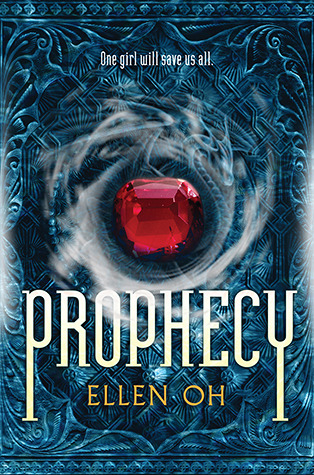
Prophecy

by Ellen Oh
ages: 10+
First sentence: “People feared Kira.”
Support your local independent bookstore: buy it there!

In the seven kingdoms on this peninsula, there are two problems: first is the force of the Yamato nation to the south: greedy and powerful, they are looking to conquer the nations to the north. Second, is trickier: the demons who kill and then possess people, infiltrating armies and families in order to take over the world.

While Kira, even though she’s the daughter of the Hansong kingdom general and niece to its queen, can’t do much about the first problem, she’s the only defense the people have against the second. She can sense — through smell and sight — demons, knowing exactly whom to attack and how to kill them. Except, the only people who know truly what she does are her father and the king. The rest of the populace think she’s some sort of demon herself, ostracizing her.

Then the unthinkable happens: a traitor kills the royal family, and lets in the Yamato soldiers (and a few demons). Kira, her brother, a trusted monk, and some loyal soldiers are on the run, solely responsible for the young prince’s safety. She’s lost her parents in the attack, she’s on the run, she’s responsible for her cousin, and on top of that, there’s this Prophecy about the Dragon Musado that’s hanging over everyone’s head. What’s a girl to do.

I have to give props to Oh for creating a brilliant world. I liked the Korean influence in the world, from the land through to the various Korean words (with a glossary!) sprinkled throughout. I thought she handled the whole prophecy thing pretty well; it wasn’t a Chosen One exactly, and because the prophecy was old enough and vague enough, there wasn’t a set List of Hoops she had to jump through over the course of the story. I did like her family loyalty, and the fact that her parents believed in her capabilities. (Which is why, sadly, they had to go.)

However, the book fell flat for me. Some of it was the writing: too much telling (“Kira hid her disappointment.” “Kira was puzzled.” “She pondered her father’s words, profoundly affected by his confidence in her.”) and not nearly enough showing. Which made the book choppy. Especially choppy was the attempt at romance. Kira’s been betrothed to a horrid man, and she doesn’t like him. But he goes around preening that she will love him, and that he can’t wait to get married. All the while, she’s developing a friendship with another young man, and it’s a nice enough relationship, until Kira starts having “feelings” that she doesn’t know what to do with. It’s not enough to make this uninteresting to a MG reader, but it is enough to wonder why Oh felt it necessary to include. The story was fine without it.

So, it’s a mixed bag. While I am happy there’s a Korean-inspired fantasy out there, I’m not sure this was enough to make me interested in keeping up on the series.

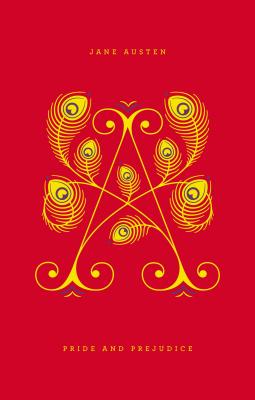
Audiobook: Pride and Prejudice

by Jane Austen

read by Josephine Bailey
ages: adult
Support your local independent bookstore: buy it there!

I’ve already reviewed Pride and Prejudice here on the blog, so I’m not going to do that again. (Though, looking back, my review really isn’t much of a review.) I picked this one up again because I was inspired to do a reread of all of Austen’s works by A Jane Austen Education.  But, I decided to do something different: listen to it on audio book. (In fact, between that and listening to To Kill a Mockingbird, I’ve decided that I’ll try to listen to classics this year. We’ll see how that goes.)

So. Thoughts.

The narrator was good. Though her Lady Catherine and Mr. Darcy were wrong. I mentioned that to M, and she said that’s because I’ve watched the A&E movie too many times and Colin Firth will always be Mr. Darcy, and no one else will do. She’s right, you know.

I know some of the lines well enough that I can say them right along.

The humor came out really well when I was listening. I catch it when I read, but I actually laughed aloud when listening and that’s something I don’t usually do when I read it.

One of the themes I caught this time was how much appearance matters. They’re always talking about the way people look — whether they give off a good impression, whether they have “goodness” in their “countenance” — and that sat uneasily with me. I try very hard not to judge on my first impression, though I do have to admit that it’s a human trait: we all do it. Even if we think we don’t. The more I think about it, the more I think the original title of this one — First Impressions — is almost more accurate. There’s a lot in here about judging and being judged for they way people (not only yourself, but your family) acts in public. And the sad thing is that it’s still applicable.

It’s still a delightful read, after 200 years and multiple rereads (on my part, anyway). It doesn’t get much better than that.

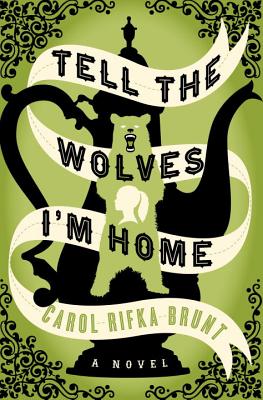
Tell the Wolves I’m home

by Carol Rifka Brunt
ages: adult
First sentence: “My sister, Greta, and I were having our portrait painted by our uncle Finn that afternoon because he knew he was dying.”
Support your local independent bookstore: buy it there!

It’s 1987, and June is 14 years old. Her uncle Finn has recently died AIDS, something which (as I well remember) is new and Scary in 1987. Finn and June had a special bond, they shared interests and outings, but it was more than that: to June, Finn was the only one who really Understood her. And to say his passing has really upset her is an understatement.

Little does she know there is a balm for her wound (sorry: too much Jane Austen lately): Toby, Finn’s boyfriend, whom the family shuns, reaches out to June for help and healing. Together these two people who cared immensely for Finn, and whom Finn cared for as well, might just figure out how to go on living without him.

While I enjoyed this novel, and I understood June’s connection with her uncle, a couple things bothered me. First, I’m not really sure it needed to be in 1987. Perhaps it was just so the family could be so deeply homophobic (they’re okay with Finn being gay, he’s just not allowed to have a relationship, so he keeps Toby under wraps). Maybe it was so that June could run around the forest behind her school or into NYC on a whim, because as we all know, parenting in the 1980s was much more permissive than it is today. But it disappointed me that there wasn’t much done with the whole AIDS scare. There were brief mentions of it here and there, but I didn’t feel anything substantial was achieved by it.

What I did like, however, was the exploration of June’s relationships. Not only with her uncle and his boyfriend, but also with her mother and sister as well. June’s perceptions of all those relationships were — partially because she’s 14 — off, sometimes drastically. And it’s a growing process for her to realize that everything isn’t quite how she perceives, that the truth of everything is multilayered and complex. For me, the true draw of the novel, the true heartache, was watching June grow up.

Not bad. Not bad at all.

State of the TBR Pile 14: March 2013

Look! It’s not terribly out of control this month. That said, I didn’t take a picture of my ARC shelf. That is out of control. What I’m thinking I’ll get to sometime soonish rather than later:

One for the Money, by Janet Evanovich (lent to me by a member of my in-person book group)
What Would Barbara Do?, by Emma Brockes (for my online bookgroup)
Last Days of Summer, by Steve Kluger (Because I adore My Most Excellent Year)
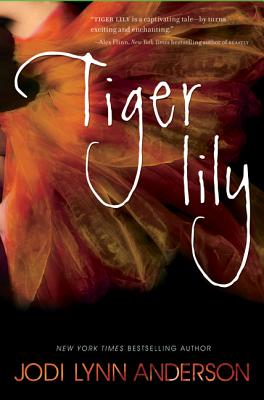
Tiger Lily, by Jodi Lynn Anderson (This month’s YAckers pick)
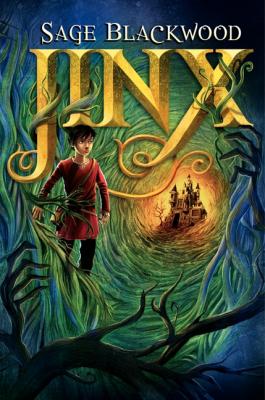
Jinx, by Sage Blackwood (Because both Charlotte and Sondy liked it.)
The Blind Side, by Michael Lewis (this was initially for the library winter challenge, but I didn’t get to it in time. I’m still interested in it, though.)
Endangered, by Eliot Schrefer (SLJ BoB book)
Shadow and Bone, by Leigh Bardugo (because I got the ARC of Siege and Storm, and need to read this first!)

Revolution 19, by Gregg Rosenblum (seeing if this is any different from all the other dystopians out there)

Moonbird, by Phillip M. Hoose  (SLJ BoB book)

What’s on your TBR pile?

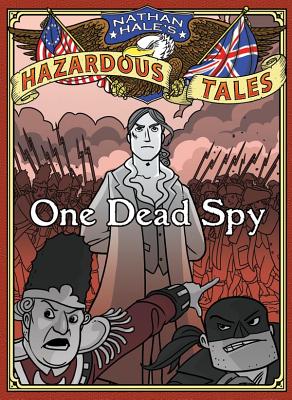
Nathan Hale’s Hazardous Tales: One Dead Spy

by Nathan Hale
ages: 9+
Support your local independent bookstore: buy it there!

I suppose if your name is Nathan Hale and you are an illustrator, it’s probably inevitable that you do a graphic novel series on American History. And,  as part of that, do one on the Revolutionary War spy, Nathan Hale.

On the one hand, I found this graphic history to be highly entertaining. Hale framed the story around the execution of Revolutionary Hale, allowing him to tell his story to the hangman and a lone British soldier. They weave in and out with commentary and gallows humor (har har), but get all the basic historical facts in there. It’s history and at times it’s entertaining.

On the other hand, though, it’s cluttered. It’s not laid out very well — chapters would sometimes start in the middle or near the end of the page. I found it really hard, visually, to get into the story, to keep track of each of the players. Half the time, I didn’t know whether or not Hale was even a part of the action. It didn’t draw me into the story, and it sure didn’t often keep me there.

It’s a good idea, telling history in graphic novel form, making it more accessible to the younger kids that way. I just wish it could have engaged me more.