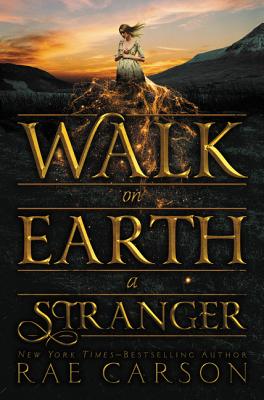
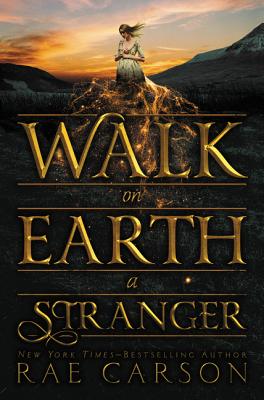
Walk on Earth a Stranger

by Rae Carson
First sentence: “I hear the deer before I see him, though he makes less noise than a squirrel — the gentle crunch of snow, a snapping twig, the soft whuff as he roots around for dead grass.”
Support your local independent bookstore: buy it there!
Review copy picked up at Children’s Institute and signed by the author (who I fangirled over).
Content: There’s some violence, including a few deaths, and some talk about sex (but none actual). It’s in the YA section (grades 6-8) of the bookstore.

Leah Westfall has a talent for finding gold. Well, maybe more than a talent: she can magically sense gold out in the wilderness. But, in northern Georgia in 1849, gold is getting pretty scarce. Even so, she and her parents get by. She’s fairly content. Then, her parents are brutally murdered by a man wants to control her “talent”, so she disguises herself as a man, runs away and head for the place where gold is most plentiful: California.

That’s basically the premise, as this book is primarily concerned with Leah’s — Lee’s — journey getting to California. It’s full of action and suspense, but it’s ordinary action and suspense. Robbers, rough rivers, threats from the known and unknown. It doesn’t seem like much, but it kept me turning pages.

This book deviates from Carson’s other works in that it’s more of a historical fiction piece and less of a magical one. Sure, Lee has magical abilities. But (so far), that’s the only magic. The rest of it, from the inherent sexism and racism to the trials they face while crossing the plains is historical. Even though I like Carson’s magic, I think I enjoyed this one more because the magic was so understated. It did help Lee out, on occasion. But for the most part, she was making her own way on her own terms. Which was awesome.

The other thing is that this is the first of a projected trilogy, but I have no idea where Carson is heading. Sure, the Big Bad isn’t taken care of, but he wasn’t a real threat in this novel either. I was actually content with the way this one ended: Lee survived the journey, she got to California, she can live happily ever after. However, I will follow Carson down whatever road she wants to take, and I wouldn’t mind reading more of Lee’s story at all.

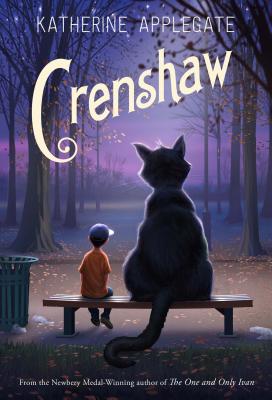
Crenshaw

by Karherine Applegate
First sentence: “I noticed several weird things about the surfboarding cat.”
Support your local independent bookstore: buy it there!
Review copy snagged off the ARC shelves at my place of employment.
Content: There’s some difficult things for the younger set to handle, but Applegate handles them at an age-appropriate level. There’s larger print, a lot of white space, and illustrations as well. It’s in the Middle Grade (grades 3-5) section of the bookstore.

Jackson has had a bumpy life. His parents are musicians, which isn’t the most stable job, and his dad has MS. They’ve managed okay, mostly; though there was the one time when they were living in their van for a few months. It was during this time that Jackson’s imaginary friend, a huge cat named Crenshaw, showed up.

For the past few years, though, they’ve been pretty stable. Except things are going downhill again. How does Jackson know? Crenshaw has showed up again.

The question is: what can Jackson do about the piling bills, and the growing sense of helplessness that he feels. The answer may lie with Crenshaw.

I wanted to love this one. I really did. I adored The One and Only Ivan, loved Applegate’s simplicity in relating a story. But this one kind of fell flat. It wasn’t Jackson’s story: I feel that his story, the one of good people who just can’t make ends meet, is one that needs to be told. But I never could quite figure out what Crenshaw was doing there. Or why he was necessary. To add a bit of levity? To help Jackson? It never quite felt right, felt seamless to me.

That said, Applegate does know how to tell a story; it wasn’t so bad that I didn’t finish it. It just felt a little… off.. to me. Which, in the end, was disappointing.

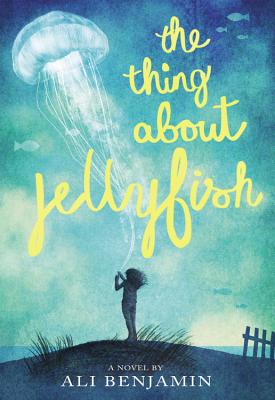
The Thing About Jellyfish

by Ali Benjamin
First sentence: “During the first three weeks of seventh grade, I’d learned one thing above all else: A person can become invisible simply by staying quiet.”
Support your local independent bookstore: buy it there!
Review copy provided by the publisher.
Release date: September 22, 2015
Content: It’s longish, but there’s nothing questionable for younger kids. It is a bit on the depressing side, so maybe super-sensitive ones wouldn’t want to read. That said, the science is pretty cool. It’ll be in the middle grade (grades 3-5) section of the bookstore, though the 6-8th grader would like it as well.

Suzy Swanson knows why Franny Jackson died. Sure, everyone has been telling her that it was “just one of those things” when her former best friend drowned in the ocean, but Suzy is convinced that there Needs to be a Scientific Explanation. And she knows she’s figured out what it is: deadly jellyfish stings. So, Suzy sets out to research that, and even plans a trip to Australia in order to come to terms with her best friends’ death. And Suzy’s guilt about what happened between them before.

There’s a LOT going on in this book: dead friend, grief, friends growing apart, bullying, science, divorce…. it was almost too much for me. I ended up focusing on the science aspect of it, which was really pretty cool. I really liked all the jellyfish facts, and the research that Suzy ended up doing on them. I liked that she had a fantastic science teacher (my girls’ 7th grade science teacher was really pretty awesome too) who inspired kids to want to learn.

But other than that, it was just drama and more Drama. Middle school kids are mean, and Benjamin caught that perfectly. I felt copious amounts of pity for Suzy; such an awkward girl, and no one (hardly) had any compassion for her. No wonder she stopped talking.

That said, while the resolution was done well, I never really wholly enjoyed this book. Too much being made uncomfortable by Suzy’s awkwardness and the bullying of the kids around her.

But then, maybe that was the point?

Birthday Reflections

Back in February, my plans for getting a MLS derailed when the store I work at was awarded a grant by James Patterson. The owner decided that what she really wanted to do was put all the children/family/school stuff under one person and she sent out a job description that I really couldn’t turn down. And so, last March, I became the Children’s Event Coordinator.

There’s a lot that falls under my purview, from scheduling author visits (this past week it was with Judy Schachner) to helping promote children’s, middlde grade, and teen books at the store. I do outreach with the schools here in town (prepping and delivering 1800 letters was a lot of fun) with book talks and book orders and in-store book fairs. It’s all a lot of fun.

But, I have realized that my favorite thing is my Saturday morning story time/monthly party in which I get to express my inner dork.

I know this isn’t what I was thinking where I’d be last year at this time. But, I’m quite happy to be a dork at work. At least for the foreseeable future.

Husky

by Justin Sayre
First sentence: “Ducks, now would you look at this!”
Support your local independent bookstore: buy it there!
Release date: September 22, 2015
Review copy provided by the publisher rep.
Content: There’s really nothing objectionable, though the subject matter is a bit on the more mature side. It will be in the YA section of the bookstore, though it’s probably good for 5th graders as well.

Davis is an only child, living with his mother — who is gone all the time, working at the bakery she owns — and his grandmother. His father’s out of the picture (dead? I think?) and his grandpa died a few years ago. And his grandmother is one of those Irish Grandmothers: overprotective, nosy, loud. The only real escape Davis has is his opera music (yes, he likes opera. No, it doesn’t come off as weird) and his friends, Sophie and Ellen. Except that Ellen is a sarcastic mean and likes Charlie (whom Davis isn’t really quite sure of), and Sophie has been hanging out with Allegra who is one of those stereotypical Mean Girls. So, where does that leave Davis?

During this summer before high school, Davis tries to figure all of it out.

I wanted to like it. Partially because I like our rep, and she really liked this one. But. I just didn’t get it. Davis was bothered by his weight, but it’s not a fat book. Which is a good thing. It’s not one of those books where he has to Overcome Being Fat in order to be happy. But, it’s also not a Accept Yourself and Be Happy book, either. On the one hand, it’s a process, and it doesn’t have a tidy happily-ever-after, which I respect. But I didn’t like the underlying assumption — especially at the end — that Davis was gay. A boy who listens to opera and whose best friends are girls isn’t necessarily gay. (Way to play into stereotypes.) That really bothered me, in the end.

Davis was a decent enough character; a bit lethargic for my tastes, and prone to being a reactor instead of someone who actually participates in his own life. But, it wasn’t a bad thing.

Aside from the stereotypes, I really can’t pinpoint why I didn’t love this book. It just wasn’t my thing.

Switch

by Ingrid Law
First sentence: “Please, Mrs. Foster– I’ve seen your future, and you really don’t want to buy this soap.”
Support your local independent bookstore: buy it there!
Review copy provided by the publisher rep.
Others in the series: Savvy, Scumble
Content: It’s pretty basic for younger kids (though I think it might be a handful for some 3rd graders), and though there’s some kissing and a little bullying and some scary driving in the snow, it’s mostly harmless. It’s in the Middle Grade (grades 3-5) section of the bookstore.

One of the things I like best about Law’s books is that even though they’re a trilogy, they’re also three stand-alones. Sure, it helps if you know what a savvy is and what scumbling means, but other than that, the whole story is basically self-contained. And that’s wonderful.

This one is Gypsy’s story (who was a wee babe in the first book). It’s a couple months after Gypsy gets her savvy, which is seeing a person’s future (or past) when she looks at them. It’s a tough one to scumble, but she’s trying. Then comes the news that her Grandma Pat (her dad’s mom, one without a savvy and who doesn’t really like the Beaumont kids) is deteriorating and needs to come live with them. This is not something that Gypsy is happy about; she and her grandma don’t really get along. But, she doesn’t have much say in the matter, so she’s dragged along to Colorado when her mom takes her and her brothers Samson and Tucker off to Colorado to fetch Grandma Pat.

And that’s when things get interesting: somehow their savvys are switched. Mom is no longer perfect, Samson went from being invisible to being the Lord of the Fire, and Tucker, who is only eight, got his savvy five years early. And Gypsy discovers she can stop time. Then Grandma escapes the house (she has Alzheimer’s and is determined to go to a school dance) in the middle of a blizzard and it’s up to Gypsy, Samson, Tucker, and their new friend Nola to bring her back.

It had very much the same feel as Law’s other books: sweet, family-centric, with a bit of unbelievableness thrown in. I had a hard time suspending my disbelief: why on EARTH were they wandering around in Denver during a BLIZZARD? But, aside from that I loved Gypsy and Samson (and Tucker was adorable, though acted a bit young for an eight-year-old; he felt more like five). I liked the story, I liked that most of the book was over one night, and I liked that Gypsy learned to understand and accept her grandmother for who she was, not who Gypsy wanted her to be.

I’m not sure it’s my favorite of the series, but it’s a solid addition.

State of the TBR Pile: September 2015

I told my husband last night that I wasn’t going to buy any books for my birthday (even though there are three on hold for me at the store). It’s probably a good thing, considering how many I have in my piles to read. Do I really NEED to be adding more?

Firebrand, by Aaron Barnhart
The Hired Girl, by Laura Amy Schlitz
The Porcupine of Truth, by Bill Konigsburg
The Jumbies, by Tracey Baptiste
Last in a Long Line of Rebels, by Lisa Lewis Tyre
Becoming Maria, by Sonia Manzano
Never Always Sometimes, by Adi Alsaid
A Mad, Wicked Folly, by Sharon Biggs Waller
Milo Speck, Accidental Agent, by Lina Urban
Jinx Fire, by Sage Blackwood
The Life of Zarf: The Troll Who Cried Wolf, by Rob Harell
Lois Lane: Fallout, by Gwenda Bond

What’s on your TBR Pile?

Siddhartha

by Herman Hesse
First sentence: “In the shadow of the house, in the sun on the riverbank by the boats, in the shadow of the sal-tree forest, in the shadow of the fig tree, Siddhartha, the beautiful brahmin’s son, the young falcon, grew up with his friend, the brahmin’s son Govinda.”
Support your local independent bookstore: buy it there!
Content: It’s dense. And there’s some illusion to sex, though nothing graphic. It’s in the adult fiction section of the bookstore.

I picked this up because I was looking for something to fill out one of my last bingo squares, one on a religion I knew very little about. I picked Buddhism, mostly because it’s the one I know the least about (though I do know some). A friend suggested this, even though it’s written by a Westerner, because it’s an accessible read for Westerners about a Buddha-like character and Buddhist thought.

It’s basically the life journey of Siddhartha, a young, well-to-do man in India (I’m assuming). He starts out with everything and then gives it up to join the shramanas, a group the eschews material things in search of knowledge and nirvana. He leads that life for a while, until he sees a beautiful woman, and he gives up his path for the path of material things and love. He finds happiness for a while, but eventually gives that up for a simpler life of service and meditation by a river.

I’m not sure I fully got what this book was supposed to teach me. It’s one of those that I think will be different at different stages of your life, and that multiple readings will lend to more insights. I’m glad I read it, even if I didn’t fully understand it. It’s definitely given me something to think about.

The Blackthorn Key

by Kevin Sands
First sentence: “I found it.”
Support your local independent bookstore: buy it there!
Review copy provided by the publisher.
Content: There’s some violence, but it’s not grisly and mostly off stage. There’s a lot of white space and fairly large print, so even though it appears long, it goes fast. It’s in the Middle Grade section (grades 3-5) of the bookstore.

Christopher Rowe has a good life, especially considering he was brought up in an orphanage. He’s apprentice to an apothecary, he has a best friend, and he’s given a bit of freedom. Until the Cult of the Archangel strikes, killing off apothecaries one by one. And finally, they reach Christopher’s master.

Suddenly Christopher’s stable life is turned upside down: the Guild, the King’s men, and the Cult are all after him. And he’s got to figure out the cryptic note that his master left in the ledger before they catch up.

It’s a simple premise, and yet it’s SO much fun. Seriously, people: So. Much. Fun. And no magic, which is really refreshing these days. It’s historic fiction — set in 17th century London — and I loved that it didn’t get too bogged down in history. Sands keeps a balance between historical tidbits and action so that it feels like it’s 17th century London, but it moves like a modern book. There’s a mystery of who is in the Cult, and who is behind all the murders. Sure, it’s pretty much white boys (I think there was two female characters, and no people of color), which means it’s same-old in that respect. But, I can forgive it for that because it was SO much fun. (I’m just going to say it again. You want some fun action/adventure/mystery? This is it!)

I couldn’t put it down.

Room With a View

by E. M. Forester
First sentence: “‘The Signora had no business to do it,’ said Miss Barttlet, ‘no business at all.'”
Support your local independent bookstore: buy it there!
Content:  There’s some mild swearing, but not much at all. It’s dated, and English, but not too difficult to understand. It’s in the adult fiction section of the bookstore.

I don’t know when I first read this one; probably sometime soon after the Merchant Ivory movie (which I own still on videotape!) came out in the 1980. I don’t know when I got the copy I own, either. (A duo with Howard’s End). I do know that it’s loved enough that it’s falling apart.

And it’s well worth it.

I love Lucy’s innocence and Charlotte’s fussbudget-ness and George’s impulsiveness and Mr. Emerson’s progressiveness and Cecil’s snobbishness. I love Forester’s commentary on the Victorian English upperclass. I love it all. (And yes, I do firmly have the movie in mind when I read.)

I don’t have much more to say; this has been one of my comfort reads in the past, and it was absolutely delightful revisiting it again after being away for so long.