Watchmen

by Alan Moore
Support your local independent bookstore: buy it there!
Content: There is graphic violence, swearing (no f-bombs though) and nudity (and sort-of on-screen text). It’s in the graphic novel section of the bookstore.

I wrote about this one ten years ago when I first read it, but I thought I’d write my thoughts that I turned in as well.

Intellectually, I know the Watchmen is a classic work of not only comic storytelling, but also a classic work of literature. However, while I can respect what Moore and Gibbons are doing, I didn’t like the experience. Partially it was the art; Gibbons’ art was completely subservient to the text, lacking very little originality. I did find the panel in issue 4, , the moment when the test chamber went off (9) and the particles dissolved Dr. Manhattan and the following few panels to be incredibly striking. But otherwise, I found the moment-to-moment and scene-to-scene art slowed down the narrative, especially through volume nine. I understand that, thematically, Moore is reflecting the world he saw when this was written in 1987 — a very sexist, homophobic (issue 11, p. 9, among others), and bleak world — and critiquing the way we use superheroes in our cultural life: None of the characters are honorable or admirable (like Superman or Captain America) or even serving the cause of justice, even if it’s in a vigilante manner (Batman). The backstories we learn (I’ll admit; I didn’t read the “excerpts” in the end; and felt like they were filer that added no substance to the actual plot line) don’t take away from the feeling that the characters are mostly individuals without any integrity in what they do. I wish he had allowed the women (all two of them) to be more than just sex objects — Sally, whose most significant characteristics were that she is aging and that the Comedian raped her (issue 2, p. 5-7), and her daughter, Laurie, whose sole purpose is to be a companion to her lovers, both Dr. Manhattan (issue 5, p. 11) and Dan Dreiberg (most of issue 7, but specifically p. 28). This is a reflection of both the mid-1980s society and popular culture, but doesn’t excuse the lack of development of these characters. Admittedly, Moore isn’t putting up hyper-masculinity as an ideal: Neither of the hyper-masculine characters of the Comedian and Ozymandias are admirable characters, while Rorschach, who would not be considered “masculine” at all — being called “queer” (issue 5, p. 27) and “runt” (issue 6, p. 8) among others — also happens to be the moral center of the series. He is the one who realizes that someone is creating a plot against “costumed adventurers” (issue 1, p. 12) to get them out of the way and in the end refuses to compromise his ideals forcing Dr. Manhattan to kill him (volume 12, p. 14). I did like the ending; while Ozymandias “gets off”, Dr. Manhattan’s prophecy that “Nothing ends, Adrian. Nothing EVER ends” (issue 12, p. 27) is fulfilled in the very final panel, where readers see Rorschach’s journal detailing everything delivered to the newspaper, and the final image (issue 12, p. 32) is the same as the cover of issue one and the first image the readers see (p.1). True, there is a lot to think about and discuss — is it right to kill off millions of people just to save the world? — but it was not an enjoyable reading experience. If this had been my first foray into graphic novels, it might have turned me off on the format completely. Thankfully, it wasn’t.
Thunderhead

by Neal Shusterman
First sentence: “How fortunate I am among the sentient o know my purpose.”
Support your local independent bookstore: buy it there!
Others in the series: Scythe
Content: There is violence (less than in Sythe) and swearing. It’s in the YA section (grades 6-8) of the bookstore.

Spoilers for Scythe, obviously.

K picked this one up first, and because we swore her to silence (no spoilers!), she suffered in silence. Then A read it, and she and K had to go off in a separate room to discuss it (because there is much to discuss). By the time I got to it, they kept asking “Where are you?”  “Have you gotten to The Part yet?” (and there are a couple of The Parts). And when I finished, K looked at me and said, “I couldn’t talk to ANYBODY!”

Because this book demands to be discussed.

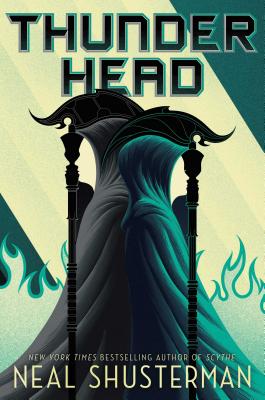
It picks up nearly a year after the events in Scythe: Citra has become Scythe Anastasia and is serving her junior scythe years under the guidance of Scythe Curie. She has a very unique method of gleaning her subjects, one that gives her peace of mind at night which is good. Rowan, on the other hand, has become Scythe Lucifer, going around gleaning scythes that have become corrupt. Both are doing what they feel called to do. But then, things go wrong.

There’s also a side plot with a new character, Greyson, whom A loved and was wholly invested in and whose life becomes intertwined with Anastasia’s. And Rowan? Well, let’s just say his plot line made me super anxious. And Faraday’s plotline is interesting, but as K pointed out, kind of gets dropped near the end.

Oh: and I want to see the ending of this book on the big screen.

I know I’m being evasive, but really, the less you know, the better it’ll be. There’s really a lot to talk about: violence and corruption and religion and tradition and freedom. But mostly, just what an excellent storyteller Shusterman is.

I can’t wait for the next part of this story!

Audio book: Crazy Rich Asians

by Kevin Kwan
Read by Lynn Chen
Support your local independent bookstore: buy it there!
Or listen at Libro.fm
Content: There is a lot of swearing, including multiple f-bombs, plus some illusions to sex and a couple of pretty crass characters. It’s in the adult fiction section of the bookstore.

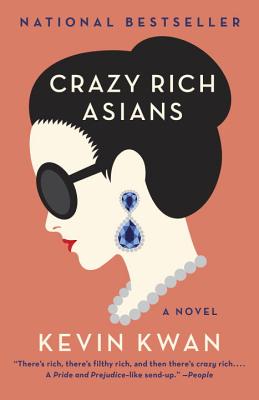
This is a trip and a half! Seriously. The basic plot is that Rachel Chu has gone to Singapore with her boyfriend, Nicholas Young, to attend the wedding of his best friend. What she thinks Nicholas is: a history professor who was educated at Oxford. What Nick really is: the grandson of one the richest people in Singapore, with a huge and wildly rich and snobbish family. Rachel — who grew up the daughter of a single immigrant mother in the US — has absolutely no idea how to fathom the wealth or handle the snubs of Nick’s family and friends.

What this book really was: a huge soap opera featuring incredibly wealthy Asians, both old money and new. The book was full of name-dropping and place dropping and everything dropping, but yet, I couldn’t stop listening. Partially it was because Chen is a fantastic narrator, handling all the accents, from old-world Chinese accented English, to both posh and Aussie English to a flat American accent. It was delightful listening to her nail every character and every voice. And, I have to admit, I love the soap-y aspect of it all. What wild and crazy and absurd and outrageous things are these people going to do?

It also serves as a reminder that a good percentage of the world’s money is not, actually, in the US. That there are some really really really rich Asians out there, and that they spend their money. A lot of money.

Was it a good book? Maybe not. But it sure was fun! (Am I going to read the sequels? Maybe…. Will I see the movie? Heck yeah!)


Arrows of the Queen

by Mercedes Lackey
First sentence: “A gentle breeze rustled the leaves of the tree, but the young girl seated beneath it did not seem to notice.”
Support your local independent bookstore: buy it there! (Though, to be honest, you’ll probably have to buy it used.)
Content: There is some violence, and some (tasteful) attempted sex. It would be in the YA section (grades 6-8) of the bookstore, if we had it.

Talia is a young, sheltered girl in a Holding that is super patriarchal, giving all the power to men and making women either wives or nuns in service to the Goddess. But Talia dreams of something more: she wants to be a Queen’s Herald. She’s secretly read tales of the Heralds, with the horse-Companions and the adventures, and longs to be one of them. She has no idea how one becomes a Herald, but when she turns 13 and her elders start talking about marrying her off, she runs off. And is chosen by one of the Companions, Roland. From there, Talia is thrust into a whole new world, one of classes and work and acceptance and challenges and friends. At first, she is hesitant, but as the months and (eventually) years go on, she becomes more confident with her role not only as a Herald, but as the Queen’s Own.

I’ve read Lackey before, but not in a while, and not very much. I like her style, though there seems to be a lot more exposition than either action or dialogue. Perhaps that was part of the style when this was written in 1987, but it did drag the story down. That, and Talia was super perfect. I liked her — I mean you have to be heartless if you don’t — but she wasn’t the most interesting character. She was always stalwart, always likable, and always had the answers to her problems. It got old pretty quickly.

Even so, I liked her adventures and the world that Lackey built, and I’m not sorry I dipped into this one.

State of the TBR Pile: July 2018

My class for this semester started last week, and I (finally) have all the books in one place. I’m taking a comics and graphic novel course, and so far (one week into a three week course!) there’s a lot of work, but it’s also fun work, which is a good thing.

Here’s the reading pile, aside from The Watchmen (I read Hubby’s original serialized version of it, which he still has in the plastic bags…) and one of my text books:

Your Lie in April 2 by Naoshi Arakawa
Fullmetal Alchemist 2 by Hiromu Arakawa (I have to read a manga, and K recommended both of these — they didn’t have the first volume at the library — and I haven’t picked which one to read yet.)
Persepolis by Marjane Satrapi
Black Panther: A Nation Under Our Feet by Ta-Nehisi Coates
Maus I by Art Spiegelman
The Prince and the Dressmaker by Jen Wang
Cancer Vixen by Marisa Acocella Marchetto
Freddie & Me by Mike Dawson
Understanding Comics by Scott McCloud (one of my two textbooks, but it’s a graphic novel, so I’m counting it)
Ms. Marvel: No Normal by G. Wilow Wilson

What are you reading this month?

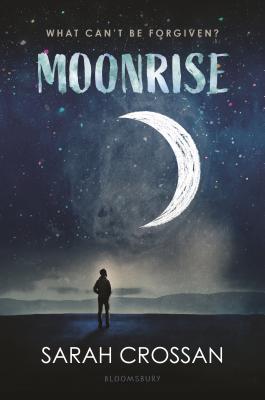
Moonrise

by Sarah Crossan
First sentence: “The green phone on the wall in the hall hardly ever rang.”
Support your local independent bookstore: buy it there!
Review copy provided by the publisher.
Content: There’s swearing, including multiple f-bombs, and some off-screen sex. It’s in the teen section (grades 9+) of the bookstore.

Ten years ago, Joe’s older brother, Ed, was imprisoned and sentenced for killing a cop. He says he didn’t do it, but that hasn’t made any difference, since they can’t really afford a good lawyer. Or one at all, really. And now Ed’s time is up, and an execution date has been set. And he wants Joe, who’s 17, to come to Texas and be with him as he faces his execution. Since Joe (and their older sister) is really all Ed’s got.

This is heartbreaking. Seriously. It’s easy to forget with Black Lives Matter (which is important!) that the problem with the U.S. justice system isn’t just race, it’s also money. Crossan picks a poor white family as her characters, one that scrapes by barely making ends meet. A mom who is plagued by drugs and alcohol, kids who aren’t the brightest in school. And it didn’t take much for the cops to intimidate and bully Ed into a “confession” which held up in a jury. It’s heartbreaking.  And the take away? If you’re poor, you’re going to end up in prison.

That said, this isn’t a book about the justice system, though that’s a part of it. It’s about forgiveness and family and decisions and choices. And it’s packs a punch. Written in verse, it’s spare but that spareness works to Crossan’s advantage in the book. There’s nothing extra in here that needs to be cut out; it’s straightforward, but told with a lot of heart.

Excellent.

(As an aside: I met her at Children’s Institute, and she’s hilarious. She also has the Irish storytelling genes, keeping us all spellbound with her stories.)

Girl Mans Up

by M-E Girard
First sentence: “There are four of us dudes sitting here right now.”
Support your local independent bookstore: buy it there!
Content: There’s smoking and drinking, a lot of swearing (including multiple f-bombs) and talk of sex. It’s in the Teen section (grades 9+) of the bookstore.

I’m going to say this up front: I’m glad this book exists. I’m glad that this book is out there for the people it represents, and for people to understand those who are different. I understand the value of this book, even if I didn’t finish it.

Pen Oliveria just wants to be herself. She likes playing video games, and she likes dressing in jeans and tshirts and hanging out with guys. She’s attracted to girls, but she doesn’t want to be your stereotypical “feminine” girl. Unfortunately, this doesn’t hold up with her old-world, traditional Portuguese parents, and no one at school — even her friends — seem to get this.

I bailed mostly because I wanted to punch Pen’s best friend, Colby. He’s the definition of toxic masculinity, picking up girls to hook up with them and dump them, judging them solely on their looks. He claims that loyalty is the most important thing, but he is constantly making fun of his friends and leaving them high and dry.  He tolerates Pen because she reels the girls in for Colby to bag and bang, but when she decides to be done with that — after Colby gets a girl pregnant and says it’s not his problem — he’s done with her. I literally wanted to punch him every time he opened his mouth. And Pen’s parents were no better. They are constantly upset at Pen’s older brother, Johnny, for not having a “real” job — Johnny owns his own landscaping business that is slowly gaining a good reputation — because he doesn’t want to work at the factory where their father works. And they’re constantly railing on Pen for not being feminine enough. It’s awful and toxic and a good way to ruin a relationship with your children.

Between the two of those things, I just couldn’t finish. Call it wrong time for me and the book.


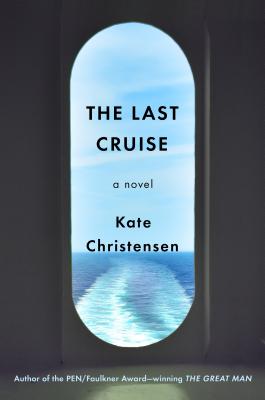
The Last Cruise

by Kate Christensen
First sentence: “As Christine walked out of the air conditioned terminal into the balmy, sweet air of Southern California, she inhaled sharply and wanted to laugh.”
Support your local independent bookstore: buy it there!
Review copy provided by the publisher.
Content: There’s a lot of swearing (including multiple f-bombs) and some on-screen sex. It’s in the adult fiction section of the bookstore.

I’m going to pitch this the same way the publisher rep pitched it to us. It’s a great character study set on this cruise ship — the last cruise of an old, retiring ship — and that’s all you think it is until something happens — I’m not going to say what — and everything gets really intense. You probably  won’t want to read this while on a cruise.

See, I don’t know what you’d expect from that, but I expected something Really Interesting. A murder perhaps. Or an accident that capsizes the ship. Something… intense. He was right: it is a really good character study of three main characters. A Hungarian chef, who wasn’t supposed to be on the cruise and who is considering getting out to start a restaurant (or something) and who just wants to be with his girlfriend in Paris; a New England farmer’s wife, who maybe just wants a little more out of her life; and an Israeli violist, who is in love with the first violinist in her quartet, whose wife has recently died and so they are now able to follow their hearts.

But, it never got intense. The Thing I Was Waiting For never happened. Something did happen — the engine dies, they’re stranded at sea, and everyone gets sick with norovirus — and when it first started I thought it was going to be big. But, it really wasn’t. They floated along for a week or so, and then they were rescued. A few people died from the sickness. Meh.

I think Christensen missed out on a really good opportunity by not focusing on the disgruntled kitchen staff — they organized a walk out to demand higher pay and their contracts reinstated  but it got lost in the engines dying — that sounded like it could be an interesting story.

In the end, this was just a reminder of why I don’t read too many adult fiction books.


First Sunday (sort-of) Daughter Reviews: July 2018

When the first day of the month is a Sunday, I always get off. And then, with morning church… well… better late than never, right?

I’ve noticed that C has been carrying around one of her go-to comfort series lately:

She loves these, even after all the re-readings she’s done. Still a smart, fun series.

A just finished this:

She really liked it! Though she said that the big thing that happens in the blurb on the back happens really early on and then the rest of the book was spent trying to solve the problem the main character created. But, she said it was fun!

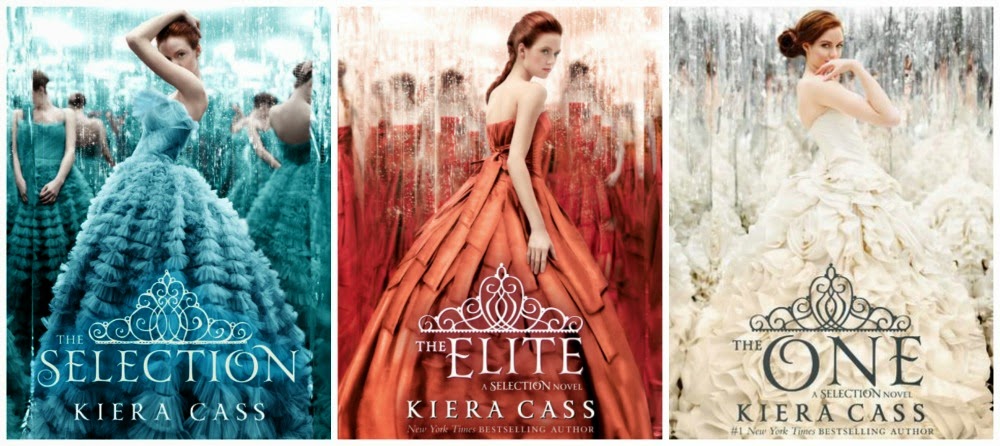
And K is almost done with this (though she may not finish it):

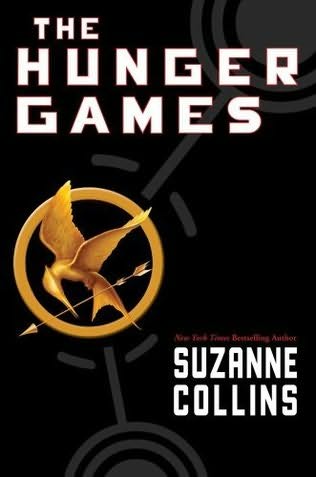
She says it’s okay, but she LOATHES the love triangle. She gets all mad when she talks about Katniss having to choose, and thinks it’s just stupid. She’s #teamkatniss all the way.

What are your kids reading?

Peter & Ernesto: A Tale of Two Sloths

by Graham Annable
First sentence: “Rabbit.”
Support your local independent bookstore: buy it there!
Content: There’s a lot of pictures, and simple words on each page. It’s in the Beginning Chapter Book section (grades 1-2) of the bookstore.

I have to admit that I picked this one up primarily because the title makes me smile. Making two sloths the subject of a graphic novel? How delightful! How absurd! And that perfectly describes the book.

Peter & Ernesto are two sloths, friends living in a tree together. They have their games and traditions, and it’s all good. That is, until the day that Ernesto decides he wants to see more of the sky than the small patch above their tree. So, he leaves. He has some interesting adventures, and makes a lot of new friends, as he explores all the sky. Peter, on the other hand, is worried when Ernesto doesn’t come back. So he follows him, at least until he can’t. Then he waits until Ernesto comes back. And when he does, he shares all the things he learned by being away.

it’s super simple, and the illustrations and text reflect that. I adore Annable’s sloths; while they’re more cartoonish than actual renditions, it captures the, well, slothiness of the animal. And I like the dichotomy between Ernesto — who is more adventuresome — and Peter, who is just a bundle of anxiety. It’s delightful. My favorite interaction is when Ernesto meets a fox and a raccoon when he’s exploring a mountain sky. They say,  “I thought sloths were lazy.” And Ernesto replies, “We’re content. There’s no need to move much when you’re content. But I’m not content. So I’ve been traveling.” I love that sentiment.

It really was a charming little beginning graphic novel.