The Lincolns

A Scrapbook Look at Abraham and Mary
by Candace Fleming
ages: 10+
First sentence: “I’m an Illinois girl, raised in the very heart of the ‘land of Lincoln.'”
Support your local independent bookstore: buy it there!

Everyone knows the story of Abraham and Mary Lincoln. We learn about it in school, all the stories and events that made up their lives. So, really, why do we need yet another biography of them?

That’s the question I asked when I opened this book. And, surprisingly, while I didn’t learn much new information — and most of what I learned was about Mary Lincoln and not Abraham — I did thoroughly enjoy this book.

The book is laid out like old newspapers, complete with photos and different type faces. The stories themselves are short, just snippets and overviews of events. There’s very little that is in-depth here, but then it’s not aiming to be anything more than what it is: an introduction for elementary-age kids. It’s engaging reading, even if the stories aren’t in-depth or new: Fleming has a accessible and engaging writing style. It’s simple without being simplistic.

What I did learn was all about Mary; she seems to have gotten a bad rap in the history books (unsurprisingly). Fleming did much to paint Mary as human (she did much to paint Abraham as human, too; he was not a larger-than-life figure), with faults, yes, but also with many virtues as well. She was a spitfire, someone who was a good companion to her husband. I was amazed at their child-raising habits (very modern, and thus were looked down upon back then), and at the amount of tragedy that Mary had in her life. Sobering, to say the least. It made me curious to read a good biography (if there is one) solely about Mary.

I’m glad I read the book, even if it wasn’t in-depth or enlightening. It’s definitely something I’d recommend to anyone looking for a good overview of the Lincolns.

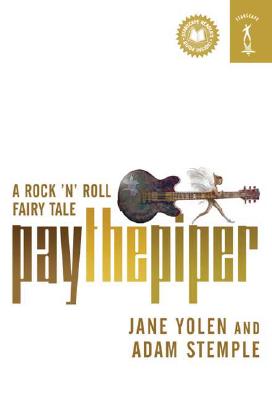
Pay the Piper

by Jane Yolen and Adam Stemple
ages: 10+
First sentence: “The piper caught sight of the river long before the sound of rushing water reached his ears or the salt smell of blood struck his nose.”
Support your local independent bookstore: buy it there!
Review copy sent to me by Corinne, so I can participate in her library’s awesome program.

Callie (short for Calcephony; because of ridiculously lame parents: that’s not even a real word!) wants to be a world-class journalist. So when she snags an assignment to cover the band Brass Rat (they’ve been around since her parents were in college; and yet they don’t look a day over 20), she’s incredibly excited. That is, until she starts seeing and hearing weird things… like rats dancing whenever the lead singer/flautist (can a rock band have a flautist? Really?) Peter Gringas plays.

Callie doesn’t think anything of it, though, until the next night, Halloween, when all the children go missing. It turns out that Peter is a cursed prince of faerie in exile, paying a blood teind to his father for the murder of his brother. It’s up to Callie, if she wants to save her brother and the rest of the children, to figure out how to break the curse. Before midnight. Can she do it? (Need I ask?)

I generally love fairy tale retellings, but this one was clunky. (With a capital clunk.) Maybe it’s the fairy tale: the Pied Piper isn’t one for sweeping grand retellings. (Though I did like Wild Magic well enough.) But, even so, the writing was uneven. The was split in two: reminiscences from faerie and the modern day Callie. The reminiscences were beautiful, lyrical; I could have read a whole book about how Gringas became dissatisfied and eventually killed his brother and was exiled. The rest was mundane, pedantic, and a sad attempt at being hip and cool (or so I thought; I’m not the world’s best judge). The whole thing was a bit rushed, as well: lots and lots of set-up and a quick, and not very satisfying (though logical), resolution at the end.

It seemed to me, that there was a good YA (or even adult) story in here, and they just simplified it for younger kids, rather than making something wholly organic for middle grade readers. Which is just frustrating.

The library program, however, is really quite cool.

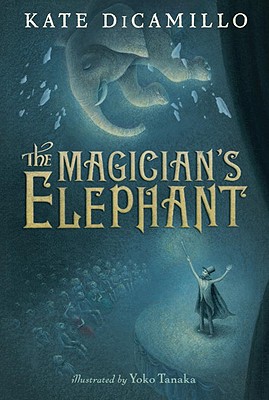
The Magician’s Elephant

by Kate DiCamillo
ages: 9+
First sentence: “At the end of the century before last, in the market square of the city of Baltese, there stood a boy with a hat on his head and a coin in his hand.”
Support your local independent bookstore: buy it there!
Review copy picked up at KidlitCon 2009 (Yes, it really has taken me this long to get around to reading it.)

Peter is an orphan, being taken care of by an old military friend of his father’s. He barely remembers his parents, and his guardian has told him for years that Peter’s baby sister was stillborn. Peter feels no hope of ever seeing any of them again, resigned to his meager lifestyle with a cranky old man. That is, until he spends a coin on a fortune teller who gives him hope. Hope that his sister is alive, hope that he can find her. Sure, it’s impossible, but since when is the impossible — especially when you have a magician and an elephant and a policeman helping — improbable?

It’s a very charming and sweet story. One that has the power to resonate with you afterward: it’s about hope and love and change, but nothing Grand or Sweeping. It’s all very small, very personal. It explores, very subtly, the effects that one person can have on another, and the desires we have to be Grand and Sweeping sometimes. It worked as a parable, the writing was gorgeous. I think it’d work wonderfully as a read aloud. Which brings me to my only quibble: would a kid read this? My friend Tricia assures me her daughter loved it, but I’m not sure.

Even with that, I think it’s a marvelous little story.

Sunday Salon: Post-Vacation Catching Up

We arrived home safe and sound last week, only to be pummeled by snow! On the upside, we were all quite grateful for the first two snow days as it allowed us to get used to our own time zone again. That’s the hardest part of traveling, I think: adjusting to local time.

That said, we had a lovely time in Hawaii; so much so, that I don’t think any of us really wanted to come home!

These were all taken on our last full day there; I have more, but this is a book blog, not a travel blog!

I didn’t check anything while we were on vacation, though I did read (though not as much as I was planning to) and write reviews (they’ve already gone up). The one thing I did miss that’s worth mentioning is that my favorite March competition, The Battle of the (Kids) Books announced their contenders for this year. It’s a good list of books (of which I’ve read half; woot!), but I think I’m going to join Charlotte in her cheer: Go Bartimaeus!

There were other things that I missed, or only caught on the perifery, most notably the Bitch magazine kerfuffle. The two best things I read on that were at Chasing Ray (who basically gives you a play-by-play) and Scott Westerfeld (who explained why it was a kerfuffle in the first place). I acutally found it kind of interesting watching things blow up, even if I was a bit muffled in the first place: they were books for feminist readers, and admittedly I could see how a lot of them would appeal. But I did wonder how they determined what went on the list in the first place….

One last thing: Clare Vanderpool is going to be at our local indie bookstore tomorrow night. I cannot tell you how excited I am; at last I’ll get my copy of Moon Over Manifet signed! (Hopefully, I’ll be brave enough to get pictures too!)

Happy reading!

Guys Read: Funny Business

edited by John Scieszka
ages: 10+
First sentence: “A kid gets transferred to a new school.”
Support your local independent bookstore: buy it there!

Ah, humor.

It’s such an individual thing, really. Some people snort milk out their nose at the slightest silliness (guilty), others just crack a small smile. It’s so hard to find one style that suits everyone.

The best solution? A short story collection. There’s enough different kinds of stories in here (all with male protagonists, so hand this one to the boys. Which was its point, actually.), from enough different authors, that everyone will find at least one that will tickle their funny bone.

For me, it was Eoin Colfer’s story. If I had been drinking milk (or anything at all), I would have snorted it. I howled. It’s basically a personal essay about his older brother, the evil genius, and how he got his younger brother out of trouble. Seriously, it doesn’t sound that funny, but it is. Or at least it was to me.

The other stories were nothing to sneeze at either: there are stories about not-so-great friends, projects gone bad, getting addicted to danger, stupid English assignments, obnoxious parents and grandparents, and superheroes. Not all were equally funny, in my opinion, but all were entertaining and interesting and fun to read. Completely worth picking up (and not just for the guys.)

Besides, how can you not want to read a book that has a trailer like this?

10 Questions for Stuart Gibbs

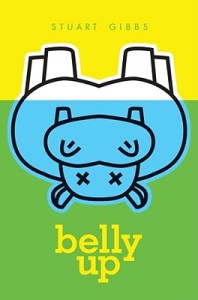
After I finished Belly Up, I wondered a bit about the guy, Stuart Gibbs, who wrote this incredibly funny story. And after it made our Middle Grade Cybils shortlist, I knew I needed to interview him. A few interesting bio tidbits first: he grew up in South Texas, was at one point one of the world’s experts on capybaras (the other two being the Kratt brothers?), and has written shows for TV and movies before venturing into the world of middle grade fiction. And if his first novel is any indication, I, at least, am glad he made the jump.

MF: This is your first novel, yes? Congrats! Can you tell us a little bit about the whole process?
SG: Yes, this is my first novel. I sold it by writing a pitch for Simon & Schuster: A synopsis of the story and the first few chapters. Originally, the story was told in third person, but my first editor at S&S suggested changing it to Teddy’s voice – and gave me a few suggestions as to what to concentrate on in the story. For example, he felt that the interplay between corporate hype and reality would be interesting to kids. I worked at a zoo when I was in college – and I studied biology – so I had a good background of knowledge to draw on. It took me about four months to write the book.

MF: Did you choose to write for middle grade audiences, or did that just “happen”? If you did choose it, why?
SG: It really just happened. I’d always thought about writing an adult novel, but had never given the idea of writing for middle grade any thought until my agent (Jennifer Joel) approached me about it. The moment she did, I realized that was exactly the audience I should be writing for. I had originally thought of Belly Up as a book for adults with an adult protagonist – but then realized the murder of an animal was the perfect crime for a kid to solve. Plus, I have young children, so the idea of writing something that they could read was exciting to me.

MF: How on earth did you come up with a hilariously outlandish idea like a murdered ornery hippo for a book?
SG: I worked at a zoo when I was in college and always knew a zoo was a great setting for a story. At some point, I realized I’d never heard of a murder mystery where the victim was an animal, so that seemed like a fun idea. But then, to create a good mystery, I needed an animal that a lot of people wanted dead. A hippo seemed like a great victim. They’re extremely dangerous and foul-tempered, yet most people seem to think of them as docile and harmless. Just the sort of animal that a corporation might mistakenly turn into their mascot and then regret doing so.

MF: Tell me about writing comedy: humor’s such a personal thing, how did you go about making sure it was funny?
SG: You’re right that humor is personal. Because of that, it’s hard to write something that will be funny to everyone. So I basically just wrote what was funny to me and hoped other people would enjoy it as well. I know that not everyone finds everything in Belly Up as funny as I do – but I’ve also had parents write to me saying that their children were laughing so hard reading the book that they fell off the couch, which is probably the greatest praise I could ever get.
MF: I remember being curious while I was reading: how much of the animal information is fact and how much was fiction?
SG: About 99% the animal information is fact. I really wanted to be as factual as possible in writing this. I’d like to say it’s 100% fact, but it’s possible that I got some things wrong.

MF: The book has a strong (but not overpowering) environmental vibe: what are you hoping, if anything, your readers take away from reading this book?
SG: I certainly want kids to care about the environment, though I think that’s a message they get pounded with through various media these days, so I didn’t want to be overbearing with it. Hopefully, my readers are also learning that zoos are an extremely important part of the conservation movement. They’re not – as some people think – ‘jails’ for wild animals. At one point, I have Teddy voice a very personal thought of mine: That zoos are a compromise. There probably isn’t a zookeeper in the world who wishes we didn’t need zoos, but the fact is, without them, there might never have even been an environmental movement in the first place.

MF: Do you have a favorite character or scene in the book?
SG: I truly love Teddy, though I’m also very pleased with how Summer McCracken turned out. As for my favorite scene, well, it was a banner day when I came up with the sequence at Henry’s funeral. I think that one turned out to be quite funny.

MF: Oh, I agree: that was hilarious! You’ve also written for TV, correct? What are the differences and/or similarities between writing for TV and writing novels?
SG: They are extremely different experiences. Writing for TV is a much more collaborative process. You have producers, studio executives and network executives all giving you notes – and that’s just for the outline. By the time your show gets filmed (and there’s a good chance it won’t), the director, the actors and other writers have all weighed in too. Sometimes, this all works out great – and sometimes it doesn’t. When writing the novel, really the only other person with much input is your editor, so it’s much easier to stay true to your original vision.

Writing a novel is much more exacting work, however. In a book, every single word has to be just right, whereas, when you’re writing for TV, it doesn’t really matter how well you write a scene description; all that really matters is the dialogue.

MF: Are there five books you think everyone should read? (If there aren’t, what’s the last book you read and loved and why?)
SG: Wow. Five books. That’s very hard to narrow down. Can I pick my five favorite humor writers? These are the authors who’ve probably influenced my style the most – and the writers whose books I’ve read over and over again:

Roald Dahl made me laugh out loud all the time as a young reader.
Carl Hiaasen, Gregory McDonald and Donald Westlake are the funniest crime writers there are.
Bill Bryson writes nonfiction, but he does it in an amazingly accessible, incredibly funny way.

MF: Those are amazing writers. If you don’t mind telling us, what can we expect from you next?
SG: My next book, The Last Musketeer, will come out in the fall. It’s about a teenager who goes back in time to medieval France and ends up uniting the Three Musketeers – who are also teenagers — for their first adventure. This book is the first of a trilogy.

And in spring 2012, Spy School will be released. That’s about a kid who is thrilled to learn he’s been accepted to the CIA’s top secret Academy of Espionage – but then discovers he’s only been brought in as bait to catch a mole.

Plus, I’ve just developed the story for a sequel to Belly Up. So, hopefully I can get started on that sometime soon.

MF: Wow, things to look forward to! Thank you so much for your time, Stuart!