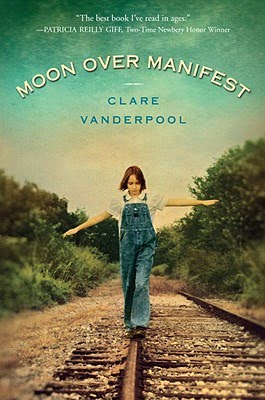
Moon Over Manifest

by Clare Vanderpool
ages: 11+
First sentence: “The movement of the train rocked me like a lullaby.”
Support your local independent bookstore: buy it there!

First off: I’ve got a local author! YAY! I really had no idea (honestly, I get the book notes from our local independent bookstore, but I’m not always the best about reading it thoroughly, so I missed it when they announced her) when I started the book, but it’s set in Southeast Kansas, so I flipped to the author blurb to see what credentials this author had for writing about Kansas. I was quite pleasantly surprised to find out that she’s here in Wichita. Pleasantly surprised is too mild. I was quite excited!

I do have to admit that I was a bit anxious as well: what if I didn’t like the book?

I shouldn’t have worried.

Alternating between two time periods, the Great Depression in 1936 and World War I in 1918, Vanderpool tells the story of the small fictional town of Manifest in southeastern Kansas. Nominally, it’s the story of 12-year-old Abilene Tucker who has spent her life traveling the rails with her father, Gideon. Then, soon after her 12th birthday, he up and sends her back to Manifest, a town he’s never talked about but has some connection with, to live with an old friend of his so he can go work in Nebraska. Feeling abandoned, Abilene decides what she needs to do is figure out what connection her dad has with this town, and why he’s sent her there. She ends up working for an old Hungarian fortune teller, and in return she tells Abilene stories, slowly unveiling the mystery of her father’s past. And, by digging up the past, Abilene manages to pull a town that was slowly falling apart back together.

It’s an excellent portrait of a time and a place, making Kansas come alive rather than just being an Everyplace like it usually is in novels. (We need someplace non committal. How about Kansas? ) I could tell that Vanderpool knows her stuff (well, she is a native Kansan; she says that this was based on memories of her grandparents), and loves the place and its small, rural towns. Additionally, she’s created some winning characters; Abilene is a smart, fiesty girl, one with a nose for adventure. But it’s not solely a “girl” book: the two main characters from 1918, Jinx and Ned, are just as engaging as the girls from 1936. Vanderpool manages to balance the two time periods, capturing the essence of each, and transitions seamlessly between them.

It’s a captivating read. I’m really looking forward to Vanderpool’s next work. And not just because she’s a local author.

(Just for the record: because this is a Cybils nominee, I’ve been asked to make sure y’all know this is my opinion only, and not that of the panel.)
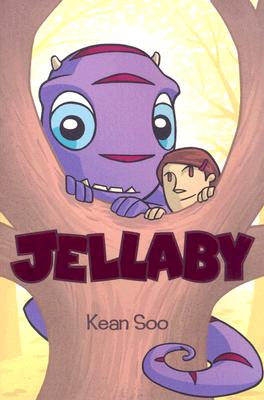
Jellaby

by Kean Soo
ages: 9+
Support your local independent bookstore: buy it there!

This monster, this book, is very cute. I fell in love with Jellaby (it’s the monster on the cover) as soon as it appeared in the book. It’s charming, it’s cute in a monsterish sort of way, and made me want to wrap it up and put it in my pocket.

It’s just the beginning of a story — I need to find the next part; I want to know what happens! — but it’s a good beginning. Portia is a girl who’s father is missing (did he die? did he disappear?), and she’s not adapting to that well. She’s struggling in school, her mother leaves her alone a lot. And then she finds Jellaby. It’s a friend (she makes another friend in the bullied kid, Jason Tham), someone to keep her company. And then, by random chance, she discovers that Jellaby is a lost soul, too. Together her and Jason concoct a plan to get Jellaby back to his home.

That plan is just put in motion in this book. It’s really mostly background and set up, though it’s done incredibly well. There’s something deep going on in the book, even if I can’t quite figure out what it is. Which means, I’m definitely curious as to where the story is going, and the adventures Portia, Jason and Jellaby will have.

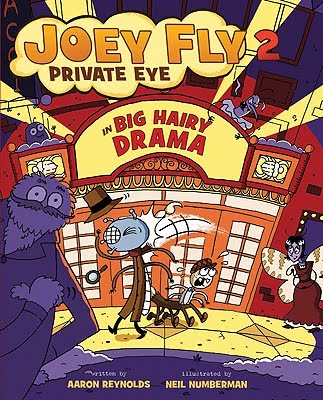
Joey Fly, Private Eye in Big Hairy Drama

by Aaron Reynolds/Illus. by Neil Numberman
ages: 9+
First sentence: “Life in the bug city.”
Support your local independent bookstore: buy it there!
Review copy sent by the author

Joey Fly and his sidekick, Sammy Stingtail are on the case. Again. This time, a big-time (and big) theater owner is asking him to find his main star, the four-winged, long-legged Greta Divawing. Joey and Sammy are up to it of course (they’re up to anything). It’s just a matter of tracking down the bug who did it.

The question is: which bug would that be?

This book is much like the first in the series: smart and fun and interesting. It’s well-written and funny, and has elements that will appeal to both boys and girls (mine were very excited to see it when it came in the mail!). The story has some great twists and turns, plus sliding a bit of educational information in there. There’s a little bit for everyone, but nothing feels shortchanged or slighted. And visually, it’s quite engrossing: it’s worth stopping and poring over the frames to find all the little things Numberman has hidden in there.

In short, it’s a great little series.

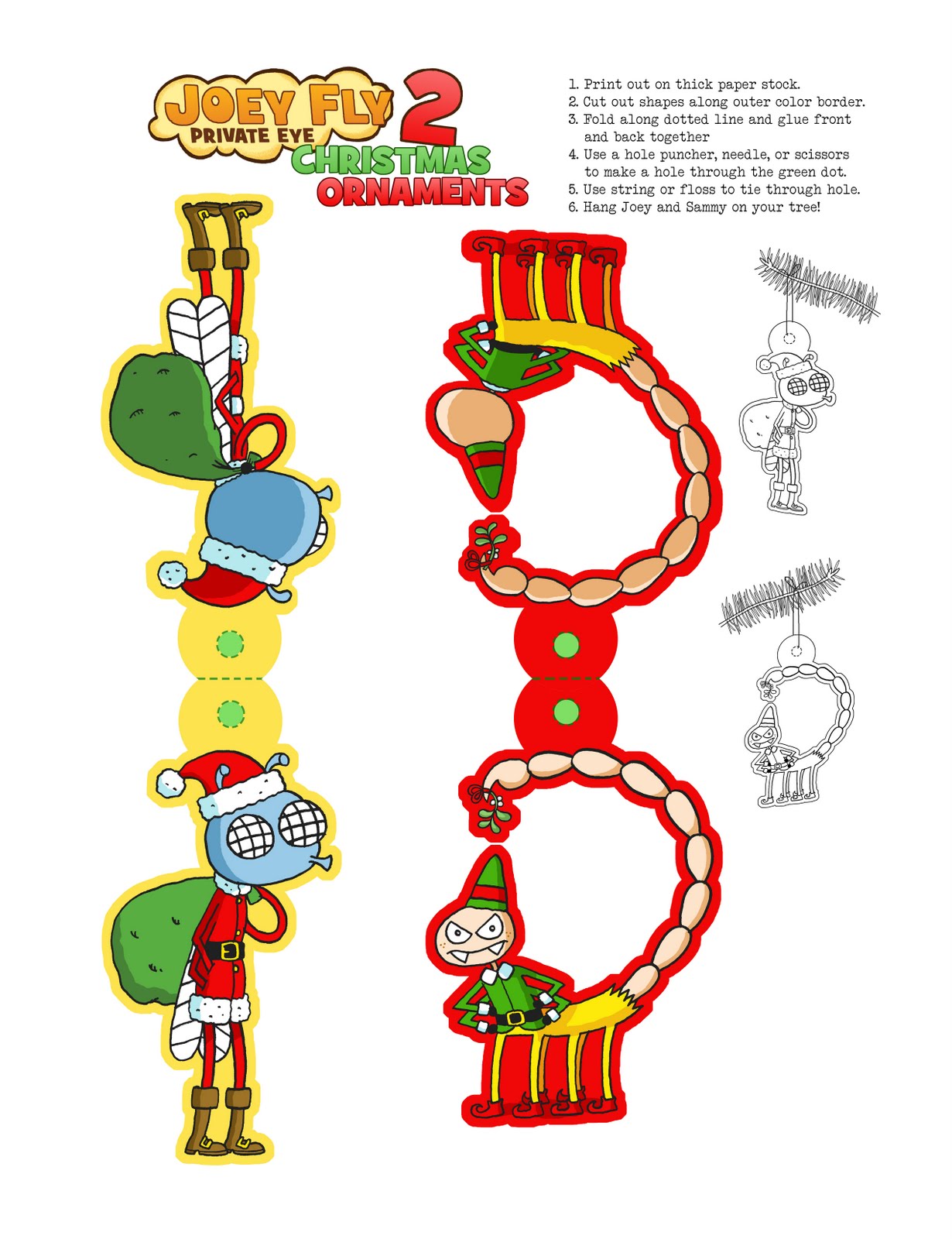
As an added bonus, the author/illustrator are offering up these ornaments to print off and cut out. Click to embiggen, and enjoy!

The Great Book Swap of 2011

I’ve seen this idea of swapping book lists floating around for a couple of weeks now, and (since I think I’m going to forgo most challenges next year) I got to thinking that it might be a fun idea to throw my towel in the ring. So I rounded up two of my bookish friends from my online book group, Corinne and Tricia, and we all swapped lists.

Here they are:

Corinne’s for me:
On Fortune’s Wheel by Cynthia Voigt
Precious Bane by Mary Webb
either The Zookeeper’s Wife or The Natural History of the Senses by Diane Ackerman
Cold Sassy Tree by Olive Ann Burns
Pastwatch or Wyrms by Orson Scott Card
Bonus: A Tree Grows in Brooklyn, by Betty Smith

Tricia’s for me:
The Lincolns ~ Candace Fleming
Unwind ~ Neal Shusterman
Crossing to Safety ~ Wallace Stegner
Drums, Girls & Dangerous Pie ~ Jordan Sonnenblick
The Power of One ~ Bryce Courtenay

Corinne’s for Tricia:
Davita’s Harp by Chaim Potok
A Room with a View by E. M. Forster
A Woman in Berlin by anonymous (okay, this is an intense book, it floored me and sickened me and made me think about a lot of things) or Refuge: An Unnatural History of Family and Place by Terry Tempest Williams
Summers at Castle Auburn by Sharon Shinn
Quest for a Maid by Frances Mary Hendry

I’ve read the first two and Refuge, but it’s been a very long time, so I think I’m going to reread them as well.

Tricia’s for Corinne:
The Only Alien on the Planet ~ Kristen D. Randle
The Wednesday Wars ~ Gary D. Schmidt
Sabriel ~ Garth Nix
The Shadow of the Wind ~ Carlos Ruiz Zafon
Letters to a Young Poet ~ Rainer Maria Rilke

I’m excited to read all of these!

Advent Tour: O Tannenbaum

I haven’t thought to talk about our Christmas tree before, because usually we wait to put it up after A’s birthday. Which means, if I generally choose the first Sunday in December (and I do), then I don’t think about my tree as a viable advent calendar topic.

But this year, because my husband is off to Hong Kong, we put the tree up early. And I realized, that there’s a story I could tell.

This is our tree:

I don’t know if it shows, but my tree is not what you’d call elegant. Or put together. It’s a hand-me over, 9 feet tall, and leans slightly to the left; in fact, we’ve warned the kids that if they do too much bouncing around, the tree will fall over (we know this from experience). It’s not color coordinated, and I’m sure Martha Stewart would not approve. However, what my tree has going for it is that each ornament (or at least most) have a story behind them. I can tell you where we got each and every ornament and why it’s hanging on the tree. Okay, sure, I’m getting older, and some of the stories are a bit fuzzy. But it’s one of the things I like most about our tree: it’s got stories.

Let me tell you a few.

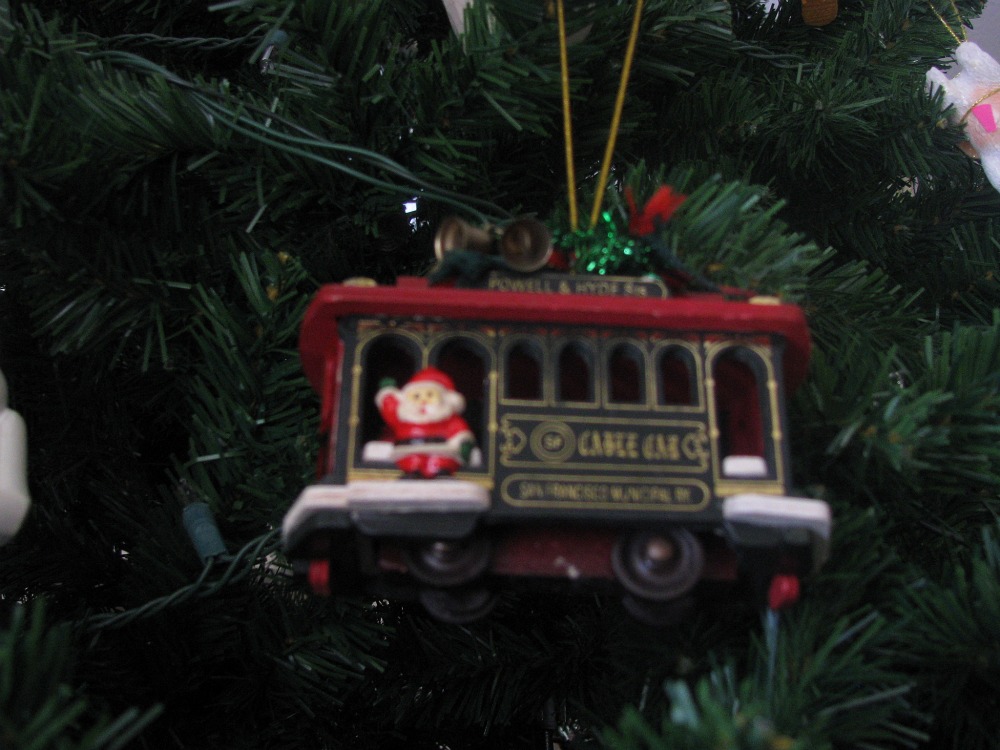
This one was the first one Hubby and I purchased, on our honeymoon to San Francisco. We saw it sitting in the gift shop of the San Francisco Botanical Gardens, and knew we had to get it.

This one is another early one: I cross-stitched it because of Hubby’s love of cows. I think there should be more cows at Christmas, personally.

While we’re talking old ornaments, this is one of the oldest on the tree. It’s a shrinky dink, made in 1973, when I was one. I’m constantly amazed that it’s still in one piece (though the words “Merry Christmas 1973” on it are are fading). I do still love seeing it on the tree, though.

Another homemade one… if I had a chance and the money to collect anything, I would probably collect Santas/Father Christmases. I’m quite enamored with the whole mythology of Santa, and how he’s represented in different cultures. (There are a lot of Santas on our tree, in various forms, as a result.)

One of the other things we’ve done is get each one of the girls their own ornament for each year. We’re doing it so they have something to take with them when they move out, but, like everything else on the tree, they have their own stories, too.

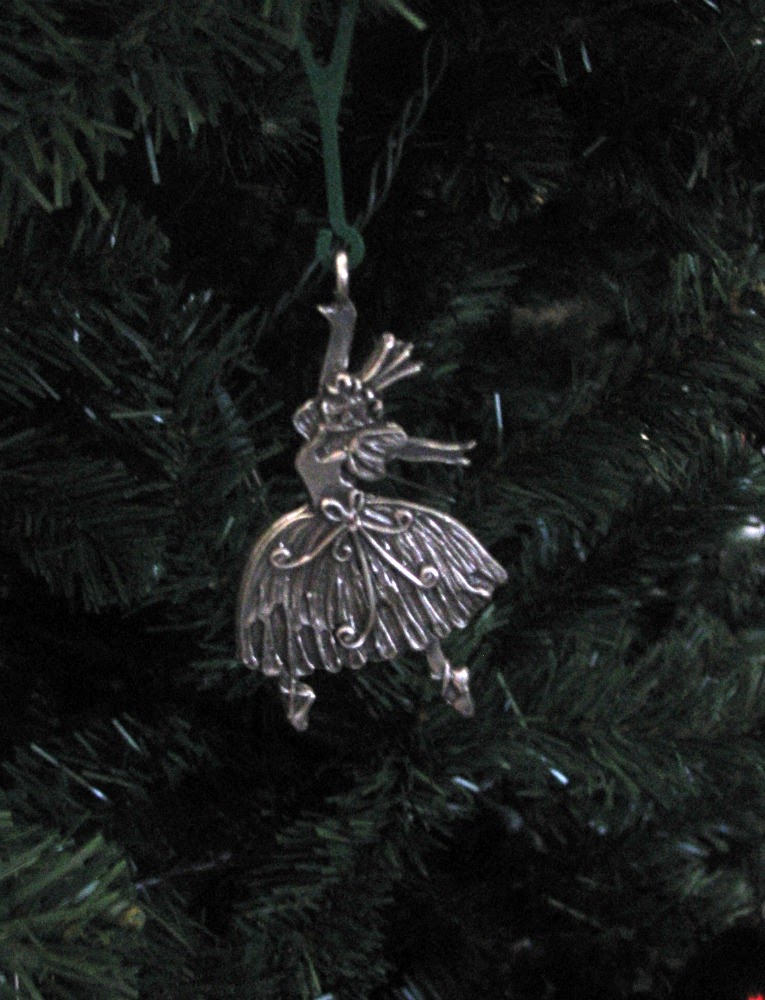
This one of M’s we bought when we stopped over in Salt Lake City the Christmas of 2000. I was so excited by the stopover that I took her to see Ballet West’s Nutcracker, which happens to be my favorite. They had a gift shop, and so we had to pick out an ornament. She got the Sugar Plum Fairy. (We also have a Nutcracker ornament from the same place, but he was bought much earlier, and is a bit worse for the wear these days.)

This one of C’s was one that I painted (not well, but there it is) the Christmas she adored The Snowman. She was 20 months old, and it was her favorite movie and favorite book. We wanted to remember that.

This one of A’s was a pair of baby shoes that her grandma sent her the year she was born. (She’s our December baby, if you haven’t figured that out yet.) They were much, much too nice to wear, so we tied the laces together and threw them on the tree. Perfect.

K, being the youngest, only has a few ornaments (she wanted to know why she didn’t have very many). This one we picked up at a craft fair in Coeur d’Alene a couple years back. It’s sculpted out of candle wax. I’m not sure she picked this design out; it may have been picked out for her. Still, the detail is amazing.

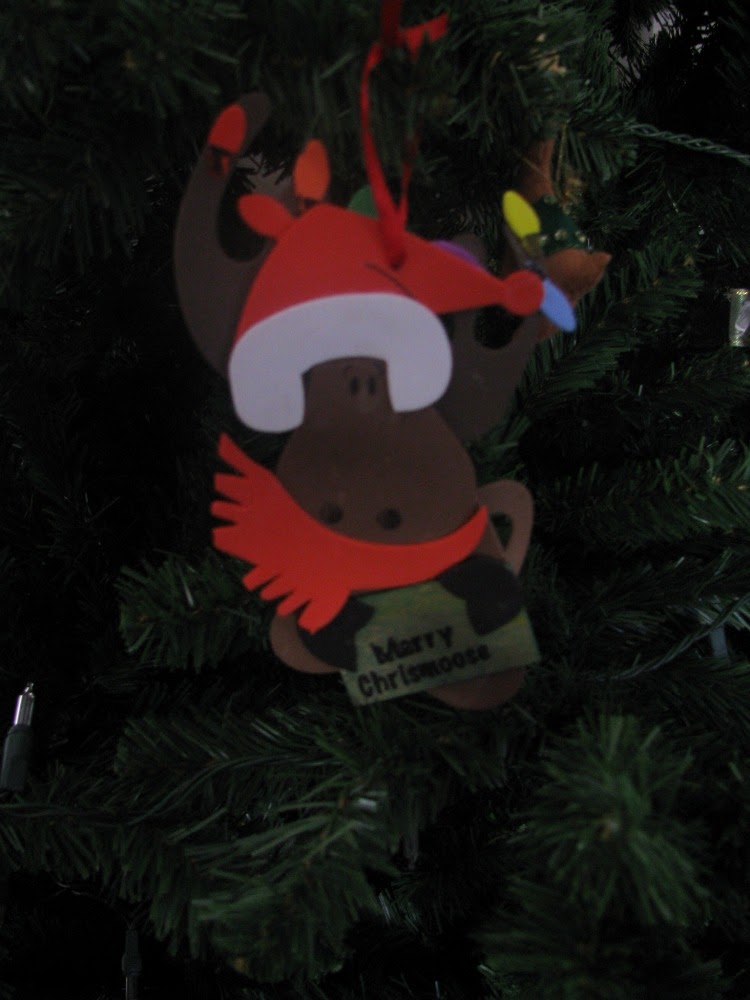
And being parents of school-aged children, there’s a handful of odd little school ornaments. Things they make in class, and then bring home to throw on the tree. The girls love seeing them as they come out of the box, and so I don’t have the heart to throw them away.

And finally, our tree wouldn’t be our tree without our fireman. He was sent to us by Hubby’s older sister, many years ago. I have no idea why she sent him, but we immediately fell in love: what tree shouldn’t have a guardian fireman? We stick him near the top so he can keep an eye on all the other ornaments, and protect the tree from any danger.

Merry Christmas!

Be sure to check out the other stops on today’s tour:

Veronica @ The First Draft

Betti on the High Wire

by Lisa Railsback
ages: 10+
First sentence: “A bright light shines on the beautiful girl.”
Support your local independent bookstore: buy it there!

Babo is a leftover child. In her unnamed war-torn country — unnamed on purpose, to give her a sense of universality, which I found both interesting and disconcerting; I wanted something more concrete as a reader — she lives with other orphaned children in an abandoned circus camp. It’s not an easy life; there’s not much food, and there’s always the danger of soldiers and bombs. And yet, she’s happy. She tells stories to the other children, she pretends that her parents will come back and get her.

And then, one day, an American couple come to the camp and want to adopt Babo. Although she tries desperately to get them to change their mind, the next thing she knows her name is Betti and she is on a plane (with her friend and fellow leftover child, George) to America. The book is mostly about her struggles to, and against, adjusting to her new life.

It’s a heartbreaking story; Babo/Betti is a fighter and a survivor, and she feels guilty about having comforts when her friends are still stuck with a lousy life. She’s been struggling her whole life, and she’s afraid about what it might do to her. In a couple of very telling scenes — it’s one of the best books I’ve read lately that shows rather than tells — you get the sense of Babo/Betti’s desperation and fear. Her adoptive parents are complex as well; on the one hand, they’re overly generous and kind of clueless Americans, but there’s a real love for lost souls, and a genuine concern for Babo/Betti’s well-being. Railsback doesn’t paint everything in black and white, though Babo/Betti tries to make things that way, and as a result, the book is a complex, and yet accessible, look at war, refugees and adoption.

(Just for the record: because this is a Cybils nominee, I’ve been asked to make sure y’all know this is my opinion only, and not that of the panel.)
2010 Challenge #3: The Flashback Challenge

It has come to my attention (aka: I realized today) that I’m not going to read anything more for the Flashback Challenge this year. I’ve got too much on my plate with the Cybils and other reading (I WILL read Fried Green Tomatoes. I promise!) to actually reread any more.

That said, I still accomplished my goal of rereading six books, though half weren’t on my original list.

1. The Wrinkle in Time series, Madeline L’Engle (childhood)
A Wrinkle in Time
Wind in the Door
A Swiftly Tilting Planet
2. The Dark is Rising series, Susan Cooper (adult)
Over Sea, Under Stone
The Dark is Rising
Greenwitch
The Grey King
Silver on the Tree
3. Howards End, E. M. Forester
4. The Girl in Hyacinth Blue, by Susan Vreeland
5. Under the Tuscan Sun, by Frances Mayes
6. Nine Parts of Desire, by Geraldine Brooks
7. The Graveyard Book, by Neil Gaiman

It was fun to reread books I haven’t in years. I’ll have to do this more often.

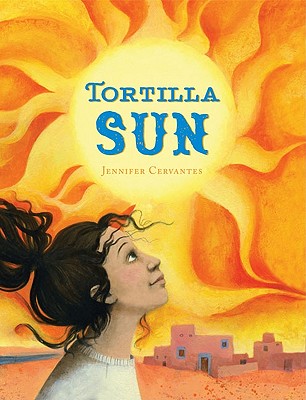
Tortilla Sun

by Jennifer Cervantes
ages: 10+
First sentence: “I stared at the glossy image.”
Support your local independent bookstore: buy it there!

Izzy has just moved, again, and is looking forward to a summer getting to know people in her neighborhood so she’s not the new kid at school. Again. But then her mom drops a bombshell: she’s off to Costa Rica to finish research for her dissertation, which means Izzy has to spend the summer with her Nana in a small village outside of Albuquerque. This is not what Izzy wants. At all.

And yet, once she’s there she discovers that learning her heritage is much more interesting than she gave it credit for. Her nana is interesting, fun, full of life. Her neighbor, Mateo, is intriguing. But more than that, she slowly learns the story of her father who died before she was born, something which her mother hasn’t been willing to share. And that may be the greatest gift of all.

It’s a sweet story, one that’s full of vibrant color and life. Even though it was a parent dying book — in fact, there was quite a bit of death and trauma in this book — much like Milo, it focused on healing and understanding and celebrating the life of the one who’s dead, rather than mourning. It felt natural and celebratory rather than depressing. There was a bit of magical realism, but only a touch and that added to the healing tone of the book. Yes, there was conflict, and Izzy needed to learn lessons and grow a bit (and there was a few tense moments near the end), but it was a happy book, one that celebrates life and family and traditions.

A great first novel; I’ll be quite interested to see what Cervantes comes up with next.

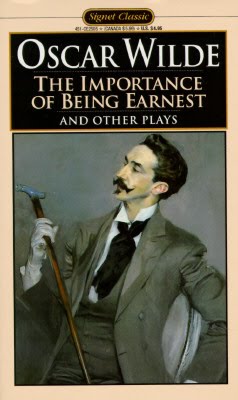
The Importance of Being Earnest

by Oscar Wilde
ages: adult
First sentence: “Did you hear what I was playing, Lane?”
I’d tell you to go buy it, but you can get this one online for free.

I really don’t have much idea what to say here. I’ve been a fan of the play for ages: my mom had a copy of a BBC production while I was growing up, and I remember watching and finding it hilarious. And I own the Colin Firth/Rupert Everett version which still makes me laugh. Judi Dench is so fabulous as Lady Bracknell.

So, I don’t really know what I expected to get out of reading the play, if I expected anything. I guess I was kind of curious to see how the movie version held up to the actual play, and I also figured since I loved it so much I should actually read the play. That, and I have decided that I really like Wilde’s writing. So, I wanted to read more of him.

And, the long and short of it: I like it better performed. That shouldn’t have come as a surprise; I have a terrible track record reading Shakespeare, and I don’t see why any play should be different. The lines weren’t as funny, the silliness of it all came off as banal rather than hilarious. I’m terrible at reading inflection and timing; I need narration. And while I enjoyed it, I didn’t love it like I love the movie. I did find out (and it’s to be expected) that the movie does take some liberties with the play, giving Lady Bracknell a past, and switching the ages of Jack and Algy around as examples, it’s really quite faithful to the original.

The play itself is a delightful spoof on Victorian England, on class restrictions, and on love in general. No matter how you get it, whether reading or watching, it’s quite worth your time.

Crunch

by Leslie Connor
ages: 10+
First sentence: “I saw it like this: a single worker at some faraway oil refinery with his head tilted down, peering into a pipe, waiting for one more drop that never came.”
Support your local independent bookstore: buy it there!

The unthinkable has happened: we’ve run out of oil. It’s not because of anything really drastic: no catastrophic natural events or wars. There is simply no more oil. Which means no more gasoline.

This means that 14-year-old Dewey Marriss and his four siblings are home alone — their parents are stranded in Maine on vacation — for who knows how long. In addition, the little bike shop they own and run is suddenly no longer little. Bikes are the new transportation, and everyone needs theirs fixed. Now. It all starts out okay, but the longer the crunch goes one, the more stressed the siblings become. It doesn’t help that Dewey thinks parts are slowly going missing; can he figure out who the thief is before everything completely collapses.

It’s a vaguely dystopian premise, though an interesting one to explore: what would happen to society and the infrastructure if the oil — for whatever reason — ran out? The book doesn’t go as far as a dystopian does: it really is a story of how Dewey and his siblings deal with the crisis. And it’s fascinating how that happens. It helps a lot that Connor’s writing is incredibly engaging; she keeps it simple yet doesn’t talk down to her readers. The mystery element comes on slowly, and it’s not really a central aspect to the book, but it’s still interesting.

Most of all, though, it’s an immensely entertaining book, one that kept me turning pages.

(Just for the record: because this is a Cybils nominee, I’ve been asked to make sure y’all know this is my opinion only, and not that of the panel.)