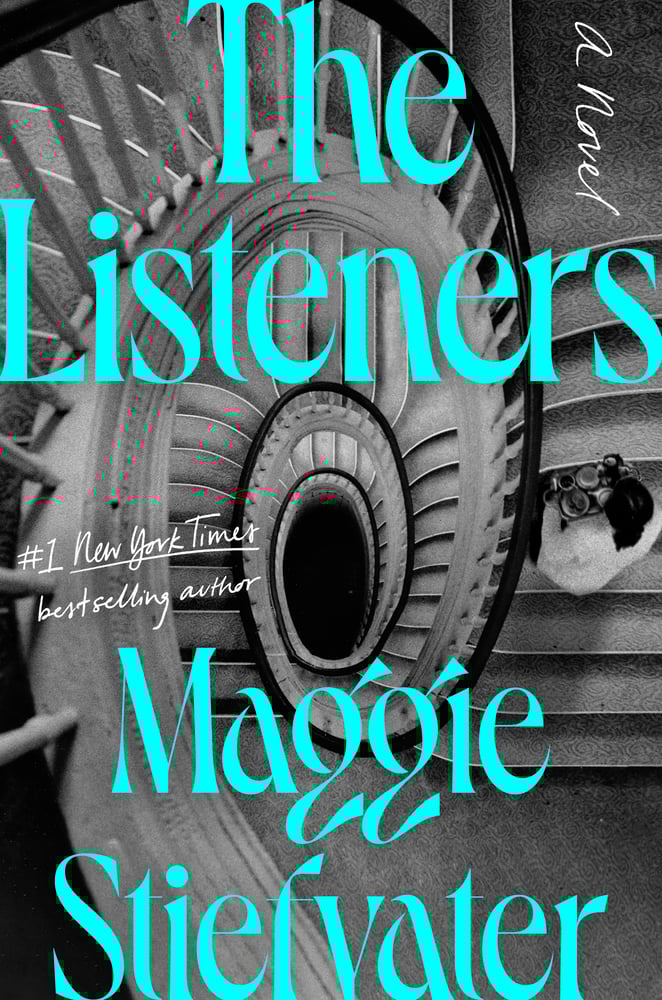
The Listeners

by Maggie Stiefvater
First sentence: “The day the hotel changed forever began as any other.”
Support your local independent bookstore: buy it there!
Content: There is some fade to black sex and actual Nazis. It’s in the Adult Fiction section of the bookstore.

June Hudson has worked at the Avalon Hotel – a luxury hotel in the mountains of West Virginia – since her mother abandoned her at age 10. She worked her way up from maid to general manager, earning the trust of the owners, the Gilfoyle family, and the staff. It helps that she knows how to keep the sweetwater – the water that runs through everything at the Avalon – from turning. But, it’s January 1942, and June has found that her hotel has been commendeered by the State Department to house diplomats from Germany, Italy, Japan, and Hungary while they figure out an exchange with those countries. The sweetwater feeds on emotions, and tensions are high as the diplomats crash. But, what can June do to keep these people – guests she didn’t want – happy, and keep the water from turning, and still keep the Avalon the Avalon. Because one thing is for sure: nothing will ever be the same.

I wrote a teaser review seven months ago when I first read it, and my opinion hasn’t changed much. It’s a delight to read. I adore the way Maggie writes characters, and June (and Tucker Minnick, the FBI agent) are no exception. She also has a way of creating a place that comes to life; I could see and hear and feel the Avalon around me. I liked that the stakes were high, but nothing was unreasonable. It all made sense in the context of the book. It was as much of a delight to read this time around as it was the first.

Absolutely one of her best.
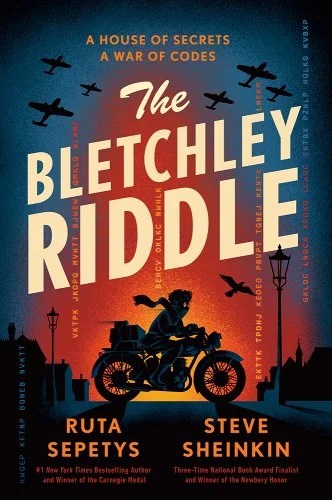
The Bletchley Riddle

by Ruta Sepetys and Steve Sheinkin
First sentence: “First things first: a riddle.”
Support your local independent bookstore: buy it there!
Review copy pilfered from the ARC shelves at work.
Content: There are some intense moments, and talk of a small crush. It’s also a bit on the longer side for middle grade books. It’s in the Middle Grade (grades 3-5) section of the bookstore, but is probably for the older end of the age range.

Lizzie Novis is supposed to get on a boat to America to be with her grandmother because London is evacuating in preparation for Hitler’s invasion. Except she believes her mother is not dead and wants to look for her, so she evades getting on the boat and heads to Bletchely Park (or rather, the address she has for her brother which turns out to be Bletchley Park) to be with her brother Jakob, who has been working at the top-secret code-breaking facility.

Once there, Lizzie has the unwelcome job of trying to convince Jakob of her belief that their mother is still alive, and part of that is finding proof. All the while, Jakob is part of the team that is trying to figure out the codes for the Enigma machine so they can break the coded transmissions they’re getting from Germany. And Hitler’s army is on the march, coming closer to Great Britain. It’s all a lot to handle.

I have been selling this book for months solely on the basis of the authors’ names. Seriously: any book written by Sepetys and Sheinkin HAS to be good, right? And, dear reader, it was. Of course it was. They just have a way of writing historical fiction and history that makes it seem exciting, that brings it to life. And this book – with spitfire Lizzie and anxious, concerned Jakob, plus the rest of the cast of kids and code breakers – did exactly that. It was fun, intense, often funny, and a page-turner. It didn’t exceed my expectations, which were admittedly high, but it did absolutely meet them.

And you can’t ask for more than that.

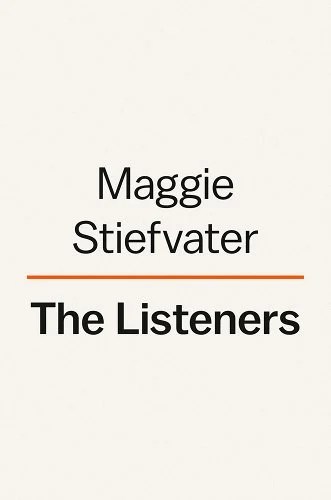
The Listeners

by Maggie Stiefvater
Support your local independent bookstore: buy it there!
Release date: June 3, 2025
Review copy provided by the publisher.
Content: There is some fade-to-black sex and talk of Nazis. It will be in the Adult Fiction section of the bookstore.

The story goes like this: Maggie announces that she’s got a book out in June, that it’s published by Viking. She then posts, saying (much more Maggie-like) that she announced too early. But, by this time, I figured out that Viking is published under Penguin, and I emailed our Penguin rep asking if there are ARCs and if can I have one. He emailed back saying that it was super early, and maybe… though later, when I saw him in person, he admitted I caught him off-guard because he had no idea about the book. At any rate, her editors were looking for people to read early manuscript copies, and he gave them my name. Eventually (a month after he told me all this!), the book came in the mail to the owner, who then asked if I wanted it. I had a fangirl moment “Ohmygod, ohmyGod, OHMYGOD, YES!” (she laughed at me) and then took it home and read it practically in one night.

This won’t be a real review; I will want to read it again when it comes out, to get more out of it, to enjoy the cover (that’s just a placeholder there), and to write a real review. But know this: if you like Maggie’s work, you will like this one. The magic is subtler than in her other books, but it’s all very much Maggie. And the characters are so fascinating, so complex. And there are so many little turns of phrase that just melted my heart and caught my fancy. It’s going to be a good one.

I can’t wait for others to get to read it!

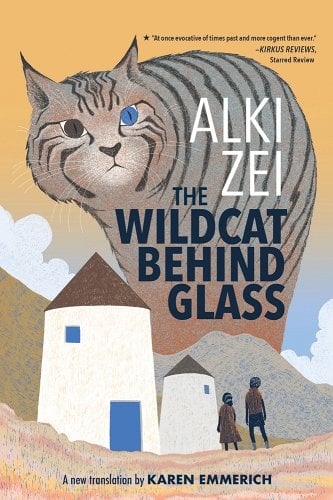
The Wildcat Behind Glass

by Alki Zei
Translated by Karen Emmerich
First sentence: “Winter Sundays are the most boring days of all.”
Support your local independent bookstore: buy it there!
Content: It’s a little long and talks bluntly about fascism. It’s in the Middle Grade (grades 3-5) section of the bookstore.

It’s 1936 in Greece and all Melia wants is to run and play, listen to their grandfather tell stories about his “ancients”, and hang out with her sister, Myrto. But, it’s 1936, and the adults are all concerned about the rise of fascism and the overthrowing of the king. It really doesn’t help when their older cousin Nikos ends up in hiding because he’s wanted by the government. Or, when, in the fall, they go to a public school for the first time (they were homeschooled before), and Myrto gets sucked into their school’s phalanx, which is kind of like the Hitler Youth Program. Melia doesn’t quite know how to process everything.

And, honestly, after finishing this book, neither do we. It was initially written in 1968, and you can feel that when reading it. It’s a lot of everyday stuff happening, and not a lot of conflict and resolution. In fact, the book just kind of ends, and peters off without any real resolution. (Well, spoiler: Nikos gets away, but that’s about it.) Also, a bone to pick with the marketing: the back reads as if the titular wildcat- a taxidermied cat in Melia’s house – was magical and took them on adventures. It’s not. I wanted it to be. But there is no magic adventures here. I think the author wanted to tell Nikos’s story, but someone told her that it would be better if you made a young girl the protagonist and so she did that. Nikos was a much more interesting (and less whiny!) character. Oh well.

At least it wasn’t terribly long.

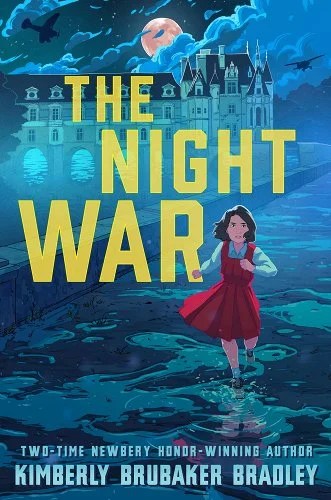
The Night War

by Kimberly Brubaker Bradley
First sentence: “I could hear sirens.”
Support your local independent bookstore: buy it there!
Content: There are intense moments, including a round-up of Jews to go to concentration camps. It’s in the Middle Grade (grades 3-5) section of the bookstore.

Miri and her parents are living in Nazi-occupied Paris in 1942, after fleeing Germany after the kristalnacht. They’re making do in a small apartment, but they have Jewish neighbors and it’s working. That is, until the French police raid the neighborhood and round all the Jews in France up. Miri escapes with her neighbor’s 2-year-old daughter, Nora, and after finding refuge in a nunnery (the nun saved her from an interaction with a Nazi soldier), she is separated from Nora and sent to a Catholic school in the French countryside. She has to pretend to be a Catholic, which is hard. The only bright side is that she’s close to the Vichy border, and escape. Can she find Nora and get across before she is found out?

On the one hand: this is a well-written book. (I have issues with the ghost, but aside from that.) Bradley knows how to pace a story and knows how to make a historical story relatable (in this one: all religions are valid, we shouldn’t be afraid of those who are not like us, we shouldn’t believe the propaganda we hear). However, I am just so tired of World War II books. I just am. I know these stories need to be told, but I am so so very tired of them. And, I don’t think that the ghost in this one was necessary. Bradley used the ghost as a narrative cop-out – Miri was the only one who could see the ghost and it helped her get out of sticky situations.

I just wanted more (or something entirely different) from this one.

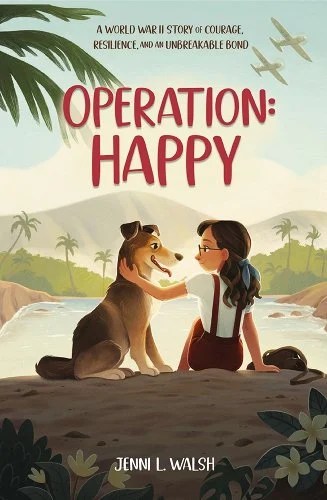
Operation: Happy

by Jenni L. Walsh
First sentence: “A dog is at the top of my wish list.”
Support your local independent bookstore: buy it there!
Content: There are some intense moments – bombs dropping on Pearl Harbor, and an attempted assault – though it is short and age-appropriate. It’s in the Middle Grade (grades 3-5) section of the bookstore.

Jody is the daughter of a Marine, who is stationed in Pearl Harbor in 1940. If you know history, you know where this is going. The book is divided into two: before the attack, where Jody is enjoying living in Hawaii and having her family around, and then after, when she, her mom, and her sister are evacuated to San Francisco, dealing with the aftermath of the attack.

It’s a slim book to handle all that’s in there, but Walsh handles it quite beautifully. As a reader, you get a sense of the idyllic Hawaiian life before the attacks, how Jody loves spending time with her dog and her family. And then the intensity of the attacks and the spiral afterward, when Jody’s mom becomes overwhelmed and depressed and Jody and her sister have to figure out how to deal with creating a livable life for themselves in San Francisco. And I appreciate that while Walsh didn’t sugarcoat the panic or the fear, she made it age-appropriate.

The only thing I didn’t get was the purpose of the chapters written from the dog’s perspective. While it never veered into speculative, I didn’t feel like they added much to the story. But, aside from that, it’s a charming historical novel that addresses some intense subjects.

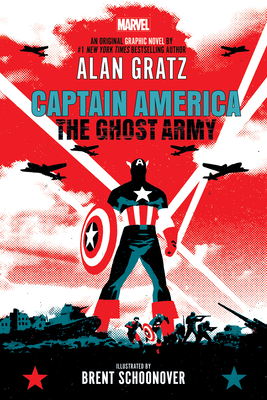
Captain America: The Ghost Army

by Alan Gratz, illustrated by Brent Schoonover
Support your local independent bookstore: buy it there!
Publication date: January 3, 2023
Review copy provided by the publisher
Content: There is violence depicted, but not terribly graphically It’s in the middle grade graphic novel section of the bookstore.

Captain America and Bucky are in the field in the middle of World War II when they encounter something they’ve never seen before: Ghost Nazis. They defend themselves against some Nazis, later coming back as indestructible ghosts. The source of this turns out to be a magician that’s trying to prove something to his grandfather and (dead) father. It happens to be just outside of Romania (yes there was a Dracula joke), and Bucky and Cap find a good Romany family to help them infiltrate the magician’s castle and defeat them.

Give this to either a kid who is a history buff but also wants a bit of action/adventure/magic with it or a kid who is a Captain America fan and won’t mind the history bit. Alan Gratz is known for his middle-grade historical fiction books, and you can tell here that he knows his stuff. It’s jam-packed with tidbits about WWII – mentions of the Japanese internment and the United States “Ghost” Army. It’s got adventure and a small bit of romance. Perfect for lots of kids.

Honestly, though? It’s not for me. I found it kind of pedantic and predictable. And the relationship between Cap and Bucky was kind of weird (i was expecting more Batman/Robin, and it didn’t quite hit). But I can see how certain kids will eat it up.

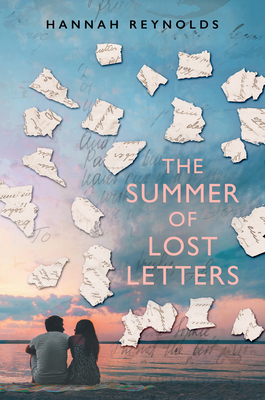
The Summer of Lost Letters

by Hanna Reynolds
First sentence: “I am going to try to explain.”
Support your local independent bookstore: buy it there!
Content: There is some teenage drinking and a few swear words including a couple of f-bombs. It’s in the Teen section (grades 9+) of the bookstore.

Abby Shoenberg isn’t really looking forward to the summer — her best friends will be gone away to camps and she doesn’t want to bump into her now ex-boyfriend around their small Massachusetts town. Then a package of her recently passed grandmother’s letters arrives, and they’re juicy: a series of love letters from an Edward on Nantucket island. The thing is: her grandmother — who came to the US by herself in 1934 before the War, and whose parents didn’t survive the Holocaust — never mentioned this Edward, or that she had ever spent any time on Nantucket. And suddenly, Abby has a plan for the summer: find a job and go live on Nantucket, and do some digging. Maybe she could find not only this Edward but her grandmother’s family: with the war and being so young, she had completely lost track of everyone, especially after finding out her parents were killed.

The thing is: Edward is the head of a very rich business family, with a huge estate on Nantucket, and Abby finds herself reluctantly getting the assistance o his grandson, Nick. And the more they find out, the more time they spend together, the closer they become.

Oh this was just the smart, sweet, interesting teen romance I needed. I liked that while it dovetailed into World War II, it wasn’t set there, and while the war had an impact on the story, I’ m not sure it was the most important impact. I liked that the characters were Jewish, comfortable in their faith, but also honest about antisemitism. I liked the romance; Reynolds has a way with writing chemistry and tension, and I liked the push and pull between Nick and Abby. It felt real. I also liked Abby’s obsession with learning her history; she is right that our ancestors stories mean something, even if they are not always the best or most honorable.

It was an excellent YA romance, fluffy and fun but with depth as well. I loved it.

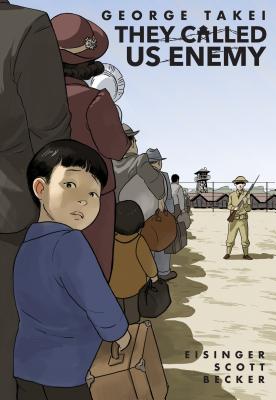
They Called Us Enemy

by George Takei, Justin Eisinger, Steven Scott and illustrated by Harmony Becker
Support your local independent bookstore: buy it there!
Content: There is violence, some swearing, and many racist actions. It’s in the graphic novel section of the bookstore.

Everyone knows George Takei as Sulu on Star Trek (and as a side note, Hubby and K and I are working our way through the original series on Netflix — a consolation prize for not paying for CBS all access so we can watch Picard — and are enjoying it immensely). And if you’ve followed Takei on social media at all, you know about his childhood in the Japanese internment camps during World War II. But, since not everyone knows about this (shameful) part of our past, and because his story is relevant today with the ICE camps in California and Texas, he decided to tell it as a graphic novel.

It’s a tough story, but an important one; Takei was about 4 or 5 when his family was shipped off to live in one of the camps in Arkansas. He admits that he doesn’t remember much, and that he is grateful his father was willing to talk about their time in the camps (many of those who were sent felt shame and didn’t talk about it). It reminded me of John Lewis’s March, in that this is framed by a TED talk, by Takei looking back at this time. It’s a mirror to white people, at how harsh and how exclusive and judgmental we can be. And what the government will do — to citizens! — in the name of national security. (War is just awful.) While I’m not entirely sure the storytelling was smooth and the art was good but not brilliant, but the story is important enough to make this one worth reading.

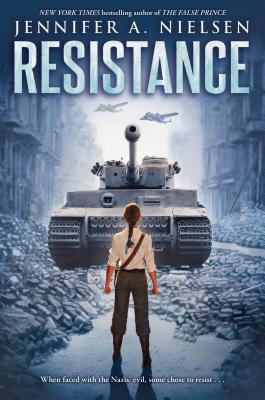
Resistance

by Jennifer A. Nielsen
First sentence: “Two minutes.”
Support your local independent bookstore: buy it there!
Content: There is a lot of violence, and talk of death. It’s in the middle grade (grades 3-5) section of the bookstore.

Chaya is a teenager in the Krakow ghetto during World War II, and after her younger sister and brother disappeared (presumably put on a train to the death camps), Chaya decided that she wasn’t going to sit idly by and let the Nazis destroy her world. So, she joined the resistance as a courier. She could pass as a Polish (non-Jewish) girl, so she took to smuggling supplies into the ghetto and people out.

But her path didn’t end there: when things on a raid go wrong, Chaya and her friend Esther find themselves on the road to Warsaw, dodging Nazis and Nazi sympathizers until they get to Warsaw and are able to join the Jewish resistance for the Warsaw Ghetto uprising (which was a real thing).

This is really good historical fiction, if you’re not already tired of World War II stories. I got the distinct impression that Nielsen was trying to use this as a lesson for the climate in the US today — there were multiple references to people who just sit idly by and watch the horrors of the world being on the wrong side of the fence — but honestly? I’m tired. I know Holocaust stories are important. And I believe that everyone should learn about them, so we don’t repeat history. I’m just, personally, quite done with them. I liked Chaya well enough, I respected her journey, I got that Nielsen was telling me that I needed to be more pro-active in resisting hate and evil in this world.

But all that said, I didn’t quite like the book. I think it’s me, though, and not the book.