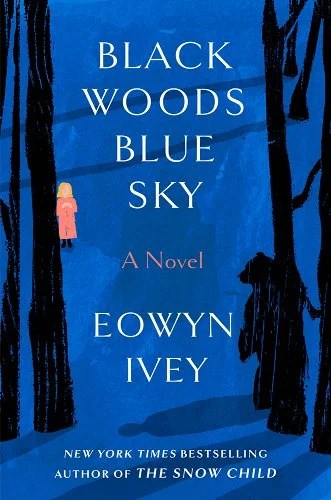
Black Woods Blue Sky

by Eowyn Ivey
First sentence: “Birdie knew her mistake as soon as she cracked open her eyes.”
Support your local independent bookstore: buy it there!
Release date: February 4, 2025
Content: There is animal-based violence, swearing (including multiple f-bombs) and death. It will be in the Fiction section of the bookstore.

Birdie is a 26-year-old single mother in a remote Alaskan town, and is trying to get her life together. She’s got a job at the local lodge, and while it kinda-sorta pays the bills, it does mean she has to leave 6-year-old Emaleen on her own or with Birdie’s grandmother much too often. But then Arthur wanders down from his cabin on the other side of the North Fork River, and Birdie takes a liking to him. Sure, he’s odd: he doesn’t eat much or talk much, but he lives a wild and free life in nature, something that Birdie craves. So, she arranges for her and Emmaleen to go with Arthur (against the advice of other townsfolk, including Arthur’s dad) out to his cabin. Where everything is perfect, until it isn’t.

Ivey’s writing is so spare and so beautiful that you don’t really notice the impending doom, though the clues are there. And while this wasn’t a book to tug at my heartstrings, I did find it hard to put down. I kept wanting to know what would happen next. And Emaleen becomes more central to the story as it goes on, which I thought was a fascinating way to tie everything together. It’s a love letter to the Alaskan wilderness, to the harsh unforgiving beauty and wildness of nature and the epic scale you can find both beauty and horror there. The people who live and thrive in Alaska are a unique sort, and Ivey pays testament to that spirit.

It’s a remarkable book, and one where the characters and the haunting beauty of it all will stay with me for a while.

Audiobook: The Sun is a Compass

by Caroline Van Hemert
Read by Xe Sands
Support your local independent bookstore: buy it there!
Or listen at Libro.fm
Content: There’s some swearing, including several f-bombs. It’s in the creative non-fiction section of the bookstore.

I picked this one out of my audiobook stash primarily because I’m a sucker for travel books, and this one — in which Caroline and her husband Patrick traverse from Bellingham, Washington to the Arctic Circle entirely on foot and boat over the course of six months –seemed to fit the bill.

A biologist by trade, Van Hemert also grew up in Alaska, and has had a need for adventure — or to at least be in the outdoors — her whole life. And she found a kindred spirit in Patrick, who (if I remember right) built his own cabin in Alaska (though he grew up on the East Coast) and lived in it for a year between high school and college. They are the sort of people to decide to spend six months trekking 4000 miles and then write a book about it.

I don’t mean to sound bitter (if I do); they are amazing people. And I’m glad that there are people like them out there. I’m not sure this one worked entirely in audio; while I was transfixed with the story, I was a bit frustrated I didn’t have a map. The places she was talking about (aside from Bellingham; I know where that is) were foreign to me. Sure, I could have stopped the book and Googled it, but I listen while I drive, and it wasn’t practical. That said, I did enjoy her story, the ups and downs of six months of backwoods hiking, and the reminder that the world is a big, wild place that has been here (and will be here) a lot longer than we humans.

The Wild Robot Escapes

by Peter Brown
First sentence: “Our story begins in a city, with buildings and streets and bridges and parks.”
Support your local independent bookstore: buy it there!
Review copy provided by the publisher.
Others in the series: The Wild Robot
Content: Same as the first one: short chapters, large print, illustrations. It’s in the middle grade (grades 3-5) section of the bookstore. This one, like the first, would also make a good read-aloud.

Spoilers for the first one, obviously.

When we left our fair robot Roz, she was being airlifted off her beloved island and transported back to the city. She was reprogrammed, and then sent out to be a farm robot, helping a family. Except, she wasn’t reprogrammed enough: she remembered her life on the island and her son, Brightbill, and while she wasn’t entirely unhappy at the farm — cows are good conversationalists and Roz had a lot to do — she missed her, well, home. So, she sets out to escape, which leads her on a whole adventure trying to get back to her island.

It’s much of the same as the first book here: intrusive narrator (but again, not so much that it was bothersome) and Roz is a very sweet character to root for. I liked her adventure this time, and the different things she saw and how her story spread out and paved the way for her to get back. The ending was sweet and satisfying at the same time, which was nice.

It really is a delightful story.

The Wild Robot

wildrobotby Peter Brown
First sentence: “Our story begins on the ocean, with the wind and rain and thunder and lightning and waves.”
Support your local independent bookstore: buy it there!
Release date: April 5, 2016
Review copy provided by the publisher.
Content: It’s fairly large print, with illustrations. It’s good for third grade and up (and is in the middle grade section of the bookstore), but would make a great read-aloud for younger kids.

After a hurricane, the ROZZUM unit 7134 robot washes up on the shore of an uninhabited island. The robot is inadvertently activated by some otters, and Roz (as she introduces herself) comes on. She doesn’t know that she isn’t supposed to be on the island, so she sets about trying to figure out what this place is and how to fit in. She initially meets resistance from the animals: they call her a monster and try to run her off the island. But, through time and some cleverness, Roz learns to adapt. She makes friends with the beavers. She accidentally orphans a goose, but then adopts him as her son. She learns how to fit in.

There really isn’t much to this book; there’s a lot of narration and an intrusive narrator that I didn’t mind terribly much. Because of that, I think this would probably make a better read-aloud than one kids are going to want to pick up. That said, I tossed it in K’s direction for a book report, and so far she’s enjoying it. It helps, I think, that the chapters are short (some as little as one page) and there are illustrations liberally scattered throughout.

In the end, I found I really liked it. I came to really care about Roz and her relationship with the animals. And while I didn’t really care for the abrupt ending (sequel, anyone?), I cared about the journey. And it was an interesting mix of tech — Roz was able to use her computer database to find out answers — and nature — the winter was rough, animals (even though they were talking) died.

A very intriguing book, in the end.