Bone Gap

by Laura Ruby
First sentence: “The people of Bone Gap called Finn a lot of things, but none of them was his name.”
Support your local independent bookstore: buy it there!
Content: There’s some intense situations, some creepiness, and some on-screen, tasteful sex. It’s also pretty mature in its themes. For those reasons, it’s in the Teen (grades 9+) section of the bookstore.

Bone Gap is one of those places that everyone knows everyone else’s business and opinions once formed aren’t so easily changed. So, everyone knows that the Rudes are hopeless and mean. That Charlie Valentine is just plain weird. And that Priscilaa — who insists upon being called Petey — is homely. And that Sam and Finn are okay without their mom, who ran off, but they could be better. And that the strange newcomer, Roza, is the most beautiful girl ever.

They also know that Finn’s not the most reliable person; he’s kind of spacey, like his mom, and so when he says some guy in a black SUV took Roza, no one believes him. They chalk it up to “women are always leaving those boys”. They assume that Roza wants to go. But Finn? Finn knows different. So, he sets about trying to find Roza, not because he loves her but because his brother does and his brother can’t quite bring himself to find her. Little does Finn know that looking for Roza will change everything.

I have been sitting here, staring at the screen, trying to figure out what to say about this book. It’s not that I didn’t like it; I did. But I didn’t love it like I felt I should.

My favorite part?  The women. I loved them. I loved Roza and her desire to be Seen for herself and not for her beauty. I loved Petey and her fierceness. I wished there were more women to love, because Ruby knows how to write them whole and complex, people rather than stereotypes.  I liked that they saved themselves, even though the men weren’t worthless louts or even helpless. It was something that was just Done, that they rose up and just did that. They were my kind of women. I also loved the idea that what we assume about other isn’t always the Truth. That there’s more to people than what we see.

But aside from that, I didn’t really love it. Maybe it was the whole magical realism thing; that genre and I have never really quite gotten along. I think I prefer my magic overt: if there’s going to be something strange going on, then give me magic with Rules. I didn’t understand what was going on until the book was nearly done, and that left me feeling, well, stupid.

So, I didn’t enjoy it as much as others on the interwebs, but I still think it’s a novel worth reading.
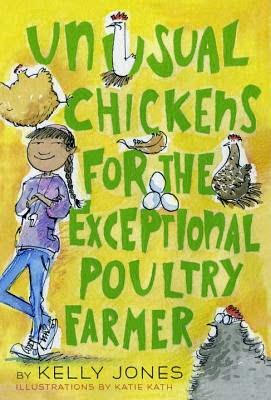
Unusual Chickens for the Exceptional Poultry Farmer

by Kelly Johnson
illustrated by Katie Kath
First sentence: “My great-uncle Jim had your flyer in his barn.”
Support your local independent bookstore: buy it there!
Review copy swiped off the ARC shelves at my place of employment.
Content: There’s some tricky words, and I’m not sure whether or not the epistolary format will turn off reluctant readers or encourage them. There’s a lot of fun illustrations and some good chicken facts, though. It’s in the middle grade (grades 3-5) section of the bookstore, but I’d probably give it to a confident 2nd grade reader.

Sophie Brown and her parents have just moved from the bustling city of Los Angeles to a farm in the middle of nowhere California. It was a move partially because of necessity — her dad lost his job and hasn’t been able to find a new one — and partially out of happenstance — Sophie’s dad’s uncle died and left him the farm. So, they’re trying to figure this whole thing out. And it’s not going terribly well. That is, until Sophie discovers a catalog for “exceptional” chickens. Turns out, that Uncle Jim was not only a farmer (he had a vegetable garden and some grape vines) but he raised, well, unusual chickens.

The chickens are not quite magical, and they’re based on real chickens, but they’re not quite normal either. (One lays glass eggs, for example.) Sophie is given instructions by the person who runs the catalog on how to catch and care for the chickens, but someone is trying to steal Sophie’s chickens. The question is: will she figure out how to keep the chickens (without divulging their magical properties)? And can she stop the thief from stealing her chickens?

The cleverest thing about this book is the format: Sophie’s story spills slowly over the course of the book through letters she writes to her dead abuela, dead great-uncle Jim, and the chicken place. (It’s kind of unusual her writing to dead people, but it works. She doesn’t really expect an answer back.) It’s a very one-sided story, and we only get snippets of things other than chickens: her mother’s free-lance writing, or her father’s failing search for a job. But, the tone is light, and there is a mystery to be solved with the chicken thief. But what really comes through is Sophie’s voice. She’s a determined child, someone who is willing to figure things out and solve problems. She’s spunky. And she’s half Latina. All of which makes for a charming book, a fun read, and a book worth checking out.

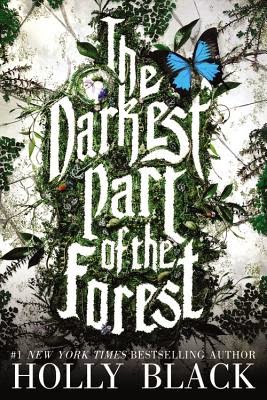
The Darkest Part of the Forest

by Holly Black
First sentence: “Down a path worn into the woods, past a stream and a hollowed-out log full of pill bugs and termites, was a glass coffin.”
Support your local independent bookstore: buy it there!
Content: There’s a few f-bombs and some teen drinking at the beginning. And some intense kissing, not to mention violence. It’s in the Teen section (grades 9+) of the bookstore.

Siblings Hazel and Benjamin have grown up in Fairfold, where they know that faeries are in the forest. They know not to mess with the fairies, but since Ben was blessed (cursed) to make gorgeous music as a child and Hazel has always been drawn to the forest, they really didn’t listen. They made up stories about the prince that was in the glass coffin, they fought some bad faeries, and Hazel even made a bargain with the Alderking to help with Ben getting some musical training.

But all that was in the past. Hazel, now 16, is reckless with boys’ hearts and Ben stopped making music years ago.

And now the prince in the coffin is awake and Hazel’s life is falling apart. The question is whether or not Hazel can figure things out before her life is completely destroyed.

I love Black’s storytelling. Wholly and completely. She pulls you into the world she creates, and makes you believe everything she writes. I loved Hazel in her brokenness, and her relationship with Ben. I loved that there were faerie characters and human characters in all shades of the rainbow (both in terms of skin color and morality). I loved the myth she spun around the town and these characters, and the way she worked with the whole idea of the fey.

I just loved the book. Period.

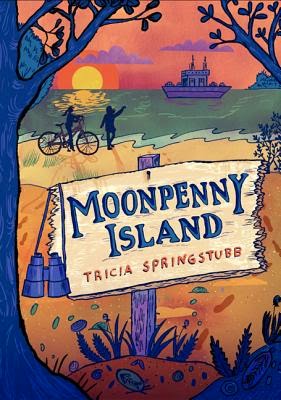
Moonpenny Island

by Tricia Springstubb
First sentence: “Transparent.”
Support your local independent bookstore: buy it there!
Review copy pilfered from the ARC shelves at my place of employment.
Content: It’s pretty basic, language-wise, with short chapters and simpler words. Good for anyone who likes friendship stories. It’s in the Middle Grade (grades 3-5) section of the bookstore.

Flor and Sylvie have been best friends forever. Growing up on a small island in the middle of Lake Erie (it’s doesn’t exist, but it’s possible, though I had to look it up) on the Ohio side, they were pretty much all they had. Which was just find with Flor. Then things change: Sylvie is sent to Cleveland to live with her aunt and go to school there. And Flor’s mother leaves as well, and they don’t know when — or if — she’s coming back.

With her life falling apart, how can Flor cope?

Once I got over my annoyance about the whole there’s an island in Lake Erie by Toledo thing… I found I really liked it. It’s not magical quirky, but it does fit with the whole small-town quirky thing. I liked how Flor knew everyone on the island, and was willing to stick up for the less “acceptable” members of their community. I liked how Springstubb introduced a scientific-minded, homeschooled girl into the mix, and how she wasn’t weird or unusual or super-religious. I felt like Springstubb tackled everything — from problems at Flor’s home to problems with her friends — with an evenness that suited her audience.

The only thing that bothered me, really, about the story was that it had the feel of a first person narration, but it wasn’t. For the most part, I was able to flow with it, but every once in a while, it pulled me out of the story.

But that’s a small quibble in an otherwise good book.

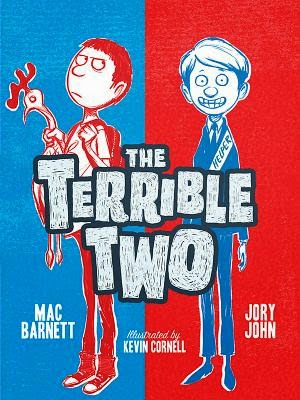
The Terrible Two

by Mac Barnett and Jory John, illustrated by Keven Cornell
First sentence: “Welcome to Yawnee Valley, an idyllic place with rolling green hills that slope down to creeks and cows as far as the eye can see.”
Support your local independent bookstore: buy it there!
Review copy snagged from the ARC shelves at my place of employment.
Release date: January 13, 2015
Content: It’s a bunch of silly pranks. Simple writing and lots of illustrations make it good for younger and reluctant readers. It will be in the Middle Grade (grades 3-5) section of the bookstore.

Miles Murphy is The King of the Pranks. Or, at least he was back in his old school. But in his new one? Not so much. Oh, he tries to become the king again. But in small Yawneee Valley, Miles is finding it difficult to get a good prank in. He keeps being thwarted by someone else. Soon, it’s an all-out prank war, the like Yawnee Valley has never seen.

As soon as I saw this one, I snagged it; Mac Barnett is one of my favorite picture book writers, and I figure he and his friend (or so the bios say) Jory John had to produce something worth reading. I was right (of course!). It’s hilarious. Silly and stupid. Dumb and amusing.

It’s perfect.

Really. It’ll be great for the reluctant readers who need something silly to keep them turning pages. (Plus: illustrations!) It’s got some great conflict, a hilarious buffoon of an adult to root against, and the best. ever. prank. at the end.

What more could you ask for in a book?

Absolutely nothing.

Audiobook: Randi Rhodes Ninja Detective: The Case of the Time Capsule Bandit

by Octavia Spencer
Read by the author.
Support your local independent bookstore: buy it there!
Content: There wasn’t anything objectionable. I don’t know how it’d be reading it, but my 8-year-old followed the story pretty well while listening to it. We did have to stop the audio a few times to explain some things, however. It’s in the middle grade (grades 3-5) section of the bookstore.

I threw this in the audiobook pile mostly because I’ve seen it at the store and wondered if it was any good. (I know: celebrity authors. Ugh. But, sometimes they surprise me. Not often, though.)

Randi Rhodes is a die-hard city girl. She’s grown up in Brooklyn and loved every minute of it. Her family summers in Deer Creek, Tennessee, which is just about the right length of time for a city girl to spend in a boring, dull, small town. But the year after her mother dies (I called that pretty early on; I do get so tired of dead parents), her father, a mystery writer, packs the two of them up to live full-time in Deer Creek. Randi is not happy about this.

But, once there, she falls head-first into a mystery: the 200-year-old time capsule for the town’s Founder’s Day has been stolen. And they have 72 hours to get it back. Much against her over-protective father’s wishes, Randi (and her two new friends, D. C. and Pudge) decide that they are the only ones to solve the mystery.

It’s a pretty run-of-the-mill middle grade mystery book. Nothing too fantastic or brilliant; in fact, as an adult, I’ve seen all the tropes before. The banker is a Bad Guy, as is the power-grabbing Mayor. There’s a grumpy old man with a heart of gold, and a woman sheriff who’s a bit bumbling. (Though — spoiler — this isn’t a true middle grade novel, because by the end, you discover that the sheriff isn’t bumbling at all, but has instead figured out the mystery WAY before the kids ever did.) The best parts of the book are when Randi and her friends are out being detectives; the worst are the angsty tensions between her and her overprotective dad. I got extremely tired of the rants Randi went on about not being “understood.” (But that’s a parent speaking. I did appreciate that Randi was a non-girly girl; she was often ranting about how she wasn’t a princess and didn’t need protection. She’s a black belt in Tae Kwon Do, after all.)

In the end, it wasn’t anything special, though A and K enjoyed listening to it. But, it wasn’t absolutely horrible, either, and Spencer did an admirable job of narrating her book (which I would expect, with her being an actress and all).

Fat Boy vs. The Cheerleaders

by Geoff Herbach
First sentence: “Shortly before midnight on June 15, Gabriel Johnson, a sixteen-year-old from Minnekota, MN, was apprehended outside Cub Foods by Officer Rex McCoy.”
Support your local independent bookstore: buy it there!
Review copy pilfered from the ARC shelves at my place of employment.
Content: There’s a lot of swearing, none of it strong. I put it in the Teen (grades 9+) section of the bookstore primarily because I like to keep the YA section toned down. Also, because that’s where all of Herbach’s other books are. I’d say, depending on your kid, it’s good for as young as 7th graders.

In high school, there are two types of people: the jocks and everyone else. Gabe is everyone else.  Actually, Gabe is a band geek, and a mostly friend-less loser. He’s been going downhill since his mom ran off with a Japanese guy a few years back, and his grandpa moved in. It’s not just that he has only two friends, it’s that he’s overweight. Massively so. In fact, everyone (including his friends) call him Chunk. And he’s okay with that.

Gabe spends his days chugging Code Red, primarily because the money in the school’s soda vending machine goes to support the band that is Gabe’s lifeline. He figures he can chug 5 bottles of the stuff, if the money goes to fund his program. Then he finds out that a Super Sekrit school board meeting took away the vending machine money from the band and gave it to the Brand Spanking New dance team. Which makes Gabe mad. Eventually.

There’s more to the plot, of course, but it’s more about Gabe gaining self-respect than any eventual result. You know from the start — the whole book is his confession; a one-sided conversation with a Mr. Rodriguez — that he’s gotten arrested for doing something. You assume it’s for stealing money out of the vending machine. But, things are more complex than that.

Part of the charm of this book is the format; I was entertained by hearing only one side of the conversation, and imagining what Mr. Rodriguez’s side was. But, it was also Gabe. He was such a loser to start with, and it’s empowering to see how he regains control over his life, in spite of the people — from his friends to his father — who are trying to hold him back. Everyone needs a summer in which they find their best selves, and this story of Gabe’s was a truly fun one.

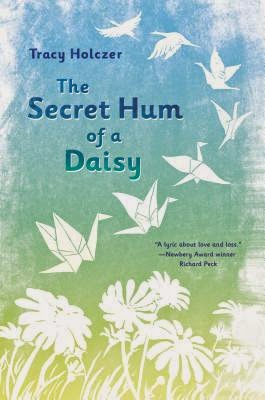
The Secret Hum of a Daisy

by Tracy Holczer
First sentence: “All I had to do was walk up to the coffin.”
Support your local independent bookstore: buy it there!
Review copy downloaded from Edelweiss.
Content: The subject matter — death and forgiveness — is a bit mature, but not so much that I don’t think a fourth-grader could handle it. There is some talk of crushes and bras, but even that is pretty tame.

It has always been just Grace and her mother. For 12 years, they’ve been wandering from city to city, finding work and a place to live here and there, never really settling down. When they finally make it to Sacramento, moving in with another single mom and her daughter, Grace finds she’s had enough of moving. She and her mother argue, and later that night, her mother dies in a tragic accident.

Suddenly, Grace is faced with moving in with her grandmother, whom she’s never met (and has a terrible opinion of, since she kicked Grace’s mom out when she got pregnant). To say it’s not something she wants to do is an understatement. At first, she tries to resist moving in with her grandma; she takes to sleeping in the shed, and tries to pull pranks to get her grandma to send her back to her friends’ house, where she was living. But, slowly, as she gets accustomed to the town, she learns that clues to her mother’s past, and therefore hers, are there, and slowly builds a home for herself.

I’ve read a lot of books with dead parents, so it takes something special to make one stand out of the pack. And I think, in many ways, this one had that something special. First: it was death-by-accident, and Grace was the first one to find her mom. It was realistic in that they argued, it was sudden, and Grace has to live with that. There’s also the non-shiny way everything fit together. Grandma was curt and doesn’t deal with loss well. Grace was petulant and stubborn and doesn’t deal with loss well. People are selfish, and unhappy, and yet…. it all works to make it feel more real than grating (it sounds grating. It isn’t. Well, maybe a little. But that helps give Grace her growth arc.). I also enjoyed the artistic thread that weaved its way through the book; Grace’s mother was an artist, her grandmother a landscape designer, and she’s a writer. The words of Robert Frost also tie this book together, giving it a poetic feel. It’s also a very hopeful book, one that looks past grief and loss to find a new beginning.

And one I found that, in spite of being about death and loss, I thoroughly enjoyed.

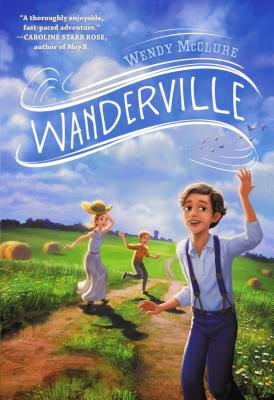
Wanderville

by Wendy McClure
First sentence: “Jack didn’t notice the smoke until there was far too much of it.”
Support your local independent bookstore: buy it there!
Content: There’s a some bullying and a fire that kills a family member of a main character, but that’s about it. It’s short enough to be a beginning chapter book, but it might be too challenging for most 1st and 2nd graders. Definitely belongs in the middle grade (3-5th grade) section of the bookstore.

Jack lives in a walk up in New York City in 1904. Their family is poor, but making it. That is, until a fire takes both their building and the life of Jack’s older brother. Frances and her younger brother Harold are orphans and living off the charity of one of the many orphanages in the city. Both find themselves on a train headed west, as part of the efforts of the Society for Children’s Aid and Relief Office. But, as all three find out, the best intentions of adults don’t always translate into good things for kids.

Faced with being separated from her brother, and looking forced labor in the eye, Frances, Harold and Jack decide to jump off the train before they reach their final destination. They’re wandering the Kansas prairie when they find Alexander, another orphan train escapee. He’s decided to start his own town, called Wanderville, and while it doesn’t look like much (or anything, really) it’s not his own. Unfortunately they way they get supplies is by “liberating” them from the nearby town. Which, obviously, is going to lead to trouble.

I wanted to like this one. It’s got a good idea — exploring the world of the orphans from the orphan train — and it’s set here in Kansas. I was hoping that it’d be a good contribution to historical/Kansas middle grade fiction. But it’s not. Perhaps it was me, but I didn’t like the characters, and felt the text itself was too condescending and predictable. I felt that if I had a checklist I would have ticked every single cliche off.  Bully on the train? Check. Evil man exploiting the system for his own gain? Check. Rugged and slow cop? Check. Sisterly figure who always knows better than the boys? Check. Adorable 7-year-old who is Wiser Than His Years? Check.) That’s not to say that kids won’t like it. I’m sure many will.

I just didn’t.

A Snicker of Magic

by Natalie Lloyd
First sentence: “‘They say all the magic is gone up out of this place,’ said Mama.”
Support your local independent bookstore: buy it there!
Content: Because the main character collects words, some of the vocabulary might be more advanced for some of the younger readers. Also, there’s a bit of a romance(ish; they’re more just really good friends though the hint is there) but it’s pretty tame. Is in the middle grade (grades 3-5) section of the bookstore.

All Felicity Juniper Pickle wants is to stop moving. Sure, she’s used to her mother’s wandering ways — the longest they’ve ever stayed in one spot has been six months — but that doesn’t mean she doesn’t long for the comforts of a true home and the ability to make friends. So when the Pickled Jalapeño (that’s their car) rolls into Felicity’s mom’s hometown of Midnight Gulch, Tennessee, Felicity hopes that they will finally settle down and call this Home.

Of course, getting her mom to settle down isn’t all that simple. And the longer they stay in town the more secrets are revealed about the town’s history. About why the ice cream there is so good. About why Felicity can actually see words floating through the air. And, mostly, about why her mother is so keen on wandering, and how Felicity can get her to stop.

And it all involves… a snicker of magic.

It’s a very quiet book, this, with a quiet sort of magic. And as I was reading this charming little story, the thought that came to me the most was that this felt a lot like Ingrid Law’s Savvy. This one is more Southern and small-town-ish than Savvy is, but at its heart, they’re quite similar. Both have a strong female character at the core, one who is determined to not only keep their family together, but to figure out how she fits in with everything else. And the magic is similar as well. Felicity sees words and “catches” them, by writing them down. (Which leads to a lot of fun word play: in addition to making words up — like spindiddly — words have textures, shapes and colors. It’s pretty cool.) The Blackberry Sunrise ice cream makes you remember. Her uncle sees colors when he plays notes. Someone in town doesn’t show up in pictures. Nothing grand, nothing life-changing, but magic nonetheless.

But it was more the feel of the book, the discovery of finding a home, a place to fit in. And Felicity’s desire to help her mother move past her divorce (dad just walked out on them), and their realization that home can mean a lot of different things. Full of delightful characters and quirky magic, it’s a delight to read.