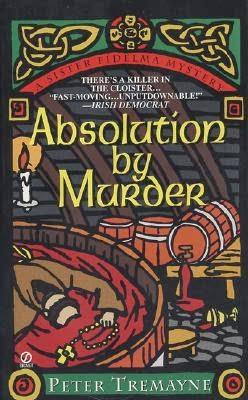
Absolution by Murder

by Peter Tremayne
First sentence: “The man had not been dead long.”
Support your local independent bookstore: buy it there!
Content: Murders, all off screen, and a lot (a LOT) of historical information to wade through. A novel for people with patience and time and a passing interest in Seventh Century Ireland/England/Catholicism. Nothing untoward (aside from the dead people) though.

This book is about a lot of things:
1. The mid-seventh century.
2. Early Catholicism in medieval England and Ireland.
3. The history of convents/monasteries in that time period.
4. The Saxon-Irish animosity of the time.
5. Saxon traditions that someone Irish would find despicable.
6. A woman court advocate in Ireland.
7. Solving a murder.

This book (I know I skipped the plot. It goes like this: there was a murder. They solve it. There’s 200 pages of incidental historical information.) has the same problem that many of the fantasy books I read have: there’s too much world-building (in this case, it’s medieval Great Britain) and not enough, well, plot.

I had the same problem I had with Deborah Harkness’s Shadow of Night: I felt like Tremayne (who is a professor of Celtic history) thought: “I’ve got ALL this historical information I NEED TO SHARE. Let’s see HOW MUCH I can put in this book!!” and then he proceeded to cram it ALL in. There was a plot — the abbess is murdered and Sister Fidelma (she’s the Irish woman court advocate) and a Saxon male (for the sake of balance) solve it. But I felt like the murder — which is really supposed to be the PLOT of the whole book — was incidental to the history. And I realized (even though I finished this one) that if I really wanted to read a book about medieval Great Britain, I’d find a non-fiction one.

All the Truth That’s in Me

by Julie Berry
ages: 13+
First sentence: “We came here by ship, you and I.”
Support your local independent bookstore: buy it there!
Review copy pilfered off the ARC shelves at work.

Two girls go missing. One turns up dead, floating in the stream. Two years later, the other one returns to the small town, intact, but with her tongue cut out. The villagers — from the preacher to her own mother — call her cursed, and shun her.

I’ve tried to sum up what goes on in the rest of the book, but I’ve found that I don’t really want to give too much away. Because much of the pleasure I got from reading this (in one sitting!) was not knowing that much about it. I will tell you this: at first, I thought it was a fantasy setting, because I think that’s what I was expecting. It’s not. Even though it’s not explicitly stated, it’s a Puritan setting, somewhere on the east coast. And the religion and mores that those communities set out play a major role in the book. And, even though it’s a story about kidnapping and murder, and you fear the worst for Judith, I will tell you that, as the story unfolds, it’s not the worst. It’s bad, but it’s not as bad as it gets.

The meat of the story is Judith — she’s the girl that returns — and her road to healing. For, in spite of everything that the village (and her mother) heaps on her, she does need to heal. It’s this process that is the true story. How Judith salvages her life from her trauma and reclaims her own sense of self. How she finds friends in the face of all the opposition in the town. How she even finds love. It’s a testament to the power of truth, to the power of the human spirit.

Remarkable.

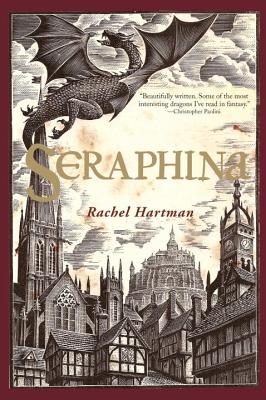
Seraphina

by Rachel Hartman
ages: 13+
First sentence: “I remember being born.”
Support your local independent bookstore: buy it there!
Release date: July 10, 2012
Review copy provided by my place of employment.

I should get the gushing out of the way first: I have read books about dragons, some of which were really clever, but I have never seen dragons like this.

And that blew. me. away.

I have struggled with how to sum this novel up, but am completely at a loss. There is so much going on, much of which is best left to be discovered as you go, that a summary is almost impossible. This is what I can tell you: the main character is Seraphina, a sixteen-year-old assistant chief musician in the castle. Except she has a secret, one that will cost her her life if revealed. The country is Goredd, which has been at peace with the dragons for forty years. It’s a tentative peace, one which is hanging by the slimmest of threads. There is prejudice against the dragons rampant in the populace of Goredd, a fire that is barely constrained. And so when Prince Rufus is found beheaded, it’s everyone’s — from the military down to the common people — assumption that the dragons did it, and there are people calling for blood.

And then there are the dragons. They walk among the humans, as humans: learning, teaching, advising, observing. Granted, they stand out to the humans; dragons are more rational, less emotional, mathematically minded, and not at all spontaneous. But, even though they are differences, it’s their ability to mimic humans that is the root of all the prejudice and terror in Goredd.

Really, that’s all you need to know to start. Know this as well: this is an excellent first novel. It’s a rich, rich world that Hartman has created, full of religion, politics, romance, music, and action. And while it works as the start of a trilogy, it also stands on it’s own, bringing the story arc to a satisfying conclusion, while leaving threads open to pursue in later books.

But really, read this one for the dragons. You’ll never see them like this again.

The Cross Gardener

by Jason F. Wright
ages: adult
First sentence: “I was born on the side of a two-lane Virginia highway at 1:21 a.m. on February 1, 1983.”
Support your local independent bookstore: buy it there!

Perhaps it’s best if I’m up front with this one: I didn’t like it. I thought it was sappy, manipulative, blatant and poorly written. I felt like a rat being run through the maze, being prodded which way to turn. And the ending? Unpredictable and kind of, well, lame.

Basic plot: John Bevan, who has suffered lots of loss in his life (first his mom died in a car accident which resulted in his birth; then his grandfather, whom he never met; then his father), loses (why is it always loss and loses for death? We don’t misplace anyone when they die, do we?) his True Love (ugh) and unborn child in a freak car accident. He suffers grief and pain and basically ceases to function until he meets The Cross Gardener, who helps him find The Way Back.

Before I get too snarky, I should admit something: aside from a couple of early-term miscarriages (I didn’t even make it to a D and C) and the deaths of my grandparents at generally advanced ages (my grandmother died when she was 64, but I was only 9, so it didn’t really impact me), I have not had much experience with death. No infant deaths, no spouse deaths, no parent deaths, no sibling deaths. So, I admit, readily, that I had no frame of reference in which to connect with this book. Perhaps if I had experienced some sort of tragic event, some grand loss in my life, I would be better equipped to actually connect with this book.

That said, if it were a better written book, I wouldn’t have had to have shared experience in order to connect with the characters and their experience with grief.

Heart of a Shepherd

by Rosanne Parry
ages: 10+
First sentence: “Grandpa frowns when he plays chess, like he does when he prays.”
Support your local independent bookstore: buy it there!

There are obviously powerful books, books about Problems or Trials or Oppression, books where the main character has something obviously Moving happen to them. And then there are books that are quietly powerful. Ones that seem simple on the surface, but then work their way under your skin and move you in ways that you totally didn’t expect.

This is one of those books.

Twelve-year-old Ignatius — Brother to everyone, since he has four older brothers — part of the east Oregon ranching community. Even though he’s small, and he doesn’t like killing the animals, he — along with his father, grandfather and brothers — does the work: take the cows to the mountains, raise and shear the sheep, mend and tend the ranch. Except, all the brothers are away, at school, in the army. And then, when Brother’s dad’s National Guard gets called up for a fourteen-month tour in Iraq, Brother is left with Grandpa to manage the the ranch by themselves. It’s up to him to prove that he can be what he doesn’t think he can: a rancher. Except, over the course of the year that his father is gone, that’s not what Brother finds out, about himself or his family.

It’s a deeply religious book — Brother and his family are Irish Catholics, though his Grandpa is a Quaker — but not overly preachy. There’s a lot of references to God and His will, but it’s a quiet religion, one that’s open, accepting and fluid in ways that are unexpected and ultimately beautiful and movie. It’s a harsh reality, east Oregon ranching life, but Parry writes about it in ways that will keep you thinking about Brother and his family long after you close the book.

(Just for the record: because this is a Cybils nominee, I’ve been asked to make sure y’all know this is my opinion only, and not that of the panel.)