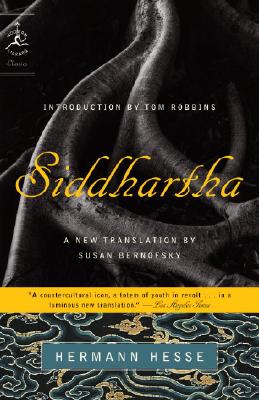
Siddhartha

by Herman Hesse
First sentence: “In the shadow of the house, in the sun on the riverbank by the boats, in the shadow of the sal-tree forest, in the shadow of the fig tree, Siddhartha, the beautiful brahmin’s son, the young falcon, grew up with his friend, the brahmin’s son Govinda.”
Support your local independent bookstore: buy it there!
Content: It’s dense. And there’s some illusion to sex, though nothing graphic. It’s in the adult fiction section of the bookstore.

I picked this up because I was looking for something to fill out one of my last bingo squares, one on a religion I knew very little about. I picked Buddhism, mostly because it’s the one I know the least about (though I do know some). A friend suggested this, even though it’s written by a Westerner, because it’s an accessible read for Westerners about a Buddha-like character and Buddhist thought.

It’s basically the life journey of Siddhartha, a young, well-to-do man in India (I’m assuming). He starts out with everything and then gives it up to join the shramanas, a group the eschews material things in search of knowledge and nirvana. He leads that life for a while, until he sees a beautiful woman, and he gives up his path for the path of material things and love. He finds happiness for a while, but eventually gives that up for a simpler life of service and meditation by a river.

I’m not sure I fully got what this book was supposed to teach me. It’s one of those that I think will be different at different stages of your life, and that multiple readings will lend to more insights. I’m glad I read it, even if I didn’t fully understand it. It’s definitely given me something to think about.

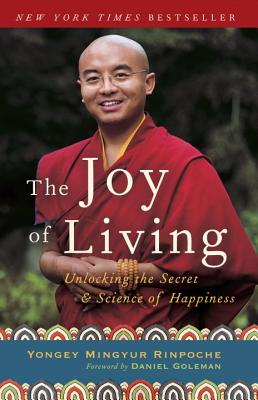
The Joy of Living

by Yongey Mingyur Rinpoche
First sentence: “When you’re trained as a Buddhist, you don’t think of Buddhism as a religion.”
Support your local independent bookstore: buy it there!
Content: It’s pretty complex, and somewhat dull, so it’d probably appeal to those who have the patience for it. It’d be in the religion section of the bookstore.

This was for another bingo square. I initially picked it up to cover “a religion you don’t know about” (hard for me, actually) but ended up using it as “popular psychology” because this was less about Buddhism and more about the scientific benefits of meditation.

And there are many: Rinpoche draws upon Western studies proving that the brain is calmer and that people are healthier when you meditate. And he explores some of the Western preconceptions about meditation: how we’re often intimidated by it because it seems so, well, unattainable.

He gives some practical advice for meditating: shorter times, more frequently during the day. And I’ve tried to take some of what he said to heart. During my last “down” time (I suffer from intermittent depression; it’s not chronic, but it is there and it is real), I worked on being attentive to my feelings and breathing through the sadness. I won’t say it worked well (or even much at all), but I did manage to come out of the funk faster than in the past. I need to get into the habit (again; I used to meditate more often) of stopping and unplugging and just Be longer.

I did find that a lot of this was familiar to me through my experiences with yoga over the years. A truly mindful yoga practice (of which I am not doing right now; I still go to yoga, but it’s more about the physical movement rather than a mindful practice) will incorporate elements of Buddhist meditation, I think.

It has made me curious about Buddhism, though. I think I’m going to hunt down and read more.

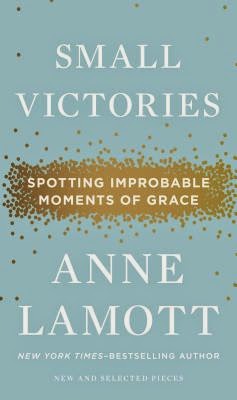
Audiobook: Small Victories

by Anne Lamott
Read by the author
Support your local independent bookstore: buy it there!
Content: She likes the word s**t, and drops about five f-bombs.  Which kind of caught me off-guard. It’s in the religion/philosophy section of the bookstore.

I’ve been curious about Anne Lamott for a while now; she’s an incredibly popular author at the store. I was in between audio books recently and discovered this one, and it was delightfully short. I figured audio was a good way to experience her.

This is basically a series of short reflections on life, God, and the intersection of the two. For the record: Lamott is a liberal, which I don’t mind at all, and was very against the invasion of Iraq in 2003. (Several of the essays are from around that time period.) She belongs to a church in northern California. She has a son, and lots and lots of friends, many of whom are suffering from serious illnesses. She has a good sense of humor, and is honest about her struggles with God, people, and just life in general.

In many ways, the words were just what I needed to hear: we’re all human, we’re all trying. God is in connecting with other people and reaching out to love them.

What I didn’t like so much, was Lamott’s reading of her own work. I understand why she needed to read her own words; it would have been odd otherwise. But Lamott read in such a way that it soundedlikeonereallylongsentancewithoutevertakingapauseorevenraisedorloweredhervoicewithsentenceinflection. When I concentrated to hear the words, I loved it. But her reading of them almost turned me off altogether. I’m glad I stuck it through to the end, for the thoughts and ideas. But, I wish Lamott had been a better narrator.

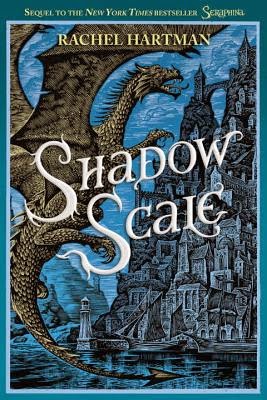
Shadow Scale

by Rachel Hartman
First sentence: “I returned to myself.”
Support your local independent bookstore: buy it there!
Others in the series: Seraphina
Release date: March 10, 2015
Review copy snagged off the ARC shelves at work.
Content: It’s pretty complex, when it comes to keeping tabs on everything that’s going on, and it’s fairly long and slow-moving as well. It’s also more mature in its sensibilities, though there’s not much else that would put it in the Teen section (grades 9+). Even so, that’s where I shelve these.

There’s so much going on in this novel that, much like Seraphina, it’s kind of difficult to put all of what’s going on down on paper. (Or the internet, for that matter.) On the one hand, this is a straight-forward road trip: to help her friend Glisselda, who is now queen of Goredd, Seraphina goes on a quest to find the other ityasaari — those who are half-dragon, half-human. She feels that, if she gets everyone in one place, they’ll be able to create a mind-field to keep the renegade dragons out of the city. Seraphina initially thinks this will be a simple task: go into the surrounding countries, locate the ityasaari, get back to Goredd and they will all live happily-ever-after.

Thankfully for the reader, it’s not that simple. There are obstacles in Serpahina’s way, and not least of all is Jannoula, an abused, embittered, scheming ityasaari who has the ability to manipulate the humans (and dragons) around her. She is there every step of the way, adding conflict, tension, and suspense to Seraphina’s path.

Also like Seraphina, there’s much to love about this one. Hartman’s world-building is impeccable, and it’s fantastic to see what she’s done with the other cultures, religions, and people surrounding Goredd. The romance that was budding at the end of Seraphina is still here, but it takes a back-seat to Seraphina’s journeys and allows Seraphina to become her own strong woman independent of anyone else. That said, there’s some surprises by the end of the book, ones that I thought were thoroughly refreshing.

Speaking of the end, about two-thirds of the way through, I worried that Hartman wasn’t going to wrap up the story, but she pulled through. In classic high-fantasy style, she gives us an epic and truly fantastic ending, one that is thoroughly satisfying while staying true to the story, characters, and world she built.

Hartman is truly a writer to keep an eye out for. Whatever she touches is just amazing.

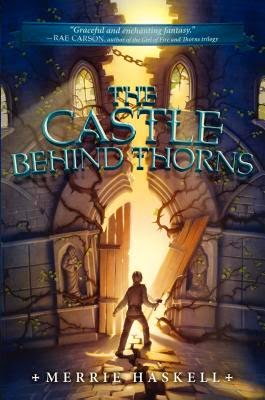
The Castle Behind Thorns

by Merrie Haskell
First sentence: “Sand woke, curled in the ashes of a great fireplace.”
Support your local independent bookstore: buy it there!
Content: There’s death and betrayal and politics, and lots of funny French names, so maybe it’s not for the most reluctant of readers. It’s in the midde grade (grades 3-5) section of the bookstore.

Sand, short for Alexandre, is the son of the local smithy in a small French duchy. (Well, it’s in one of those offshoots just when France was becoming, well, France.) The duchy castle has been in disrepair for longer than Sand’s 13 years, and surrounded by thorns. No one has gone to see what could be seen  inside.

Then Sand, who has been arguing with his father about attending university (he doesn’t want to), throws a token in Saint Melor’s wishing well, and ends up inside the castle. With no clue how he got there or how he will get out.

A brief aside here: we discover things right along with Sand, and while that generally annoys me, in this book it works to great effect. Sand is disoriented and alone, and Haskell captures that perfectly, transferring Sand’s anxiety and his slow realization that he’s stuck there and no one is coming to get him to the reader. All of which is followed up by his determination to survive and make things work.

During his explorations, Sand finds a body of a dead girl, and straightens her up. And because this place is magical (something which comes on very slowly, and quietly), she wakes up. Suddenly, Sand is not alone, and he and Perrotte — who happens to be the daughter of the long-dead Count — have to work together to find their way out of the castle.

I know it sounds boring, but it’s not. Haskell is a gifted writer, and she captures so many inner emotions and struggles and makes them not only real but captivating. I loved the friendship that developed between Sand and Perrotte (and that it wasn’t a romance!). I loved how they worked together to figure out how to get out of the castle. I loved that Sand’s strengths and Perrotte’s strengths were different and they found a way to compliment each other.

Yeah, all of this is really introspective for a middle grade fantasy novel, but in Haskell’s talented hands, it works well.

More than just well: it works wonderfully.

Vivian Apple at the End of the World

by Katie Coyle
First sentence: “There came a time when the American people began to forget God.”
Support your local independent bookstore: buy it there!
Release date: January 6, 2015
Review copy snagged from the ARC shelves at my place of employment.
Content: There is teenage drinking and a lot of swearing, including multiple f-bombs. There is also frequent off-screen violence. It’ll be in the Teen Section (grades 9+) of the bookstore.

In this sort-of future, American has been taken over by the conservative, pseudo-Christian  Church of America. Except “taken over” is too strong. It’s not like America has become a theocracy. No, it’s just that the Church of America founder, Beaton Frick, has predicted the end of the world. The rapture will come on a night in March, and all the faithful will be taken up.

Even though a good majority of Americans follow the Book of Frick, as it came to be called, Vivian Apple doesn’t. Her parents do, though. They’re faithful believers. And so, when the “rapture” comes, they disappear, leaving Vivian behind.

I’m going to stop right here for a minute. I’ve read a bazillion dystopian/post-apocalyptic novels and this is the first time I’ve come across the rapture as the cause. (At least in mainstream fiction. Is this a theme in Christian fiction?) In fact, this is what compelled me to pick the book up. I’m often curious about the way religion is portrayed in mainstream fiction, and I thought this could be an interesting take on it. And it was, even if it wasn’t necessarily a kind one. Religion and believers come off badly in this book, as people who believe anything they hear without question and are willing to commit acts of violence for the sake of their belief. More than once, I cringed at the “religion” and marveled at what I saw as pot-shots against the religious right.

But I digress.

Vivian determines that it’s all a hoax and she sets out from her hometown in Pittsburg to the Church headquarters outside of San Francisco with her friend, Harp. She just wants to know answers. They pick up a boy along the way, Peter, who seems to be on their side. Little do they know what’s waiting for them.

There is some good in this book: I really liked the tentative romance that budded between Vivian and Peter. I liked that Harp was Indian. I liked the way Vivian grew and became more willing to make decision and to Act in her own life throughout the course of the book. And I can even forgive that the book didn’t end, but rather left me hanging with more questions than answers.

But this one will be a tough sell around here.

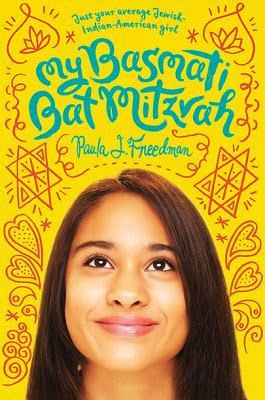
My Basmati Bat Mitzvah

by Paula L. Freedman
First sentence: “When Ben-o came over on Saturday for movie nigt, my dad answered the door wearing gray silk pajama bottoms and his Math Teachers Play by the Numbers T-shirt, an unlit pip clenched between his teeth.”
Support your local independent bookstore: buy it there!
Review copy snagged from the ARC shelves at my place of employment.
Content: There’s a lot of questions about religion and God in this. Plus some 7th-grade kissing. If we had it at the bookstore I’d probably waffle between putting it in the Middle Grade (grades 3-5) and YA (6-8) sections. It could easily go either place.

Tara Feinstein is your typical New York City middle schooler. She has two best friends, Rebecca and Ben-o (thusly named in fourth grade when there was a Ben D., even though he’s since moved away), and is looking forward to 7th grade. She’s been attending Hebrew School for the past few years — her mother, who is Indian, decided that Tara needed to get in touch with her Jewish (from her father) side — and is wondering whether or not to go through with her bat mitzvah in December. And like a typical middle schooler (at least one in my house), she has questions. About whether or not going through a bat mitzvah is somehow denying the Indian side of her. About whether or not there is a god. About why Ben-o is acting so strange and Rebecca seems to be hanging out with a girl that Tara just Doesn’t Like. Typical middle schooler stuff.

There really isn’t much overall conflict in this. Mostly it’s like life: a series of ups and downs. Tara and Rebecca accidentally ruin a priceless heirloom sari that Tara’s been given by her aunt. The new friend Rebecca has turns out to be a bit of a kleptomaniac. Ben-o turns out to like like Tara, but covers it up by hanging out with another girl, which is confusing to say the least. So, there is Drama (which, on the one hand, will make this book imminently relatable to everyone, but I was a bit Done With, only because there’s so much middle school Drama in my own house that it was a bit overkill for me).

What I did enjoy was the melding of the cultures. How Tara’s Indian aunt called Tara’s Jewish grandmother “Ruthie-ji”. Or that the grandmother would bring a matzoh ball soup to a Diwali celebration. Or the way Tara melded the two at her bat mitzvah: wearing a dress made out of the ruined sari and serving Indian food. What better way to celebrate the good things in all cultures and traditions? I also enjoyed her musings about God and the afterlife and religious traditions. It’s that which kept me reading in spite of my Drama overload. And it’s was those elements that made the book good (for me).

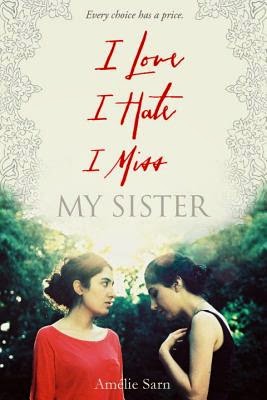
I Love I Hate I Miss My Sister

by Amélie Sarn, translated from French by Y. Maudet
First sentence: “The women walk slowly, heads down.”
Support your local independent bookstore: buy it there!
Release date: Augst 5, 2014
Review copy snagged from the ARC shelves at my place of employment.
Content: There is violence, some mild swearing, and some teen drinking and smoking. I’ll probably put this in the Teen (grades 9+) section of the bookstore, though I wouldn’t hesitate to give it to a 7th- or 8th-grader who is interested.

Sohane Chebli is many things: 18 years old, a daughter, a sister, a scholar, French, and a Muslim. She lives in an apartment complex full of others of  Algerian heritage, and mostly she and her younger sister (by 11 months), Djelila, get along with their neighbors, schoolmates, and each other just fine.

Then, during Sohane’s senior year, a few young Muslim men take it on themselves to start harassing Djelila because she dresses in jeans and tighter shirts. Because she wears makeup. Because she smokes with her friends. And Sohane, whose path has become more conservative — she wears the hijab — doesn’t step in to defend her sister. Partially because Sohane thinks her sister is wrong for following a path away from Islam. And partially because Sohane’s been expelled from school, due to a French law banning all religious symbols, for wearing the hijab.

I’m going to spoil a bit — it’s not too bad, because from the beginning,  you know this — but Djelila is killed by the Muslim boys for her refusal to conform to their expectations. And it’s that paired with the other side of the coin: Sohane’s constant discrimination for wearing the hijab. (Not that I mean to compare murder with discrimination.) But it got me thinking: why do we feel a need to tell others how to behave? Why did these boys feel compelled to not only shame, but eventually kill a girl for not following her/their religion to the letter? Why did people refuse to see Sohane’s hijab wearing as an expression of her religion, instead interpreting it as an act of repression? It’s a thought-provoking book.

And it’s written well, in tight, short chapters. It took a bit for me to catch the rhythm of the book because it’s translated, but once I did, I was hooked. And I wasn’t disappointed, in the end.

Zealot

by Resa Aslan
First sentence: “When I was fifiteen years old, I found Jesus.”
Support your local independent bookstore: buy it there!
Content: There really isn’t anything objectionable. I think the issue here is content. Again, nothing questionable, but Aslan is a scholarly writer, and so the reading ability will match that. It’s in the thought/religion section at the store, but it’s more history than anything else.

I’ve had my eye on this one for a while, since it came out. But it was only on a prompting from a friend that I finally stuck it on my library hold list and picked it up. Having only ever read one other Aslan book (No god But God) and that being years ago, I don’t know what I expected.

Whatever that was, it wasn’t a historical look at the man Jesus of Nazareth and how (historically) he came to be Jesus the Christ. I should say going in that there are other, better reviews of this one out there, as well as criticisms of both Aslan’s interpretation and presentation of what little data there is.

I am not a Biblical scholar (duh), and I’ve not really been interested in Biblical scholarship. (Hubby, on the other hand, is: most of the points I brought up as new to me, he’d already heard of.) I know that those who are have found this one reductive, but I don’t think Aslan was writing for the scholarly audience. Rather, he was writing for people like me: curious individuals who didn’t know much about Biblical history but were interested in what he had to say.

And I found what he had to say to be, well, interesting. Although he uses a mishmash of scholarship  — relying on the gospel of Mark mostly as well as Roman history from the time period — he presents his thesis — that Jesus of Nazareth was someone who wanted to overthrow the Roman rule of Jerusalem — in a way that, while it doesn’t challenge Christianity as a theology, challenges the idea of the Bible as a historical document. Which makes sense, if you think about it; having been translated and passed down and retranslated, it’s probably not a history of Jesus as a person. I’m not sure if Aslan’s book is, either, but it tries to put Jesus in a historical setting. And, with that at least, I think it succeeds.

Did I like it? Well, I was interested in it. And it made me think. And I learned things I didn’t know, though after reading some scholarly reviews of this, I’m not sure how accurate the things I learned are. But, I’m not sure that boils down to “like”. It was an interesting reading experience, which may be the best I can hope for.

The Tyrant’s Daughter

by J. C. Carleson
First sentence: “My brother is the King of Nowhere.”
Support your local independent bookstore: buy it there!
Review copy downloaded from NetGalley
Content: Some mild language, and some indirect violence. It sits in the YA section (grades 6-8) of the bookstore. I don’t know if I’d give it to a 5th grader or not. I think it depends on how news-savvy the kid is.

Laila is the daughter of the ruler of an unnamed Middle Eastern country. She has a good life — trips to Paris with her mother, a private tutor, a resort by the sea. Then one day her world turns upside down when her father is assassinated right before her eyes.

Suddenly Laila, her mother, and her younger brother, Bastian (the “little king”) are exiled, taking refuge in the United States as Laila’s fundamentalist uncle takes over the country. Not only is Laila exiled from her country, she’s thrown into a world that — for all the riches and opulence she was used to — is vastly different from her own. And, on top of that, as she meets other refugees from her country, she discovers that her loving father was actually a brutal dictator.

I think the publishers are billing this as a thriller — J. C. Carleson is a former CIA operative, after all — but it’s not. It’s much more one girl’s story of awakening, and the harsh realities that brings, as well as of the plight of immigrants and how difficult it is to make a new home. Although she makes friends in her Washington D. C. school, Laila never quite belongs here, being uncomfortable with little things: from wearing short skirts to the dance to the seeming nonchalance that the students have to a bomb threat. Laila is constantly a fish out of water, and I think Carleson captures that perfectly.

There are some thriller-esque elements; Laila’s mom is a constant schemer, and there’s a CIA guy hanging around ominously. And I felt the ending was a bit too pat, not quite fitting in with the rest of Laila’s story. But, for the most part, it was a fascinating exploration of one girl’s attempt to come to terms with her family and the outside world.