Audiobook: Randi Rhodes Ninja Detective: The Case of the Time Capsule Bandit

by Octavia Spencer
Read by the author.
Support your local independent bookstore: buy it there!
Content: There wasn’t anything objectionable. I don’t know how it’d be reading it, but my 8-year-old followed the story pretty well while listening to it. We did have to stop the audio a few times to explain some things, however. It’s in the middle grade (grades 3-5) section of the bookstore.

I threw this in the audiobook pile mostly because I’ve seen it at the store and wondered if it was any good. (I know: celebrity authors. Ugh. But, sometimes they surprise me. Not often, though.)

Randi Rhodes is a die-hard city girl. She’s grown up in Brooklyn and loved every minute of it. Her family summers in Deer Creek, Tennessee, which is just about the right length of time for a city girl to spend in a boring, dull, small town. But the year after her mother dies (I called that pretty early on; I do get so tired of dead parents), her father, a mystery writer, packs the two of them up to live full-time in Deer Creek. Randi is not happy about this.

But, once there, she falls head-first into a mystery: the 200-year-old time capsule for the town’s Founder’s Day has been stolen. And they have 72 hours to get it back. Much against her over-protective father’s wishes, Randi (and her two new friends, D. C. and Pudge) decide that they are the only ones to solve the mystery.

It’s a pretty run-of-the-mill middle grade mystery book. Nothing too fantastic or brilliant; in fact, as an adult, I’ve seen all the tropes before. The banker is a Bad Guy, as is the power-grabbing Mayor. There’s a grumpy old man with a heart of gold, and a woman sheriff who’s a bit bumbling. (Though — spoiler — this isn’t a true middle grade novel, because by the end, you discover that the sheriff isn’t bumbling at all, but has instead figured out the mystery WAY before the kids ever did.) The best parts of the book are when Randi and her friends are out being detectives; the worst are the angsty tensions between her and her overprotective dad. I got extremely tired of the rants Randi went on about not being “understood.” (But that’s a parent speaking. I did appreciate that Randi was a non-girly girl; she was often ranting about how she wasn’t a princess and didn’t need protection. She’s a black belt in Tae Kwon Do, after all.)

In the end, it wasn’t anything special, though A and K enjoyed listening to it. But, it wasn’t absolutely horrible, either, and Spencer did an admirable job of narrating her book (which I would expect, with her being an actress and all).

Audiobook: The Cuckoo’s Calling

by Robert Galbraith
read by Robert Glenister
Support your local independent bookstore: buy it there!
Content: None of the murders are grisly — they’re all alluded to — and there’s some talk of sex, but none actual on screen. However, the language is very adult (including many, many f-bombs), and for that reason, it’s in the mystery section (well, also because it’s a mystery) of the bookstore.

Cormoran Strike is hard up on his luck. Retired from the military due to an accident in which he lost part of his leg, and recently broken up with his posh, upper class girlfriend, the only thing Strike has is his private detective practice. And even that’s not doing terribly well. He can’t afford the temporary secretary that’s shown up, and he’s pretty sure he’s going to default on the loan his estranged (but famous) father gave him.

Things are looking pretty down when John Bristow, adopted brother of supermodel Lula Landry walks in Strike’s office with an incredible story. Bristow claims that the police have it wrong: that Landry’s death was not a suicide as originally thought, but rather murder. Someone pushed her off her third floor balcony to her death. The question is: who?

I really didn’t have expectations going into this one. I knew it was J. K. Rowling but I don’t really read many mysteries, so I wasn’t dying to get to this one. But, when I saw the audio book, I figured it was worth a try. I didn’t love it, but I was intrigued by it.

Perhaps it was because I knew it was Rowling before I went in, but I could tell that it was Rowling’s work. The way she described things (and because it’s audio, I don’t have a handy example) felt similar to the Harry Potter books. That, and she really does have a gift for names. The plotting was good as well; she kept up a good pace, and even though there were some bits that weren’t vitally necessary, it wasn’t under-edited. And the twist at the end didn’t come out of nowhere; something which was incredibly important to me.

I did feel like she under-utilized the administrative assistant, Robin. She gave us background on her, and made her a sympathetic character, but really didn’t have her do much of anything. I kept waiting for a grand Robin Moment that never quite came. The narration was excellent; I was impressed with the range of accents and voices that Glenister could do; perhaps one of the reasons I stayed interested in the book was because his narration was so compelling.

That said, it was a good, solid mystery. Nothing too spectacular, but nothing mundane or pedantic. Which means it’s just about right.

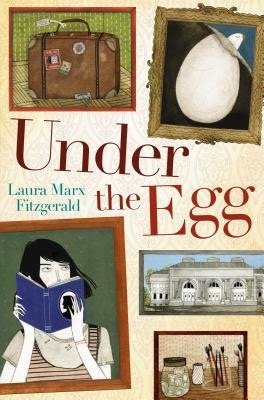
Under the Egg

by Laura Marx Fitzgerald
First sentence: “It was the find of the century.”
Support your local independent bookstore: buy it there!
Content: There some descriptions of horrible events, but nothing graphic. I think younger readers might have problems with the languages — there’s French and Latin, though translations are provided — and some of the names, but it’s in the middle grade (grades 3-5) of the bookstore, and I think it fits there.

Theodora (call her Theo) Tenpenny is the granddaughter of an artist and the daughter of an extreme introvert. She lives in what was once a grand old New York City house, but over the years has become neglected. Her grandpa Jack has kept everything reasonably in shape over the years and has managed to keep the family afloat by being mostly self-reliant. But since he was hit by a car and died (which seems overly gruesome for a guy in his mid-80s), Theo’s been in charge. And she’s struggling.

That is, until she takes her grandfather’s last words — “Look under the egg” — literally, and discovers that he’s been hiding a very old painting underneath the one of an egg that’s been hanging over their mantelpiece for years. Because she’s spent her life in her grandfather’s shadow, going to the Met and other art museums, Theo has a good eye, and realizes at once that this painting is something special. Something, perhaps, worth a lot of money.

However, as she and her new friend, Bodhi, find out, declaring a painting a lost work by a master is easy. Proving it is another matter. Especially when it turns out that this could be looted Nazi treasure.

On the one hand, there’s a lot of information to be had in this slim book. Both art history as well as WWII history play a major role in the plot. But I think that Fitzgerald handles it well, even if all the information and history might make it harder for younger readers to get into the book. But, she gave us a couple of great characters in Bodhi and Theo; they really are a team that works well together. I enjoyed the old-fashioned sleuthing to solve the mystery of the painting, and I liked how the history fit into the larger picture. I did find the ending to be a bit convenient, but even that was explained in a reasonable (if somewhat implausible) manner.

In the end, a highly enjoyable book.

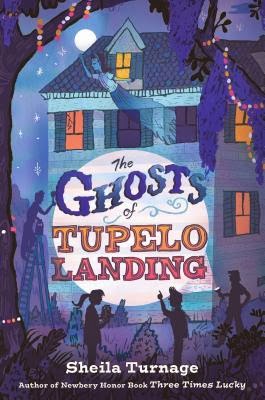
Ghosts of Tupelo Landing

by Sheila Turnage
First sentence: “Desperado Detective Agency’s second big case snuck up on Dale and me at the end of summer, dressed in the happy-go-lucky colors and excitement of an auction.”
Support your local independent bookstore: buy it there!
Others in the series: Three Times Lucky
Content: There may be a few instances of mild swearing (but I really don’t think so), and some talk of abuse, and another (potential) murder. But it really is innocent and happily belongs in the middle grade (3-5th grade) section of the bookstore.

Every once in a while, a series of books captures my fancy so completely that I fall head-over-heels in love with the characters. The Casson family books are that way. As is My Most Excellent Year. I’m adding the Tupelo Landing books to that list. I adore the town, even with all its quirks, and the people in it. I want to live next door and enjoy them every day.

This installment picks up as the school year is starting, and Mo and Dale are about to enter sixth grade. This is a good time as any: one of the amazing things about this book is that while it is a sequel, it really does stand on its own. Turnage works in the story from Three Times Lucky as you go along, in ways — like press releases or newspaper clippings or just dropped comments — that don’t stop the narration of the current story. It was lovely to get a refresher while being immediately immersed in the new story.

The case that the Desperado Detective Agency is working on this time is a good old-fashioned Haunting. Miss Lana and Grandmother Miss Lacy bought the old inn at an auction, mostly because they didn’t like the look of the “city” woman (whom Mo less-than-affectionately calls “Rat Face”) who was bidding on the property. They didn’t want her to come in, tear the dilapidated inn down, and put up condos in place. Unfortunately, buying an inn to renovate and then renovating it — especially when there’s a bona fide ghost lurking about — are two different things.

Mo and Dale get involved because of a history assignment. They’re supposed to interview one of the town “elders”, and Mo’s nemesis, Anna (whom Mo less-than-affectionately calls “Attila”) nabs Grandmother Miss Lacy first. So, Mo — in a fit of pique — says they’re going to interview the inn’s ghost. That sets them to unraveling a 60-year-old mystery of how a girl — one of Grandmother Miss Lacy’s best friends — met her death.

The only real criticism I have of this book is that all the conflict seems a little contrived. The outside city girl just lurks in the background being uptight, and the new character, Harm Cremshaw, turns out to have more bark than bite.  Even the resident town grump, Red Baker, turns out to be mostly harmless. That said, I’m not reading these books for the conflict. Or even for the mystery. (Or the ghost story in this case, though it’s so slight, I’m not really considering this as a “speculative fiction” though it probably is.) No, I read this because I love the characters — Mo’s spunk and observations; Dale’s adorable cluelessness, Miss Lana’s optimism, the Colonel’s stoic nature — and I love the way Turnage writes them.

And that’s why you should be reading these as well.

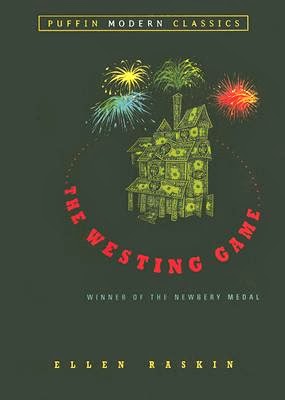
The Westing Game

by Ellen Raskin

First sentence: “The sun sets in the west (just about everyone knows that), but Sunset Towers faced east.”
Support your local independent bookstore: buy it there!
Content: There are about three mild swear words, and some talk of murder. Plus a couple of bombs. It’s in the middle grade (grades 3-5) section of the bookstore (actually, I have a Newbery Award Winner section; it’s in that), and I can see no reason for this not to be there. 
Review copy provided by the publisher as a complimentary copy for my bookgroup.
There are very few books I have fond memories of from when I was a kid. The Little House books, and Wrinkle in Time are a couple. And this one. I’m not sure why I remember it so well; maybe it was because it’s a pretty decent puzzle book/mystery, or maybe I just liked the spunk that Turtle Wexler has. Either way, this one has stayed with me throughout the years as a charming, fun little book.

I’m happy to say that this is still — even after all these years — a charming, fun little book. For those who don’t know the plot, it’s this: Sam Westing has died, and 16 people –all connected to Sam Westing in some way — are called into solve the mystery of his “murder” in order to win his inheritance. It’s a rag-tag collection of people, from a judge to a doorman, to a dysfunctional family, to a couple of restaurant owners. There are several sympathetic characters: Doug Hoo, the resident jock/track star; Theo Theodorakis, an incredible support to his disabled older brother; and (my favorite) Turtle Wexler, 13-year-old spitfire. There are also some despicable characters, most notably Turtle’s mom. She is the epitome of overbearing mothers who have good intentions but go about it all wrong. Pushing her older daughter (at age 19!) into a marriage she doesn’t want, and emotionally abusive to Turtle… I disliked her with every fiber of my being.

I’m not sure if the puzzle was terribly well-plotted. I knew the answer, having remembered it from a previous read (maybe 10 years or so ago), but A read it and kind of felt the answer came out of nowhere. That didn’t much matter; she enjoyed the story for the characters. And perhaps that’s the real charm of the book. Raskin created a group of people that we can’t help but identify with and either love or hate. Either way, we’re more than happy to go on a bit of an adventure with them. 

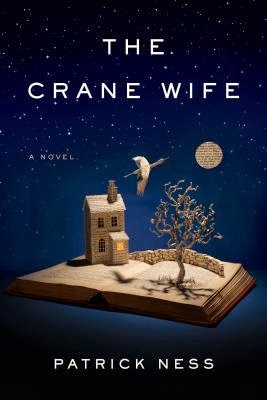
The Crane Wife

by Patrick Ness
First sentence: “
Support your local independent bookstore: buy it there!
Review copy given me by the Penguin rep.
Content: Multiple f-bombs and other language, some off-screen sex. Rightly sits with the adult fiction at the bookstore.

George is your very typical kind-of-loser guy. He’s divorced (nine years) with a child (who’s in her 20s) and can’t seem to keep a relationship (he’s too nice; they always break it off, but he’s always friends with them after). Even though he’s the owner of a print shop, he’s a bit of a pushover, letting his one employee, Mehmet, push him around. But, because he’s nice, because he’s George, when a crane with an arrow piercing its wing unexpectedly lands in his suburban London backyard in the middle of the night, he helps it out.

The next day, a woman named Kumiko shows up in George’s print shop. And suddenly, George’s life — and the life of his daughter, Amanda — are irrevocably changed.

Yes, this is a fairy tale. A very charming, sweet, wonderful fairy tale. Ness divides its time between George, Amanda, and Kumiko’s tales, but does so in a way that doesn’t feel awkward or forced. But it’s not just a fairy tale — or at least not just a one-dimensional fairy tale — art (in this case, paper cuttings) and a slight Japanese-inspired tale within a tale play major roles, which gives the book depth and substance.

But what I enjoyed most with this one was Ness’s use of the language. The fact that one of his characters, Rachel (who is very confused and not at all nice), speaks entirely in questions. Or the way he uses “…” to represent silence. Or the way George and Amanda think of themselves. And descriptive sentences like “He loved physical books with the same avidity other people loved horses or wine or prog rock.” (60) or “Stories do not explain. They seem to, but all they provide is a starting point. A story never ends at the end.” (141-142) or “She stopped, her face scrunching up in some really, really unattractive crying.” (161) There were others, but those are the ones that I marked.

It did all the things I want a book to do: it gave me characters to care about, and transported me away from the dreary winter months. It delighted me, and made me wish I was even a tiny bit artistic.

Delightful.

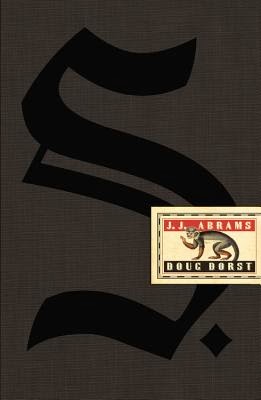
S.

by J. J. Abrams and Doug Dorst
First sentence: “If found, please return to the workroom B19, Main Library, Pollard State University.”
Support your local independent bookstore: buy it there!
Content: Language, including lots of f-bombs. And some violence. It’s in the adult section of the bookstore.

The thing that piqued my interest about this book was the buzz about the form. We had a sample copy and I perused through it. The format — a book published in 1948, stolen from a high school library, with notes scribbled in the margins — was intriguing. Enough so, that I bought myself a copy for Christmas, and eagerly dove in. It IS an intriguing concept, reading someone else’s notes, figuring out the story as you go.

It’s an incredibly layered book: the “book” is one Ship of Theseus, written by the mysterious V. M. Straka. A book where the main character, S., has amnesia, and goes on a journey to figure out who he really is. In doing so, he finds out that he was involved with some shady figures. The second layer is the work that a disenfranchised grad student, Eric, is doing to figure out the real identity of V. M. Straka. All that’s really known about him is that he was involved in this mysterious organization, the S. Eric gets help on this quest from a struggling undergrad, Jen, who finds Ship of Theseus laying in the stacks and begins a conversation. Which brings me to layer three: Jen and Eric’s story. They work together, and over the course of the book, develop their own relationship.

I realized fairly early on that the layers were too dense for me. I couldn’t hold everything in my mind, for starters. I ended up giving up the main Ship of Theseus story, partially because it was boring, but also because I just couldn’t keep multiple storylines in my head. Call it being out of practice, or lack of interest, but I just couldn’t do it. But there was also the fact that the story’s told  inside out and backward. I did think that maybe if I had read it in shifts — read Ship of Theseus first, then the inked-comments, then maybe it would have made sense.

So, in the end, this was all form and no substance. In the end, all the thrills, chills, and mystery They were promising weren’t there. It was a simple story, one that tries to give grad school a mystique and make it cool (it doesn’t succeed). It did succeed in being a homage to paper books — there’s no way this would make a decent e-book. But it wasn’t much else.

And in the end, I found that disappointing.

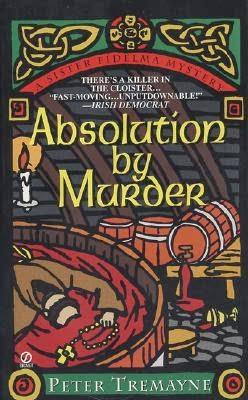
Absolution by Murder

by Peter Tremayne
First sentence: “The man had not been dead long.”
Support your local independent bookstore: buy it there!
Content: Murders, all off screen, and a lot (a LOT) of historical information to wade through. A novel for people with patience and time and a passing interest in Seventh Century Ireland/England/Catholicism. Nothing untoward (aside from the dead people) though.

This book is about a lot of things:
1. The mid-seventh century.
2. Early Catholicism in medieval England and Ireland.
3. The history of convents/monasteries in that time period.
4. The Saxon-Irish animosity of the time.
5. Saxon traditions that someone Irish would find despicable.
6. A woman court advocate in Ireland.
7. Solving a murder.

This book (I know I skipped the plot. It goes like this: there was a murder. They solve it. There’s 200 pages of incidental historical information.) has the same problem that many of the fantasy books I read have: there’s too much world-building (in this case, it’s medieval Great Britain) and not enough, well, plot.

I had the same problem I had with Deborah Harkness’s Shadow of Night: I felt like Tremayne (who is a professor of Celtic history) thought: “I’ve got ALL this historical information I NEED TO SHARE. Let’s see HOW MUCH I can put in this book!!” and then he proceeded to cram it ALL in. There was a plot — the abbess is murdered and Sister Fidelma (she’s the Irish woman court advocate) and a Saxon male (for the sake of balance) solve it. But I felt like the murder — which is really supposed to be the PLOT of the whole book — was incidental to the history. And I realized (even though I finished this one) that if I really wanted to read a book about medieval Great Britain, I’d find a non-fiction one.

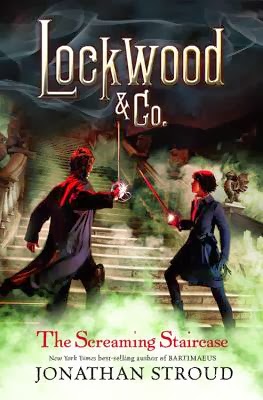
The Screaming Staircase

Lockwood & Co, Book 1
by Jonathan Stroud
First sentence: “
Support your local independent bookstore: buy it there!
Review copy snagged from the ARC shelves at my place of employment.
Content: It’s a ghost story and pretty scary at times, which means, while it’s on a middle grade reading level (and it’s shelved in the middle grade — 3-5th grade — section of my library), I’d be pretty wary about giving this to a Sensitive Child. There’s also a handful of mild swear words.

Even though I saw the rave reviews and the gushing praises, I put off reading this one for much too long. Even though I’ve loved Stroud’s books in the past, I was wary of the rave reviews: it couldn’t be THAT good, could it?

Well, yes. Yes, it was.

Set in a London where there is a Problem with ghosts — they’re everywhere, infesting the buildings and graveyards  — and where only the young can see, and subsequently fight, them. Usually, those with the Talent to see/hear the ghosts, are supervised by adults, but at Lockwood & Co. there’s no such oversight. It’s just Anthony Lockwood, George, and Lucy, teenagers and ghost fighters extraordinaire.

Okay, so it’s not that simple. Lucy and George constantly bicker, and Lockwood is more optimistic about the future of his company than actually capable of running it. But the three of them are talented ghost fighters (hunters? I wasn’t quite sure what to call them), and even though they’re not exactly careful, they get the job done.

Then, on a routine clearing, Lockwood and Lucy stumble on a particularly fierce ghost. It turns out that it was Annabel Ward, a socialite and actress who was murdered and shoved into a chimney. This captures the imagination of our narrator, Lucy, and she ropes the boys into helping her figure out what, exactly, happened to Annabel 50 years ago. One of the best things about this book is the way Stroud handles the mystery: he gives us enough clues as we go along to make a good guess, but it also isn’t the only element to the book. Neither is the ghost Problem. There’s enough layers and depth in this book to keep even the most reluctant of readers interested.

And even though it takes a good 2/3 of the book to get to where the title came from, it all comes together splendidly (fantastically, I might add) at the end.

Additionally, Stroud knows how to do atmosphere. It’s creepy, it’s funny, it’s haunting. It’s eloquent. One passage that stuck out (it’s near the end, but it doesn’t give anything away):

All around us rose the scream, issuing directly from the steps and stones. Its volume was appalling — as painful as repeated blows — but it was the psychic distress it carried that made it so unbearable, that made your gorge rise and your head split and the world spin before your eyes. It was the sound of the terror of
death, drawn out indefinitely, extending on forever. It spiraled around us, clawing at our minds. 

It’s not just good. It’s brilliant.

(Just for the record: because this is a Cybils nominee, I’ve been asked to make sure y’all know this is my opinion only, and not that of the panel.)

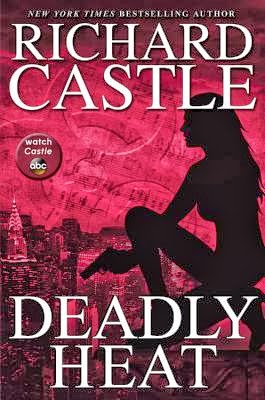
Deadly Heat

by Richard Castle
ages: adult
First sentence: “NYPD Homicide detective Nikki Heat double-parked her gray Crown Victoria behind the coroner van and strode toward the pizza joint where a body waited.”
Support your local independent bookstore: buy it there!
Others in the series: Heat Wave,  Naked HeatHeat Rises, Frozen Heat

I’ve always kind of thought that you couldn’t pick up these books without having first watched the show. But, after finishing this one, I realized that really the only frame of reference you need is Frozen Heat. It picks up almost directly where that one leaves off, and ties most directly into it, giving us some nice loose ends all wrapped up.

Nikki knows who actually killed her mother. What she doesn’t know, is who called the shots. And that’s something she’s determined to do, even though the Department of Homeland Security Agents Bell (who happens to be Jameson Rook’s ex) and Callahan keep getting in her way. In addition, she’s faced with a serial killer, nicknamed Rainbow, who is playing games with her. And yes, she’s next on his list.

She’s also getting flack from her incompetent commander for juggling two cases, something which Nikki resents. But, determined as she is, she (and Rook, of course) doggedly persevere, and manage to solve the crimes in the end.

Much like season 5, this was a bit lighter, but also like Frozen Heat, it’s really it’s own beast now. I recognized a few plotlines from the season, but mostly, that’s not what I was reading this for. No, now I’m invested in Nikki Heat the character (not Nikki Heat as a reflection of the way Stana Katic plays Kate Beckett… man, that’s confusing!), and her own personal journey. And this one, I think it’s safe to say, is a pretty decent mystery. I suspected the end, though the clues were there, and if I had been paying attention I would have figured it out. I also liked the way the two storylines intersected in the end, and how they helped each other resolve. I liked that both Nikki and Rook had a chance to shine.

I’m sold on this as a series now, which means I’ll be sad if the show ever ends and these disappear. Unless, of course, the ghostwriter decides to keep it up. In that case, I’ll keep reading them.