Popular: Vintage Wisdom for a Modern Geek

by Maya Van Wagenen
First sentence:”‘School is the armpit of life,’ my best friend Kenzie once told me.”
Support your local independent bookstore: buy it there!
Content: Because eighth graders aren’t exactly the nicest creatures in the world, there is some language, all of it mild and very infrequent. It’s in the YA section (grades 6-12) of the bookstore, but honestly, anyone who can handle the subject matter (she does talk about taking sex ed and drug inspections and lockdowns at her school), should read this one.

The summer before she starts eighth grade, Maya Van Wagenen discovers in a box a copy of “Betty Cornell’s Guide to Teenage Popularity”, circa the 1950s  Her mom suggests, offhand, that maybe Maya should follow the advice in the book, write it down, and see what happens.

This book is the result of that year.

There aren’t the words to express my love here.  Perhaps it’s because I have a daughter just finishing eighth grade, and it’s been a rough year for her. Perhaps, it’s because I was much like how Maya started eighth grade: socially awkward, at the bottom of the social hierarchy, trying to fit in my small, conservative, Michigan middle school. (I had just moved there two years before, and still hadn’t figured out how to fit in with kids who’d known each other since kindergarten.)

But my enjoyment went beyond just being able to relate to Maya. She tackled a chapter or two of Betty’s book each month during the school year, and the chapters were divided up with her reflections of her progress. Along the way, I got to know her family (she has terrifically cool parents; my favorite side story of hers was the list of answers you’re not supposed to say when crossing through a U.S./Mexico border patrol. My favorite was “I am, but I’m not too sure about the kids in the trunk.”) and her school mates (she lives in Brownville, TX, and to say that she has a rough school, is an understatement). At first, she’s very humorous about he whole project. For instance, when she hits the dress chapter, she takes it literally, dressing like someone from the 1950s, getting stared at and teased for dressing like someone’s grandma. It’s easy to think that Betty’s guide really doesn’t fit in today’s world.

Somewhere along the way, Maya — and I, as well– discovered that Betty’s book is really still applicable, and maybe she really does have the secret to “popularity”.  I was touched by Maya’s insight, her observations, and her maturity. By the time I closed the book, I wanted to cheer for her — she’s an amazing girl, one I’d be proud to call my daughter — and to thrust this book in the hands of everyone I know, grownups and teens alike.
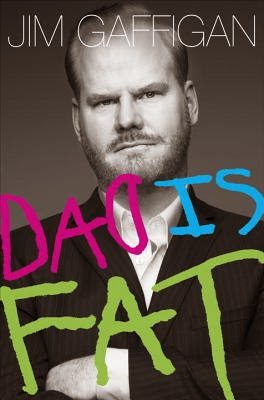
Audio book: Dad is Fat

by Jim Gaffigan
read by the author
Support your local independent bookstore: buy it there!
Content: Some mild swearing (like, less than a dozen times) and it’s all about parenting, so I’m not sure how many kids would be interested. It’s in the humor section at the bookstore.

Jim Gaffigan is a comedian (whom I hadn’t heard of) and a father of five kids. In New York City. He lives in a two-bedroom apartment in a five-story walk-up. And as you can imagine, all this leads to an immense amount of hilarity, most of which he turns into comic gold. (Well, not gold, really.)

Like most comedians (and humor really), it’s really quite subjective. This one tickled my funny bone, partially because I could relate to it (one tweet I sent out: “So true: ‘When children see animals in captivity, it makes them want ice cream.’ – Jim Gaffigan), perhaps because I have nearly as many kids as he does. And partially because he’s honest about himself and his abilities as a parent. I want to sit down with him, swap horror stories, and say, “Yeah, I think I suck at this parenting gig, too.”

I’m not sure I would have liked it if I had read it, but Gaffigan is a terrific narrator of his own material (see: stand-up comedian), and I often found myself guffawing (yes, I do guffaw) along with his hilarious and often ridiculous (see: five kids in NYC) stories. As I was telling a friend of mine: there’s nothing like listening to the war stories of someone who’s got it more challenging than you to make you feel good about your life.

And this was a thoroughly diverting ego boost.

Audiobook: One More Thing

by B. J. Novak
read by the author
Support your local independent bookstore: buy it there!
Content: lots of language, both mild and strong. Most of it unnecessary, but I don’t think I expected anything less. Is in the adult fiction section of the bookstore, but I bet older teens would like it.

I picked this up because people at work were raving about it. Said it was hilarious. And I decided that I need some humor in my life. So, even though it’s by an actor I’ve never heard of (I didn’t watch The Office, though he was the “other guy” — the one that I didn’t recognize – in Saving Mr. Banks), I figured why not give it a try.

It says it’s “stories and more stories” but I think it’s more “jokes, observations, and a couple of stories.” There were 64 in the book, and sometimes that felt derivative. Not that I minded: some of the shortest stories were some of the funniest ones. Novak is a great narrator, by the way, and he got a whole bunch of other celebrities to help him out, though he used Rainn Wilson and Mindy Kahling the most

My favorite of the whole book was “The Something by John Grisham,” where John Grisham’s newest novel gets published with his place-saving title instead of a “real” one. I was guffawing at the idea that Grisham’s novel would not only get published with such a bad title, but get rave reviews. Just because he’s John Grisham. (I suppose there’s a poignant commentary there on publishing and fame, but I was laughing too hard to find it.) I did like “No One Goes to Heaven to See Dan Fogelberg”, which is an imagining of what Heaven will be like, and how, maybe, we won’t want to spend time with people we didn’t know well in life, even if they are family. Some of them — like the “Comedy Central Roast of Nelson Mandela — made me uncomfortable, and I thought Novak’s humor was more mean than observant. But, for the most part, like in Wikipedia Brown and the Case of the Missing Bicycle” — a spoof on Encyclopedia Brown — or “Bingo” — where three cousins are vying to win Bingo at a resort, only to lose to their grandpa — or “Closure” — where a girl whose boyfriend has broken up with him gets absolute closure I was highly amused. And the discussion questions at the end of a couple stories, as well as the end of the book, I thought were a nice touch.

It’s like David Sedaris without the sardonic undertones.

I’m not sure I would have liked this as much if I hadn’t have listened to it. (Much like me and David Sedaris, come to think of it.) There’s something about hearing jokes, as opposed to reading them, that makes the humor work better for me. It’s not a deep book, or one that’s going to stay with me for a long time. But it was amusing, and it did make the drive back and forth to work enjoyable.

Blue Plate Special

by Kate Christensen
First Sentence: “Often, whenever I come up against anything painful or difficult, my mind escapes to food.”
Support your local independent bookstore: buy it there!
Content: There are other issues, but mostly, lots of f-bombs (didn’t count).

I’m going to spare you this review and tell you what I think straight up: much like Vizzini, this book is not what Christensen (or I) thought it was. It says, right there on the cover, “An Autobiography of My Appetites.” And I thought: “Oh good! Food book!” Even though Christensen threw me a bone in the form of a recipe every once in a while (though honestly: BEAN BURRITOS), this had none of the hallmarks of a food book (except said recipes): luxurious, descriptive, evocative passages about the food and the eating experience.

What it was, however, was a very long, very involved, very sordid, very blunt telling of Christensen’s very messed-up life. It’s the epitome of tell-all: she Told it ALL, from her father’s abuse of her mother to her very horrid first marriage. I read the whole thing, though I often wondered why. (Actually, I knew why: it was one of those books that I kept hoping would get around to being what I Wanted It To Be, but never did. Those are the WORST KIND.) I wondered what the point was, because even though Christensen led an adventurous life, the book version of it was anything but interesting. I don’t know what her purpose was: to make us feel sorry that she never appreciated anything? To purge all her secrets so that she can make a fresh start? Whatever it was, all I got was annoyed: annoyed that she was going amazing places and not Taking Advantage. Annoyed that she spent her 30s drunk and unhappy. Annoyed that I picked up this stupid book in the first place.

The writing wasn’t even lyrical, or evocative. It was boring on a sentence level. Which makes me wonder about her novels, which I’ve never read. But then again, a person may be able to write a novel, but not manage to be evocative about a picnic in Italy. I think I’ll go find some Frances Mayes as a counter balance.

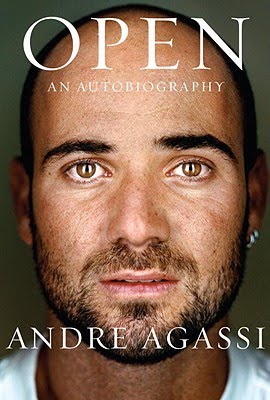
Open: An Autobiography

by Andre Agassi (with help — credited in the acknowledgments — from J. R. Moehringer.)
ages: adult
First sentence: “I open my eyes and don’t know where I am or who I am.”
Support your local independent bookstore: buy it there!

I’m a sucker for memoirs, especially well-written ones by interesting people. I was doubtful — at first — that this one would be well-written, but was game to read it anyway: I’ve adored Agassi for years. And I was pleasantly surprised: while the writing style took some getting used to (there’s conversations, but no quotation marks, which bugged me at first), thanks to the help of Moehringer, this book was honest– almost brutally so — and interesting.

It’s basically Agassi’s story about his relationships: with tennis, with his father, with the women in his life, with his trainers and coaches, with himself. It’s not an easy road: he was (you get the impression, by the end, that he isn’t anymore) a very tortured individual. He was often depressed, conflicted, unsure of himself. You would think it would be a very depressing book, a harsh read, and yet it’s not. Partially that’s because it’s fascinating (I thought, anyway) to see Agassi’s tennis career from his point of view. It’s interesting to see the inner conflict between his hatred of the sport and the fact that he had this natural talent for it. It’s interesting to see his career ups and downs from his point of view — like how much losing to Pete in Slam finals really ate at him, and how much winning the 1999 French Open meant to him. He breaks down most matches he played, talks about the men he played against (dislikes Connors, loathes Chang, and hates Becker; respects Borg, Federer and Sampras), and talks about what’s going through his mind. I found it interesting to see the game from the inside (even if it was tortured), to get a feel for what goes on in the head of a player on the court. Fascinating stuff.

But, what really made the book for me was when he finally got to his relationship with Steffi (he calls her Stefanie, since that’s what she prefers, which I think is really sweet) Graf. She’s a running theme through the book, an aside here and a mention there (I wonder if it really happened that way, or if he’s just remembering it that way because he loves her), but his recollection their first “real” meeting (they met in 1991 and 1992, and she brushed him off) in 1999, before the French Open, is so incredibly sweet, you can’t help but smile. And for the rest of the book, the tone changes: he’s a better man because of her. (Well, that, and he finally realizes that doing something for someone other than yourself is a helpful thing; he’s so incredibly proud of the school he’s helped build and the good its doing.) Maybe he’s not a better player — he still wins some and loses some — but he’s less conflicted, more sure of himself.

I’m not sure if your average reader would like this book, though. It’s for fans of Agassi, of tennis. But for us, it’s fantastic.

The Year My Son and I Were Born

A Story of Down Syndrome, Motherhood, and Self-Discovery
by Kathryn Lynard Soper
ages: adult
First sentence: “No. Oh, no.”
Review copy sent to me by the author.
Support your local independent bookstore, buy it there!

Some books can just be summed up in a few words. The words for this one: Honest. Brave. Beautiful.

I’ve been working on this review for two days now, and I am still at a loss how to adequately sum up this book. It’s a story of a mother learning to accept her newborn son’s diagnosis of Down Syndrome. It’s a story of a woman who’s dealing with depression. It’s a story of a person who has been dealt an unexpected set of cards trying to come to terms with her faith and her community.

It’s not the story that makes this book compelling, though it’s a compelling story. What drew me in, and kept me there even though I thought I couldn’t relate, was the writing. There’s always a self-indulgent aspect to memoirs: one has to think they’re unique or important enough to write a memoir in the first place. But Soper takes an incredibly unflinching, honest tone, and uses spare, beautiful writing. Both of these combine to give the book an emotional wallop, making Soper’s journey not only captivating, but accessible and understandable to those who haven’t had the same journey. We come to care about Soper and her family. We become emotionally invested in them and their lives.

It’s also an unexpected story, which gives it a raw edge. Soper doesn’t take everything just fine. There are ups and downs, both emotionally and medically. It’s a hopeful ending — I almost wished for an epilogue; how is her son, Thomas now? — but it’s not a pat ending. There will be bumps down the road; Thomas will have medical problems, there will be discrimination, there will be trials. But, by the end, Soper (and the reader) have come to a new enlightened state, where everything is, if not happy, then at peace.

I do have one more word: remarkable.