The Real Boy

by Anne Ursu
First sentence: “The residents of the gleaming hilltop town of Asteri called their home, simply, the City.”
Support your local independent bookstore: buy it there!
Content: Some intense moments — both physically and psychologically — and the language and pacing are a bit slow, especially for a struggling reader. Still, it fits in the middle grade (3-5th grade) section of the bookstore.
Review copy snagged from the ARC shelves at my place of employment.

After I finished reading this, A took a look at it and said,”Huh.’The Real Boy’? Is that like Pinocchio?”

Well, yes. Yes it is.

The island of Aletheia is full of magic, even though there are no wizards anymore. There are magic smiths, and Oscar is the hand to one. Which means, he collects and chops the herbs and basically stays out of the way. That is, until the apprentice turns up dead and the magic smith go missing. That’s when Oscar’s world starts unraveling: everything he thought Aletheia was built on, everything he thought his master was turns out to be built upon a lie. And it’s up to Oscar and Callie, the healer’s apprentice, to figure out what the truth is, and how to set everything right. And, because I alluded to it, yes, the Pinocchio story does play a small role.

This was a lovely, lyrical book; Ursu is a magnificent, quiet writer. She knows how to evoke a feeling and a place — the forest is dark and magical and calming. And even though it’s never explicitly said, Ursu makes it obvious through little words and phrases that Oscar has some form of autism. That simple fact upped the tension when it was up to Oscar become the Hero of this story. How — if he doesn’t know how to interact with people — is he supposed to figure everything out? Enter Callie, who was a remarkable character. (In fact, all the characters, from the magic smiths to the bullies, to the people in the city who were Indulged and Coddled, were remarkably written.) She is the healer’s apprentice, magicless in a world where magic is everything, and yet she’s smart and plucky and brave, but most of all caring.

In addition to all that, and refreshingly, it’s not a start of a series! Hooray for stand-alone books! My only detriment is that I’m not sure this will appeal to many kids. But for the ones who are daring enough (or quiet enough) to pick it up, they’re in for a real treat.

(Just for the record: because this is a Cybils nominee, I’ve been asked to make sure y’all know this is my opinion only, and not that of the panel.)

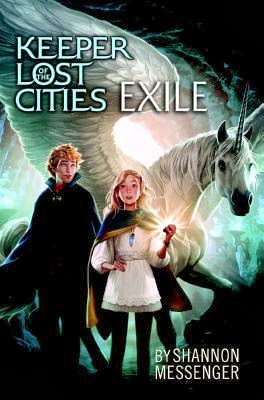
Exile

by Shannon Messenger
ages: 9+
First sentence: “Sophie’s hands shook as she lifted the tiny green bottle.”
Support your local independent bookstore: buy it there!
Others in the series: Keeper of the Lost Cities
Review copy snagged off the review shelves at my place of employment.

First off: kids like this series. So, take everything I say about it with a HUGE grain of (adult) salt. Also: spoilers for the first one. Obviously.

Sophie is still living with the elves. She’s still multitalented, which many of her age-mates find annoying. She’s still trying to get used to living with her adopted family. And she’s still trying to figure out who the Black Swan are, and why they created her.

It’s a lot for a 12-year-old to handle.

Especially since she found a rare alicorn — part unicorn, part Pegasus — in the woods and brought it home. It could “reset the timeline” (no, I have no idea what that means), and so Sophie’s been given charge (reluctantly) by the Council to tame and train the alicorn. Which, of course, she forms a bond with.

Much like the first one, this one was TOO long. Sure, there was a lot of white space and the text is big, but at 570 pages, I was exhausted before I was halfway through. And, much like the last one, I feel like Messenger has a good story in here. This time, though, she needed an EDITOR to hack her stuff down to 250 pages. (Especially all of Sophie’s anxiety moments. ENOUGH ALREADY.) I did like some of the characters — Keefe, especially– and I thought Messenger tied up the story nicely while leaving some threads for the next book.

(Can I hope for that one to be shorter??)

But, as I said at the first, kids do seem to like this series. It’s good for those who aren’t old enough for Harry Potter or want more like that. But it’s just not doing it for me.

City of Bones

by Cassandra Clare
ages: 14+
First sentence: “‘You’ve got to be kidding me,’ the bouncer said, folding his arms across his massive chest.”
Support your local independent bookstore: buy it there!

For YEARS, I have told myself that I ought to read the Mortal Instruments series. For YEARS, I have looked at these books and said, “I’ll get too them… sometime.”

Well, sometime is now. Yes, I was prompted to pick these up because of the movie  coming out in August (I tell my kids to read the book before seeing the movie. I do practice what I preach, sometimes). But, honestly people: I was unprepared for how awesome it is.

Short version for the other rock-dwellers: Clary Fray is an ordinary NYC teenager until she witnesses what she thinks is a murder in a nightclub. Suddenly, she’s seeing things — and people — that shouldn’t exist. Then, her mother disappears and Clary’s drawn into this world of Shadowhunters: half human/half angels who fight demons. (An aside here: I don’t watch the show, but from what M has told me, this sounds a LOT like Supernatural. I mentioned that to a co-worker today and she said, “Yeah, I can see that. Without the angst and with more humor, though.”) And Clary has to figure out not only how to get her mother back, but how to keep herself alive.

Things I loved: the humor. It was so much fun to read; the witticisms, the sarcasm, the witty retorts. The world building: Clare put all sorts of effort into creating this alternate reality, and the effort comes through. Sure, in parts it was vaguely Harry Potter-esque, but I can forgive that. The fact that the love triangle fizzled. Yay for no love triangles. Jace. I don’t go for blondes or tough guys, but he was pretty swoon-worthy and awesome. Clary herself: considering she had no idea what she was doing half the time, she held her own and was all sorts of headstrong. The climax, but you will have to read it yourself.

And yes, I already put City of Ashes on hold. I can’t wait.

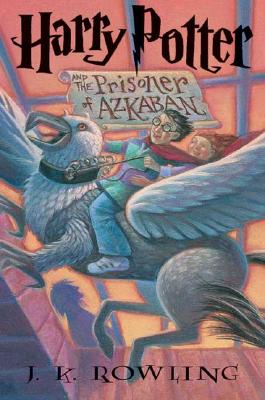
Audiobook: Harry Potter and the Prisoner of Azkaban

by J. K. Rowling
read by Jim Dale
ages: 9+ (Listening 6+)
Support your local independent bookstore: buy it there!

I could have sworn I had a review of Prisoner of Azkaban on here, but I only found a smallish blurb about the whole series here. But, I guess, I read this before the blog, and I haven’t gotten around to a reread until now.

The reason for picking this particular Harry Potter? Well, we went to the Wizarding World of Harry Potter for our family vacation a couple of weeks ago, and figured since we were going there, we needed to read a Harry Potter book. And since this is the next one in the series for K to read (her dad’s read her one and two), that’s where we started.

My thoughts, since everyone knows the plot already:

Out of all the books, this one is one of the tightest, I think. As they go on, they become more meandering and Rowling tries to pack so much in.

That said, at the end, when Sirius and Lupin confront Peter Pettigrew, there is an awful lot of monologuing. I know that Rowling needs to give us a whole bunch of information that existed before the story even started, but still. It slows the story down.

I really, really dislike the way Jim Dale reads Hermione. She’s a capable, smart girl, and every time she opens her mouth, Dale makes her sound like a whiny brat.

I adore Lupin as a character. That is all.

Hubby and I got into a discussion about adult figures in middle grade books. It was started because we realized that Dumbledore is a Really Bad Headmaster. He’s terrible at his job. Don’t get me wrong: I adore the character, but think about it: he’s neglectful, he’s bad at enforcing rules, and he plays favorites like no other. But then, if  Dumbledore were good at his job, there wouldn’t have been a story.

I think the lack of Voldemort in the story actually helps the book. It’s not as Dark and Foreboding as some of the others. 

It’s still one of my favorites of the Harry Potter series.

And I’d really like — for comparison’s sake — to hear the Stephen Fry audio versions. I wonder if he can do Hermione any better.

Jinx

by Sage Blackwood
ages: 9+
First sentence: “In the Urwald you grow up fast or not at all.”
Support your local independent bookstore: buy it there!

The setting: the Urwald, a forest of no uncertain danger. There are trolls, werewolves, witches, and wizards out there and no one — NO ONE — left the Path unless they were asking for trouble. Needless to say, there is magic here. The Urwald has no king, and belongs to no country, in spite of what the two neighboring kingdoms seem to think.

The main character: Jinx, a boy who lives in one of the clearings, being raised by his stepparents (mother died; dad remarried; dad died; stepmother remarried), who don’t particularly want him. So, his stepfather takes him off the path, presumably to leave him there. Except they run into Simon, a wizard of some power. He’s not as Powerful (or Evil) as the Bonemaster (whom, everyone knows, sucks your soul out with a straw), but he’s powerful enough to stop Jinx’s stepdad and take Jinx as a sort of serving boy/apprentice.

The other characters: One of the most delightful things about this enchanting novel were the characters. There is the mysterious, yet somehow comforting, Simon and his spitfire wife, Sophie. There’s the cackling witch (I swear I could hear her) Dame Glammer, who traveled by butter churn. There were the friends (of sorts) that Jinx met when he finally (not that I minded the set up; it was so cleverly imagined) got around to Questing, Reven (whose curse was that he could not say who he was) and Elfwyn (whose curse is that she always has to tell the Truth). And then there was the Urwald itself, written in such a way to be a character in itself.

It’s not an action-packed page-turner of a middle grade fantasy, and I appreciated that. It was a slow reveal, a world to revel in, characters to enjoy a journey with. And if there’s a sequel, I will happily follow Jinx through whatever adventure he has next.

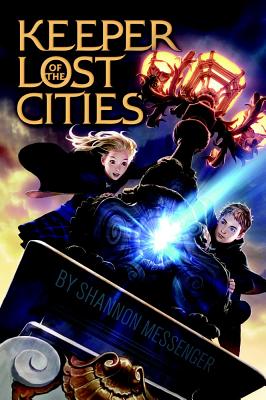
Keeper of the Lost Cities

by Shannon Messenger
ages: 10+
First sentence: “Blurry, fractured memories swam through Sophie’s mind, but she couldn’t piece them together.”
Support your local independent bookstore: buy it there!

A young boy girl is raised among humans, never knowing that he’s she’s not one of them. He She manifests some special abilities, but mostly what he she does is lay low, living with his her family, knowing somehow that he’s she’s different than they are. Then on his eleventh birthday a school field trip soon after she turns twelve, he she is found by an emissary of the different world, gaining a glimpse into his her real future: that of the wizards elves. As he’s she’s introduced to this world by a soon-to-become good friend, he she learns that his place in the world is a unique one: that of the Chosen One Keeper. (Possibly; it’s not really clear.) He She is sent off to Hogwarts Foxfire, the wizard boarding school elf nobility school, where he she makes friends, endears himself herself to some teacher and offends others, shows incredible abilities in certain areas, gains a mentor, and ends up breaking a lot of rules. He She succeeds in thwarting the evil that he she faces in the end, but it’s only a temporary fix. How can he she, a mere boy girl, save this world?

If you haven’t figured it out by now, my main problem with this one — that I started with high hopes: a separate world with elves! Cool! (And, no, that’s not a train on the cover. I thought it was) — was, that by about halfway through, I realized it was Too Much Harry Potter Knockoff, and not enough cool elves doing cool, unique, elvy things. I thought that Messenger had a cool idea for the world, but in the end, just wasn’t able to pull it off as well as I’d hoped.

That, and  I realized that halfway through, at 488 pages, this was Much Too Long. All of which makes me kind of sad.

(Just for the record: because this is a Cybils nominee, I’ve been asked to make sure y’all know this is my opinion only, and not that of the panel.)
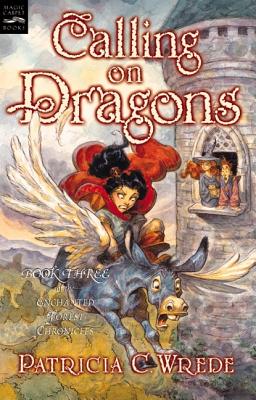
Calling on Dragons

by Patricia Wrede
ages: 9+
First sentence: “Deep in the Enchanted Forest, in a neat gray house with a wide porch and a red roof, lived the witch Morwen and her nine cats.”
Support your local independent bookstore: buy it there
Others in the series: Dealing with Dragons, Searching for Dragons

It’s about a year after Cimorene and Mendenbar got married, and things are afoot in the Enchanted Forest. Again. (Yes, it is the wizards. Again.) This time, Morwen was clued into the problems by a six-foot-tall rabbit named Killer. Things get a little trickier when they — Morwen, the cats, and Killer, of course — get to the castle to find out that the wizards have stolen the sword that the magic of the Enchanted Forest is tied to.

Unfortunately, that means Mendenbar (unfortunately, in A’s opinion) has to stay in the forest, while everyone else (including Killer) goes off to find the sword and get it back from those nasty wizards. They end up on a few adventures, and in some interesting pickles. Eventually, the six-foot-tall rabbit ends up a six-foot-tall blue floating donkey with wings, but that’s neither here nor there, really.

In fact, that’s kind of what we thought of this book, as well. A lost interest in it; even though I read it out loud to her, she bailed about 2/3 of the way through. And the ending — which practically requires you to read book 4 — was highly irritating.

We should have bailed at the last book, but now that I’ve come this far, I think I’m just going to have to read the next one just to see how it ends.

Searching for Dragons

by Patricia C. Wrede
ages 9+
First sentence: “The King of the Enchanted Forest was twenty years old and lived in a rambling, scrambling, mixed-up castle somewhere near the center of his domain.”
Support your local independent bookstore: buy it there!
Others in the series: Dealing with Dragons

The King of the Enchanted Forest, Mendenbar, doesn’t really appreciate messes. (Especially ones made by wizards.) So, when he finds a patch of his forest dead — completely void of magic and life — he’s not only annoyed, but also a bit curious. How on earth did that happen? Especially since there’s dragon scales lying around the area. That sends him off to see the King of the Dragons, Kazul, but only finds her princess, Cimorene, setting off to find Kazul, who has been missing for several days.

From there, Mendenbar and Cimorene set off on an adventure to find Kazul (and stop those pesky wizards), that will take them all over the Mountains of Morning, meeting giants, dwarves, and a theoretical magician before they will figure it all out (and rescue Kazul) in the end.

I remember listening to this one on audio years and years ago (I didn’t write a review), and I remember thoroughly enjoying it then. That hasn’t changed. I thoroughly enjoyed reading it aloud to A. Mendenbar and Cimorene are such engaging, fun, witty characters, and Wrede does a fantastic job weaving in fairy tales throughout her original story. It was a lot of fun to read for both A and me.

On to the next book!

Reread: Dealing with Dragons

by Patricia C. Wrede
ages: 9+
First sentence: “Linderwall was a large kindgom, just east of the Mountains of Morning, where philosophers were highly respected and the number five was fashionable.”
Support your local independent bookstore: buy it there!

I didn’t really give much of a review when I read this one seven (!) years ago, so I thought I’d do it up proper this time. Especially since I just finished reading it aloud to my current 8-year-old, A.

Princes Cimorene doesn’t like being a princess. She would much rather learn magic, Latin, fencing or *something* other than being proper and embroidery. So, when her parents drag her to a nearby kingdom in order to marry her off to an insipid prince, she does the only reasonable thing: she runs away and becomes a dragon’s princess. The dragon is Kazul, and she (the dragon is a she) is smart, reasonable, interesting, and makes Cimorene feel useful. So, aside from the stupid knights who keep trying to rescue her, Cimorene is perfectly happy in her new life. Then she gets wind of a plot the wizards are cooking: after the death of the king, they’re going to rig the trials in order to get Waroug, who happens to be sympathetic to the wizards, in as king. And it’s up to Cimorene (and her new friends) to stop them.

I do love these little books. Sure, they’re light and frothy fantasy, but they’re fun. And Cimorene is one of the great heroines out there: a strong, smart girl, who knows what she wants and is willing to work for it, is kind without being a pushover.  The books are funny, too: I was constantly cracking up while I read. Lest you think it goes over an 8-year-old’s head, some of it did, but I was always able to stop and catch her up. She adored Cimorene as much as I did, and is quite excited to see what adventure they go on next. And since I never did get around to reading the rest of the series, I am as well.

Audiobook: The Wee Free Men

by Terry Pratchett
read by Stephen Briggs
ages: 9+
Support your local independent bookstore: buy it there!

I first read The Wee Free Men two years ago, and thoroughly enjoyed every bit of the time I spent with the book. It’s hilarious, adventuresome, cool, and Tiffany Aching, even when she’s just 11 years old, is a force to be reckoned with. There’s a power in her, a determination. I love that in this world, all it takes to be a witch is powers of observation and the knowledge that you’re the only one who can do anything about the situation.

There’s magic, of course, but it’s not flashy magic. It’s quite, subtle, and still there, even after you know how it’s done.

That said, I loved hearing this book read aloud. Even more so than when I read it. It’s fine reading it and all, but nothing — nothing! — is funnier than someone doing a spot-on Scottish accent for the Nac Mac Feegle. And the voice for Toad? So deadpan, so hilarious. I laughed. So hard. Often. And I actually got the section near the end when Tiffany goes up against the Queen; something which I remember eluding me when I read it. Perhaps because listening to it means I go through things more carefully than when I read them? Whatever it is, listening to the audiobook made this books so much more loveable and enjoyable than it already was.

Which means, of course, that I’m going to have to listen to the rest of the Tiffany Aching books.