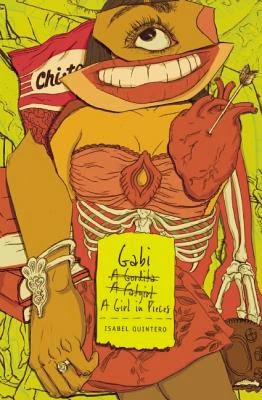
Gabi a Girl in Pieces

by Isabel Quintero
First sentence: “My mother named me Gabriela after my grandmother who — coincidentally — did not want to meet me when I was born because my mother was not married and was therefore living in sin.”
Support your local library: buy it there!
Content: There’s a lot here: talk of drug use, sex (off screen, not graphic), and swearing (including multiple f-bombs). It’d be in the Teen section (grades 9+) of the bookstore.

I didn’t know what to expect when I picked this up. I’d heard good things about it, and it won the Morris Award this year. Even so, I wasn’t prepared for the onslaught of emotions I’d feel while reading it.

It’s Gabi Hernandez’s senior year, and life has gotten more complicated than usual. One of her best friends is pregnant; the other just came out, and has been kicked out of his parents’ house. She’s still struggling with math in school, but she has hopes that she can get into college, the first in her family, since her parents immigrated from Mexico. She wants a boyfriend, but is afraid since she’s a self-proclaimed “fat girl” that she’ll never find love. Then there’s her meth-addicted father, and her punk younger brother. Not to mention a mom who is constantly placing pressure on her to be a “good” girl.

Writing all that down, it both sounds like a lot and not quite enough to hold a book together. One of the things that makes this book shine is the voice. Told in diary form, we get Gabi’s innermost thoughts, her insecurities and feelings, her poems and heartfelt letters to her father (which she never sends). Even though her life is complicated and hard, you can’t help but connect with Gabi on the most elemental level: she’s just a girl trying to live the best she can.

But, it’s also a feminist book, showing us the double standard we have for girls and boys. Which leads me to: oh my gosh, her mom. I wanted to smack her. She was SO hard on Gabi, from nagging her constantly about her weight to lectures about sex (while she tells Gabi’s brother “be sure to use a condom”). I know she was trying and doing the best she could under the circumstances, but I wanted to shake her. Call this another one of those reverse-parenting books, but there is no way I want to have the sort of relationship with my daughter that Gabi had with her mom.

It was Gabi’s awakening to the double standard, and her actively trying to do something about it — which came near the end of the book –which endeared me to the book. There was so much crap going on (if there’s an issue out there that deals with teenagers, it was in the book) going on in Gabi’s life that I found it difficult, initially, to relate. But by the end, I was cheering for Gabi, for her attitude toward her life, and for Quintero’s unflinching portrayal of her.
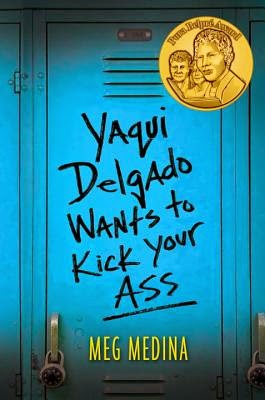
Yaqui Delgado Wants to Kick Your Ass

by Meg Medina
First sentence: “Yaqui Delgado wants to kick your ass.”
Support your local independent bookstore: buy it there!
Content: There’s some mild swearing. The real reason it ended up in the Teen (grads 9+) section is for the bullying and the violence. It’s pretty graphic and the fallout is pretty severe.

Piddy Sanchez is starting a new school. It’s one of those inner city schools in a Hispanic neighborhood in Queens, the kind that justifies every bad stereotype there is. Just a few weeks in, and someone informs Piddy that Yaqui Delgado — whom Piddy has neither seen nor spoken with — is going to kick her ass. Why? Because she thinks Piddy is flirting with her boyfriend. (She’s not.)

It’s this threat, among other things, that begins defining Piddy’s life. She doesn’t feel like she can talk to her mother, who is working extra shifts to try and provide for the both of them. She does turn to her aunt Lila, but even then she keeps the awful details to herself.

It’s a harsh journey, one that I wouldn’t wish on any kid. I did like that there was a range of diverse people in this one; not all white characters were “good” and not all Latin@ ones were “bad”. There was a wide range of personalities, and the color of the skin just happens to be incidental. I also enjoyed how Piddy embraced her culture and loved her neighborhood.

I was glad for the solution to this one, as well. No one really “learned their lesson” and the bully wasn’t reformed and they didn’t become friends and live happily ever after. No, it was much more realistic and messy and showed that sometimes the best option isn’t always the most noble one.

It was a tough read, emotionally raw especially for me (because of the whole daughter thing), but I’m glad I did.

I’ll Give You the Sun

by Jandy Nelson
First sentence: “This is how it all begins.”
Support your local independent bookstore: buy it there!
Content: There is some teen drinking, a (non-graphic) rape scene, and several f-bombs. That, and because of the subject matter, puts it in the Teen section (grades 9+) of the bookstore.

Noah and Jude are twins, separate people but connected in thought and purpose (generally). So much so that they’ve become NoahandJude, pratically inseparable. That is, until the summer they turn 14. Then everything starts to fall apart. Jude becomes “wild”; Noah retreats into his own world until a new boy shows up next door. They end up “dividing” their parents, each vying for the other parent’s attention and love. On top of that, they are fiercely competing to get into the local prestigious art high school. It’s a mess.

Two years later, things aren’t much better. Jude made it into the school; Noah (who was arguably the better artist) did not. They’re still dealing with the aftermath of their mother’s fatal accident. They harbor secrets. And they’re no longer NoahandJude. They’re not even Noah and Jude. They’re two separate planets, who never talk to each other. It’s different from what it was before, but no better.

Did I mention that Jude sees the ghost of her dead grandmother, and senses the presence of her dead mom?

It’s thanks to the two ghosts that Jude searches out Guillermo, sculptor extraordinaire and Latino Mystical Guide, and finds not only salvation but True Love.

Yeah, the book derailed just about there.

For the record: everyone in this book is a Tortured Soul Needing Redemption. And they all find it together. I did enjoy Guillermo — in fact, he was the most interesting character — but that doesn’t change the fact that his role in the book was to cause a change in the white people around him. He was Passionate Lover, he was Father Figure, he was Spiritual Guide. And sometimes he was a living-breathing person, but those times were rare.

And don’t even get me started on the whole Soul Mate thing. Ugh.

What saved this book from being Truly Horrible was the writing — Nelson paints the world vividly, and I do have to admit that there was some good chemistry between Jude and her Soul Mate, even if that’s a trite trope and needs to be done away with. But what I really loved was the art. I loved Guillermo’s giant sculptures and the way Nelson depicted the process of art. I loved Noah’s chapters and the way he’d come up with paintings for everything. I loved how she considered fashion an art.

In the end, I did respect what Nelson was trying to do. But it’s not a perfect book by any means.