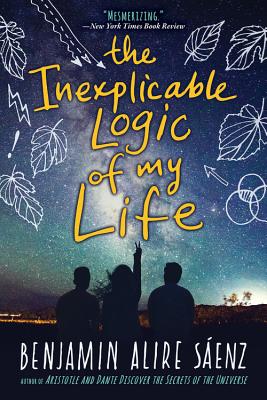
The Inexplicable Logic of My Life

by Benjamin Alire Sáenz
First sentence: “Dark clouds were gathering in the sky, and there was a hint of rain in the morning air.”
Support your local independent bookstore: buy it there!
Content: There is some drinking and swearing, including mulitple f-bombs. It’s in the teen section (grades 9+) of the bookstore.

Sal is starting his senior year of high school, and he feels like his life isn’t making sense. He’s mom died when she was three, he never knew his biological father, and although he loves his adoptive father and his Mexican family, he still wonders about the family he never knew. His best friend, Samantha has a crap relationship with her mom, and his other friend, Fito’s, mom has drug problems. Sal’s life is pretty tame comparatively, but still. He’s trying to figure himself out.

Actually, the plot of this one is kind of incidental to the book. It’s mostly about relationships: between Sal and his father, Sal and his grandmother, and Sal and Sam. It’s about the dynamics between them all and what it means to be a part of a family. There is discussion of death and making life worthwhile, as Sal (and Sam and Fito) try to figure out how they fit into the world. Even though it wasn’t heavy on plot, it was beautifully written. Sáenz has a gift for language and I enjoy the way he wrote the characters. Sal’s dad, Vincente, is one of the best fathers I’ve read in a very long time. It was delightful spending time with these characters that I came to care about. (Yes, I cried when Mima died.)

Perhaps not the most exciting book I’ve read recently, but I did enjoy it.

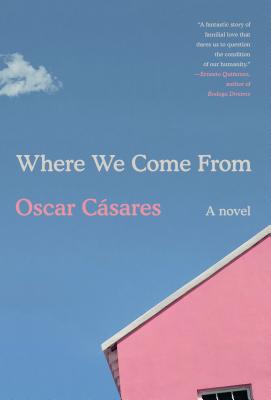
Where We Come From

by Oscar Cásares
First sentence: “No kicking the ball against the side of the house.”
Support your local independent bookstore: buy it there!
Review copy provided by the publisher.
Content: There is a lot of swearing, including multiple f-bombs. It’s in the adult fiction section of the bookstore.

Nina is an older woman who has grown up in Brownsville, TX, which is right along the US-Mexican border. Having never married, she’s spent her whole life in service of her family, ending up being the one to take care of her mother while her brothers all married and moved away (and they all treat her like absolute crap). She is a kind woman, and so when her housekeeper asks for a favor in helping get family across the border illegally, Nina says yes. It almost turned into something awful, but the traffickers were caught. Except one boy, Daniel, got away in the raid, and made his way back to Nina’s and she’s been trying to help him find his father in Chicago.

All this is complicated by the visit of Orly, her godson. She doesn’t want word to get back to her brothers or Orly’s father (Nina’s nephew). She doesn’t want her mother to know. So, Orly is given a strict set of rules to follow. Of course, he is made curious about the pink house behind the main house, and discovers Daniel’s presence, which just complicates things.

If this were a middle grade or YA novel, there would be adventure or intrigue and Orly and Daniel’s relationship would be at the center of the book. And to be honest, I almost wish it was. As it was, I didn’t dislike it, but I did feel like there was too much adult book getting in the way. I felt bad for Nina, but I wanted her to grow a backbone. I wanted *something* to happen, but mostly it was a lot of everyday stuff. Which wasn’t bad. It just wasn’t really engaging either.

It’s not a bad book, I’m just not sure it was quite what I wanted out of it.

Lowriders to the Center of the Earth

by Cathy Camper, illustrated by Raul the Third
Support your local independent bookstore: buy it there!
Content: There are some scary images — all based in folklore. It’s in the middle grade graphic novel section.

First off: this is a second book in a series, so I felt like I was missing a bit of origin story, but it really does work okay as a stand alone.

Three friends: Elirio Malaria (a mosquito), Lupe Impala (an impala, the animal not the car), and El Chavo Flapjack Octopus (again, self-explanatory) have noticed that their friend, Genie (the cat!) has gone missing. They decide to go looking for Genie, and soon discover that he’s been taken captive by Mictlantecuhtli, the god of the underworld. Not to be outdone by some god, the three friends take their car into the underworld to get Genie back.

On the one hand, this is a super cool graphic novel. Ancient gods, huge fights, and who doesn’t love a trip into the underworld? They met all sorts of mythical creatures, from the jackal to La Llorona, and even celebrated Dia de los Muertos. If you know Texas, too, you’ll recognize some landmarks.

I’m not a huge fan of the art style, it’s tri-color pen-and-ink, but it just reinforces the busy-ness of the book to me. I get why the author was using that style; it kind of looks like tattoos, and it is reminiscent of doodling on pages, but it didn’t work for me. And while I appreciated the use of Spanish mixed in with the English, the fact that they provided footnoted translations (which, again, I understand why) really ground my reading to a halt. It worked better once I figured out I could just gather the meaning of the Spanish from the context.

I’m not sorry I read this one, though. It’s clever and fun, and even if the art wasn’t my favorite, I think it was worth the time. Maybe start with book one, though.

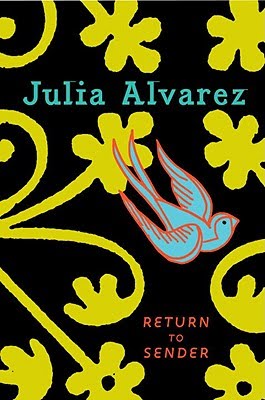
Return to Sender

by Julia Alvarez
First sentence: “Tyler looks out the window of his bedroom and can’t believe what he is seeing.”
Support your local independent bookstore: buy it there!
Content: There’s a bully, and some conflict. And it’s a bit on the longer side. It’s in the middle grade (grades 3-5) section of the bookstore.

So, I’m taking a mulitcultural children’s literature class, and this one is on the list. I was a little way in, and I thought it felt familiar, so I looked it up, and yep: I’ve read it before. Except this time, because it’s for a class, I felt a need to finish it.

It’s told in two voices: Tyler, the son of white dairy farmers in Vermont who are going through a rough patch and need to hire people to help out. They go with the cheap option, and hire a family of migrant workers, who are in the U.S. illegally. And Mari, the daughter of the Mexican family.

There are Things Going On: not just the threat of a raid since they hired undocumented workers, but Mari fitting in at school, the fact that Mari’s mom has disappeared (she went home to Mexico for her mother’s funeral and hasn’t come back yet, even though she started), and just general pre-teenage angst in general.

I found it less preachy this time — mostly because I hadn’t remembered that issues of undocumented immigration or the wall was an issue back in 2005-2006. I found that aspect of it interesting. The idea of The Wall isn’t new, it’s just the most recent manifestation of people who want to enter this country and our extreme dislike for letting them in.

But it was’t a great story either. I didn’t like the format; Tyler’s chapters were odd (written in the present tense) and Mari’s chapters were all letters, which I found a bit hard to suspend my disbelief. I don’t usually mind epistolary novels, but this one was just a bit much.

I finished it this time, sure, but it’s not one of my favorites.

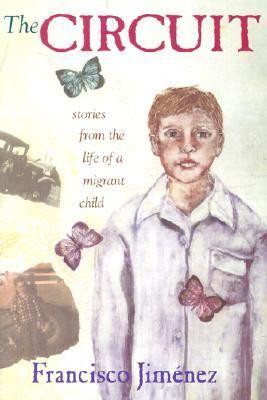
The Circuit

by Francisco Jimenez
First sentence: “‘La frontera’ is a word I often heard when I was a child living in El Rancho Blanco, a small village nestled on barren, dry hills several miles north of Guadalajara, Mexico.”
It’s out of print, unfortunately. I found a copy at the library.
Content: It’s a series of short chapters, fictional but with an autobiographic feel. It’s in the teen section at the library, but I really can’t figure out why.

This is basically the fictionalized autobiography of Jimenez. He doesn’t bother to change the names of his family (maybe of the other characters?) or even of the situations he finds himself in over the time that his family — he’s the second of seven children — spent as migrant workers in California. This book covers the time they entered the United States (his father had a green card; his mother, older brother, and he were all undocumented. His younger siblings were all born in the United States) through the time when, in high school, his older brother was picked up by ICE. (Though he doesn’t go into what happened after. Just that he was picked up.)

Jimenez does an amazing job making the migrant worker’s life come to life on the page: the back-breaking labor, the constant moving to follow the work. Not just for his parents — there was a scene when his father was sitting in their meager tent, smoking cigarette after cigarette, cursing the rain that wouldn’t stop and that was ruining the crops and therefore their livelihood that really brought it home to me — but also for the children, how they couldn’t start school until after the cotton crop in November, how they moved often so he went to multiple schools in the course of one school year.

It makes one think about where one’s food come from. Who is out there picking the crops, and what kind of conditions they live in. And yes, it made me think about immigration — this story took place beginning in the 1940s — and the way they are treated, not just by the government but also by business owners. It’s not an easy thing, politically, but I think we often forget that there are people on the other end.

At any rate, it was a fascinating little book.

With the Fire on High

by Elizabeth Acevedo
First sentence: “Babygirl doesn’t even cry when I suck my teeth and undo her braid for the fourth time.”
Support your local independent bookstore: buy it there!
Review copy provided by the publisher.
Content: There is swearing, including multiple f-bombs, one almost sex-scene, and frank talk about teenage sex. It’s in the teen section (grades 9+) of the bookstore.

Emoni is many things: Afro-Puerto Rican. A mom. A senior in high school. And most importantly, someone who loves to cook.

As she starts her senior year, she’s navigating her world: co-parenting with her ex, Tyrone, and taking more responsibility for their daughter. Her relationship with her abuela and her absent father. And her final year at high school. She wasn’t really expecting any challenges, but she is thrown for a loop: her school has just added a culinary arts class. And she wants to take it, but will she be able to handle the pressure from a working chef.

This isn’t a novel in verse like Poet X is but it’s still just as lyrical. I thoroughly enjoy Acevedo’s writing, and her celebration of Afro-Latinx culture. I loved the food in this book, and though she touched on magical realism (I really love it when food makes people feel/do things) she didn’t really go there. I loved Emoni as a character, and her struggle to overcome the results — the baby — of a bad decision she made when she was 15. I loved the support she got from her abuela and friends, and I felt that Acevedo captured some very real emotions.

It was just a delight to read and I can’t wait to see what else Acevedo writes.

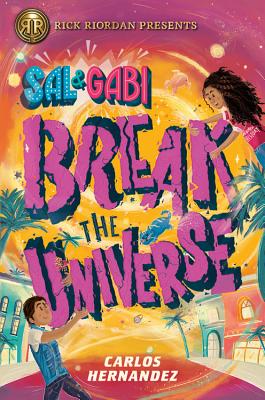
Sal and Gabi Break the Universe

by Carlos Hernandez
First sentence: “There’s all sorts of bad advice out there about how to deal with bullies.”
Support your local independent bookstore: buy it there!
Review copy provided by the publisher.
Content: It’s long and sometimes meandering, which might discourage reluctant readers. There are also hints of romance (but none actual) which might turn off squeamish kids. It’s in the middle grade section (grades 3-5) of the bookstore.

Sal Vidón has just moved to Miami from Connecticut, and is starting his first week at a really cool performing arts and technology school. The problem? It’s the third day of school, and it’s the third time he’s landed in the principal’s office. The first two were reasonable: to meet the principal on his first day, and the second because he was eating Skittles after PE and the gym teacher was unaware that Sal is diabetic. But this time? It’s because he played a prank — put a raw, whole chicken — into the locker of a kid who was bullying him. Sure, as a prank goes it’s mostly harmless. The real catch? Sal pulled that chicken out of a different universe.

And he was being watched: by Gabi Reál, student council president extraordinaire, and puzzle figure-outer. And once she turns her sights on Sal, his life is never going to be the same.

This is one part science fiction book: with multiverses, and calamity physics (is that a real thing?) and warping the space-time continuum, with self-driving cars (I want one, please) and really advanced AI. And one part Cuban family drama: Sal’s mother died six years ago, and he’s been pulling other versions of his Mami out of other universes ever since. There’s also Gabi’s drama with an infant baby brother fighting for his life, and the bully with a bigger backstory. There’s a lot going on in this book, but it all works, and works well together. Hernandez has given us a funny, clever Cuban speculative fiction book, that kept me turning pages and wondering where he was going to go next. There are cool teachers and Gabi’s gaggle of dads (too hard to explain), and it’s all just enormous amounts of fun.

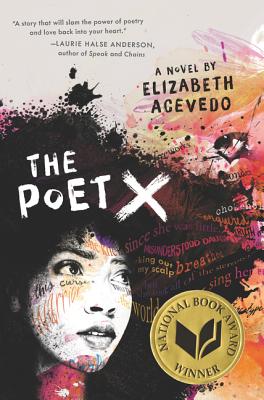
The Poet X

by Elizabeth Acevedo
First sentence: “The summer is made for stoop-sitting and since it’s the last week before school starts, Harlem is opening its eyes to September.”
Support your local independent bookstore: buy it there!
Content: There’s some mild swearing, a tasteful almost-sex scene, and some talk of smoking weed. It’s in the Teen section (grades 9+) of the bookstore.

Xiomara is many things: a daughter, a poet, a twin. But she feels like she doesn’t quite fit. It doesn’t help that her parents — both from the Dominican Republic — don’t really get along, or that her mother is super religious. Or that her twin, Xavier, is super smart, and goes to a magnet school, while Xiomara is stuck going to the not-really-great neighborhood one. And on top of everything, as she starts her sophomore year, her mother is insisting that she go to classes so that she can be confirmed (I think that’s how it is in Catholic churches?). But Xiomara has questions about God, and religion, and the way her parents treat her.

On the one hand, I can see where Xiomara’s mother is coming from. She wants her daughter to have all the things she didn’t have. She wants her daughter to follow in her footsteps, and to have the faith she did. What she doesn’t take into consideration — and this is the conflict at the heart of this elegant novel in verse — is that Xiomara’s feelings and desires might be different than her own. It’s often the conflict at the heart of young adult books: parents who believe they know better and don’t stop to listen to the desires of their kids. I loved getting to know Xiomara through her poetry, to understand her feelings and the tensions she perceived in her family. And I’m glad that, in the end, there was a resolution that didn’t involve someone dying. That Xiomara realized her parents loved her, even if they didn’t always show it in a way she could understand it.

Acevedo’s writing is gorgeous and her storytelling exquisite. This is definitely worth the hype.

Lety Out Loud

by Angela Cervantes
First sentence: “If Lety Muñoz could adopt any animal in the world, it would be Spike, the sweet black-and-white terrier mix sitting across from her on the lawn that very minute.”
Support your local independent bookstore: buy it there!
Release date: February 26, 2019
Review copy provided by the publisher.
Content: It’s aimed at 3-5th graders (and it fits that), so it’ll be in the middle grade section of the bookstore.

Lety’s first language isn’t English. She’s been learning, since she arrived in Kansas City with her parents and younger brother a few years ago. She knows that she’s not the strongest English speaker, or even writer, but she loves the animals at the Furry Friends Animal Shelter so much that she wants to be the volunteer who writes animal profiles. Except Hunter, who’s a bit of a jerk, wants the job, too. So he creates a contest (that he’s probably sure to win) to see who will be the best profile writer.

But — and this was one of the things I really liked about this book — things didn’t quite go as planned. Hunter, while a bully, had a reason, and a personality and humanity. As do all of the kids Cervantes writes about (even Lety’s friend Kennedy, who could have been Generic White Kid). Cervantes gets kids, and gets their concerns, and knows how to write about hard things — like discrimination and racism and needing to belong — in ways that the readers she targets are able to understand and appreciate.

It’s a fun book, and a delightful story.

The Moon Within

by Aida Salazar
First sentence: “There is a locket in my heart that holds all of the questions that do cartwheels in my mind and gurgle up to the top of my brain like root beer fizz.”
Support your local independent bookstore: buy it there!
Release date: February 26, 2019
Review copy provided by the publisher.
Content: There is frank talk of puberty and the way girls bodies change. It’ll probably be in the YA section (grades 6-8) of the bookstore, though it’s perfectly appropriate for younger kids, if parents don’t mind the subject matter.

Celi Rivera is many things: A bomba dancer. The daughter of a Mexican mother and an Afro-Puerto Rican father. A friend to Magda, who is transitioning and wants to go by Marco and use he/him pronouns. A girl who has a crush on Ivan. Except things aren’t as simple as they seem on paper: Ivan is a bit of a jerk to Magda, especially after he changes his name to Marco. Celi’s mother, whom she loves, has decided that she wants to have a moon ceremony when Celi gets her first period, something which her mother feels is honoring their ancestry, but Celi just feels is embarrassing. Being 11 almost 12 is tough, and Celi’s trying very hard to navigate the transition from childhood.

On the one hand, I loved the language and culture in this slim novel in verse. Salazar has a talent for poetry, and I loved how she effortlessly she worked the Xicana traditions in the book. It was a bit hippy-dippy for even me (a lot of moon lore and nature tradition), but I didn’t mind that. What I did mind was the mom. Chalk this up to years of reading middle grade and YA books, but I get really annoyed when parents just barrel ahead, not listening to the desires of their kids, and do what they want to do, thinking it’s the Best Thing. Sometimes it is (in this case, it turned out well), but often, it isn’t. And it frustrates me. Children, pre-teens, and teenagers have desires too. And wants. And they need to feel like they can talk to adults about them. And the mom, in this book, just didn’t listen. Which really annoyed me.

But that’s me. There is much to appreciate in this book, and perhaps there are kids out there who probably have parents like this who can relate to Celi and her struggles.